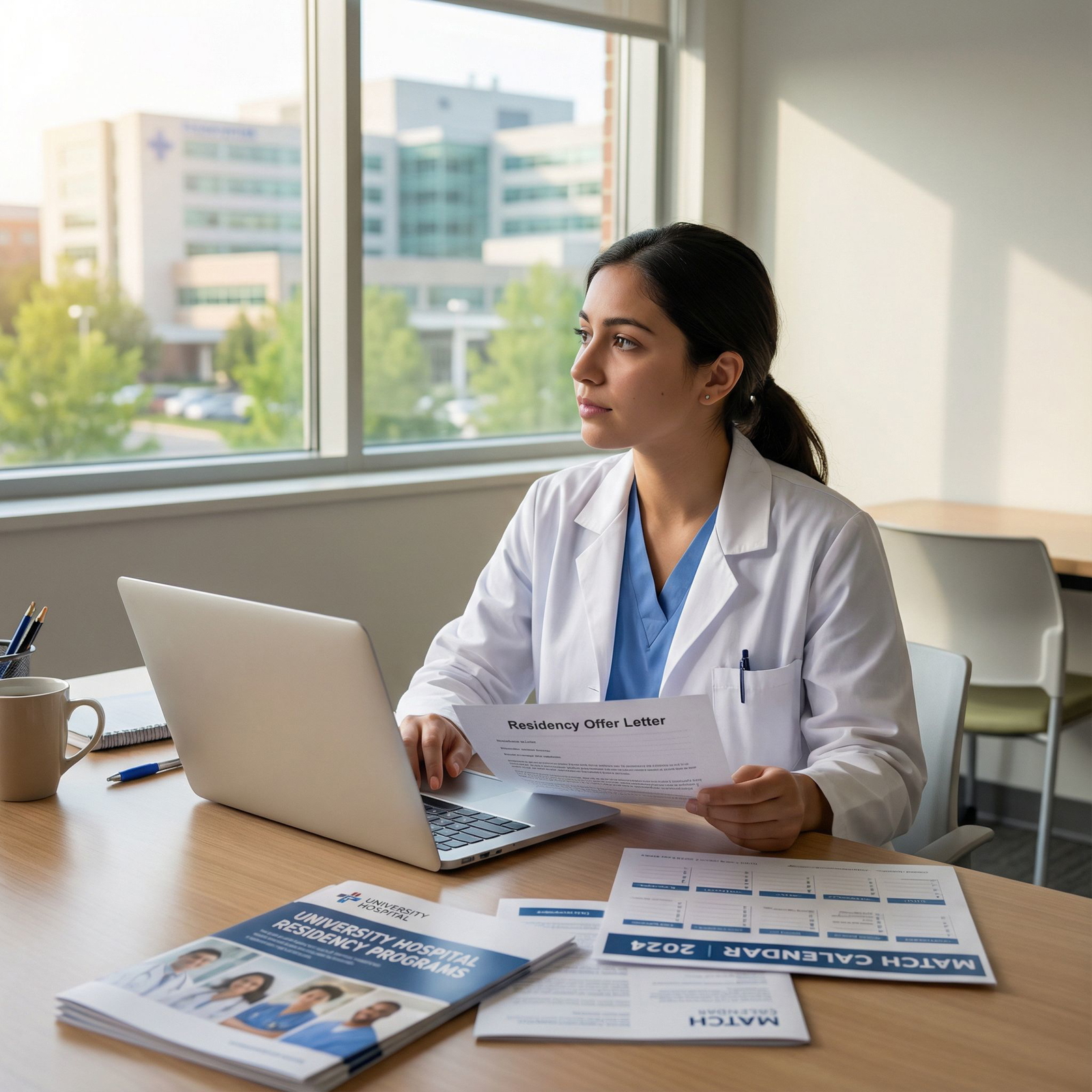
Pre-match communication can make a meaningful difference for an MD graduate residency applicant targeting a preliminary surgery year. Used wisely, it clarifies mutual interest, answers critical questions, and may open doors to pre-match offers or early commitment discussions. Used poorly, it can feel pushy, unprofessional, or even raise red flags.
This guide focuses on how an MD graduate from an allopathic medical school can approach pre-match communication specifically for a preliminary surgery residency—especially in programs and states where pre-match offers and early commitment may still occur.
Understanding Pre-Match Communication in Preliminary Surgery
What “Pre-Match Communication” Really Means
Pre-match communication refers to any contact between you and a residency program outside of ERAS and outside of the official NRMP/Match algorithm process, including:
- Emails before or after interviews
- Phone or video calls (scheduled or unsolicited)
- Thank-you notes and “letters of interest/intent”
- Conversations at away rotations or hospital events
- Messages through advisors or faculty champions
For MD graduates interested in a prelim surgery residency, these interactions can:
- Signal your genuine interest in a program
- Clarify how a prelim year fits into your long-term career (e.g., categorical surgery, radiology, anesthesia, other specialties)
- Open a conversation about pre-match offers or early commitment pathways, when applicable
- Help you get noticed among a large pool of prelim applicants
Where This Fits in the Allopathic Medical School Match
Most MD graduates from allopathic medical schools go through the standard allopathic medical school match (NRMP). Many surgery departments use preliminary positions to:
- Supplement their categorical surgery residency
- Fill service needs on surgical floors and ICUs
- Offer a year for undecided applicants or those planning to reapply to a competitive specialty
- Provide a landing spot for applicants who didn’t initially match their target field
In some states and specialties, especially in certain community or independent surgery programs, pre-match offers and early commitment may be possible (most commonly outside strict NRMP pathways, or in non-NRMP programs). Even when pre-match offers are not allowed, program communication before match remains an important way to build relationships and clarify your status.
Strategic Goals of Pre-Match Communication for Prelim Surgery
Pre-match communication isn’t about pressuring programs or “gaming” the algorithm. It’s about strategy and clarity. For an MD graduate aiming for a preliminary surgery year, your goals should be:
1. Signal Professional, Sincere Interest
Programs often receive large numbers of applications for each prelim surgery residency spot. Many applicants see prelim as a backup or placeholder. If you can demonstrate:
- Thoughtful reasons for choosing this program
- Alignment between your goals and what the program offers
- Willingness to work hard and be a team player
you’re already ahead of many other candidates.
Example:
You email the program coordinator 1–2 weeks before the rank meeting to reaffirm interest, highlighting that this program is among your top choices because of its strong ICU exposure and high operative volume for prelims.
2. Clarify Your Long-Term Plan and How a Preliminary Surgery Year Fits
Programs often worry prelims will be disengaged if they’re only “passing through.” MD graduates can ease those concerns by clearly explaining:
- Whether you’re aiming to transition into categorical surgery
- Whether you’re using the year to strengthen a future application in another field (e.g., ENT, urology, radiology, anesthesia, EM)
- How you intend to maximize the prelim year (case logs, research, mentorship, exam performance)
Being transparent—without over-sharing—helps programs understand how you’ll function in the team.
3. Determine If Pre-Match or Early Commitment Is Possible
Some programs (especially those outside NRMP or in certain states) may:
- Offer pre-match positions to strong candidates before the main Match date
- Invite you to sign an early commitment contract
- Use a hybrid model (e.g., half spots through Match, half via pre-match)
Your communication should tactfully explore whether such options exist—without violating NRMP rules and without sounding entitled.
4. Strengthen Connections from Away Rotations or Home Institution
If you’ve rotated at a program—either as a visiting student or at your home institution—you have a powerful platform for follow-up communication. You can:
- Reconnect with faculty you worked closely with
- Ask for advice on your application strategy
- Signal that, as an MD graduate, you’re ready to step into intern responsibilities from day one
This pre-match communication can be the difference between being a generic name on a list and a person they can vividly picture on their team.

Timeline: When and How to Communicate Before the Match
Before Interview Invitations
Goal: Get on the radar, but don’t be intrusive.
Appropriate moves:
- A brief, targeted interest email if you have a genuine connection to the program:
- You rotated there as a student
- It’s your home institution
- You have a strong geographic or family tie
- You worked on research with their faculty
Sample pre-interview email (MD graduate, prelim surgery):
Subject: MD Graduate Applicant – Preliminary Surgery Interest
Dear Dr. [PD Last Name],
My name is [Your Name], an MD graduate from [Your Allopathic Medical School], applying to your preliminary surgery residency this cycle. I completed a sub-internship at [Hospital/Service] and greatly appreciated the structured teaching and strong operative experience your interns receive.
I am interested in a preliminary surgery year as a foundation for a future career in [categorical general surgery / surgical subspecialty / another field, e.g., radiology with strong procedural skills], and your program’s robust exposure to [ICU, trauma, acute care surgery, etc.] closely aligns with my goals.
If my application comes under consideration, I would be honored to interview and further discuss how I can contribute to your team.
Sincerely,
[Your Full Name], MD
AAMC ID: [#######]
Keep it short; you’re just placing a flag, not arguing your case.
After Receiving an Interview Invite (Before the Interview)
At this stage, program communication before match should focus on:
- Confirming logistics
- Expressing appreciation and excitement
- Doing research so you can ask smart, specific questions
Actions:
- Send a brief reply confirming your interview date/time; no need for a separate interest email unless you have a special circumstance (e.g., needing earlier dates due to travel constraints).
Immediately After the Interview
This is one of the most impactful windows for pre-match communication.
Your goals:
- Reinforce interest
- Highlight specific program strengths you value
- Keep yourself memorable
Post-interview thank-you email template:
Subject: Thank You – Preliminary Surgery Interview on [Date]
Dear Dr. [PD Last Name],
Thank you for the opportunity to interview for the preliminary surgery position at [Program Name] on [Interview Date]. I especially appreciated learning about [specific feature: your ICU structure, how prelims are integrated into trauma call, your support for applicants transitioning into categorical positions, etc.].
As an MD graduate from [Your School], I am seeking a rigorous preliminary surgery year that will allow me to [goal: pursue categorical surgery, strengthen my application to ___, build strong operative and critical care skills]. Your program’s emphasis on [two specific elements you discussed] aligns closely with my professional goals and learning style.
I would be honored to train on your team and believe I would thrive in your high-acuity, teaching-oriented environment.
With appreciation,
[Your Name], MD
AAMC ID: [#######]
2–4 Weeks Before Rank Lists (and Common Time for Pre-Match Offers)
This is when programs are finalizing their lists and, where applicable, may be exploring pre-match offers or early commitment. Your communication should be focused and intentional.
Appropriate steps:
- Reaffirm interest to your top 2–3 programs (not 10).
- If the program is known to have pre-match pathways (or is non-NRMP), you may inquire carefully about how they fill their prelim surgery spots.
- If you are truly willing to commit to a program if offered a position, you can say so—but be honest and avoid violating NRMP rules.
Reaffirmation email example:
Subject: Ongoing Interest – Preliminary Surgery Position
Dear Dr. [PD Last Name],
I wanted to briefly reiterate my strong interest in the preliminary surgery position at [Program Name]. After completing all of my interviews, your program remains one of my top choices because of [1–2 specific reasons: operative autonomy for prelims, structured mentorship for those seeking categorical transitions, inclusive culture, etc.].
I am confident that, as an MD graduate with strong clinical evaluations in surgery and sub-internship performance, I would be able to contribute meaningfully to your team from day one.
Thank you again for your time and consideration.
Sincerely,
[Your Name], MD
If the program might offer pre-match / early commitment and you are willing to accept:
If your program participates in any early commitment pathways or pre-match processes for preliminary surgery positions, I would be very interested in being considered and would welcome the opportunity to discuss this further.
Use this type of sentence only where it’s legally/ethically appropriate and consistent with NRMP rules and with the program’s structure.
Content and Tone: What to Say (and What to Avoid)
What Programs Want to Hear from a Prelim Applicant
Programs want reassurance that:
- You understand what a prelim surgery residency entails
- You’re prepared for the intensity and workload
- You’re coachable, reliable, and collegial
- You have a coherent plan for your career (even if uncertain about specialty)
- You won’t disengage halfway through the year if something doesn’t go your way
Key themes to convey in your communication:
Work ethic and resilience
- Refer to demanding rotations you thrived in (ICU, trauma, night float).
Team orientation
- Mention positive feedback about communication and reliability.
Career clarity
- Example: “I intend to reapply to categorical general surgery and view a robust preliminary year as essential training and mentorship for that path.”
Program-specific fit
- Reference their case mix, trauma level, fellowship exposure, or academic vs. community orientation that match your goals.
What to Avoid in Pre-Match Communication
Pressure or implied bargaining
- “If you rank me highly, I’ll rank you highly” is not allowed.
- Avoid anything that could be interpreted as quid pro quo.
Dishonesty about ranking
- Saying “You are my #1” to multiple programs is unethical and, if discovered, seriously damaging.
Excess frequency
- One post-interview thank-you, and one pre-rank-list reaffirmation is usually enough. More than that risks appearing needy or unprofessional.
Over-sharing negativity
- Don’t criticize other programs or complain about prior rejections. Focus on what you like about them, not what you dislike elsewhere.
Requests that sound self-serving
- Example: “Can you guarantee that I will be considered for a categorical spot after the prelim year?”
- Better: Ask what typical outcomes are for prelims, not for personal guarantees.
- Example: “Can you guarantee that I will be considered for a categorical spot after the prelim year?”
How to Phrase Interest Without Violating NRMP Rules
You are allowed to:
- Express strong interest and enthusiasm
- Say a program is “among my top choices”
- Say you “would be thrilled to train here and believe it is an excellent fit”
You should not:
- Ask how you will be ranked
- Ask them to reveal how they are ranking you
- Make binding, contractual promises contrary to NRMP rules (in NRMP programs)
For non-NRMP or explicitly pre-match programs, carefully follow their stated processes and ask for clarification if unsure.
Special Considerations Unique to Preliminary Surgery
Distinguishing Yourself as an MD Graduate
As an MD graduate from an allopathic medical school, you often have:
- Familiarity with ACGME standards
- Access to faculty with experience placing grads into competitive residencies
- Strong institutional support for letters and advocacy
Use this in your pre-match communication by:
- Highlighting strong clinical evaluations from core surgery or sub-internships
- Referencing mentors or department chairs who can speak to your readiness
- Offering to connect the program with a known faculty advocate (with permission)
If You’re Reapplying After a Prior Cycle
If you’re using a preliminary surgery year to reapply (to surgery or another competitive field), programs will want to know:
- What you’ve learned since the previous application
- How you’re addressing previous weaknesses (e.g., exam scores, limited research)
- That you are fully committed to giving 100% to the prelim role, regardless of your long-term plan
In pre-match communication, acknowledge the reapplication briefly and confidently, but don’t dwell on it:
As I reapply to [target specialty or categorical surgery], I view a structured, high-volume preliminary surgery year as the best way to mature clinically and demonstrate my ability to excel under rigorous expectations.
If You’re Open to Staying Categorical
Some programs convert strong prelims into categorical positions when openings arise. You can mention:
While my initial application is for the preliminary surgery year, I would be very interested in being considered for internal transition into a categorical position should such opportunities become available, recognizing that this is not guaranteed.
This signals ambition and commitment without demanding promises.

Practical Scenarios and Example Scripts
Scenario 1: You Rotated at the Program as a Student
Goal: Convert a positive student rotation experience into strong advocacy.
- Ask a supportive attending or clerkship director:
- “Would you be comfortable reaching out to the PD on my behalf?”
- Then send your own email to the PD, reminding them of specific cases or services you worked on, and how those experiences confirmed your interest in a preliminary surgery year there.
Scenario 2: Program Has Not Responded Much Post-Interview
You sent a thank-you but got no reply (common). Should you email again?
- If you have genuine updates: new publication, improved Step/Level exam, or a strong new letter—yes, send a short update 2–4 weeks later.
- If no updates, a single brief reaffirmation closer to rank deadline is appropriate.
Update email example:
Dear Dr. [PD Last Name],
Since our interview in [Month], I wanted to share a brief update: my manuscript on [topic] was accepted for publication in [journal], and I continue to be very enthusiastic about the preliminary surgery opportunity at [Program Name].
Thank you again for your consideration.
Sincerely,
[Your Name], MD
Scenario 3: You Receive a Clear Pre-Match Offer
If a program explicitly offers you a pre-match position or early commitment contract:
- Request written details: start date, salary/benefits, prelim vs. categorical status, expectations.
- Clarify whether the position is outside NRMP (non-participating program) or whether there are NRMP implications.
- Consult:
- Your medical school advisor
- A trusted faculty mentor
- Your institution’s GME or career office
If you decide to accept:
- Respond promptly, clearly, and professionally.
- Withdraw from other unmatched pathways when required by rules/agreements.
- Keep documentation of all communications and contracts.
FAQs: Pre-Match Communication for MD Graduates in Preliminary Surgery
1. How often should I email a program before the Match?
For most MD graduate residency applicants in preliminary surgery:
- Before interview: Only if you have a real connection or important update.
- After interview: One thank-you email per program is sufficient.
- Pre-rank (2–4 weeks before lists): One reaffirmation email to your top 1–3 programs.
More than that typically doesn’t help and may become counterproductive.
2. Can pre-match communication really change my outcome?
It can help on the margins, especially in prelim surgery, where:
- Many applicants look similar on paper.
- Programs rely on perceived interest and reliability.
- Faculty advocacy and personal impressions matter.
It may:
- Nudge a program to rank you higher within a cluster of similar applicants.
- Prompt them to consider you for a pre-match or early commitment if they use those mechanisms.
It will not transform a severely noncompetitive application into a strong one, but it can tip close decisions in your favor.
3. Is it appropriate to say a program is my “top choice”?
Yes—if it’s true and you mean it in a way that does not violate NRMP rules. Safer phrases include:
- “You are among my top choices.”
- “I could see myself thriving at your program.”
- “Your program stands out to me as an excellent fit.”
If you genuinely know you will rank a program #1 in the allopathic medical school match, you may say that—but only to one program and only if you are certain. And remember, programs are not obligated to respond in kind.
4. How does pre-match differ for prelim vs. categorical surgery?
For prelim surgery:
- Programs may be more open to flexible pathways, including some types of pre-match offers or off-cycle hiring (especially in non-NRMP programs).
- They focus more on service coverage, reliability, and short-term training goals.
- They may be watching prelims as potential future categorical residents.
For categorical surgery:
- Match rules are stricter and pre-match offers less common in NRMP-participating programs.
- Programs heavily weigh long-term fit and commitment to a 5+ year training pathway.
Your pre-match communication as a prelim applicant should emphasize dependability, resilience, and clear short- and medium-term goals, while expressing openness to longer-term opportunities without demanding them.
Used thoughtfully, pre-match communication can be a powerful, professional tool—not to manipulate the system, but to clearly present who you are, what you offer, and how a preliminary surgery year at a given program fits your journey as an MD graduate. By timing your outreach well, choosing your words carefully, and aligning your message with each program’s values and structure, you maximize both your Match possibilities and your future surgical training opportunities.