Understanding Pre-Match Communication in Anesthesiology as a Non-US Citizen IMG
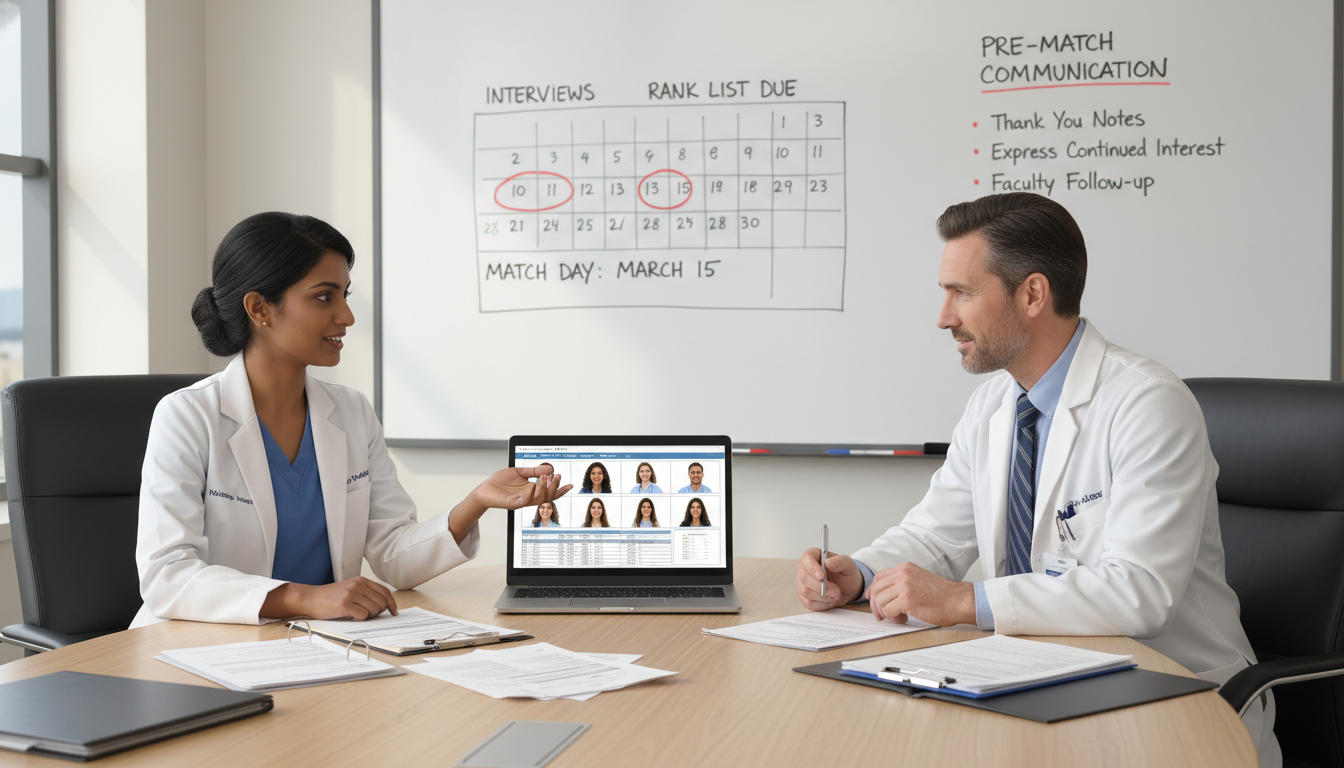
Pre-match communication is one of the least understood but most anxiety‑provoking parts of the anesthesia match process—especially if you are a non-US citizen IMG or foreign national medical graduate. You hear rumors about “pre-match offers,” “early commitment,” and “back-channel emails,” yet NRMP rules, visa concerns, and program variability make it hard to know what is allowed, what is wise, and what actually helps.
For anesthesiology, where programs often value reliability, clear communication, and team fit, how you handle pre-match communication can significantly influence how you are perceived. This article will walk you through:
- What “pre-match communication” really means in the NRMP era
- What is and is not allowed under Match rules
- How being a non-US citizen IMG affects your communication strategy
- How to email, call, and follow up without being pushy
- How to interpret “signals” from programs and avoid pitfalls
Throughout, the focus is on anesthesiology and on applicants who are foreign national medical graduates requiring visas (J-1 or H-1B).
1. Defining Pre-Match Communication: What It Is—and What It Is Not
Pre-match communication refers to any communication between you and residency programs after you submit applications but before the official Match results, including:
- Emails you send to express interest (before or after interview)
- Responses to interview invitations or waitlist notices
- Thank-you emails after interviews
- “Interest update” messages in late January/February
- Program-initiated messages about your candidacy
Pre-Match vs “Pre-Match Offers” (Old System vs Current Reality)
Historically, before the NRMP Match became dominant and in some states still outside the Match, a “pre-match offer” meant:
- A program offers you a contract before Match day
- You accept, and both parties agree not to rank or participate in the Match process for that position
In anesthesiology today, true contractual pre-match offers are rare and in most ACGME-accredited programs they are not allowed for positions participating in the NRMP Match.
What you will more commonly encounter are informal signals or strong interest statements such as:
- “You will be ranked very highly on our list.”
- “We are extremely interested in you joining our program.”
- “If you rank us highly, that will work out well for both of us.”
These are not binding pre-match offers. Under NRMP rules, no one can force or require an early commitment, and no one can guarantee you a spot outside the official Match for positions listed in the Match.
Why This Matters More for Non-US Citizen IMGs
If you are a non-US citizen IMG or foreign national medical graduate, you have additional layers of concern:
- Visa sponsorship (J-1 vs H-1B)
- Whether a program has matched IMGs previously
- Concerns about being “safe” on rank lists
- Pressure to secure any position due to immigration timelines
These pressures may tempt you to over-interpret every email or to push aggressively for “assurances.” Doing so can backfire. Understanding the structure and limits of pre-match communication helps you advocate for yourself professionally and safely.

2. NRMP Rules, Ethics, and What Programs Can and Cannot Say
As you navigate communication before the anesthesia match, it is crucial to know the rules set by NRMP (National Resident Matching Program). These rules apply to both applicants and programs.
Core NRMP Principles Around Pre-Match Communication
No coercion, no required promises
- Programs cannot require that you state how you will rank them.
- You cannot be asked to commit to ranking a program first.
- You cannot be required to tell programs whether or not you are ranking other programs higher.
No binding promises outside the Match
- Any statements made to you by phone or email, no matter how strong they sound, are not legally or ethically binding.
- Match outcomes are determined solely by your rank order list and the programs’ rank lists through the NRMP algorithm.
Communication is allowed, but cannot subvert the Match
- Programs may express interest.
- You may tell a program that you intend to rank them highly or even first (if you choose).
- Neither party is allowed to guarantee a match outcome or form a contract for a Match-participating position before Match.
Honesty is expected
- You should not falsely claim that a program is your #1 choice if it is not.
- Programs should not make statements they know to be misleading (e.g., “We will definitely rank you to match” if they don’t intend to).
How This Plays Out in Anesthesiology
Anesthesiology programs vary widely in their approach:
- Some send no post-interview communication at all.
- Some send generic, warm messages to many interviewees.
- Some send a small number of strongly positive signals to their top candidates.
For non-US citizen IMGs, it is common to feel you are at an information disadvantage. You may worry that US grads are getting “secret assurances”. In reality:
- Programs are cautious to remain NRMP-compliant.
- Officially, no one can “lock in” a candidate outside the Match.
- Many programs now publicly state they will not send signals about rank position.
Red Flags: When Communication Crosses the Line
You should be cautious if a program:
- Asks: “Will you promise to rank us #1?”
- States: “If you rank us #1, we will rank you to match; please confirm you will do that.”
- Hints you should withdraw from the Match to sign a separate contract (for a position meant to be in the Match).
If something feels off, speak confidentially with your dean’s office, advisor, or an experienced mentor. As a non-US citizen IMG, protecting your integrity and visa timeline is essential—do not let desperation push you into unethical or risky agreements.
3. Strategic Pre-Match Communication for Non-US Citizen IMG Applicants
Once you understand the boundaries, the practical question is: How do you communicate effectively with programs in a way that helps your candidacy?
3.1 Before the Interview: Initial Outreach
For a non-US citizen IMG, pre-interview communication can serve several purposes:
- Highlighting your interest in anesthesiology and a specific program
- Clarifying visa sponsorship policies (e.g., J-1 only vs. J-1 and H-1B)
- Updating programs on any late test scores, publications, or USCE
When it can help:
- If the program has a history of taking IMGs and sponsors your visa type
- When you have a specific connection (research, geographic, or personal)
Example email (pre-interview):
Subject: Application Update and Continued Interest – Anesthesiology
Dear Dr. [Program Director’s Last Name],
My name is [Your Name], a non-US citizen IMG from [Medical School, Country], and I recently applied to the [Program Name] Anesthesiology Residency Program through ERAS. I am writing to express my sincere interest in your program and to provide a brief update to my application.
Since submitting my ERAS application, I [recently passed Step 3 / had a manuscript accepted in (journal) on (topic) / completed an anesthesia elective at (US institution)]. I believe these experiences have strengthened my preparation for anesthesiology training, particularly in [briefly explain relevance].
I am especially interested in [Program Name] because of [a specific, program-based reason: e.g., your strong exposure to cardiothoracic anesthesia, simulation curriculum, resident wellness initiatives, etc.].
As a foreign national medical graduate, I would also be grateful if you could confirm your program’s current policy regarding visa sponsorship (J-1 and/or H-1B), as this is an important factor in my planning.
Thank you very much for your time and consideration. I would be honored to interview with your program.
Sincerely,
[Your Full Name, AAMC ID, Contact Information]
Keep it short, respectful, and program-specific—avoid mass, generic emails.
3.2 After the Interview: Thank-You and Reinforcement
Most anesthesiology programs do not require thank-you emails, but they remain a professional courtesy and can serve to:
- Reaffirm interest
- Clarify something you forgot to mention
- Highlight an alignment between your goals and the program’s strengths
Guidelines:
- Send within 24–72 hours after the interview.
- Personalize each email to your interviewers.
- Keep it to 1–2 short paragraphs.
You may also send one concise, well-crafted message to the program director, especially if you are a non-US citizen IMG wanting to:
- Acknowledge strengths of the program
- Briefly reaffirm your enthusiasm
- Politely restate your visa situation, if relevant
3.3 Late-Season “Interest Updates” and Signaling
January and February are high-anxiety periods. Many applicants, especially foreign national medical graduates in anesthesiology, worry about:
- Where they stand on rank lists
- Whether they should indicate a “favorite” program
- How to use “love letters” responsibly
Key points:
- You are allowed to tell a program it is your first choice.
- You should say this only to one program and only if it is true.
- Choose carefully; do not send multiple conflicting messages.
Sample “first-choice” message (if true):
Subject: Strong Interest in [Program Name] – [Your Full Name]
Dear Dr. [Program Director’s Last Name],
Thank you again for the opportunity to interview with the [Program Name] Anesthesiology Residency Program on [date]. After carefully reflecting on all of my interviews, I wanted to share that [Program Name] is my top choice, and I plan to rank your program first.
The combination of [name 1–2 meaningful aspects: e.g., your strong clinical exposure in regional anesthesia, the supportive culture I observed among residents, and the structured teaching in the OR] aligns closely with my goals as an aspiring anesthesiologist. I believe your program would be an ideal environment for me to grow as a clinician, educator, and team member.
As a non-US citizen IMG requiring [J-1/H-1B] sponsorship, I truly appreciate your program’s openness to international graduates, and I would be honored to train with your team.
Thank you again for your time and consideration.
Sincerely,
[Your Full Name, AAMC ID]
This is not a contract, but it can help demonstrate genuine commitment. Even so, the NRMP algorithm is designed so that ranking programs in your true order of preference is always in your best interest, regardless of communication.

4. Visa Considerations and Their Impact on Pre-Match Strategy
For a non-US citizen IMG applying in anesthesiology, visa sponsorship is often the single most important practical factor in pre-match communication.
4.1 Clarifying Visa Types Early
Main options in anesthesiology:
- J-1 visa (ECFMG-sponsored)
- Most common route for IMGs
- Accepted by the majority of university-affiliated anesthesia programs
- H-1B visa (institution-sponsored)
- Less common in anesthesiology
- Often requires USMLE Step 3 passed before July 1
- Some institutions or state GME policies do not support it
Because visa policies differ, early communication can help you avoid wasting interviews at places that cannot sponsor your status.
Actionable steps:
- Before the season: create a spreadsheet of anesthesiology programs with their visa policies (based on website, FREIDA, or direct confirmation).
- If unclear on a website, a brief, respectful email to the program coordinator asking, “Do you sponsor J-1 and/or H-1B visas for categorical anesthesiology residents?” is appropriate.
4.2 How Visa Status Affects Program Communication
As a foreign national medical graduate, a program may:
- Ask you if you have or will have Step 3 completed (for H-1B)
- Show more caution if they have limited experience with IMGs
- Be more explicit about their visa limits in email or at the interview
Use these interactions to clarify, not to argue. If a program cannot sponsor your needed visa, no amount of pre-match communication will change that reality. Redirect your energy to programs where a match is structurally possible.
5. Handling “Signals,” Silence, and Stress: Practical Scenarios
The most confusing part of pre-match communication is often interpreting what programs do—or do not—say. Below are common scenarios encountered by non-US citizen IMG anesthesiology applicants, with suggested responses.
Scenario 1: Generic Thank-You from the Program
You receive a brief email after your interview:
“Thank you for interviewing with us. We enjoyed meeting you and wish you the best in the Match.”
Meaning:
Often mass-sent; neutral. It does not mean you are low on their list, nor does it guarantee interest.
Your action:
- Do nothing further, unless you have a specific update or question.
- Maintain your own rank list based on your preference, not on this email.
Scenario 2: Strongly Positive Signal
You receive a note from the PD:
“We were very impressed with your application and interview. You will be ranked very highly on our list.”
Meaning:
Sincere interest, but not a guarantee. Programs may send similar messages to multiple highly ranked applicants.
Your action:
- Appreciate the signal, but do not rank them higher than your true preference solely because of it.
- If they are your genuine first choice, you may send a truthful, single first-choice message as above.
Scenario 3: Complete Silence After Interview
You hear nothing after the interview, despite sending a short thank-you.
Meaning:
Some programs have a strict no post-interview communication policy. Silence does not equal rejection.
Your action:
- Do not keep sending emails; it can hurt more than help.
- Rank them according to your genuine preference based on the interview and program characteristics.
Scenario 4: Last-Minute Update (Publication, Step 3 Result)
In February, you receive Step 3 results or a major publication.
Your action:
Send a single, concise update to programs where this new information could materially strengthen your file, especially those where you are genuinely interested:
Dear Dr. [Last Name],
I wanted to briefly share an important update since our interview on [date]. I have now passed USMLE Step 3 / had my manuscript accepted in [journal]. I remain very interested in [Program Name] and appreciate your continued consideration.Sincerely,
[Name]
For non-US citizen IMGs pursuing H-1B sponsorship, Step 3 results are particularly relevant.
Scenario 5: Feeling Pressured or Confused by Program Statements
If you feel a program is hinting at a pre-match offer or pushing you to commit outside NRMP norms, as a foreign national medical graduate you may feel pressured because of visa timelines.
Your action:
- Do not agree to anything that conflicts with NRMP policies.
- Reach out to:
- Your medical school’s dean or advisor
- ECFMG advisor (if applicable)
- A trusted mentor or faculty member familiar with US residencies
- Document any concerning communications (save emails).
Protecting your professional reputation and immigration status is more important than chasing one potentially problematic offer.
6. Putting It All Together: A Pre-Match Communication Plan
To make this practical, here is a structured approach you can adapt as a non-US citizen IMG targeting anesthesiology:
Step 1: Before Applications Open
- Research visa policies of anesthesiology programs (J-1 vs H-1B).
- Identify programs historically friendly to foreign national medical graduates.
- Prepare standard but customizable templates for:
- Pre-interview interest + visa query
- Post-interview thank-you
- Update letters
- (If applicable) Single, honest first-choice message
Step 2: After You Submit ERAS
- For high-priority programs that are visa-compatible and IMG-friendly, consider sending a brief expression of interest and any meaningful application updates.
- Avoid mass, generic outreach to every program.
Step 3: During Interview Season
- Be prepared to briefly and confidently address:
- Why anesthesiology
- Why their specific program
- Your long-term goals as an anesthesiologist
- Your visa status and Step 3 plans
- Take notes after each interview to help with later rank decisions.
Step 4: Within 72 Hours After Each Interview
- Send targeted thank-you emails (optional but beneficial if personalized).
- One to PD or program leadership, others to individual interviewers as appropriate.
Step 5: January–Early February
- Decide your true first-choice program (if you have one).
- If you feel it appropriate and true, send one “you are my top choice” message to that single program.
- Send updates to selected programs only if you have significant new material (Step 3, new publication, significant research achievement).
Step 6: Rank List Submission
- Rank programs in your genuine order of preference, regardless of signals they sent you or silence you experienced.
- Remember: the Match algorithm favors honesty in your rankings.
For a non-US citizen IMG in the anesthesia match, a calm, structured, and ethical communication strategy will showcase your professionalism—something anesthesiology program directors value highly in a specialty built on trust, precision, and composure under pressure.
FAQs: Pre-Match Communication for Non-US Citizen IMGs in Anesthesiology
1. As a non-US citizen IMG, should I send emails to every anesthesiology program where I applied?
No. Mass, generic emails can be counterproductive. Focus on programs that:
- Clearly sponsor your visa type (J-1 and/or H-1B)
- Have a track record with foreign national medical graduates
- Truly match your interests (case mix, academic vs community, location)
Thoughtful, selective communication is more effective than high volume.
2. Can a program tell me they will rank me to match? Is that guaranteed?
Some programs may say, “We will rank you highly” or even “We will rank you to match.” These statements are non-binding under NRMP rules. You may still fail to match there if:
- They rank many strong applicants highly
- Those applicants rank the program higher than you do
You should still rank programs in your true order of preference, regardless of such statements.
3. Is it okay to tell more than one program they are my “top choice”?
No. That would be dishonest and can damage your professional integrity if discovered. You are allowed—but not required—to tell a single program it is your first choice. If you do so, be sure it is the truth. The Match algorithm already protects your interests when you rank programs by genuine preference.
4. How does my visa status (J-1 vs H-1B) change my pre-match communication strategy?
Your visa needs should be clearly and calmly communicated, especially if you hope for H-1B:
- Confirm visa policies early, ideally before interviews.
- If H-1B is important, emphasize Step 3 timing and preparedness.
- If a program only sponsors J-1, do not try to negotiate for H-1B at the pre-match stage; focus instead on programs whose policies align with your needs.
Your communication should ensure mutual clarity, not attempt to bend institutional rules that are usually non-negotiable.
By understanding the rules, respecting ethical boundaries, and using strategic, honest communication, you can navigate pre-match interactions confidently as a non-US citizen IMG pursuing anesthesiology—and let the Match algorithm work in your favor.