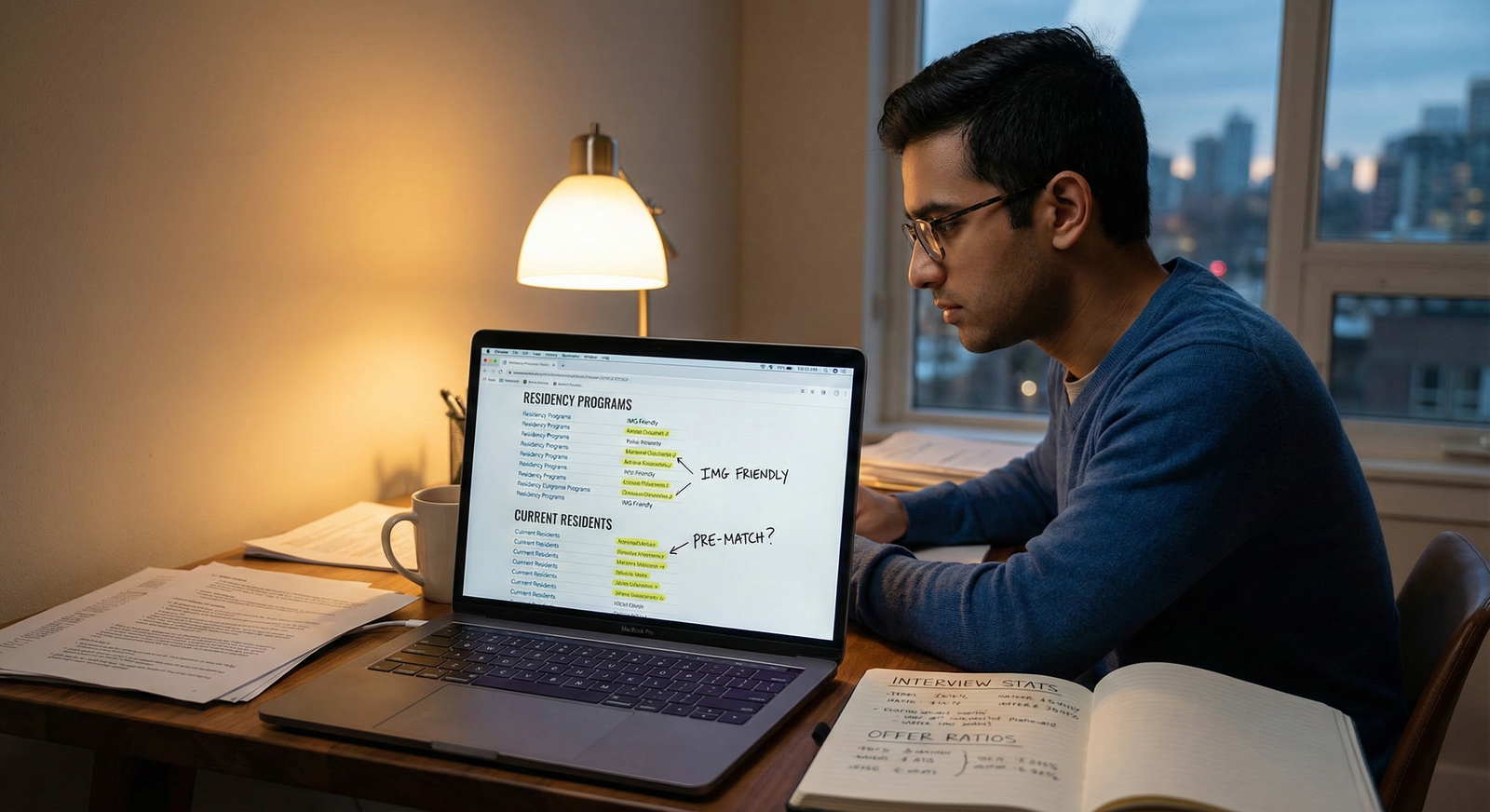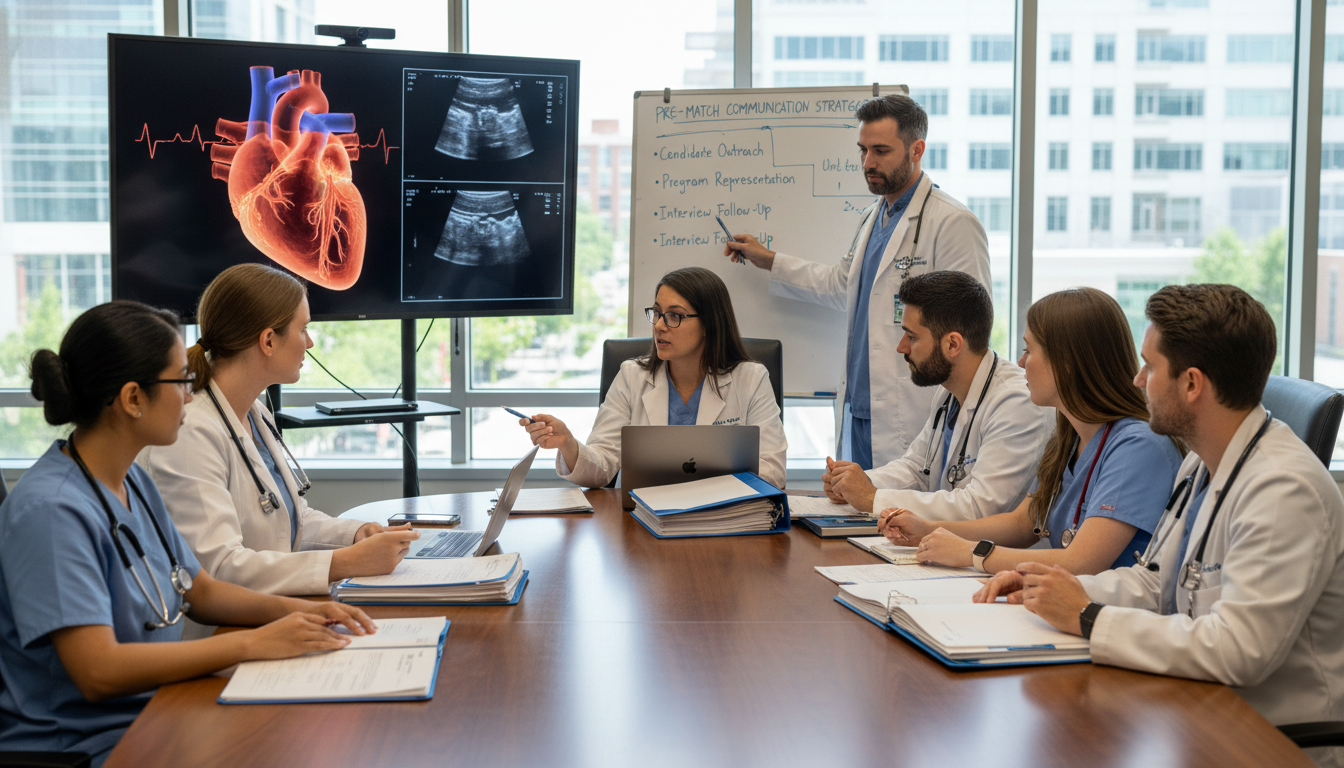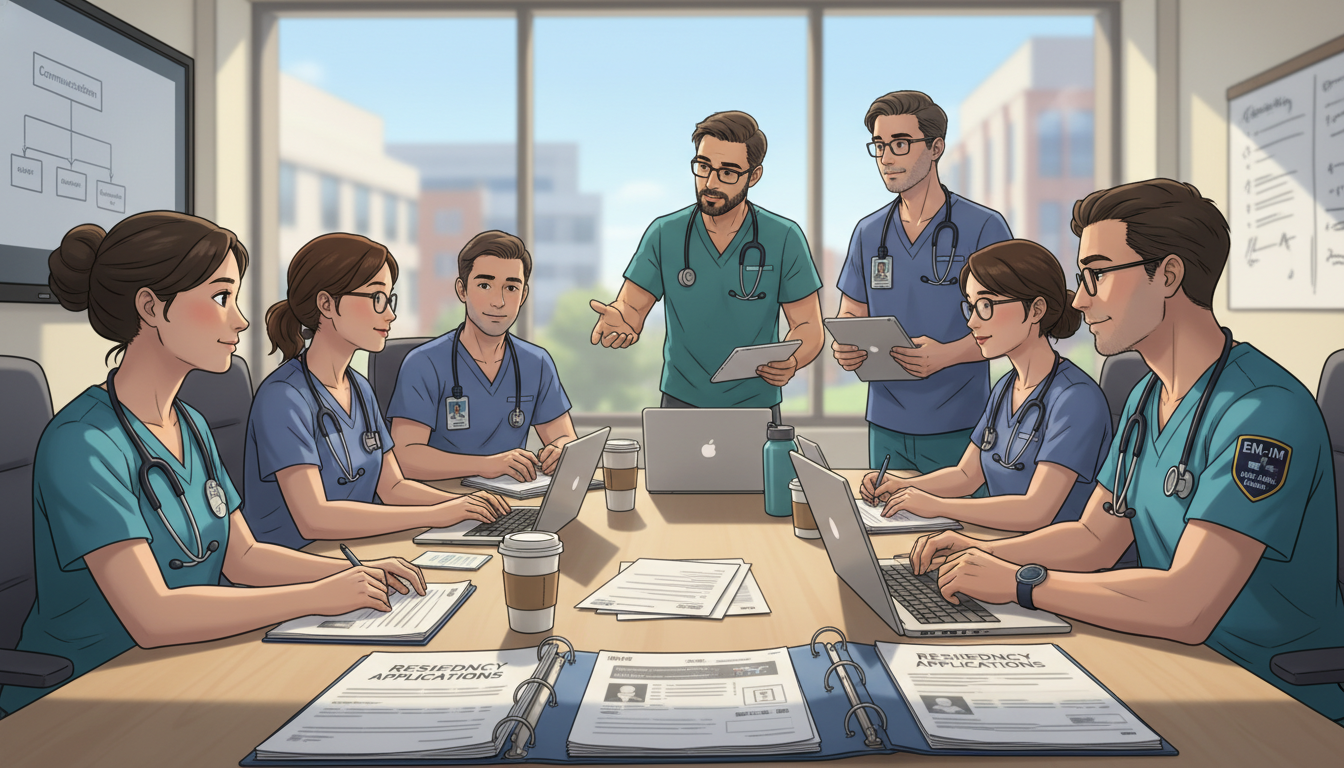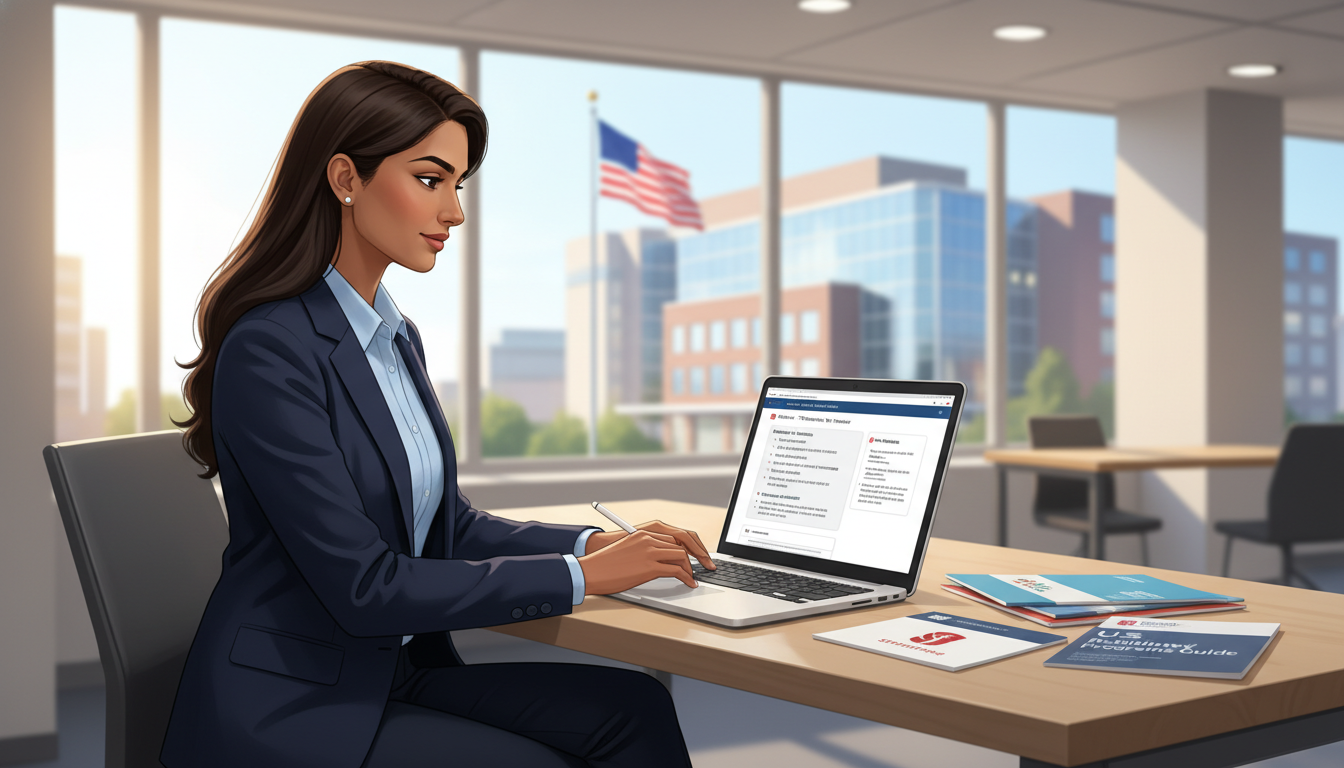
Pre-match communication is one of the most misunderstood parts of the residency journey—especially for a non-US citizen IMG pursuing Physical Medicine & Rehabilitation (PM&R). You may hear mixed advice: “Never email programs,” “Always email programs,” “Ask for a pre-match,” “Never mention pre-match.”
The reality is more nuanced. Thoughtful, professional communication can significantly help your physiatry match prospects—when it’s done at the right time, for the right reasons, and in the right way.
This guide explains what “pre-match communication” is, how it fits into the current NRMP framework, what it looks like practically in PM&R, and how a foreign national medical graduate can use it strategically without crossing ethical or regulatory lines.
Understanding Pre-Match Communication vs. Pre-Match Offers
Before you decide how to communicate, you must be clear about terms that are often confused.
Pre-match communication: what it is (and isn’t)
Pre-match communication refers to any interaction with a residency program before the official Match results are released, including:
- Emails to program coordinators or program directors (PDs)
- Thank-you letters after interviews
- Letters of interest or intent
- Updates on exam scores, publications, or visa status
- Clarification questions about the program, schedule, or curriculum
- Replies to program outreach messages
This type of communication is allowed—within professional and NRMP guidelines.
Pre-match offers and early commitment: what’s off-limits now
Historically, some specialties and institutions used “pre-match offers”—a program would unofficially offer a position outside of (or before) the NRMP Main Match, and an applicant would accept, creating an early commitment.
Today, for ACGME-accredited programs participating in the NRMP Main Match:
- Binding pre-match offers are not allowed.
- Programs and applicants must not ask for or make commitments about rank order.
- No one should say “We will rank you #1 if you do X” or “If you rank us first, we’ll rank you highly enough to match.”
Most PM&R categorical and advanced positions in the US participate in the NRMP and comply strictly with these rules. As a non-US citizen IMG, it’s critical that you do too, because visa sponsorship already complicates your situation; you cannot risk any NRMP violations.
Key Rules and Ethics: What Is Allowed and What Is Not
NRMP and ACGME basics in plain language
While you should review the current NRMP “Match Participation Agreement,” here is the practical essence for pre-match communication:
Programs may:
- Ask if you are still interested in their program
- Ask for permission to contact you
- Provide information about their program, call schedule, research options, etc.
- Tell you that they find you a strong candidate (e.g., “We were very impressed with you”)
- Host virtual open houses or Q&A sessions
Programs may not:
- Ask you how you will rank them
- Ask you to state that they are your #1 choice in writing
- Request a commitment to rank them at a certain position
- Offer you a residency position outside of the Match if they are in the NRMP Main Match, except under very specific NRMP-permitted exceptions (rare and program-specific)
You, as the applicant, may:
- Express genuine interest or enthusiasm about the program
- Clarify that a program is among your top choices or is your top choice (voluntarily)
- Send updates or letters of interest
- Ask questions about curriculum, call, research, or visa sponsorship
- Politely ask where you stand in terms of being considered—without demanding rank information
You may not:
- Ask the program directly about your specific ranking position (e.g., “What rank will you place me?”)
- Pressure a program to make a verbal commitment
- Suggest a quid pro quo (e.g., “If you promise to rank me highly, I’ll rank you first”)
For a foreign national medical graduate, it’s particularly important to avoid misunderstandings—language and cultural differences can easily make a straightforward question sound like pressure or negotiation.
Strategic Goals of Pre-Match Communication for a Non-US Citizen IMG
Pre-match communication should serve clear, positive, professional goals—not desperation or pressure.
1. Confirm and reinforce genuine interest
Many PM&R programs receive hundreds of applications. When you reach the interview or post-interview stage, good communication can:
- Help programs remember you among many qualified applicants
- Signal that you’re not just broadly applying but are specifically drawn to their training environment
- Show that you understand PM&R and their program’s niche
For example, a meaningful post-interview email might say:
- That you value their strong inpatient rehab exposure or early EMG training
- That you appreciate their track record with international graduates
- That your long-term goal (e.g., neurorehabilitation, pain, sports) fits well with their faculty expertise
2. Clarify visa and logistical concerns
As a non-US citizen IMG, visa is often the biggest unspoken filter. Program communication before match is a crucial opportunity to:
- Confirm whether they sponsor J-1, H-1B, or not at all
- Clarify if there are additional test requirements for H-1B (e.g., USMLE Step 3)
- Ask if they have recent experience training IMGs
- Address any timing issues related to ECFMG certification or licensing
This can save you from ranking programs that cannot realistically sponsor your visa.
3. Update and strengthen your file
If you receive new:
- USMLE/COMLEX scores
- Research publications or accepted abstracts
- US clinical experience letters (new LORs)
- Rehabilitation-related volunteer work or quality improvement projects
You should update programs where you are especially interested, particularly those that have already interviewed you or placed you on a waitlist. This could help you move from “borderline” to “ranked.”
4. Build rapport without overstepping
Physiatry is a relatively small, tight-knit field. Many faculty and PDs know each other. Good professional communication can:
- Build a positive impression of your maturity and professionalism
- Make it easier for a mentor or an attending to advocate for you with a program
- Show that you understand rehabilitation’s patient-centered, team-based culture—which values respect, listening, and collaboration
Timing and Channels: When and How to Communicate
Pre-interview phase: brief and targeted
Before interviews, communication should be minimal and focused:
You may email:
- To clarify visa sponsorship if this is not clearly stated
- To express particular interest after attending a virtual open house
- To send a single, concise update (for example, a new Step 2 CK score or publication)
Avoid sending generic “please consider me” emails to dozens of programs. They are usually ignored and can create a negative impression.
Example: Visa clarification email
Subject: Visa Sponsorship Inquiry – PM&R Residency Applicant [Your Name, AAMC ID]
Dear [Program Coordinator/Dr. Last Name],
I am an applicant to the [Program Name] PM&R residency and a non-US citizen IMG currently holding [visa status if any]. I am writing to clarify whether your program sponsors [J-1 and/or H-1B] visas for incoming residents.
I am very interested in your program because of [1–2 specific reasons: e.g., strong inpatient rehabilitation training, exposure to TBI, research opportunities].
Thank you for your time and clarification.
Sincerely,
[Name]
[AAMC ID]
Immediately after the interview: thank-you and reinforcement
Within 24–72 hours after each interview:
- Send a concise thank-you email to the PD and/or primary interviewers.
- Mention 1–2 specific points from your conversation.
- Reiterate your interest, but do not promise rank positions or request them.
For PM&R, you might refer to:
- A discussion about SCI or stroke rehab cases
- Early exposure to procedural skills (e.g., botulinum toxin injections)
- Multidisciplinary team rounds or patient-centered care philosophy
Example: Post-interview thank-you
Subject: Thank You – PM&R Interview on [Date]
Dear Dr. [Last Name],
Thank you for the opportunity to interview at [Program Name] on [Date]. I especially appreciated our discussion about your program’s emphasis on early inpatient exposure and the opportunity to work closely with therapists in multidisciplinary rounds.
As a non-US citizen IMG with a strong interest in [e.g., brain injury rehabilitation], I am particularly drawn to your program’s [e.g., TBI unit, research opportunities, close mentorship model]. My experiences in [brief mention of a related clinical or research experience] have reinforced my desire to train in a program like yours.
I remain very interested in [Program Name] and would be honored to train there.
Sincerely,
[Name]
Mid- to late interview season: letters of interest or intent
As interview season progresses (typically December–February for PM&R):
- You may identify a few programs that stand out as strong fits.
- It is appropriate to send letters of strong interest or (to one program only) a letter of intent.
Letter of strong interest (can send to multiple):
- Express that their program is “among your top choices.”
- Highlight fit with your goals and background.
- Avoid exact ranking language or promises.
Letter of intent (only if you are truly committed):
- Sent to only one program, usually in late January or early February.
- May state clearly that you plan to rank them first, as long as that statement is truthful and you understand you must follow through.
- You cannot ask or expect them to reveal how they will rank you.
Important: This is not a pre-match offer or early commitment in the NRMP sense. It is non-binding for the program and carries no guarantee. It simply communicates your genuine ranking plan and enthusiasm.
Style, Content, and Pitfalls: How to Communicate Effectively
Write like a future colleague, not a desperate applicant
PM&R is collaborative, calm, and patient-centered. Your communication tone should reflect:
- Professionalism – correct spelling, formal salutations, no slang
- Respect – respectful of time and boundaries; no excessive emailing
- Clarity – concise, direct, easy to understand
- Maturity – no emotional pressure, no complaining about other programs or your situation
Avoid:
- Overly emotional language (“I am begging you for a chance”)
- Excessive self-criticism (“I know I’m a weak applicant…”)
- Comparing programs negatively (“Your program is much better than others…”)
- Sending repeated follow-up emails when you receive no response
Highlight what makes you a strong PM&R fit as an IMG
When crafting your messages, reinforce PM&R-specific strengths:
- Longitudinal patient care and advocacy experiences
- Experience with disability, chronic disease management, or rehab in your home country
- Team-based work with therapists, psychologists, social workers
- Research or QI in rehab topics (stroke, SCI, TBI, MSK, pain)
- Strong communication skills across cultures and languages
For a non-US citizen IMG, you can also highlight:
- Adaptability to new systems and cultures
- Multilingual abilities helpful with diverse patient populations
- Past experience navigating resource-limited environments—valuable in rehab settings
How often is too often?
General guidance:
- Before interview: 0–1 email per program (only if needed).
- After interview: 1 thank-you email; possibly 1 follow-up later with updates or letter of interest.
- After rank list submission: No further emails are usually necessary unless requested.
If you feel tempted to email multiple times asking, “Do I have a chance?” or “Have you decided my rank?”—stop. This is usually unhelpful and can damage your impression.
Special PM&R Considerations for Non-US Citizen IMGs
Why PM&R is unique for IMGs
PM&R has historically been less IMG-heavy than some other fields (like IM or FM), but many programs:
- Do consider IMGs seriously, especially those with strong clinical exposure and good communication skills.
- Value US clinical experience in rehab settings (inpatient rehab units, outpatient MSK, pain clinics).
- Tend to be smaller; thus, each resident is a major part of the team—which makes fit and professionalism critical.
Your pre-match communication is one way to demonstrate that:
- You understand what PM&R actually entails (not a “backup” specialty).
- You have concrete reasons for choosing physiatry.
- You are ready to function as part of a multidisciplinary rehab team.
Visa concerns in PM&R programs
PM&R programs differ widely in their ability to sponsor visas:
- Some sponsor only J-1
- Some sponsor both J-1 and H-1B
- A few do not sponsor any visas
Strategic tips:
- Check program websites and FREIDA first. Don’t email questions that are clearly answered online.
- If unclear, one concise email asking about visa sponsorship is appropriate.
- If you need H-1B, clarify Step 3 requirements and timing early.
- When sending letters of interest or intent, you may briefly mention that your visa situation is clear and that you can start on time (if accurate).
Using mentors and networks ethically
As an IMG, you may rely on:
- PM&R attendings who supervised you in observerships or electives
- Research mentors in rehabilitation or neurology
- Alumni from your medical school now in US residencies
They can sometimes email or call programs on your behalf to express support. This is common and acceptable when:
- The mentor has genuine knowledge of your work and character.
- The message is supportive but not coercive (e.g., “I strongly recommend this applicant” vs. “You must rank them high”).
- It does not involve asking for promises or ranking information.
This kind of indirect program communication before match can be particularly helpful to overcome “visa hesitation” or concerns about your international background.
Practical Communication Templates You Can Adapt
Here are a few concise templates tailored to PM&R and foreign national medical graduates. Adapt and personalize them—never copy word-for-word.
1. Post-interview thank-you (PD)
Subject: Thank You for PM&R Interview – [Your Name]
Dear Dr. [Last Name],
Thank you again for the opportunity to interview with the [Program Name] PM&R residency on [Date]. I especially enjoyed hearing about the [e.g., early inpatient exposure/SCI unit/pain fellowship pathways] and the strong emphasis on multidisciplinary rehabilitation.
As a non-US citizen IMG with a deep interest in [e.g., neurorehabilitation, MSK, pain], I appreciate how your program trains residents to manage complex functional impairments while working closely with therapists and other team members. This aligns closely with my prior experience in [briefly mention relevant rotation, research, or volunteer role].
I remain very interested in [Program Name] and would be honored to train with your team.
Sincerely,
[Name]
[AAMC ID]
2. Post-interview update with new achievement
Subject: Application Update – [Your Name, PM&R Applicant]
Dear [Program Coordinator/Dr. Last Name],
I hope you are doing well. I am writing to share a brief update to my application for the [Program Name] PM&R residency.
Since our interview on [Date], my [USMLE Step 3 exam/research manuscript titled “…”] has been [completed/published/accepted]. I have attached the updated [score report/CV/manuscript citation] for your reference.
I remain strongly interested in [Program Name] because of [1–2 specific reasons]. Thank you again for your time and consideration.
Sincerely,
[Name]
3. Letter of strong interest (non-binding)
Subject: Continued Strong Interest in [Program Name] – PM&R Applicant [Your Name]
Dear Dr. [Last Name],
I hope this message finds you well. I wanted to express my continued strong interest in the [Program Name] PM&R residency program following my interview on [Date].
After reflecting on my interviews and learning more about various programs, I believe that [Program Name] is an excellent fit for my goals in [e.g., brain injury rehabilitation, MSK medicine, pain, sports]. In particular, I am drawn to your [specific features: inpatient exposure, EMG training, research opportunities, supportive faculty, track record with IMGs, etc.].
As a non-US citizen IMG with [brief unique background: e.g., prior rehab experience in your home country, language skills, or research], I am confident that I would contribute positively to your diverse and collaborative team.
Thank you again for your time and for considering my application.
Sincerely,
[Name]
Frequently Asked Questions (FAQ)
1. As a non-US citizen IMG, should I directly ask for a pre-match offer in PM&R?
No. For ACGME-accredited PM&R residencies participating in the NRMP Main Match, pre-match offers and binding early commitments are not allowed. Asking for a pre-match offer may signal that you don’t understand the system and could make programs uncomfortable.
Instead, focus on:
- Professional, concise communication
- Expressing genuine interest
- Updating programs on your progress
- Clarifying visa and logistical questions
2. Can I tell more than one PM&R program that they are my “top choice”?
You may tell multiple programs that they are “among your top choices” or that you are “very highly interested.”
But if you use the phrase “I will rank you first” or “You are my number one choice,” ethically you should:
- Say this to only one program
- Actually rank them first on your rank list
While the NRMP does not police applicant statements to programs, misrepresenting your intentions is unprofessional and can reflect poorly if discovered.
3. If a program emails saying they are very interested in me, does that mean I will match there?
Not necessarily. Programs often send positive messages to multiple candidates they like. Such communication:
- Indicates you are under serious consideration
- Can be a good sign, but is never a guarantee
You should still rank programs in your true order of preference, independent of these messages, and not assume any specific outcome.
4. Is it okay if a mentor contacts a PM&R program on my behalf before the Match?
Yes, this is a common and acceptable practice—especially for IMGs—if:
- The mentor truly knows your work and character
- The communication is supportive but not coercive
- It does not involve promises or requests for ranking information
Mentor advocacy can be particularly helpful in PM&R when programs are uncertain about visa issues or have limited experience with IMGs. Ensure your mentor understands NRMP guidelines and keeps the communication professional.
Thoughtful, ethical pre-match communication won’t magically guarantee a physiatry match, but for a non-US citizen IMG it can help close critical gaps: clarifying visa feasibility, reinforcing your genuine interest in PM&R, and demonstrating the professionalism and communication skills that define a great physiatrist. Use it strategically, sparingly, and honestly—and let your preparation, experiences, and authentic fit with PM&R do the rest.