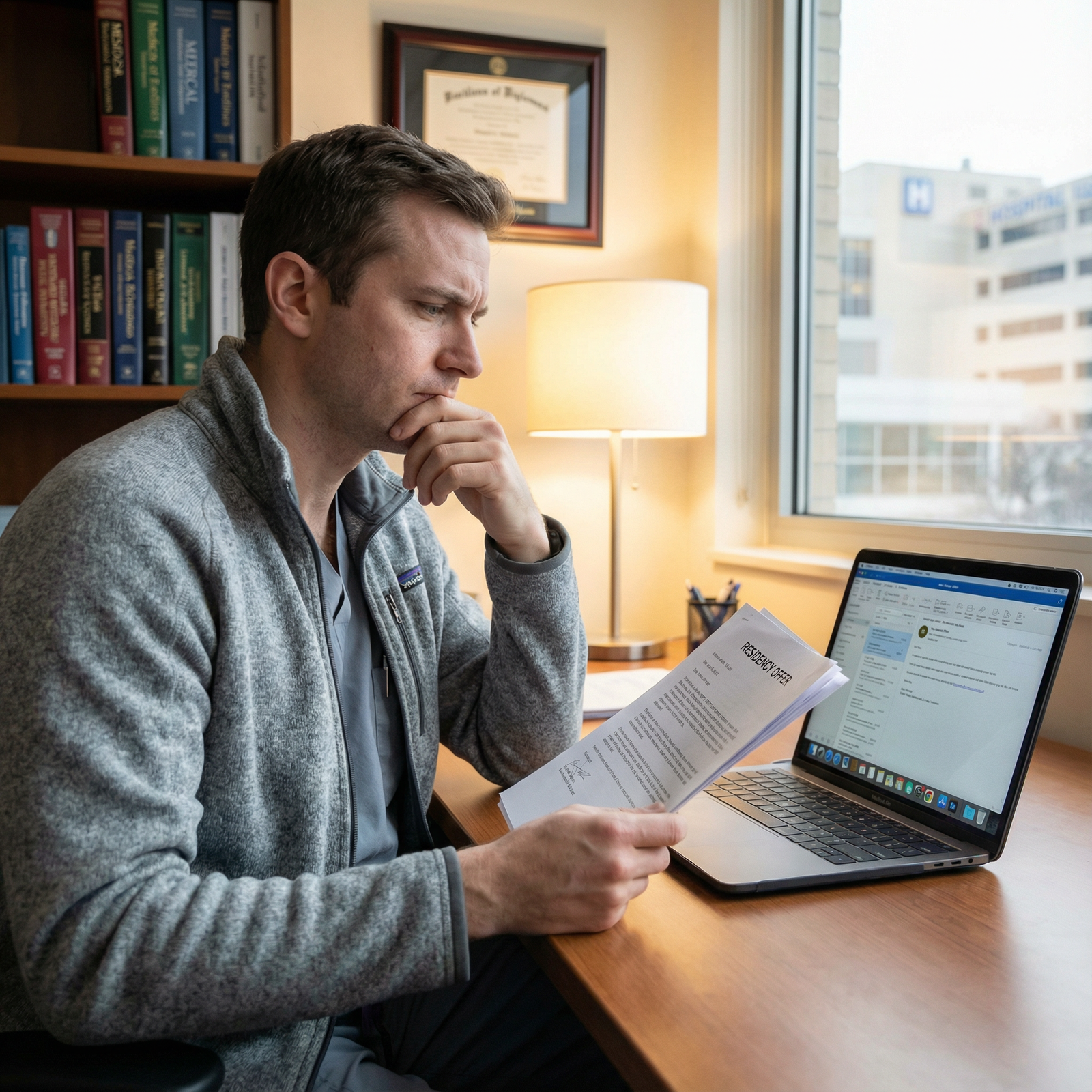
Understanding Pre-Match Communication in Orthopedic Surgery
Pre-match communication in orthopedic surgery is one of the most anxiety-inducing—and misunderstood—parts of applying for residency. Between rumors about secret commitments, whispered stories of pre-match offers, and uncertainty about what’s ethical (or even legal) to say before rank lists are certified, it’s easy to feel lost.
Orthopedic surgery residency is among the most competitive specialties, which often amplifies the importance applicants place on every email, phone call, and conversation. Yet the National Resident Matching Program (NRMP) has clear rules about what can and cannot happen before the Match, and misunderstanding them can put your ortho match at risk.
This guide walks you through what pre-match communication is, how it works in orthopedic surgery, what’s allowed versus prohibited, and how to navigate these interactions strategically and ethically.
1. The Framework: NRMP Rules and the Ortho Match
Before thinking about strategy, you must understand the rules that govern pre-match communication in orthopedic surgery residency.
1.1 What Is Pre-Match Communication?
Pre-match communication includes any contact between:
- Residency programs and applicants, and/or
- Faculty, residents, or staff who are clearly representing a program
after you have submitted your ERAS application and especially after interview invitations go out. This can include:
- Emails
- Phone calls
- Text messages or messaging apps
- Video meetings (Zoom, Teams, etc.)
- In-person conversations at away rotations or conferences
In this context, “pre-match” refers to the period before the rank order lists are locked and the Match results are released, not the old “pre-Match contracts” that used to exist outside the NRMP process in some specialties.
1.2 NRMP Rules: What Programs and Applicants Cannot Do
The NRMP Match Participation Agreement applies to both programs and applicants. A few key points that directly affect pre-match communication:
Programs may NOT:
- Offer positions outside the Match or “pre-Match” contracts (for NRMP-participating categorical orthopedic programs)
- Ask you:
- How you plan to rank them compared to other programs
- To reveal your rank order list
- To commit verbally or in writing to rank them first
- Require or request you to disclose other interviews, other offers, or your interest in other programs as a condition for ranking or interview offers
- Imply that they will rank you only if you give information about your rank intentions
Applicants may NOT:
- Enter into any agreement to accept a position outside the Match with an NRMP-participating program
- Misrepresent or falsify information in communication or in applications
- Attempt to pressure programs for “guarantees” or preferential ranking based on commitments outside the Match process
Violations can lead to NRMP sanctions, including being barred from future NRMP Matches or having a match invalidated.
1.3 What Is Allowed? The Gray Zone
Within the formal rules, there is still a wide range of acceptable communication, including:
- Thank-you emails after interviews
- “Update” or “interest” letters
- Programs telling you that you are ranked “highly” or “toward the top” (as long as they don’t require reciprocal disclosure)
- Applicants expressing strong interest in a program and even stating they will rank it highly or first
- Conversations about program fit, mentorship, research, and training environment
The difficulty is not whether communication is allowed, but how to do it:
- Ethically
- Professionally
- Without misrepresenting your intentions
- Without violating the NRMP rules around coercion or agreements

2. Types of Pre-Match Communication in Orthopedic Surgery
Orthopedic surgery residency has some unique dynamics compared to other specialties: heavy reliance on away rotations, small community, and a strong culture of mentorship. These features shape how pre-match communication tends to happen.
2.1 Communication During Away Rotations
For many applicants, the most impactful interactions before the Match happen during sub-internships (“aways”). During these rotations, you may:
- Work closely with attendings who later contact you
- Receive informal feedback or signals of interest
- Be asked about your interest in the program
Typical scenarios:
- A faculty member says: “You’d be a great fit here. Are we your top choice?”
- A resident comments: “If you rank us high, I think you’ll have a great shot.”
- The program director (PD) asks about your career goals and where you see yourself training.
How to respond:
- Be honest about interest without making promises you’re not ready to keep.
- Focus on fit, not ranks: “I’ve been very impressed by the mentorship and case volume here, and this program is definitely going to be ranked very highly on my list.”
- Avoid direct ranking statements if you’re unsure or if you plan to rank another program first.
2.2 Thank-You Notes After Interviews
Most orthopedic surgery programs are accustomed to receiving thank-you emails. They are rarely decisive, but they can:
- Reinforce professionalism
- Keep you memorable in a competitive field
- Provide a vehicle to restate fit points or unique connections
Good practice:
- Send short, individualized thank-you notes within 24–72 hours
- Reference specific discussions or aspects of the program
- Reiterate genuine interest if it exists
Example template:
Dear Dr. [Name],
Thank you for taking the time to speak with me during my interview at [Program]. I especially appreciated our conversation about [specific topic—e.g., sports medicine fellowships or resident autonomy in trauma cases].
I was impressed by [specific program feature—e.g., the breadth of complex cases, the collegial culture among residents, structured mentorship], and I believe [Program] would be an excellent fit with my goals in orthopedic surgery.
Sincerely,
[Your Name]
2.3 Interest and Update Letters
After interviews, some applicants send:
- “Letters of interest” – to express that they are highly interested in a program
- “Letters of intent” – to state that a program is their number one choice
These are not required and sometimes not even read, but in a close call, they can add nuance.
Key considerations:
- Do not tell more than one program they are your #1. That is considered misleading and unethical.
- If you send a letter of intent, mean it. Your actual rank list should match that commitment.
- Update letters can include: new publications, honors, board scores released after applications, or leadership roles.
Example “high interest” wording without a #1 promise:
I remain extremely interested in [Program] and can confidently say it will be ranked among my top choices. The combination of [X, Y, Z] makes your program uniquely aligned with my goals in orthopedic surgery.
2.4 Program-Initiated Communication
Some orthopedic surgery programs reach out post-interview to:
- Clarify aspects of your application
- Gauge your continued interest
- Offer “second looks” (virtual or in-person, if permitted)
- Indicate that you are ranked highly
Examples of what you might hear:
- “You are ranked very highly on our list.”
- “We believe you would be an excellent fit and hope you rank us favorably.”
- “You are a candidate we are particularly enthusiastic about.”
Programs may not say: “If you rank us first, we will rank you high enough to match” or ask you to disclose where you are ranking other programs.
How to respond:
- Thank them for their interest.
- Reiterate genuine interest if appropriate.
- Maintain professionalism even if you’re not ranking them highly.
Example response:
Thank you very much for your message and for the opportunity to interview at [Program]. I truly enjoyed meeting the residents and faculty and was impressed by [specific program strength]. I appreciate your consideration and will be giving [Program] serious consideration when creating my rank list.
3. Pre-Match Offers and “Early Commitment” in Ortho
The terms “pre-match offers” and “early commitment” can cause confusion in the modern Match era, especially for orthopedic surgery.
3.1 Are Pre-Match Offers Allowed in Orthopedic Surgery?
For NRMP-participating categorical orthopedic surgery residency programs in the U.S., traditional “pre-match offers” (formal commitments to hire you outside the Match) are not permitted. All standard positions must be filled through the NRMP process.
However, in practice you might hear:
- “We’d love to have you here; if you rank us first, I think you’ll match.”
- “We’re planning to rank you very highly.”
These are not binding offers and do not override the NRMP algorithm. They are expressions of interest—sometimes strong—within the Match framework.
3.2 Early Commitment: What It Really Means
“Early commitment” in this context usually refers to:
- You deciding in your own mind to rank a program #1 early,
- Sometimes after a very strong away rotation or a particularly positive interview experience,
- And occasionally after receiving explicit enthusiasm from the program.
From the NRMP’s standpoint, this still must go through the standard Match. The program cannot contract with you outside the Match, and you are free to change your mind until rank lists are certified.
Practical implications:
- Do not feel compelled to promise a program you will rank them first just because they express strong interest.
- Do not change your rank order list based solely on what a program says they will do. The Match algorithm is designed to favor your true preferences.
- Your best strategy remains: rank programs in your genuine order of preference.
3.3 Managing Pressure to “Commit”
You may experience:
- Explicit or implicit pressure from faculty mentors: “If they say they’ll rank you to match, you should commit.”
- Informal expectations during away rotations at your home or sub-I programs.
- Advice from peers who matched previously to “lock in” a spot.
How to handle this:
Return to core principles:
- No binding agreements outside the Match.
- Rank in order of true preference.
Use neutral but honest language:
- “I am very grateful for your support and interest. Your program is one of the places I feel I would be extremely happy training.”
- If you’re not ready to commit: “I’m still gathering information and reflecting on my experiences at all the programs where I interviewed, but I was very impressed with [Program] and it will be strongly considered.”
Consult objective mentors:
- Talk with your home program PD or an advisor who has no direct conflict of interest (e.g., not from the program pressuring you).
- Ask: “From a Match strategy standpoint, how should I think about this communication?”

4. Strategy: How to Communicate Effectively and Ethically
Beyond staying within the rules, good pre-match communication can support your candidacy and reduce anxiety. The goal is to be clear, honest, and professional.
4.1 General Principles for Program Communication Before Match
Be truthful.
- Don’t inflate your interest or misrepresent your intentions.
- Don’t send conflicting letters of intent.
Be specific.
- Reference concrete program strengths that matter to you (trauma exposure, sports medicine, research infrastructure, resident culture).
Be concise.
- PDs and coordinators read many messages; respect their time.
Be professional in tone and timing.
- Business email etiquette, appropriate salutations, and signatures.
- Avoid excessive follow-ups unless you’re responding to a direct question.
4.2 When and How to Contact Programs
Common, reasonable times to communicate:
- After an interview: Thank-you notes to interviewers or the PD.
- After all interviews are done:
- One final message to your #1 program (if you choose) expressing that they are your top choice.
- Optional, shorter notes to a small number of top programs expressing strong interest.
- If something significant changes:
- New first-author ortho research publication
- Honors in a major rotation
- Leadership or national recognition relevant to orthopedics
How much is too much?
One to three messages total per program is generally enough:
- Thank-you email post-interview
- Possibly one update or final interest note
- One reply if the program contacts you later
4.3 Templates for Common Situations
1. Letter of Intent to #1 Orthopedic Surgery Program
Use only if you are certain:
Dear Dr. [PD Name],
I wanted to sincerely thank you and the entire faculty and resident team at [Program] for the opportunity to interview this season. After reflecting on all of my interview experiences, I am writing to let you know that [Program] is my unequivocal first choice for orthopedic surgery residency, and I will be ranking [Program] #1.
The combination of [specific factors—e.g., high case volume in trauma and joints, strong mentorship culture, resident camaraderie, and robust research opportunities in [subspecialty]] aligns perfectly with my professional goals and values. I can see myself thriving and contributing to the [Program] community.
Thank you again for your consideration.
Sincerely,
[Your Name]
AAMC ID: [#######]
2. Strong Interest Letter (Without #1 Commitment)
Dear Dr. [PD Name],
I hope you are doing well. I remain very appreciative of the opportunity to interview at [Program]. After completing my interviews, I wanted to reiterate my strong interest in your orthopedic surgery residency.
I was particularly impressed by [specific program elements—e.g., early operative exposure, resident-run clinics, structured didactics, or subspecialty diversity]. I believe I would be an excellent fit and that [Program] would provide outstanding training for my career goals in [e.g., sports medicine, trauma, academic orthopedics].
Thank you again for your time and consideration.
Best regards,
[Your Name]
AAMC ID: [#######]
3. Responding to a Program Who Says You’re Ranked Highly
Dear Dr. [PD Name],
Thank you very much for your kind note and for considering my application so favorably. I greatly enjoyed learning more about [Program] and meeting your residents and faculty.
I remain very interested in [Program] and will be giving it serious consideration when finalizing my rank list. I appreciate your support and the time you have invested in my application.
Sincerely,
[Your Name]
4.4 Common Pitfalls to Avoid
- Overpromising: Telling multiple programs “You are my #1.”
- Aggressive follow-up: Repeated emails or calls asking “Where am I on your list?”
- Negativity about other programs: Speaking poorly of other places in an attempt to show loyalty.
- Informal or unprofessional tone: Overly casual language, slang, or text-style writing.
- Mismatched actions and words: Sending a #1 letter and then not ranking the program first.
5. Psychological Aspects: Managing Uncertainty and Rumors
The emotional stress of waiting can distort how you interpret every email, phone call, or silence.
5.1 How Much Do Pre-Match Communications Actually Matter?
In most orthopedic surgery residency selections:
Rank lists are primarily based on:
- Performance on away and home rotations
- Interview performance
- Letters of recommendation
- Research trajectory and overall file strength
Pre-match communication may:
- Confirm your genuine interest
- Help in tie-breaker scenarios
- Provide clarity to programs if they’re worried about matching you (e.g., “Will this strong candidate actually come here?”)
But they almost never override a weak file or a poor fit.
5.2 Dealing With Silence from Programs
Many excellent programs send no post-interview communication at all. This is:
- Not necessarily a negative sign
- Sometimes a deliberate policy to avoid perceived coercion
- Common in large academic centers or institutions with strict compliance policies
Focus on your sphere of control:
- Craft your rank list based on your own priorities.
- Avoid ruminating over who did or did not send a follow-up email.
5.3 Handling Conflicting Advice from Peers and Mentors
You may hear:
- “I only matched because I sent an aggressive letter.”
- “Never communicate with programs; it doesn’t matter.”
- “You must commit somewhere to secure a spot.”
Reality is somewhere in the middle:
- Thoughtful, honest communication can be beneficial, especially in ortho’s close-knit community.
- Overemphasizing communication at the expense of program fit and your true preferences is counterproductive.
- Your rank list drives your outcome more than any single email.
When in doubt:
- Consult multiple advisors (home PD, subspecialty mentors, previous matched residents).
- Look for consistent themes rather than one-off anecdotes.
6. Putting It All Together: A Step-by-Step Action Plan
To make this practical, here’s a timeline-based approach to pre-match communication in orthopedic surgery residency.
6.1 During Away Rotations
- Be professional, dependable, and engaged—this is your most important “communication.”
- Express interest in the program if it’s genuine, but avoid premature rank promises.
- Ask for feedback to understand how you’re perceived.
6.2 During Interview Season
After each interview:
- Send a brief thank-you email to the PD and/or key interviewers within 1–3 days.
- Note specific aspects of the program that impressed you.
Keep a structured log for each program:
- Culture, case volume, subspecialty balance
- Geographic and personal considerations
- Research opportunities
- Notes on residents’ happiness and faculty support
6.3 After Interviews End (Pre-Rank Submission)
Rank programs in true order of preference.
- Use your log and honest reflection.
- Don’t reorder just because you think one program “likes you more.”
Decide about communication strategy:
- Optional: Send one letter of intent to your #1 program.
- Optional: Send short “strong interest” messages to 1–3 other top programs.
- Update any programs where you have significant new achievements.
If a program reaches out to you:
- Respond promptly and professionally.
- Acknowledge their interest, restate your appreciation, and describe your interest accurately.
6.4 Final Week Before Rank List Certification
- Revisit your rank list, double-check that it matches your true preferences.
- Ensure any explicit statements you made (“I will rank you #1”) are accurate and honored.
- Avoid last-minute emotional decisions driven by anxiety or peer pressure.
FAQs About Pre-Match Communication in Orthopedic Surgery
1. Does sending a letter of intent guarantee I will match at that orthopedic surgery program?
No. A letter of intent is not binding for either you or the program and does not guarantee a match outcome. Programs consider letters as one piece of context alongside your entire application and their internal ranking criteria. You should use such letters sparingly and honestly but never assume they secure a position.
2. Can I tell more than one program they are my top choice to improve my chances?
You should not. Telling multiple programs they are your top choice is considered deceptive and unethical. While the NRMP algorithm cannot “see” your letters, misrepresentation damages your professional integrity and can harm your reputation in the relatively small orthopedic surgery community.
3. A program told me I am “ranked highly” or “near the top.” Should I change my rank list based on this?
No. You should still rank programs in your genuine order of preference. Programs often express enthusiasm to multiple candidates and may shift their rank list based on internal discussions. The Match algorithm is designed to favor the applicant’s true preferences, so basing your rank order on program speculation usually hurts, rather than helps, your chances of landing in the best-fit program.
4. Is it a problem if I do not send any post-interview communication?
Not necessarily. Many applicants match successfully in orthopedic surgery without sending letters beyond brief thank-you notes—or even without sending thank-you notes if programs explicitly instruct not to. Good performance on rotations, strong letters of recommendation, and a well-constructed ERAS application matter more than post-interview emails. If you choose not to send extra communication, you are still fully competitive in the ortho match.
By understanding the rules, recognizing what pre-match offers and early commitment really mean in the modern NRMP era, and approaching program communication before Match with clarity and honesty, you can navigate this intense phase of the orthopedic surgery residency process with more confidence—and keep the focus where it belongs: finding the program that truly fits your goals and values.