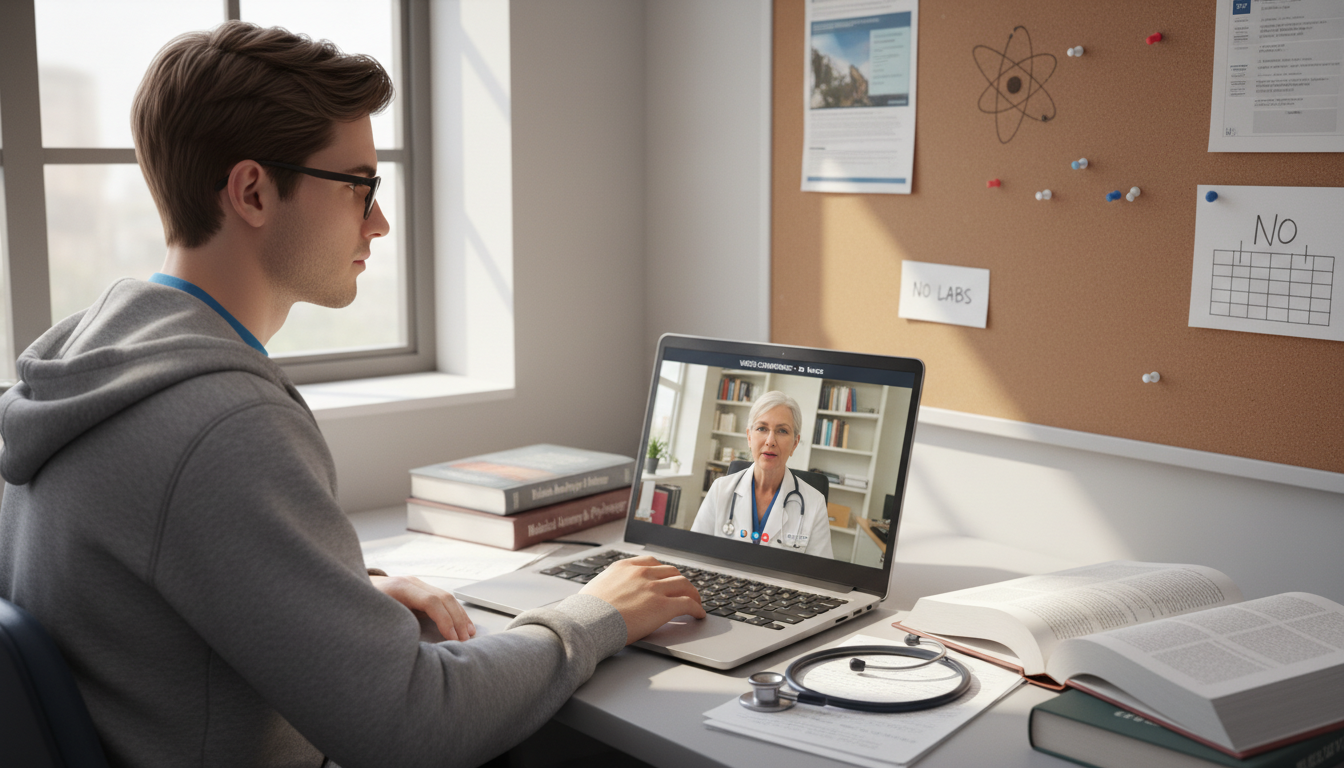
You are a sophomore at a small college. It is 10:30 pm. You have just finished a practice MCAT section, opened Reddit, and been hit with post after post:
- “3 pubs, 2 first-author, 520+ MCAT – what are my chances?”
- “Need advice: 4,000 hours of research and 2 gap years”
You look at your own situation:
No wet lab on campus.
No formal research program.
The “Pre‑Health” advising page is a single PDF from 2014.
(See also: Low Science GPA as a Pre‑Med for strategies to strengthen your application.)
But you still want to be a competitive medical school applicant.
Here is the good news: lack of research at your college is a solvable problem. Medical schools care less about where you did research and more about whether you:
- Sought out rigorous, mentored inquiry of some kind
- Learned how to think critically and handle data
- Can explain your experiences clearly and honestly
We are going to build you a practical, step‑by‑step workaround. Not theory. Not empty reassurance. Concrete substitutes and specific actions.
Step 1: Reframe What “Counts” As Research
Before hunting for opportunities, you need to understand what medical schools actually mean by “research”.
They are not saying:
“Must have pipetted in a prestigious lab with a Nobel laureate.”
They are asking:
“Has this applicant meaningfully engaged in systematic investigation or problem‑solving under guidance?”
That can include:
- Bench (wet lab) research
- Clinical research (chart reviews, outcomes, QI projects)
- Public health and epidemiology
- Social science research (psychology, sociology, anthropology)
- Education research
- Data analysis projects
- Quality improvement (QI) work in clinical settings
If your school has:
- A psychology department
- A sociology or political science department
- A statistics or data science faculty member
- A nursing or allied health program
- A capstone or honors thesis option
Then you already have potential research-like opportunities on campus, even if you do not have a biology lab.
Your immediate mindset shift:
“I do not have a traditional wet lab nearby, so I will deliberately build a strong portfolio of non-traditional, data-driven projects instead.”
That is your starting point.
Step 2: Systematically Audit What Does Exist Around You
You probably know there is “no real research” at your college, but most students never perform a methodical search.
Use this 7‑day audit protocol:
Day 1–2: Department Deep Dive
Visit every department website that might touch humans, data, or healthcare:
- Biology, chemistry, physics
- Psychology, neuroscience, cognitive science
- Sociology, anthropology, political science
- Economics, public health, environmental science
- Mathematics, statistics, computer science
- Education, nursing, social work (if present)
For each department:
Look up faculty pages and scan:
- “Publications” or “Recent work”
- “Research interests” or “Projects”
- “Student opportunities” or “Thesis supervision”
Make a spreadsheet with columns:
- Faculty name
- Department
- Research area (short description)
- Evidence of ongoing work (publication date, project description)
- Contact email
- Why you are interested (1–2 sentences)
Aim to identify 5–15 faculty who are publishing, analyzing data, or doing any form of scholarship that can involve you.
Day 3–4: Institutional and Community Assets
Next, check for:
- Nearby hospitals or clinics (within 60–90 minutes)
- Public health departments (city or county)
- Nonprofits (mental health, addiction, homelessness, youth programs)
- Area universities with more developed research infrastructure
Google searches to run:
- “[Your town] hospital research”
- “[Your state] public health department epidemiology internship”
- “[Nearby university] undergraduate research”
- “[Nearby hospital] clinical research coordinator”
Log anything that suggests:
- Clinical trials
- Outcomes studies
- QI initiatives
- Community health assessments
- Data tracking or evaluation work
Day 5–7: Talk to Humans
Email or meet with:
- Pre‑health advisor (even if they seem weak – extract what they know)
- Department chairs in biology / psychology / sociology
- Career services or experiential learning office
- Honors / thesis program coordinators
Your exact question:
“I am a pre‑med student very interested in gaining research and analytical experience. Since we have limited lab options, I am specifically looking for:
- Faculty doing any sort of scholarly work involving data, analysis, or systematic inquiry
- Community or hospital partners who involve undergraduates in projects
Who on or off campus should I reach out to about this?”
Write down every name they drop. Add to your spreadsheet.
At the end of this week, you should have:
- 10–25 names of potential faculty or external contacts
- A clearer sense of whether your school truly has nothing, or just nothing obvious
Step 3: How to Cold‑Email for Real Opportunities
Now you need to convert that audit into actual positions.
Do not send generic “Do you have research?” emails. You will be ignored.
Use this 7‑part email structure:
Subject line:
- “Undergraduate interested in [specific area] – potential project involvement?”
- Example: “Undergraduate interested in behavioral decision‑making – possible involvement in your work?”
Short intro (1–2 sentences):
- Name, year, major/minor, pre‑med track
Clear interest in their work:
- One specific paper, project, or topic they work on
- Show that you actually read something they produced
Your relevant skills or coursework:
- Statistics class, coding, writing, clinical experience, language skills
Your ask:
- Not “Do you have a position?”
- Instead: “Could I help with data entry, literature reviews, or basic analysis to learn the process?”
Time commitment:
- “I can commit ~5–8 hours/week this semester”
Close:
- “If it would be easier, I would be glad to meet for a short 15‑minute conversation.”
Example template:
Subject: Undergraduate interested in health disparities research – potential involvement?
Dear Dr. Smith,
My name is [Name]. I am a second‑year biology major on the pre‑medical track at [College].
I recently read your 2023 article on emergency department utilization in uninsured populations and was particularly interested in your analysis of repeat visit patterns. I am very drawn to work at the intersection of clinical care and social determinants of health.
I have completed coursework in statistics (including R), research methods, and sociology of health, and I am eager to gain experience with real‑world data and the research process. I would be grateful for any opportunity to assist with literature reviews, data entry, or basic analysis on your current projects, even at a very introductory level.
I can commit approximately 5–8 hours per week this semester and am flexible about scheduling. If it would be easier, I would be glad to briefly meet to discuss whether there might be a way for me to contribute.
Thank you for considering this,
[Name]
[Major, Year]
[College]
[Email] | [Phone]
Send 8–15 emails like this. Expect:
- ~30–40% no response
- ~20–30% “no openings”
- ~20–30% referrals: “Try my colleague X”
- A few real possibilities
You only need one good yes.
Step 4: Use Non‑Traditional Research Categories Aggressively
You do not have a lab. Fine. You can still build an impressive research narrative using these four main alternative lanes.
1. Social Science or Humanities Research
Medical schools recognize and value:
- Psychology experiments
- Surveys and interviews
- Sociology/public policy analyses
- Health economics projects
- Narrative medicine or medical anthropology
Strong example:
- Working with a psychology professor on a survey study of sleep and academic performance, helping design the survey, recruit participants, and run basic statistics
How you frame it on AMCAS:
- “Psychology Research Assistant – 300 hours”
- Describe:
- Hypothesis
- Methods (survey design, data entry, SPSS/R analysis)
- Your specific tasks
- What you learned about research integrity and bias
2. Clinical and Quality Improvement (QI) Work
If your town has any hospital or clinic, there is QI happening:
- Reducing hospital readmissions
- Improving vaccination rates
- Shortening ED wait time
- Increasing screening for depression or substance use
What you do:
Approach a physician, NP, PA, or administrator.
Use a direct pitch:
“I am a pre‑med student interested in quality improvement or outcomes work. Are there any ongoing projects where I could help with data collection, chart review, or tracking metrics?”
Possible tasks:
- Chart reviews (under supervision)
- Excel tracking of outcomes
- Pre/post intervention surveys
- PDSA cycles (Plan-Do-Study-Act)
This counts as both:
- Clinical exposure
- Research‑like analytical experience
3. Community‑Based or Public Health Projects
Public health departments and nonprofits often must measure what they do for grants.
Examples:
- Evaluating the effect of a new health education program
- Tracking outcomes of a smoking cessation group
- Mapping access to primary care in rural areas
You may:
- Help design pre/post program surveys
- Enter and clean data
- Create basic descriptive statistics
- Prepare simple reports
On your application, this will be a hybrid of:
- “Community Service – Health Related”
- “Research/Scholarly Project”
4. Independent or Honors Thesis
If your school requires or allows:
- A senior thesis
- A capstone project
- An independent study
Turn it into:
- A structured research project, with:
- Clear question
- Literature review
- Methods section
- Data collection & analysis
- Written product
Example topics:
- “Impact of local food insecurity on self-reported health in [County]”
- “Patterns of telemedicine utilization among older adults in rural communities”
- “College student attitudes toward mental health treatment”
The key:
- You must have a faculty supervisor
- You must use real methods (qualitative or quantitative)
- You must produce something you can show and talk about in detail
Step 5: Use Summers and Remote Work To Fill the Gaps
You are not limited to your college campus during the academic year. Summers and breaks are your leverage points.
Target Structured Summer Programs
Look for:
- NIH summer programs (e.g., NIH SIP)
- AAMC’s Summer Undergraduate Research Programs
- Programs at large universities near you
Search terms:
- “Summer Undergraduate Research [your state]”
- “REU [discipline] premed summer”
- “[Major university] SURF premed”
Many of these accept students from small or non‑research schools specifically to diversify their pool.
Remote and Hybrid Research
Some research roles no longer require you to be physically in the lab:
You can assist remotely with:
- Systematic literature reviews
- Retrospective chart reviews (via secure VPN, if allowed)
- Survey design and data cleaning
- Basic statistical analysis
- Manuscript formatting and reference management
Where to find them:
- Faculty at bigger institutions near you
- LinkedIn posts by clinical research coordinators or MD/PhDs
- Twitter/X “MedEd” and “MedTwitter” communities
- Your own professors’ collaborators at other universities
When you pitch remote help, emphasize:
- Reliability
- Comfort with digital tools (Zoom, shared drives, reference managers)
- Time zone compatibility
- Commitment across at least one semester or summer
Step 6: Build Marketable Skills That Make Faculty Say “Yes”
If you are competing against students at big research universities, you win by being easier to plug in.
Over the next 6–12 months, deliberately build:
Technical Skills
Basic stats & analysis tools
- Take a statistics course
- Learn to use:
- Excel or Google Sheets well (filters, pivot tables, basic formulas)
- SPSS, R, or Python (even at a beginner level)
Reference management
- Learn Zotero or Mendeley for organizing papers and citations
Survey tools
- Get comfortable with Qualtrics, REDCap, or even Google Forms
Data cleaning
- Practice turning messy spreadsheets into analyzable datasets
Process Skills
- Writing structured emails and brief project updates
- Documenting your work clearly
- Following IRB and confidentiality rules reliably
- Meeting deadlines without hand‑holding
You can practice all of this with:
- Small class projects
- Volunteering to coordinate data for a campus club
- Helping a nonprofit track attendance or outcomes
When a faculty member sees:
“This student already knows how to use SPSS and Qualtrics, and can manage references in Zotero”
You become easy to use immediately.
Step 7: Document Everything So It Counts on Your Application
A lot of students actually do research‑adjacent work and then under‑sell it.
You are going to do the opposite: make sure every serious, structured, supervised project becomes a clearly describable experience.
Track:
- Start and end dates
- Weekly hours (average)
- Your supervisor’s name and role
- Tools and methods used
- Outputs:
- Poster
- Presentation
- Internal report
- Manuscript draft
- IRB application assistance
On AMCAS/AACOMAS, you will likely classify these under:
- “Research/Lab”
- Or “Other” with a clear explanation that it was data‑driven, mentored research or QI
Structure your description with:
- Research question or objective
- Methods (design, participants, tools)
- Your responsibilities
- Skills learned and any outcomes (presentations, abstracts, papers)
Example description snippet:
“Assisted with a retrospective chart review study examining 30-day readmission rates for heart failure patients at a community hospital. Extracted data from 250 charts under supervision, entered variables into REDCap, and performed basic descriptive statistics using SPSS. Participated in weekly lab meetings to interpret preliminary results and contribute to abstract preparation for a regional cardiology conference.”
That sounds like real, meaningful research. And it is.
Step 8: How to Talk About “No Research at My College” in Interviews
You will probably get the question:
“Tell me about your research experience”
or
“Did your undergraduate institution have research opportunities?”
Your answer needs two parts:
- Honest context
- Evidence of proactive solution‑seeking
Example framework:
“My college is a small liberal arts institution with very limited traditional wet lab research, and no formal pre‑med research pipeline. Once I realized that, I made a deliberate effort to build rigorous research experiences in other settings.”
Then quickly pivot to:
- “I worked with a psychology faculty member on a study of X…”
- “I partnered with our local hospital to do a QI project on Y…”
- “I completed an independent thesis on Z with structured methods and formal analysis…”
You are not a victim of your college. You are the student who:
- Noticed a gap
- Built a workaround
- Gained analytical and research skills anyway
That mindset reads as resilient and resourceful—which medical schools like.

Step 9: Example 12–24 Month Action Plan
To make this concrete, here is a timeline you can adapt.
Months 0–3
- Complete the 7‑day audit of faculty and community partners
- Send 10–15 targeted emails using the template structure
- Enroll in a statistics course if you have not already
- Start learning one analysis tool (SPSS, R, or Excel at an advanced level)
Goal: Land one ongoing project for 3–6 hours per week.
Months 4–9
- Work consistently on that project
- Ask for more responsibility once you show you can handle basic tasks
- Start planning a potential independent study or thesis with a faculty member
- Apply to 3–6 summer research or QI programs (regional universities, NIH, etc.)
Goal: Accumulate 150–250 hours of substantial, supervised research/QI.
Months 10–18
- Complete a summer program or deepen your current role
- Begin designing your own project for a capstone or thesis if possible
- Present your work at:
- Campus research day
- A regional conference
- A local health system meeting
Goal: Reach 300–500 hours across 1–3 projects, with at least one poster or presentation.
Months 19–24
- Solidify documentation for your application
- Ask supervisors for letters of recommendation focused on:
- Analytical skills
- Persistence
- Ability to learn methods and handle data
- Practice talking about your experiences in interview‑style conversations
Goal: Be able to clearly say:
“My institution did not have traditional lab research, so I built strong alternative research and QI experiences in psychology/clinical/community settings totaling ~400 hours, including a thesis and regional presentation.”
That is competitive for many medical schools, especially if paired with strong clinical, volunteering, and academic performance.
FAQs
1. Will not having traditional lab research hurt my chances at MD or DO schools?
For most MD and essentially all DO programs, lack of wet lab experience is not automatically damaging. What matters is whether you demonstrate:
- Intellectual curiosity
- Comfort with data and critical thinking
- Ability to complete long‑term projects under supervision
If you have zero research or research‑like experience and apply to highly research‑intensive schools (e.g., top 20 MD programs), that will be a significant disadvantage. If you instead build strong alternative experiences (social science, QI, public health, thesis work), many schools will view that positively, sometimes even more favorably than unstructured lab hours that you cannot describe well.
2. How many research hours should I aim for as a pre‑med without a home institution lab?
There is no universal number, but a practical target range is:
- Solid but not research‑heavy applicant: 150–300 hours total
- Stronger research profile: 300–600 hours, especially if concentrated in 1–2 long‑term projects
- Exceptionally research‑oriented (for top research schools): 600+ hours with clear outputs (posters, presentations, possible publications)
Your goal is less about reaching a magic number and more about:
- Showing depth in at least one project
- Being able to explain hypotheses, methods, and what you personally did
- Having something tangible (poster, thesis, report)
3. I am already a junior with no research. Is it too late to fix this before applying?
No, but you must be strategic and focused:
- Start a project this semester with a local faculty member or community partner, even if it is small.
- Devote 5–10 hours per week through the end of junior year; that alone can yield ~150–250 hours.
- Use the upcoming summer aggressively:
- Apply to any remaining summer programs
- If that fails, create a structured independent project with a faculty mentor or community organization.
- Consider delaying your application by one year (a planned gap year) if you want a stronger research component, especially for research‑heavy schools.
Your immediate next step today:
Make a list of 10 faculty or local professionals who might be doing any scholarly, data, or QI work. Draft one targeted email using the structure above. Send it to at least one person before you close your laptop.