
The usual pre‑med timelines break the rules of time for quarter‑system students—and that mismatch quietly wrecks applications.
Most advice assumes 15‑week semesters. If you are on 10‑week quarters, your year moves 30–40 percent faster. That affects everything: when you take organic chemistry, when you schedule the MCAT, how quickly your GPA can recover, even how your letters of recommendation read.
You need a different clock.
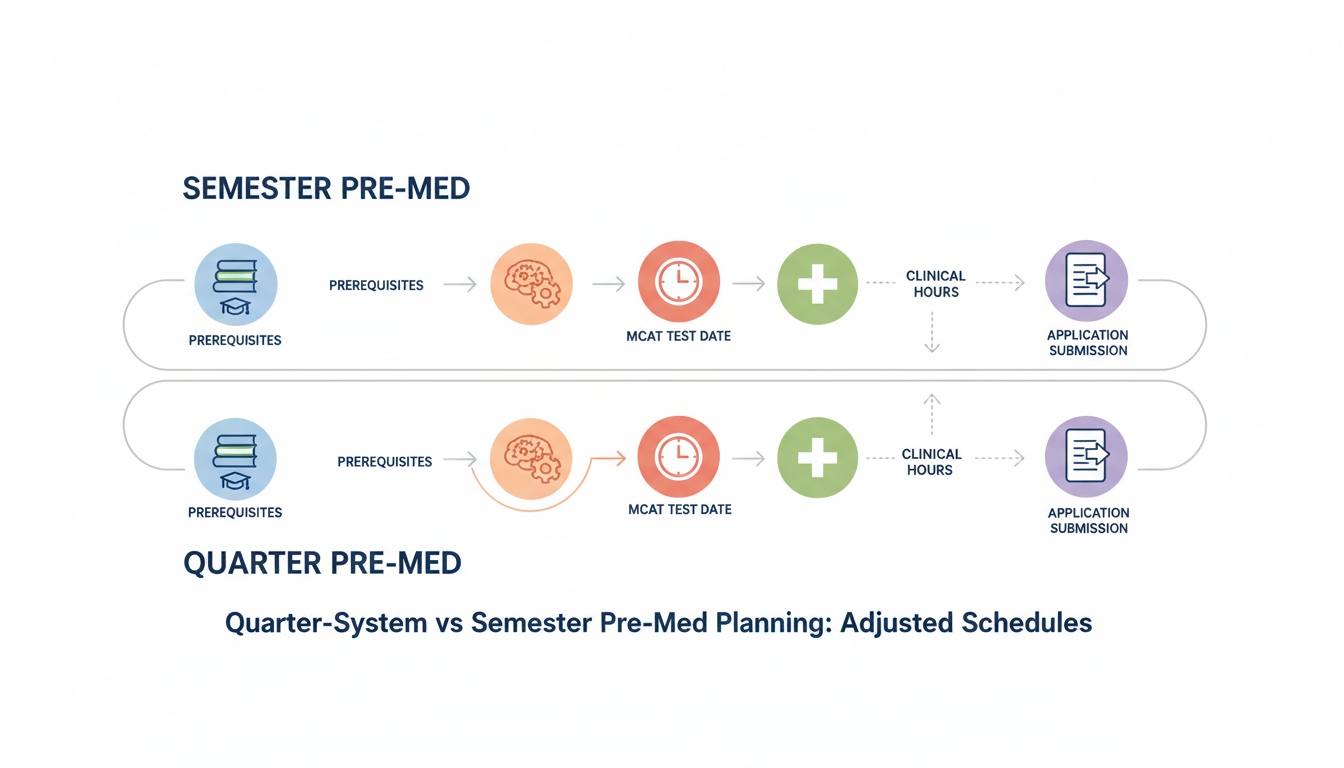
Below is a structured, chronological guide that splits planning into two parallel tracks:
- Track A: Semester system pre‑med
- Track B: Quarter system pre‑med
At each point, you will see:
- What you should focus on
- How the timing changes by system
- Common pitfalls unique to each system
- Practical, time‑anchored checklists
Big Picture: How Your Academic Calendar Changes Pre‑Med Strategy
Before you plan year‑by‑year, anchor the structural differences.
Semester system (typical):
- 2 main terms per year
- ~15 weeks of instruction per term
- Summer: 10–12 weeks
Quarter system (typical):
- 3 main terms (sometimes 4 with summer)
- ~10 weeks of instruction per term
- Breaks are shorter but more frequent
Core implications for pre‑med planning:
Course pacing
- Semester: Slower pace, more time to recover from a bad exam.
- Quarter: Faster pace, more frequent exams, less time to adjust if you start poorly.
Prerequisite sequencing
- Semester: One year of biology = 2 courses.
- Quarter: One year of biology often = 3 courses. You can finish sequences faster if you plan well, or get trapped if you do not.
-
- Semester: Content typically completed by end of second year or mid‑third year.
- Quarter: Potential to complete core content earlier, but review time can be squeezed.
GPA trends
- Semester: Fewer data points; one term has a big impact.
- Quarter: More terms—and more grades—mean faster GPA movement up or down.
From this point forward, whenever you see a timeline marker, there will be a Semester path and a Quarter path.
Year 1: Building Foundations and Testing Interest
Fall of Year 1
Primary goals (both systems):
- Confirm that medicine is a true fit
- Establish a survivable study routine
- Start science prerequisites without overloading
Semester system – Fall Y1
At this point, you should:
- Take:
- General Chemistry I + lab or General Biology I + lab
- Calculus or Statistics (if needed for your major)
- 1–2 non‑science courses (writing, humanities, social science)
- Target: 14–16 credits, no more than 2 lab sciences.
Quarter system – Fall Y1
Your 10‑week term moves quickly.
At this point, you should:
- Take:
- General Chemistry I or Biology I (not both if possible)
- 1 math or writing course
- 1 general education course
- Target: 12–14 credits, and avoid 2 lab sciences until you understand the pace.
Experience and exploration (both systems):
By November of Year 1, you should:
- Attend at least 1 pre‑med club meeting or advising session.
- Shadow 1–2 physicians for a total of 8–12 hours if possible (even one afternoon counts).
- Start a simple activities log (spreadsheet or notebook) for hours and reflections.
Quarter‑system students must be especially careful: that first midterm might arrive by Week 3. Do not wait to adjust study habits.
Winter/Spring of Year 1
Semester system – Spring Y1
At this point, you should:
- Continue the sequence started in fall:
- If you took Gen Chem I → take Gen Chem II
- If you took Bio I → take Bio II
- Add:
- A writing‑intensive course (helps for personal statements later)
- 1–2 breadth courses
By late April:
- Have 1 full year of either biology or chemistry completed.
- Have at least:
- 20–30 hours of some form of clinical exposure or community service with vulnerable populations.
(Does not have to be perfect; you are building a pattern, not a portfolio yet.)
- 20–30 hours of some form of clinical exposure or community service with vulnerable populations.
Quarter system – Winter & Spring Y1
You get two distinct terms here.
Winter Y1:
At this point, you should:
- Continue the science sequence:
- Chem I → Chem II
- or Bio I → Bio II
- Take:
- 1 writing or communication course
- 1 general education or exploratory course
- Begin low‑commitment involvement:
- 1–2 hours/week volunteering or club work
Spring Y1:
Now you can finish a 3‑course sequence or start a second:
- Chem III or Bio III (if your institution uses 3‑course sequences)
- Or start:
- Biology I if you did chemistry first
- Chemistry I if you did biology first
By late June (end of Spring quarter):
- Aim for:
- One complete sequence finished (3 courses)
- 30–40 cumulative hours of exposure or service
The advantage in quarters: you may complete both general biology and general chemistry by the end of Year 1 if you are careful, but only if your GPA is holding strong. Do not accelerate at the expense of grades.
Summer after Year 1
Regardless of system, at this point you should:
- Decide on one anchoring activity:
- Hospital volunteer position
- Research assistant role
- Scribe job
- Work at least:
- 8–10 hours/week for 8–10 weeks
Semester students may use the longer summer (10–12 weeks) to concentrate hours; quarter students may have a slightly shorter break, so plan earlier and lock in positions by April.
Year 2: Finishing Core Sciences and Positioning for MCAT
This year’s timing differences matter more. Your goal is to complete:
- General Biology
- General Chemistry
- Organic Chemistry
- Physics
- At least one term of Psychology/Sociology
Fall of Year 2
Semester system – Fall Y2
At this point, you should:
- Take:
- Organic Chemistry I + lab
- Biology II (if not finished) or Physics I
- 1 writing / upper‑division general education course
- Keep clinical or volunteer work at:
- 3–4 hours/week
Quarter system – Fall Y2
You likely have flexibility thanks to the extra term.
At this point, you should:
- Choose one main science load:
- Organic Chemistry I
- Or Physics I
- Pair with:
- One lighter course (ethics, sociology)
- One moderate course (upper‑division biology or general ed)
- Maintain:
- 3–5 hours/week of consistent clinical or research involvement
Because each quarter is only 10 weeks, avoid stacking Organic Chemistry + Physics + a lab-heavy bio in one term unless you already have A‑level performance in prior quarters.
Winter/Spring of Year 2: MCAT Content Completion
Semester system – Spring Y2
By the end of Spring Y2, to be ready to apply in the immediately following cycle (traditional timeline), you should have:
- Completed or be actively taking:
- General Bio I–II
- General Chem I–II
- Organic Chem I–II
- Physics I–II
- Taken at least:
- One Psychology course
- One Sociology or social science course
This allows you to start focused MCAT study by:
- May–June after Year 2 for a test in:
- January–April of Year 3 (before you apply)
Quarter system – Winter & Spring Y2
Your accelerated cadence lets you finish prerequisites earlier or distribute them more evenly.
By end of Winter Y2 you should aim to:
- Have completed:
- Full General Chem sequence (3 quarters)
- Full General Bio sequence (3 quarters)
- Be in:
- Organic Chemistry II
- or Physics II
By end of Spring Y2 you should:
- Have completed:
- Organic Chemistry series (up to III if required)
- At least 2 quarters of Physics
- Completed:
- 1 quarter of Psychology
- 1 quarter of Sociology or equivalent
At this point, quarter‑system students can begin early MCAT prep immediately in late spring or early summer, potentially testing:
- As early as August–September after Year 2, if all content is in place and your GPA is stable.
- Or more traditionally January–April of Year 3, with more review time.
The trade‑off: early testing requires highly disciplined summer study (see below).
Summer after Year 2: MCAT Strategy Diverges
Here the quarter vs semester divide is most obvious.
Semester system – Summer after Y2
At this point, you should:
- Start formal MCAT preparation if you plan to apply in the summer after Year 3:
- 2–3 months of content review
- 1–2 months of practice exams
Typical pattern:
- Study 15–20 hours/week starting in June.
- Target MCAT date: January–April of Year 3.
Simultaneously:
- Maintain 5–10 hours/week in 1–2 key activities (research, clinical, leadership) to show continuity.
Quarter system – Summer after Y2
Two viable MCAT tracks:
Accelerated early‑MCAT track (aggressive)
At this point, you should:- Begin intensive study in late May or June:
- 25–30 hours/week MCAT prep
- Finish content review by late July
- Begin full‑length practice exams mid‑July
- Target MCAT date:
- Late August to early September after Year 2.
This works well if:
- All core sciences are completed by Spring Y2.
- Your GPA is already strong (≥3.6).
- You can dedicate the summer primarily to MCAT work.
- Begin intensive study in late May or June:
Standard track (more common)
At this point, you should:- Begin lighter MCAT exposure:
- 5–10 hours/week building Anki decks, reviewing high‑yield topics.
- Continue substantial experience:
- 15–20 hours/week clinical, research, or paid work.
- Plan formal, full MCAT prep for Winter of Year 3 (your schedule allows this because you have an extra term).
- Begin lighter MCAT exposure:
Year 3: Aligning MCAT and Application Windows
For students aiming to begin medical school directly after graduation, Year 3 is the application launch year.
Academic Planning
Semester system – Year 3
At this point, you should:
- Fall Y3:
- Take upper‑division biology (e.g., Physiology, Biochemistry).
- Lighten load slightly if planning a January–March MCAT.
- Spring Y3:
- Maintain 12–15 credits, prioritizing GPA stability.
- Avoid the heaviest lab combinations if your MCAT is in this term.
Quarter system – Year 3
Your three main terms give you more configuration options.
At this point, you should:
- If MCAT is already done (late August/September after Y2):
- Use Y3 to:
- Strengthen GPA with well‑chosen upper‑division courses.
- Deepen involvement in 1–2 signature activities.
- Use Y3 to:
- If planning MCAT in Y3:
- Option A: Winter MCAT
- Fall Y3:
- 12–14 credits, begin MCAT content review.
- Winter Y3:
- Limit to 10–12 credits with no more than 1 demanding lab.
- Schedule MCAT for late Winter or early Spring break.
- Fall Y3:
- Option B: Spring MCAT
- Fall/Winter Y3:
- Normal course load, begin light MCAT review.
- Spring Y3:
- Reduce intensity, schedule MCAT for late April–May.
- Fall/Winter Y3:
- Option A: Winter MCAT
Quarter students can exploit short, focused terms to have one “MCAT‑light” quarter where course load is intentionally reduced.
Application Timeline (Both Systems)
For a traditional, no‑gap‑year path (matriculating right after graduation):
At this point (Spring of Year 3), you should:
- Request letters of recommendation by March–April.
- Draft your personal statement by April.
- Finalize your school list by May.
- Take MCAT no later than:
- Late April–May of Year 3 (both systems) for scores to be back by June.
AMCAS/AACOMAS submission:
- Open: late May–early June.
- Ideal submission: June–early July of Year 3.
Quarter‑system nuance: Spring quarter may end in mid‑June. Plan writing and LOR requests in Winter so you are not trying to finish finals and applications simultaneously.
For a planned gap year (matriculate 1 year later):
- You shift this entire application block to Year 4.
- MCAT can be taken:
- Summer after Year 3
- Fall of Year 4 (less ideal but possible)
The quarter system often pairs naturally with a gap year, enabling:
- MCAT in Winter Y3 or Summer after Y3.
- A full year of post‑MCAT research or clinical work before applying.
Year 4: Finalizing, Repairing, or Amplifying
By Year 4, the differences between systems mostly affect:
- How you stack upper‑division courses
- When you apply (traditional vs gap year)
- How many chances you have to demonstrate an upward GPA trend
If You Applied at the End of Year 3
Semester system – Year 4
At this point, you should:
- Fall Y4:
- Focus on strong grades and continued involvement.
- Respond to secondary invitations promptly (within 2 weeks).
- Spring Y4:
- Interview travel (if in‑person) or virtual scheduling.
- Maintain clinical or service involvement to avoid gaps.
Quarter system – Year 4
Due to shorter terms, your academic year can look like:
- Fall Y4:
- 12–16 credits, continued research or leadership.
- Heavy interview season; consider a slightly lighter term.
- Winter Y4:
- Fewer interviews; you can afford a more challenging schedule.
- Spring Y4:
- Enjoy some flexibility, but keep performance solid—schools do see final transcripts.
If You Are Applying During/After Year 4 (Gap Year)
Regardless of system, at this point you should:
Use Year 4 to:
- Repair GPA if needed:
- Quarter students: 3 additional terms to show an upward trend.
- Semester students: 2 terms but more credits per term.
- Take:
- Biochemistry
- Physiology, Anatomy, or Neuroscience
- Public Health or Social Medicine course
- Repair GPA if needed:
Application tasks shift to:
- Spring–Summer after graduation (or during late Year 4 if you have not yet graduated).
- MCAT: ideally already completed by then.
Quarter‑system advantage: With three distinct terms, you can design:
- One high‑credit research or thesis term.
- One clinical‑intensive term (fewer classes, more hours at the hospital).
- One lighter term to prepare applications and secondaries.
Quick Comparative Checklists by Academic Year
End of Year 1 – You should have:
Semester:
- 2 semesters completed
- 1 full year of either Bio or Chem
- 20–40 clinical or service hours
- Initial connection with 1 faculty member
Quarter:
- 3 quarters completed
- 1 full sequence (3 courses) of Bio or Chem, possibly both if strong
- 30–60 clinical or service hours (more terms = more small commitments)
- Contact with 1–2 faculty for potential future letters
End of Year 2 – You should have:
Semester:
- Completed:
- Bio I–II
- Chem I–II
- Organic I–II
- Physics I–II (or in progress)
- 100–200 cumulative clinical/service hours
- At least 1 ongoing activity (research, leadership, or work)
Quarter:
- Completed:
- Full Bio sequence (3)
- Full Chem sequence (3)
- Organic sequence (2–3)
- At least 2 Physics courses
- 1 Psych + 1 Soc
- 120–250 clinical/service hours distributed across more terms
- Decision made:
- Early MCAT (end of Summer Y2) vs
- Standard MCAT (Y3)
Before Application Submission – You should have:
Both systems:
- MCAT score in hand or pending with a test date not later than June of the application year.
- 3–6 solid letters of recommendation.
- 2–3 years of consistent involvement in:
- Clinical exposure
- Community service
- At least one depth activity (research, leadership, or long‑term employment)
Quarter‑system students often have more separate experiences due to more terms. Semesters often show longer contiguous experiences. Both are acceptable, but your narrative must show continuity and growth.
Three Takeaways for Quarter vs Semester Pre‑Med Planning
- Your academic calendar dictates when you should finish prerequisites and take the MCAT; quarter‑system students can move faster but must protect GPA against accelerated pacing.
- Plan at the term level, not the year level: for quarters, each 10‑week block is a strategic unit; for semesters, think in 15‑week arcs with one or two major science anchors.
- Align experiences and MCAT prep with your system’s natural rhythms: quarters favor focused, lighter MCAT quarters or early summer testing; semesters favor extended, steady MCAT prep leading into winter or early spring testing.