
Introduction: Why Your GPA Still Matters for Medical School
For aspiring physicians, GPA can feel like a constant shadow—showing up on every application, every advising meeting, and every “chance me” forum. While medical schools review applicants holistically, your GPA remains one of the strongest objective indicators of your academic readiness.
A high GPA does more than open doors:
- It signals that you can handle a rigorous science curriculum.
- It shows you’ve developed strong study techniques and time management skills.
- It gives admissions committees confidence that you’ll survive (and thrive) in medical school.
This guide goes beyond generic advice like “study harder” or “manage your time.” You’ll learn concrete GPA Tips, evidence-based Study Techniques, and realistic Time Management strategies tailored to premeds. You’ll also see how Medical School Preparation is about more than grades—it’s about building sustainable habits and a mindset for long-term Academic Excellence.
Designing an Effective Study Schedule That Actually Works
A high GPA isn’t just about intelligence; it’s about consistency and structure. The most successful premeds treat their semester like a marathon, not a series of all-nighters.
Map Your Semester Like a Project Manager
Before the semester starts—or as early as possible:
Audit Your Syllabi
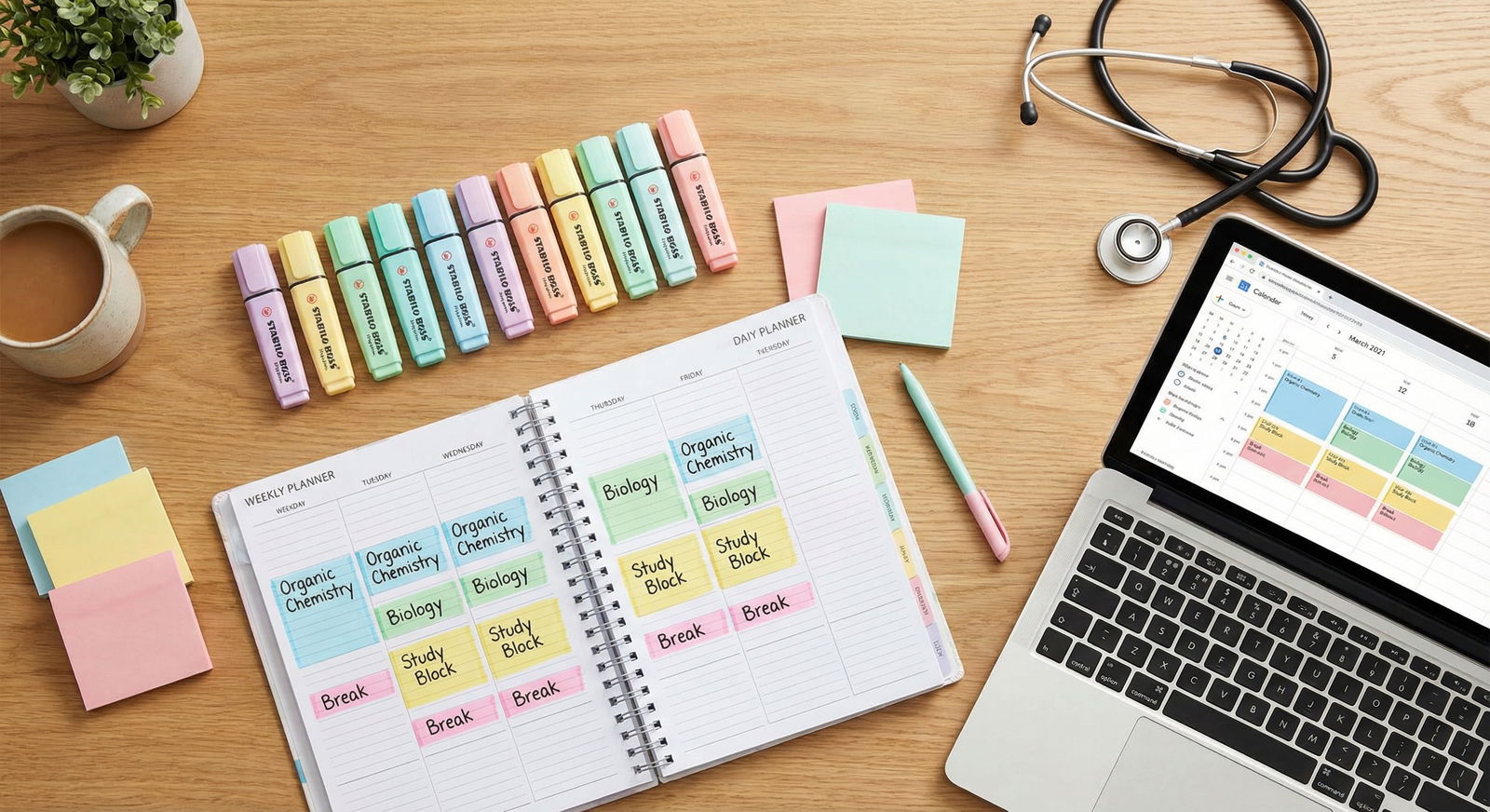
- Enter every exam, quiz, paper, and lab report into a digital calendar (e.g., Google Calendar).
- Color-code by course (e.g., red for Organic Chemistry, blue for Biology).
- Add reminders 1–2 weeks before major exams and 3–5 days before smaller quizzes.
Identify Peak Demands
- Look for weeks with multiple exams or overlapping deadlines.
- Preload those weeks by:
- Starting readings and problem sets earlier.
- Reducing extracurricular commitments temporarily.
- Planning lighter social schedules.
Set Academic Priority Targets
- Decide in advance which courses are GPA-critical (often core sciences).
- Allocate more structured study time for high-weight exams or known challenge courses.
This front-loaded planning sharply reduces last-minute panic and creates more predictable study rhythms.
Build a Weekly Study Structure You Can Repeat
Instead of asking “When will I study?” decide what you will do and when. Think of your weekly schedule as a template:
- Morning (high-focus blocks):
- Review lecture notes from the previous day
- Active recall for high-yield concepts
- Afternoon:
- Problem-solving for chemistry, physics, and quantitative courses
- Lab-related tasks, assignments, and practice questions
- Evening:
- Lighter tasks: flashcards, reading, watching supplemental videos
Example of a structured but flexible weekly plan:
| Time | Monday | Tuesday | Wednesday | Thursday | Friday | Saturday | Sunday |
|---|---|---|---|---|---|---|---|
| 8–10 AM | Review lectures | Active recall Bio | Problem sets Chem | Review lectures | MCAT-style passages | Mock exam / practice | Weekly reflection |
| 10–12 PM | Attend lectures | Lab or recitation | Attend lectures | Problem sets Phys | Study group | Review weak topics | Plan upcoming week |
| 1–3 PM | Deep study block | Deep study block | Deep study block | Deep study block | Deep study block | Off / light review | Family/personal time |
| 4–6 PM | Flashcards + recap | Office hours | Practice questions | Workshop/tutoring | Free study / catch up | Exercise / self-care | Meal prep / logistics |
Use SMART Goals for Each Week
Vague goal: “Study biology more.”
SMART goal: “By Friday, I will complete Chapters 3–4, finish 40 practice questions, and review incorrect answers twice.”
Each week, write 3–5 SMART goals:
- Specific: What topic? What resource? What output?
- Measurable: Number of chapters, questions, flashcards, or sessions.
- Achievable: Fits within your actual available time.
- Relevant: Closely tied to upcoming exams and core concepts.
- Time-based: Deadline within your current week.
This level of intention keeps your study schedule aligned with real outcomes, not just “time spent.”
Evidence-Based Study Techniques for Academic Excellence
High-GPA students don’t necessarily study longer—they study smarter. They use Study Techniques grounded in cognitive science to maximize retention and performance.
1. Time Management with the Pomodoro Technique (Done Correctly)
The Pomodoro Technique is more than a trendy timer method; it’s a structured way to manage attention.
Classic Pomodoro cycle:
- 25 minutes: Deep, distraction-free study
- 5 minutes: Short break (stand, stretch, hydrate)
- After 4 cycles: 15–30-minute break
Tips for using it effectively:
- Put your phone in another room or use app blockers.
- During breaks, avoid starting anything that’s hard to stop (e.g., TikTok, gaming).
- Use longer cycles (40–50 minutes) for reading-intensive work if 25 feels too short.
This approach helps prevent burnout during long semesters and is ideal for dense material like biochemistry or physiology.
2. Active Learning: Make Your Brain Work, Not Just Watch
Passive learning (re-reading notes, highlighting) feels productive but leads to shallow retention. Active learning forces your brain to retrieve and manipulate information.
Examples:
- Teach to an invisible student: Explain glycolysis out loud as if you’re tutoring a peer, without notes. Notice where you get stuck.
- Question-to-concept flashcards: Instead of “Term: Definition,” use:
- “Explain why…”
- “Compare X versus Y…”
- “What happens if… changes?”
- Study groups with structure:
- Assign each person a topic to briefly teach.
- Use practice questions and discuss reasoning, not just answers.
- Set an agenda and a start/end time. Avoid turning it into social time.
3. Retrieval Practice and Spaced Repetition
These two strategies are among the most powerful GPA Tips you can adopt.
Retrieval Practice:
Instead of looking at your notes, close them and ask:
- “What were the three major points from today’s lecture?”
- “What is the mechanism of action for this drug?”
- “Which steps of this pathway are regulated?”
Write or say your answers, then check them against your notes or textbook.
Spaced Repetition:
- Revisit material at increasing intervals: same day, 1 day later, 3 days, 1 week, 2 weeks, etc.
- Use Anki or similar spaced repetition apps for:
- Anatomy terms
- Biochemistry pathways
- Definitions and key concepts
Students who combine retrieval practice with spaced repetition typically require less cramming and maintain higher long-term performance.
4. Multimodal Learning: Use Multiple Inputs Strategically
Not all resources are equal—and more isn’t always better. But using multiple formats can reinforce complex material if done wisely.
Useful multimodal resources:
- Textbooks & lecture notes: For core content and tested material.
- Videos (e.g., Khan Academy, Osmosis, MedSimplified):
- Use for topics that feel abstract or visual (e.g., renal physiology).
- Watch at 1.25–1.5x speed and take brief notes.
- Podcasts / audio: Great for review while walking or commuting.
- Diagrams and concept maps: Especially helpful for:
- Metabolic pathways
- Organ systems
- Pharmacology classifications
Always ask: “How does this resource connect back to what I will be tested on?” This keeps you from drifting into endless, unfocused content consumption.
5. Practice With Purpose: Exam-Style Questions
For science courses and the MCAT, your grade depends on both knowledge and strategy.
How to practice effectively:
- Start with untimed, open-note practice to learn how questions are structured.
- Transition to timed, closed-note blocks as exams approach.
- After each session, conduct a post-mortem:
- Why was this answer wrong?
- Did I misread the question, lack content, or rush?
- What pattern of errors is emerging? (e.g., unit conversion, reading graphs, multi-step reasoning)
Use AAMC and other reputable practice materials for MCAT-style practice during your later premed years; earlier on, use your course’s recommended problem sets and question banks.
6. Use Technology Intentionally
Technology should support your Academic Excellence, not undermine it.
Helpful tools:
- Anki / Quizlet: Spaced repetition and active recall.
- Notion / Evernote / OneNote: Organized note systems by course, topic, and exam.
- Trello / Asana: Task management for assignments, lab reports, and applications.
- Distraction blockers: Forest, Freedom, Cold Turkey, or built-in focus modes.
Set specific rules (e.g., “Social media only after 8 PM” or “Phone in drawer during Pomodoros”) to protect your focus.
Building a Strong Academic Support System
No one gets a 3.8+ GPA alone. A strong support network makes your Medical School Preparation more sustainable and less isolating.
Strategic Study Groups: Quality Over Quantity
Good study groups:
- Are limited in size (3–5 people).
- Are committed to being on time and prepared.
- Have complementary strengths (e.g., you’re strong in physics, someone else excels at biology).
- Use a plan:
- 20 minutes: Review main concepts
- 40 minutes: Work through challenging problems individually, then discuss
- 20 minutes: Clarify misunderstandings and summarize key takeaways
Avoid:
- Groups that devolve into socializing.
- Groups where one person teaches and others passively listen every time.
Mentorship: Learn From Those Ahead of You
A mentor can dramatically accelerate your progress by helping you avoid common mistakes.
Potential mentors:
- Professors you’ve built rapport with.
- Teaching assistants or tutors in tough science courses.
- Upperclassmen who performed well in classes you’re taking.
How mentors can help:
- Course selection and sequence (e.g., when to take Organic Chemistry or Biochemistry).
- Study strategies specific to certain professors or departments.
- Honest feedback on your readiness for the MCAT and application timeline.
Approach them professionally:
- Send a brief email indicating who you are, why you’re reaching out, and what you hope to learn.
- Come prepared with specific questions.
Use Campus Resources Relentlessly
High-achieving students make full use of what’s already available:
- Office hours: Go early and often; bring specific questions or practice problems.
- Tutoring centers / academic success offices: Many offer free or low-cost support.
- Writing centers: For lab reports, personal statements, and writing-heavy courses.
- Counseling services: To manage stress, anxiety, and burnout—extremely common in premeds.
Proactively using support is a strength, not a weakness.
Mastering Time Management and Mindset for Long-Term Success
Time management and mindset are the hidden engines behind a strong GPA. Without them, even the best Study Techniques won’t stick.
Prioritization Systems: Do What Matters Most First
Use the Eisenhower Matrix to decide how to spend your time:
- Urgent & Important: Exams this week, due assignments → Do first.
- Important, Not Urgent: Long-term projects, MCAT prep, research → Schedule deliberately.
- Urgent, Not Important: Some emails, minor obligations → Delegate or minimize.
- Not Urgent, Not Important: Mindless scrolling, excessive gaming → Limit.
At the start of each day, list your top 3 MITs (Most Important Tasks) related to your GPA. Finish those before low-yield activities.
Defeating Procrastination With Systems, Not Willpower
Procrastination often stems from:
- Overwhelm (“This is too much.”)
- Fear of failure (“What if I can’t do this well?”)
- Lack of clarity (“I don’t know where to start.”)
Counter it by:
- Breaking tasks down: “Review Chapters 1–5” becomes “Summarize section 1.1,” then 1.2, etc.
- Using the 5-Minute Rule: Commit to working for 5 minutes. Once you start, you usually keep going.
- Studying in public spaces: Libraries or study lounges reduce the temptation to nap or scroll.
- Having accountability: Study with a friend or check in with a mentor or tutor weekly.
Developing a Growth Mindset for Academic Excellence
A growth mindset means believing your abilities can improve through effort and strategy—not that you’re “just bad at physics.”
Shift your self-talk:
- From “I’m terrible at orgo”
→ To “I haven’t yet found the right strategy for orgo; I need more practice and different resources.” - From “I blew that exam; I’m done”
→ To “This exam shows me what I need to change before the next one.”
Practical mindset habits:
- Post-exam reflection:
After each test, write:- What worked in your preparation
- What didn’t
- What you will change next time
- Journaling:
Once a week, reflect on:- Progress you’ve made in difficult subjects
- Setbacks and what you learned
- Small wins (finishing a problem set, improving a quiz score)
This builds resilience—essential for both premed years and medical training.
Protecting Your Brain: Sleep, Nutrition, and Mental Health
Your brain is your most valuable asset. High-GPA students treat their health as non-negotiable, not optional.

Sleep: The Ultimate Performance Enhancer
Sleep is not wasted time; it’s when your brain consolidates memories.
Evidence-based guidance:
- Aim for 7–9 hours most nights.
- Keep a consistent sleep and wake time, even on weekends.
- Avoid heavy screens and intense studying in the last 30–60 minutes before bed.
- If you must cram, prioritize review and practice questions, not brand-new content late at night.
Students who chronically sacrifice sleep often see:
- Slower processing speed
- Poorer concentration
- More careless exam errors
All of which hurt GPA.
Exercise and Stress Management
Regular physical activity:
- Improves mood and energy.
- Enhances focus and memory.
- Reduces stress hormones.
Realistic options for busy premeds:
- 20–30 minutes of walking between classes.
- Short bodyweight workouts at home.
- Group fitness classes scheduled like any other commitment.
Additionally, consider:
- Brief mindfulness sessions (Headspace, Calm, or free YouTube content).
- Deep breathing exercises before exams.
- Non-academic hobbies that recharge you (music, art, sports, faith practices).
Nutrition to Support Cognitive Function
You don’t need a perfect diet, but you do need a stable one.
Try to:
- Eat regular meals with protein and complex carbs (e.g., chicken + rice + vegetables).
- Choose brain-supportive foods: nuts, seeds, fish, leafy greens, berries.
- Stay hydrated; even mild dehydration impairs concentration.
- Limit extreme caffeine doses and energy drinks, which can worsen anxiety and sleep.
Meal prep on weekends (even simple items like pre-cut vegetables, boiled eggs, or pre-made salads) can make healthy eating easier during busy weeks.
Frequently Asked Questions: GPA and Medical School Preparation
What GPA do I need to be competitive for medical school?
Many allopathic (MD) medical schools in the U.S. see 3.5+ as competitively strong, and top-tier schools often have entering class averages closer to 3.7–3.9. Osteopathic (DO) schools may accept slightly lower GPAs but still value strong academic performance. That said, schools evaluate:
- Overall GPA
- Science GPA (biology, chemistry, physics, math)
- Upward trends (improvement over time)
A slightly lower GPA can be offset by a strong MCAT score, upward trend, rigorous coursework, meaningful clinical experiences, and compelling personal attributes.
How can I recover from a low GPA as a premed?
You can absolutely recover and remain a viable applicant if you act intentionally:
- Identify the cause: Time management? Study habits? Personal or health issues?
- Improve semester-by-semester: Aim for a strong upward trend (e.g., 3.2 → 3.5 → 3.8).
- Retake key prerequisite courses if you earned C/C– or lower, especially in core sciences.
- Consider a post-bacc or SMP (Special Master’s Program) to show mastery of advanced science coursework.
- Document your growth: Be ready to explain what changed—habits, mindset, support systems—if asked in secondaries or interviews.
Do extracurricular activities hurt or help my GPA?
Extracurriculars don’t directly affect your GPA numerically, but they impact how you use your time:
- Too many activities can dilute study time and lower performance.
- Well-chosen, meaningful activities (clinical exposure, research, long-term volunteering) strengthen your application and can improve time management skills.
Protect your GPA by:
- Scaling back during heavy exam weeks.
- Prioritizing consistent, long-term commitments over scattered one-offs.
- Ensuring you still have adequate weekly study hours (often 2–3 hours per credit hour in challenging science courses).
Should I take easier courses to protect my GPA?
Balance is key:
- It’s reasonable to mix demanding science courses with less-intensive electives in the same semester.
- However, consistently avoiding rigor can hurt you:
- Admissions committees look at course difficulty.
- You need a strong foundation to handle the MCAT and medical school.
Choose a schedule that is challenging but manageable:
- Don’t overload with multiple heavy lab sciences plus major extracurricular obligations in one semester without a plan.
- Use academic advising and mentors to design your course sequence.
How early should I start serious Medical School Preparation?
Your preparation begins from your very first semester of college, primarily through:
- Building strong study habits and Time Management systems.
- Establishing a competitive GPA foundation.
- Exploring clinical and volunteer experiences (even lightly at first).
- Developing relationships with faculty who may later write letters of recommendation.
By your second or third year, you’ll shift more into:
- Formal MCAT prep
- Deeper involvement in clinical, research, or leadership experiences
- Planning your application timeline
Starting early with good habits makes the entire process less stressful and more successful.
A high GPA for medical school admission is not about perfection—it’s about consistency, strategy, and sustainability. By combining structured scheduling, proven Study Techniques, strong support systems, intentional Time Management, and real self-care, you’re doing more than chasing numbers. You’re training yourself to think, work, and grow like a future physician.
Use these GPA Tips as a starting point, experiment with what works for you, and refine your system each semester. Over time, you’ll not only see your grades rise—you’ll feel more confident, capable, and prepared for the demanding but rewarding road to medicine.