
Pre‑meds are sabotaging their futures on social media every single day—and most have no idea it is happening.
You can have a 520+ MCAT, a 3.9 GPA, stellar research, and still quietly get filtered out because of what is sitting, unprotected, on your Instagram, TikTok, X, or “private” Finsta from sophomore year.
This is not paranoia. It is pattern recognition.
Admissions committees, professionalism offices, residency program directors, even student conduct offices are checking applicants online. Some do it formally, with policies. Others do it informally, with a quick search “just to be safe.” Either way, the digital version of you is being evaluated.
Your job is simple: do not give them ammunition.
Below are the most damaging social media mistakes pre‑meds keep making, why they are so dangerous, and how to avoid turning a careless post into a professionalism red flag that follows you into medical school—and possibly beyond.
1. Believing “Private” or “Deleted” Means Safe
The worst mistake is not a specific post.
The worst mistake is the belief: “It’s private, so it does not matter.”
That belief gets people burned.
The reality you are underestimating
Screenshots are forever.
Friends, ex‑friends, group chats, random followers—one screenshot means your “private” content can become public without your consent.Deletion is not guaranteed erasure.
Cached pages, backups, archived content, or reposts can survive long after you press “delete.”Platforms change privacy policies.
A setting update, a bug, or a “feature” change can quietly expose content you thought was locked down.Access is easier than you think.
All it takes is:- A classmate who knows your handle.
- A group chat leak.
- Someone showing a screenshot to a faculty member after a conflict.
Once that happens, context does not matter. The image, statement, or joke becomes your “professional” identity in the eyes of someone with power over your application.
What this looks like in real life
A pre‑med has a “close friends” Instagram story where they rant about a professor, calling them incompetent and using profanity. A classmate screenshots it after a grade dispute and forwards it to the department. That student suddenly has a professionalism concern on record.
A student tweets angry, sarcastic comments about patients they encountered as a hospital volunteer—no names, but clearly mocking. A resident who follows them gets uncomfortable and mentions it to program leadership. That student loses a strong potential letter writer.
Avoid the mistake:
Assume anything you post can become:
- Public
- Permanent
- Attached to your real name
If that possibility would damage your professional reputation, do not post it—no matter how “private” it feels.
2. Posting Anything That Looks Unprofessional in a Clinical or Volunteer Setting
This one sinks applicants fast.
You cannot treat patients, clinics, or hospitals as aesthetic backdrops or content props.
High‑risk mistakes in clinical environments
These are the types of posts that can trigger major consequences:
Photos or videos inside patient care areas, even with no faces visible:
- Hallways with room numbers
- Glimpses of charts, wristbands, monitors
- recognizable locations where someone could connect details
“Storytime” posts about:
- Weird, funny, or dramatic patient cases
- “Gross” injuries or conditions
- Emotional outbursts or “difficult” patients
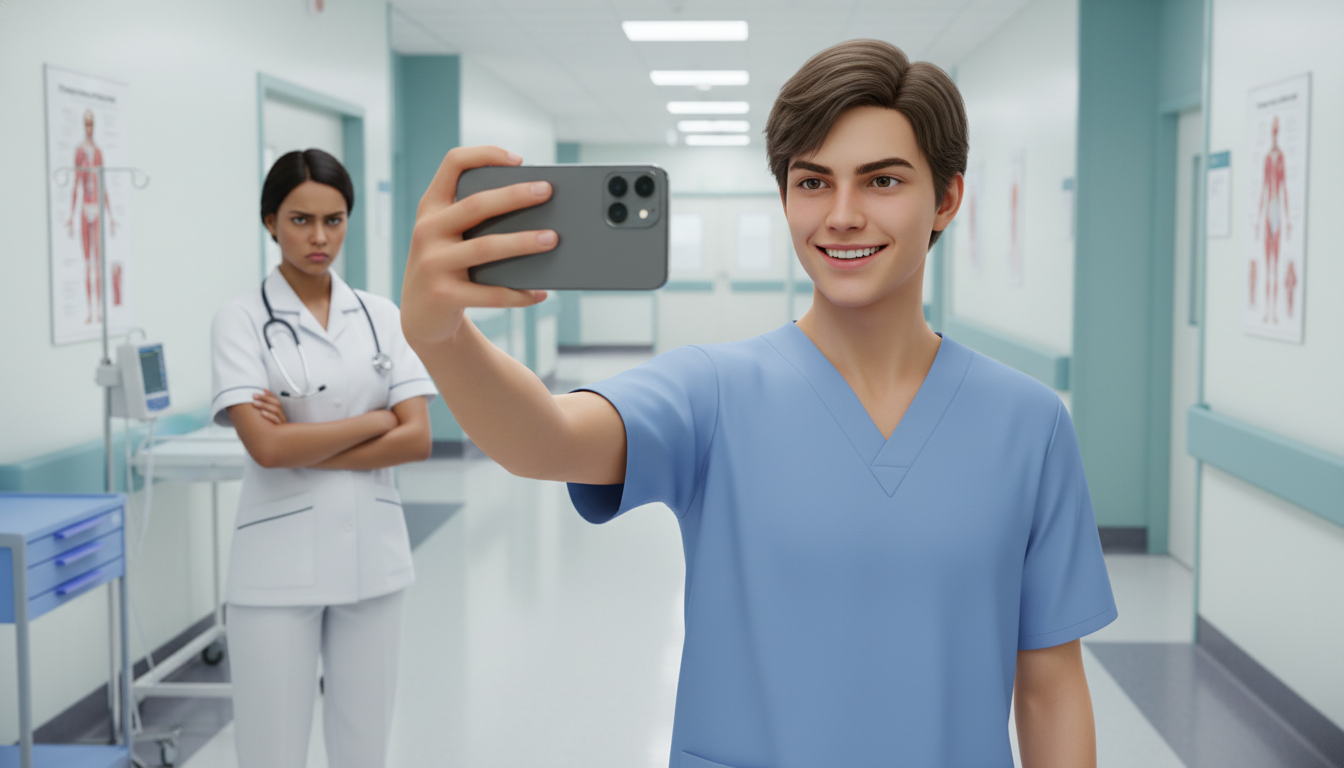
Selfies in scrubs with captions like:
- “Another day saving lives”
- “Fake it till you make it in the ER”
- “Look like a doctor, get treated like a doctor”
TikToks/Reels dancing or joking in hospital halls, exam rooms, or volunteer sites.
Even if you think you are being vague, your attitude is what is being evaluated:
- Are you mocking patients?
- Are you seeking attention from suffering?
- Are you violating trust or privacy?
- Are you treating a serious environment like a stage?
Why schools care so much
Medical schools know that unprofessional social media behavior in pre‑med years often predicts future problems:
- HIPAA violations
- Disrespect toward patients
- Poor boundaries with social media as a physician
They would rather not take the risk.
Avoid the mistake:
No photos or videos in clinical spaces.
Not in the ED. Not in the OR waiting area. Not “just in the hallway.” If you are wearing a badge and around patients, do not record content.No posting about patient stories.
Even if you “change details.” Even if you think it is educational. As a pre‑med or student, this is high‑risk.No joking about patients, staff, or families.
Humor about suffering will nearly always age badly and be interpreted poorly by admissions.
If you want to share about clinical experiences, do it in applications, essays, and interviews—where you can show maturity, reflection, and respect.
3. Blurring the Line Between Personal Opinions and Professional Judgment
You are allowed to have opinions. You are allowed to care deeply about social, political, and ethical issues.
The mistake is not having opinions.
The mistake is publishing them in ways that signal poor judgment, intolerance, or lack of maturity.
Opinion content that raises red flags
Dehumanizing language about any group:
- Patients with substance use disorders
- People with obesity
- Those with mental illness
- Certain racial, ethnic, religious, or gender groups
Example: “If you do X to your body, you do not deserve healthcare.”
Mocking or dismissive tone about controversial public health issues:
- COVID, vaccines, reproductive health, gender‑affirming care
Especially when you present misinformation as fact and ridicule others.
- COVID, vaccines, reproductive health, gender‑affirming care
Aggressive, personal attacks:
- Calling others “idiots,” “wastes of oxygen,” “disgusting”
- Encouraging shaming, harassment, or exclusion
Extremely rigid, absolutist judgments about patient behavior:
- “I would never treat someone who does ___”
- “If people make bad choices, they should live with the consequences”
You can be passionate and still appear thoughtful. What alarms committees is the combination of:
- Hostility
- Oversimplification of complex issues
- Lack of empathy
Why this is so dangerous for pre‑meds
Medicine is built on:
- Respect for persons
- Non‑discrimination
- Willingness to care for people you disagree with
If your posts loudly broadcast that you:
- Hold certain groups in contempt
- Believe some people are less deserving of care
- Enjoy humiliating those who are vulnerable
then you are telling schools you may be a liability to patients and to the institution.
Avoid the mistake:
If you post about controversial topics:
- Use careful, precise language
- Avoid demeaning anyone’s humanity
- Focus on systems and policies, not on mocking individuals or populations
Ask yourself:
“If this were read aloud to a diverse admissions committee and to patients of many backgrounds, how would it sound?”
If the answer is “angry, contemptuous, or cruel,” you are handing someone an easy reason to pass on your application.
4. Trying to Be a “Doctor Influencer” Before You Know What You Are Doing
There is a subtle but growing trap: pre‑meds trying to build a brand as “future doctors” or “medfluencers” while still undergraduates.
This often backfires.
Common missteps in “professional” accounts
Giving medical advice or explanations as if you are a qualified clinician:
- “Here is what your chest pain really means”
- “Doctors do not want you to know this…”
You are not a physician yet, and pretending to be one is a serious credibility and professionalism issue.
Exaggerating roles and experiences:
- “Saving lives in the ED tonight” when you are a volunteer restocking blankets
- Wearing a white coat in photos when you are not a medical student
Admissions will notice the gap between image and reality.
Monetizing pre‑med content with questionable judgment:
- Selling “shadow me” sessions
- Charging for “pre‑med consulting” with minimal actual experience
These can look exploitative and premature.
Sharing inaccurate or oversimplified health information:
- Misstating guidelines
- Promoting fad health trends
In a world drowning in misinformation, this is not a harmless hobby.
How this reads to admissions committees
The red flags are:
- Ego > humility
- Image > integrity
- Attention > learning
They do not fault you for being on social media. They do worry if your priorities look like:
- Followers over patients
- Branding over evidence
- Clout over accountability
Avoid the mistake:
If you want a public “pre‑med” or “future physician” account:
Make it about:
- Study habits
- Time management
- Application strategy
- Motivational stories
- Documenting your journey with honesty and humility
Make it very clear what you are not:
- Do not give medical advice
- Do not pretend to be more advanced than you are
- Do not dress and act like a physician for aesthetic content
Your credibility will come from authenticity and restraint, not costume and performance.
5. Ignoring How Your Partying and Substance Use Appear Out of Context
Admissions committees know pre‑meds are human. They know people have social lives.
The problem is not that you attend gatherings.
The problem is when your online identity appears to be:
- Heavy alcohol use as a personality
- Drug use as a recurring joke
- Recklessness and poor decision‑making as entertainment
Patterns that look bad—fast
Single photos rarely sink an application. Patterns do.
Here is what patterns look like:
Post after post of:
- Blackout drinking
- Binge sessions captioned “do not remember anything”
- Shots, funnels, or dangerous stunts
Drug‑related content:
- Repeated weed posts with “future doctor” in bio
- Jokes about harder drugs (“Need a break from orgo, pass the ___”)
- Photos of paraphernalia tagged with your real name
Videos showing:
- Clearly intoxicated behavior
- Risky actions (drunk driving references, unsafe stunts)
- Vandalism or fights presented as funny
Even if you never mention medicine, people can connect your face, your name, your school, and your “aspiring doctor” claims from other platforms.
Why this is more damaging than you think
Schools are asking:
- Will this student struggle with professionalism or impaired performance?
- Will this person be a liability in clinical settings?
- Will this behavior trigger Title IX or conduct issues?
They do not need proof of wrongdoing. They often just need enough concern to put your file in the “too risky” stack.
Avoid the mistake:
Do not post:
- Evidence of illegal drug use
- Bragging about extreme intoxication
- Anything involving driving and substances
If your social media is heavily party‑centric:
- Clean it up.
- Un‑tag yourself from the worst content.
- Ask friends not to tag you in compromising photos.
You are not required to look like a monk. You are required not to look like a walking liability.
6. Underestimating How Easy It Is to Connect Your Accounts to Your Application
Many pre‑meds think: “My accounts are under a nickname. They will never find me.”
That belief is naive.
Ways people connect the dots
Your real‑name email is linked to:
- Your Instagram or TikTok recovery email
- Your YouTube account
- Your old Twitter/X handle
Your LinkedIn proudly lists:
- Your research lab
- Your university
- Your pre‑med club
Then your Instagram bio lists the same lab, school, and club—now they match.
You use the same profile photo across platforms:
- A facial recognition‑like visual match is easy even for a human.
Friends tag you with your real name:
- In group photos
- In birthday posts
- In “good luck on the MCAT” shout‑outs
Everything forms a network of identifiers. One handle leads to another.
Who actually looks you up?
Some admissions staff, especially when:
- There are professionalism concerns in your file
- Something in your application raises questions
- A faculty member recognizes your name from somewhere
Peers:
- Future classmates, student leaders, or club officers
- They can share impressions—both positive and negative—with faculty.
Letter writers:
- Curious mentors sometimes search your name, especially for competitive positions.
Avoid the mistake:
Operate under a simple rule:
“If it is attached to my face and name—even indirectly—it must be defensible as a future physician.”
This does not mean sterile or robotic. It does mean:
- No obvious disrespect
- No glaring hypocrisy
- No content that would shock a conservative professionalism committee or embarrass a supportive mentor
7. Reacting Emotionally and Publicly to Academic or Institutional Conflicts
One of the most self‑destructive social media habits:
Turning every academic disappointment or institutional dispute into a performative rant.
High‑risk behavior here includes
Posting angry threads about:
- An unfair exam
- A “terrible” professor
- A grade dispute
- A conduct issue
Naming or clearly describing:
- Departments
- Individual professors
- Specific administrative offices
Accusing without restraint:
- “This professor is a racist/sexist/ableist clown”
- “My school is corrupt and does not care about students”
Even if you have a legitimate complaint, how you handle it is what gets judged.
What this signals about you
To admissions committees and future program directors, frequent public rants suggest:
- Poor emotional regulation
- Inability to handle conflict professionally
- Tendency to escalate, not resolve, issues
- Risk of becoming a social media liability for the institution
Medical training involves:
- Unfairness
- Bureaucratic mistakes
- Personality clashes
Those are sometimes real and serious. However, physicians are expected to use:
- Formal grievance channels
- Careful documentation
- Measured communication
Not scorched‑earth threads and TikTok venting.
Avoid the mistake:
- Do not litigate academic or institutional conflicts on social media.
- If you must share:
- Keep details anonymized
- Focus on your feelings and growth, not on attacking named individuals
- Avoid language you would be ashamed to see attached to your application
If something is serious—discrimination, harassment, safety issues—use official reporting channels and trusted mentors, not your Instagram story.
A Practical Social Media Safety Checklist for Pre‑Meds
Use this list to audit your profiles:
Search yourself
- Google your name + school.
- Check images.
- See what is publicly visible on each platform (log out and view).
Review your content through an ad‑com lens
Ask of every post:- Could this be interpreted as:
- Disrespectful?
- Immature?
- Reckless?
- Cruel?
- Would I be comfortable with:
- My dean seeing this?
- A residency director seeing this?
- A patient’s family seeing this?
- Could this be interpreted as:
Clean up systematically
- Delete or archive:
- Partying or substance posts that look extreme
- Clinical content of any kind
- Mocking, demeaning, or hateful language
- Un‑tag yourself from questionable photos.
- Ask friends to remove or untag you when needed.
- Delete or archive:
Lock down what you cannot—or do not want to—clean
- Set accounts to private where appropriate.
- Remove school, job, or “future doctor” identifiers from your most casual accounts.
Create a separate, professional presence if needed
- A clean LinkedIn
- A professional Twitter/X or Instagram focused on:
- Research
- Advocacy
- Academic achievements
Keep this one carefully curated.
FAQs
1. Do medical schools really check applicants’ social media?
Some do formally, many do informally, and anyone (faculty, residents, other students) can look you up on their own. You should behave as if it is likely someone will see your online presence, even if it is not part of a standardized process. The risk is not worth assuming you will never be checked.
2. Should I delete all my social media before applying?
Usually no. A normal, human, moderately boring online presence is fine and can even be helpful. You should remove clearly problematic content and lock down highly personal accounts. A complete disappearance can sometimes look odd, but it is much less concerning than an obviously unprofessional trail of posts. If you are unsure, lean toward caution.
3. What if I already posted something bad—am I doomed?
You are not automatically doomed, but you must act decisively. Delete or archive the content now, tighten privacy settings, and avoid repeating the behavior. If the issue is serious and public (for example, a viral post that drew complaints), you may eventually need to address it honestly and reflectively in an interview. What worries committees most is not a single past mistake, but a pattern of poor judgment that continues unchecked.
Key takeaways:
- Assume every post can become public, permanent, and attached to your name.
- Anything involving patients, clinical settings, demeaning language, or reckless behavior is a direct threat to your future in medicine.
- Your online presence should show enough maturity that an admissions committee can trust you with patients, colleagues, and their school’s reputation.