
Visa sponsorship timelines are not uniform. They vary by region, by visa category, and, critically, by where you sit in your training cycle. A PGY-1 matching into a North American program faces a fundamentally different clock than a PGY-3 transferring into an Australian system. Miss that distinction, and you will spend your first weeks of training fighting immigration paperwork instead of learning medicine. This article delivers a practical roadmap: what to do now, how to sequence your steps, and how to avoid the timeline traps that derail otherwise qualified candidates.
The timeline variables that change everything (region + PGY + visa category)
Two forces dictate your sponsorship timeline. First, the regional ecosystem: how employers file, how immigration authorities process, and how long adjudication typically takes. Second, your PGY year: how much start-date pressure you carry and how much credentialing overlap you can tolerate.
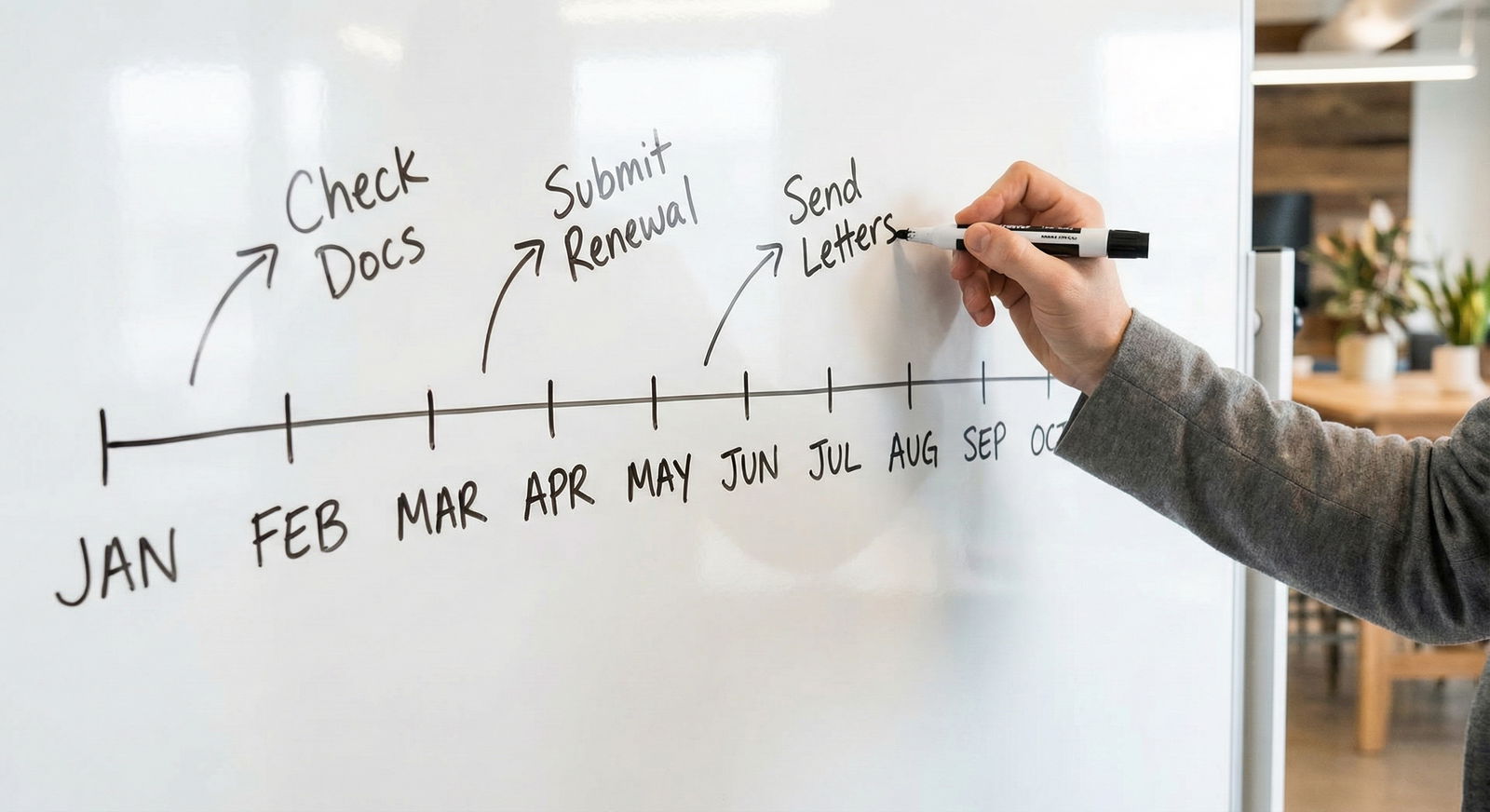
Here is what you are actually sequencing:
- Offer and contract timing. When your employer can formally initiate sponsorship. Some regions require a signed contract before petition filing. Others allow a conditional offer.
- Petition preparation. Employer-side document collection, labor certification (where applicable), and filing. This step is where most delays hide, because it depends on your HR team, not you.
- Interview and biometrics windows. Certain visa categories require in-person appointments. If your local embassy has a backlog, your timeline bends around it.
- Travel and arrival constraints. Your visa may be approved, but if you cannot secure a travel slot or arrive before your start date, the approval is functionally useless.
The mistake most applicants make is treating "visa sponsorship" as one event. It is a chain of dependencies. Your job is to identify the slowest link in that chain for your specific region and PGY year, then build your buffer around it.
Region-by-region: typical sponsorship timeline patterns (and why they differ)
Regional differences are not trivia. They determine whether you have months of breathing room or weeks of panic.
North America (J-1, H-1B pathways). Plan for 4-8 months. The biggest bottlenecks are employer readiness (especially if the institution files H-1B cap-subject petitions) and USCIS adjudication variability. J-1 sponsorship through ECFMG is more predictable but still requires months of lead time. Do not assume your program's HR team moves fast. They often do not.
UK/Ireland. Typically 3-6 months. The Skilled Worker route in the UK is more streamlined than North America, but certificate of sponsorship allocation and English-language verification can introduce delays. Ireland's medical registration pathway via the Medical Council adds its own layer.
EU/Schengen. Highly variable, 3-7 months depending on the country. Some member states have employer-driven work permit processes that move quickly; others require regional labor market tests. The lack of a single EU immigration policy means you must research your specific destination country. Generalizations here will hurt you.
Australia/New Zealand. 2-5 months. These systems are often more digitized and employer-competent, but medical registration through AMC or MCNZ runs in parallel and can become the slowest link. Sponsorship approval may be faster than credential verification.
Middle East. Often the fastest at the sponsorship stage, 2-4 months, but medical licensing through local health authorities (DHA, HAAD, QCHP, SCFHS) can introduce its own delays. Your timeline here is licensing-driven, not visa-driven.
The pattern is clear: your region determines which step is the bottleneck. Identify it early. Attack it first.
How PGY year shifts the timeline: PGY-1 vs PGY-2/3 vs late-stage trainees
Your PGY year is not just a number. It determines how much start-date pressure you carry and how much sequencing flexibility you have.
PGY-1 trainees face the tightest timelines. Match results, contract finalization, and credentialing all compress into a narrow window. If you are matching into a North American program, you must treat your visa process as urgent the moment the match concludes, ideally, you should have preliminary documents ready before match day. PGY-1 start dates are often rigid. Programs will not hold your spot indefinitely if your visa is delayed.
PGY-2/3 trainees have slightly more breathing room because you are already in the system or transferring with a documented training record. But you face a different risk: credentialing mismatch. Your prior training documentation must be verified by the new system, and if your previous program's verification is slow, your sponsorship stalls.
Late-stage trainees (PGY-4+) often have the shortest sponsorship timelines because they are entering specialized roles with employer urgency. But this cuts both ways: the pressure to start on time is immense, and expedited processing options must be identified early. If you wait until 8 weeks before your start date, you are gambling.
Here is the operational rule:
- PGY-1: Initiate document preparation 4-7 months before your start date. Confirm employer sponsorship plans within 30 days of match.
- PGY-2/3: Initiate 3-6 months out. Prioritize prior training verification and transfer documentation.
- Late-stage: 2-4 months out, but only if your documents are audit-ready. If anything is incomplete, add 4 weeks minimum.
Your PGY year is your pressure gauge. Act accordingly.
Action plan: how to build a sponsorship timeline calendar that actually works
A vague plan will fail you. You need a concrete calendar built by back-calculating from your program start date.

Step 1: Identify your hard start date. This is your anchor. Everything else back-calculates from here.
Step 2: Determine your region's typical processing range. Use the estimates above as a starting point, then confirm with your employer's immigration counsel. Do not trust internet forums. Get a written estimate from the person handling your case.
Step 3: Build your timeline backward. If your start date is July 1 and your region typically takes 6 months, your filing must be complete by January 1. That means document preparation starts in November. Employer coordination starts in October.
Step 4: Add buffer. Minimum 4 weeks. If your region has high variability (EU, North America), add 8 weeks. This buffer absorbs biometrics delays, RFEs, and HR slowdowns.
Step 5: Prepare documents now. Do not wait for your employer to ask. Assemble:
- Passport valid for at least 6 months beyond your start date (longer if possible).
- Medical degree, transcripts, and translations if not in the official language of your destination.
- Training verification letters from every prior program.
- Background checks and police clearances, these take weeks and often require apostille.
- Licensing exam scores and board certifications.
- Marriage and birth certificates if dependents are included.
Step 6: Keep everything audit-ready. Digital copies in a single secure folder. Physical copies in a travel-ready binder. When HR asks for a document, your response time should be under 24 hours.
This is not bureaucracy for its own sake. This is how you prevent your visa from becoming the reason you miss your start date.
Common timeline failures and how to fix them fast (Problem Solver)
Most delays are predictable. Here is how to triage them.
Failure 1: Missing or incorrect documentation. The most common delay. Fix: Within 24 hours of notification, identify exactly what is missing, locate or re-request the document, and submit in the required format. If a document requires apostille, flag the 2-4 week timeline immediately and notify immigration counsel in writing.
Failure 2: Credentialing mismatch. Your visa is approved but your medical credentials are not recognized by the licensing authority. Fix: This must be anticipated early. Confirm licensing requirements in parallel with visa sponsorship, not after. If you discover a mismatch late, contact your program director and immigration counsel simultaneously to negotiate a delayed start or provisional credentialing.
Failure 3: Inconsistent dates. Your contract says July 1, your visa petition says August 1. Fix: Immediately notify HR and immigration counsel in writing. Request that the petition be amended. Do not assume the discrepancy will be overlooked. It will not.
Failure 4: Slow employer response. Your documents are ready; HR is not. Fix: Escalate professionally. Send a timeline summary showing the consequences of delay. Copy your program coordinator if necessary. Most HR delays are caused by workload, not malice, clear communication about deadlines often unblocks the process.
Failure 5: Status not aligned with start date. Your visa is pending and your start date is approaching. Fix: This is the highest-risk scenario. Immediately contact immigration counsel to discuss premium processing (if available), expedite requests, or a delayed start date. Do not wait. Every day of delay reduces your options.
When delays hit, the order of operations is: identify the root cause, notify the responsible party in writing, and request a concrete fix timeline. Vague communication produces vague results.
Summary: Use region + PGY to predict your risk, and execute a timeline-safe plan
Your visa sponsorship timeline is predictable if you treat it as a project. Region determines your baseline processing pattern. PGY year determines your start-date pressure and sequencing risk. Together, these two variables tell you how much buffer to build and where to focus your effort.
The framework is simple:
- Start early. PGY-1 needs 4-7 months. Later PGYs need less, but only if documents are complete.
- Build buffers. Minimum 4 weeks. Up to 8 weeks for high-variability regions.
- Keep documents audit-ready. Response time under 24 hours when HR or counsel requests anything.
- Respond fast when delays appear. Identify, notify, and fix, within days, not weeks.
Visa sponsorship is not something that happens to you. It is something you manage. The residents who start on time are not lucky. They planned. They back-calculated. They communicated. Do the same.

Key Takeaways:
- Treat visa sponsorship like a project plan: back-calculate from your program start date and adjust your buffer based on both region and PGY year.
- The fastest way to avoid delay is early document completeness plus tight communication loops with HR/immigration counsel, most timeline breakdowns are fixable within days when you triage correctly.