

Most applicants rank programs like visas are an afterthought. That is how people end up unmatched, out of status, or stuck in a dead‑end visa situation three years later.
If you are an IMG or any non‑US citizen: your rank list is only as strong as your visa plan.
Let me walk through this like I would with a PGY‑1 who shows up with a contract in one hand and a half-baked visa plan in the other. We will be concrete. J‑1 vs H‑1B, contract clauses, what to email programs about, red flags buried in “standard” GME language.
You are not just matching a residency. You are matching an immigration pathway.
1. Start with the Big Picture: What Visa Do You Actually Want?
You cannot evaluate program policies until you are brutally clear on your own constraints and goals. This is the decision tree I use in real conversations.

| Step | Description |
|---|---|
| Step 1 | Non-US Citizen Applicant |
| Step 2 | H-1B Possible |
| Step 3 | J-1 Most Likely |
| Step 4 | Prioritize H-1B or J-1 with strong waiver history |
| Step 5 | Prioritize best training; visa is secondary |
| Step 6 | Ask programs detailed visa questions |
| Step 7 | USMLE Step 3 done by rank deadline? |
| Step 8 | Long-term US plan? |
Core decision: J‑1 vs H‑1B
You can want both. But ranking strategy gets clearer if you know your preferred end state.
J‑1 (ECFMG sponsored) – Pros:
- Most IMG‑heavy programs are used to it; process is streamlined.
- You do not need Step 3 before residency.
- Easier for many programs administratively; GME often prefers it.
Cons:
- Hard 2‑year home residency requirement unless you get a waiver (Conrad 30, VA, hardship, etc.).
- Can become a bottleneck for fellowship if timing is not handled well.
- Spouse on J‑2 cannot easily work in some timing situations if EAD issues drag.
H‑1B (employer sponsored) – Pros:
- No 2‑year home requirement.
- Cleaner transition to long‑term US practice, green card pathways, and some fellowships.
- Spouse on H‑4 may have later options for work (H‑4 EAD with I‑140, etc.).
Cons:
- Step 3 is mandatory before starting.
- Not all programs will bother; some cap‑exempt H‑1B quirks.
- Can limit the length of training (6‑year max in H‑1B for many, minus prior time).
If your long‑term plan is clearly “I want to stay and work in the US,” you should at least try to build a rank list that preserves an H‑1B pathway or, at minimum, a solid J‑1 waiver trajectory.
If your plan is “return home,” then you can be more aggressive ranking programs that only offer J‑1 and focus primarily on training quality and career outcomes.
2. Program Visa Profiles: What You Must Clarify Before Ranking
Do not rely on the one-line box on FREIDA or a website statement from 2018. Visa policies change when:
- GME leadership changes.
- Legal counsel changes.
- A prior visa case went badly and scared everyone.
Here is what you need to know for each program high on your list:
| Dimension | Program A | Program B | Program C |
|---|---|---|---|
| J-1 Sponsorship | Yes/No | Yes/No | Yes/No |
| H-1B Sponsorship | Yes/No | Yes/No | Yes/No |
| Step 3 Required by | Date | Date | Date |
| Visa Type Preference | J1/H1/Equal | J1/H1/Equal | J1/H1/Equal |
| Historical Waiver Support | Strong/Weak/Unknown | Strong/Weak/Unknown | Strong/Weak/Unknown |
Questions to ask programs (explicitly)
You either get this in writing (email) or you are guessing. Guessing with your immigration status is reckless.
Send a short, pointed email to the program coordinator or GME office:
“What visas do you currently sponsor for incoming residents in [specialty]? J‑1, H‑1B, or both?”
Do not ask “Do you sponsor visas?” That is too vague.“If you sponsor H‑1B, how many incoming residents in the last 2–3 cycles were on H‑1B vs J‑1?”
This tells you their real behavior, not just theoretical policy.“Is there a written policy or preference encouraging J‑1 over H‑1B?”
Many places technically allow H‑1B but strongly steer people to J‑1.“Do you require USMLE Step 3 to be passed by the rank list deadline, contract signing, or by residency start date for H‑1B?”
That timing difference can make or break your plan.“For J‑1 residents, do you provide support for J‑1 waiver positions after training (e.g., hospital-employed Conrad 30 positions)?”
You are checking whether they have a track record of helping people into jobs that solve the 2‑year requirement.If you already have some US work/visa history:
“I have previously held [F‑1 OPT, H‑1B, etc.]. Does that affect your ability to sponsor H‑1B for residency?”
Programs that answer clearly and promptly are usually safer. Programs that dodge, give vague replies like “Our legal office will review that after you match,” or copy‑paste generic policy statements are a risk.
3. Contract and Policy Language: Where Visa Traps Hide
You will not usually see detailed visa policy in the contract itself. It lives in:
- GME policy manuals.
- HR onboarding documents.
- Side letters or offer letters.
Still, you need to know how to read the contract and surrounding documents for visa landmines.
Clauses to look for
“Employment contingent upon ability to work in the United States.”
This is boilerplate. It is normal. But on its own, it tells you nothing about sponsorship. Pair it with written email confirmation about visa type.“The institution does not guarantee visa sponsorship.”
That sentence is a problem. If you see it, you must clarify in writing how they handle IMGs in practice. Sometimes this is just lawyer-speak; sometimes it means “If things get complicated, we may walk away.”“House staff are required to maintain appropriate work authorization at all times at their own expense.”
Translate: you may be paying attorney fees or petition fees for H‑1B if they do not explicitly cover them.Training length and visa
Some contracts or manuals quietly mention:- Maximum sponsored duration (for H‑1B especially).
- No visa extensions beyond standard residency length. If you are entering a long program (e.g., neurosurgery, integrated plastics), this matters.
Moonlighting and visa status
If you care about moonlighting, remember:- J‑1 usually forbids outside employment. Any internal moonlighting has to be strictly controlled.
- H‑1B is employer‑specific and location‑specific; moonlighting can be illegal unless specifically amended.
If the manual is public, read the visa section fully. Many residents never do. Then they act surprised when GME refuses to consider H‑1B for “policy reasons.”
4. H‑1B‑Specific Issues You Must Weigh
Programs love to say: “We offer H‑1B for exceptional candidates.” Translation: they will give it to one person every few years, maybe, if the department begs hard enough.
You need more precision than that.
The hard Step 3 reality
For H‑1B in residency:
- You must have passed Step 3 by the time they file the H‑1B petition, not just by July 1.
- Some institutions set earlier internal deadlines: by the time they certify rank lists or send contracts.
So rank list strategy:
- If your Step 3 is pending or scheduled close to Match, you should not build a rank list that assumes H‑1B at places with strict deadlines.
- Email and ask:
“What is the last date by which Step 3 must be passed for you to file an H‑1B for a matched resident?”
If their answer is “We require Step 3 at the time of rank list certification,” and your exam is a month after that, you do not have a real H‑1B option there anymore.
Cap‑exempt vs cap‑subject
Most residency programs are cap‑exempt H‑1B (university or non‑profit hospitals). That is good:
- No lottery.
- Can file any time of year.
But this has a hidden downstream impact:
- When you move to an H‑1B job in private practice after training, you may fall into the cap and lottery.
- Or you use a J‑1 waiver job that is cap‑exempt (like a non‑profit or academic practice) to stay out of the cap.
So, H‑1B in residency does not magically remove all immigration obstacles. It just repositions them. Still, it is usually better for long‑term flexibility than J‑1, if you can get it.
Duration limits
Standard rule of thumb: 6 years max on H‑1B (with some exceptions if green card is in process).
If you:
- Already used 3 years in a prior US job on H‑1B, and
- Plan a 5‑year residency (IM+peds, surgery, etc.),
You need to ask GME:
- “Do you track prior H‑1B time and will that limit my ability to complete residency on H‑1B?”
- “Has your legal team confirmed that full training length can be covered in my case?”
This is not theoretical. I have seen people forced to switch to J‑1 mid-residency because nobody counted their pre‑residency H‑1B time correctly.
5. J‑1‑Specific Issues: Waiver Reality vs Fantasy
Too many residents treat the J‑1 home residency requirement like a minor paperwork annoyance. It is not. Without a waiver, you cannot just slide into a fellowship or private job in the US.
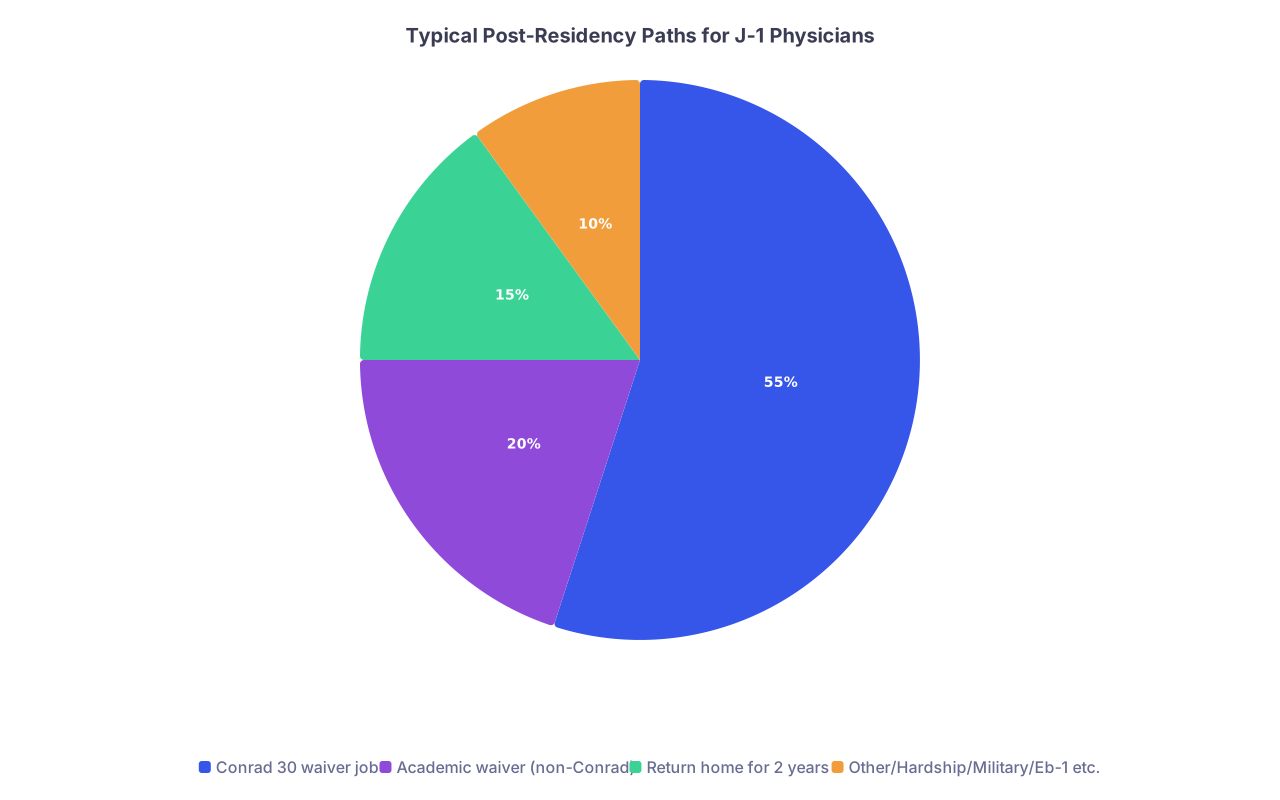
| Category | Value |
|---|---|
| Conrad 30 waiver job | 55 |
| Academic waiver (non-Conrad) | 20 |
| Return home for 2 years | 15 |
| Other/Hardship/Military/Eb-1 etc. | 10 |
The exact percentages vary by specialty and state, but the pattern is consistent: most J‑1 physicians who stay in the US do so through some flavor of waiver job.
When ranking, ask one very specific thing
“Over the last 5 years, how have your J‑1 graduates typically cleared the 2‑year home requirement? Do they:
- Get Conrad 30 waivers,
- Go into academic jobs with waiver support,
- Return home,
- Or use hardship/other options?”
If they cannot answer, they probably are not paying attention. That is not automatically a dealbreaker, but it means you must do more of your own homework.
Fellowship timing with J‑1
Two common failure modes:
Resident finishes J‑1 residency → wants fellowship on J‑1 → then try to get waiver after fellowship.
This is doable, but it compresses your waiver job search into a tight window and some states are not friendly to sub‑specialists.Resident finishes J‑1 residency → plans waiver job → realizes the jobs available do not align with their specialty aspirations (e.g., invasive cards vs general IM in a rural area).
The strategic version:
- If you know you want a very competitive fellowship, J‑1 is still possible, but you must:
- Target programs with strong fellowship track records and
- States with realistic waiver opportunities in your intended field.
Some programs will say: “Our J‑1 residents almost always get fellowships first and then waivers.” Others: “Most go straight into waiver jobs after residency.” That difference should influence your ranking.
6. Risk Categories: How to Classify Programs on Your Rank List
I like to bucket programs into 3 visa‑risk profiles when advising people.
| Category | Visa Support Pattern | Ranking Implication |
|---|---|---|
| Low Risk | Clear J-1/H-1B policies, history of support | Safe to rank high if training fits |
| Medium Risk | J-1 only or H-1B rarely used, unclear waiver help | Rank based on how badly you want them |
| High Risk | Vague/contradictory policies, no experience | Avoid as top choices if visa is critical |
Low‑risk programs
Characteristics:
- Can state exactly how many current residents are on J‑1 vs H‑1B.
- Have recent H‑1B residents if they claim to sponsor H‑1B.
- For J‑1, can tell you at least a few examples of recent graduates who secured waivers or fellowships.
You rank these based on training quality and fit. Visa is a solid secondary factor.
Medium‑risk programs
Typical patterns:
- “We only sponsor J‑1.”
That is not inherently bad, but it limits your long‑term paths. - Or: “We sponsor H‑1B in rare cases,” with no meaningful track record.
- They may have a few IMGs but mostly rely on US graduates.
Here you ask yourself:
- Will the training quality and career outcomes be strong enough that even a constrained visa path is acceptable?
- If I end up with J‑1 and a tough waiver search, does this program’s reputation offset that risk?
If you have strong alternatives that are more visa‑friendly, do not stack your top 5 entirely with medium‑risk programs.
High‑risk programs
Warning signs I have actually seen:
- Coordinator: “We do not pre‑discuss visa matters before Match; legal will review after.”
- Website says “We accept residents with appropriate work authorization” and nothing else, and they refuse to clarify by email.
- Program has virtually no history of IMGs and cannot name any past J‑1 or H‑1B residents.
Unless this is your absolute dream training environment and you have a solid backup plan (like already having a green card pending through a spouse), these should not sit at the top of your list.
7. Personal Scenarios and How Ranking Should Change
Let me make this concrete with common profiles.
Scenario 1: Strong IMG, Step 3 done, long‑term US career goal
You:
- Have ECFMG certification.
- Already passed Step 3 with a solid score.
- Want to stay in the US for fellowship and practice.
Ranking strategy:
Aggressively prioritize programs that:
- Actually use H‑1B for residents at your level.
- Or, if J‑1 only, have a real track record of helping with waivers or placing residents into big fellowships.
De‑prioritize:
- Programs that “consider H‑1B” but have not sponsored one recently.
- Programs in states with notoriously limited Conrad 30 slots for your specialty, if J‑1 only.
You are one of the rare IMGs positioned to capitalize on H‑1B from day one. Do not waste that advantage by ranking J‑1‑only programs at the top unless the training is truly exceptional.
Scenario 2: IMG, no Step 3 yet, realistically J‑1 only for now
You:
- May take Step 3 late or after Match.
- Are a solid candidate but not in a position to dictate visa type.
Ranking strategy:
- Assume J‑1 is your starting point.
- Focus on:
- Programs with lots of IMGs; they tend to be efficient with J‑1.
- Places in regions where J‑1 waiver jobs exist in your specialty (Midwest, South, rural areas) rather than hyper‑saturated urban markets.
You still email about whether they might convert to H‑1B later (for fellowship, etc.), but do not base your rank list on that hope.
Scenario 3: Already used H‑1B time, entering longer training
You:
- Worked in the US previously (research, clinical job) on H‑1B.
- Have 2–3 years of H‑1B time already “spent.”
Ranking strategy:
- You must speak to programs’ legal/GME about cumulative H‑1B time.
- J‑1 may actually be safer numerically if your total training exceeds the remaining H‑1B window.
- Rank higher the programs whose legal departments can articulate a clear plan for your full training on H‑1B or who are extremely comfortable with J‑1 processing and later waivers.
This is nuanced. You cannot just say “H‑1B is always better” here.
8. Practical Email Templates and What to Document
You should not sound like an immigration attorney in your emails. You just need to be direct and respectful.
Example email:
Dear [Coordinator Name],
Thank you again for the opportunity to interview with your [specialty] residency. I am a non‑US citizen and will require visa sponsorship to train in the United States.
Could you please clarify your current policy for incoming residents regarding visa types? Specifically:
– Do you sponsor J‑1, H‑1B, or both for PGY‑1 residents?
– If H‑1B is possible, by what date must USMLE Step 3 be passed?
– Over the last few years, approximately how many residents have been on H‑1B versus J‑1?This information will help me rank programs appropriately based on my visa needs. I appreciate your time and assistance.
Sincerely,
[Your Name], MD
Save every reply. If there is ever a discrepancy later, having the written response can help you negotiate internally.
9. Balancing Training Quality vs Visa Security
There is one uncomfortable truth: the absolute top‑tier university programs sometimes have the least flexible visa policies. Their attitude can be: “We have plenty of applicants. If visas are messy, we will take someone simpler.”
You have to decide where you sit on this spectrum:
- “I will accept a J‑1 with tough waiver prospects to train at a true top‑tier program, then solve immigration later.”
- vs
- “I would rather take a slightly less prestigious program that gives me a clean H‑1B path or strong J‑1 waiver support.”
There is no universally correct answer. But you should not drift into a high‑risk visa situation just because you fell in love with a program on interview day. Do it deliberately.
If two programs are roughly equal in training quality, but one:
- Has clear H‑1B sponsorship,
- States Step 3 deadline openly,
- And has recent graduates on waivers in your specialty,
then sacrificing that to rank a vague, non‑committal program higher purely on “vibe” is a bad trade.
10. Red Flags and Green Flags to Use When Finalizing Your List
Let me be blunt.
Red flags
- Program has no idea how many of their current residents are on visas.
- Coordinator forwards your visa question to five different offices and you get three conflicting answers.
- They insist “We treat all residents the same” but never answer whether they sponsor H‑1B at all.
- Website says “We do not sponsor visas,” yet they tell you on interview day “We can sometimes work something out.” That is not a stable foundation.
Green flags
- You see multiple current residents on J‑1 and/or H‑1B, and they speak openly about their experiences.
- GME office responds to visa questions with specific timelines, forms, and recent examples.
- The institution has an immigration attorney or office that is clearly familiar with resident cases, not just faculty.
These signals matter as much as that “nice simulation center” they showed you on tour. Probably more, if you are honest about your visa dependence.
Key Takeaways
- Visa policy is not a side issue. For non‑US citizens, it should be a core factor in how you structure and order your rank list.
- Do not guess: email programs, get concrete answers on J‑1 vs H‑1B, Step 3 deadlines, and any historical patterns with waivers and fellowships.
- Rank programs not only on training quality but on visa stability: clear policies, recent experience, and realistic long‑term pathways that match your career goals.


