

You are here
It is late January. Your ERAS season is almost over. You just finished your last interview dinner, where a PGY‑3 casually mentioned, “Yeah, nobody from here has matched GI in the last three years.”
You smile, nod, finish your dessert.
Back at the hotel, you open your spreadsheet: 14 internal medicine programs, 4 diagnostic radiology programs, and a cold realization. You want IR. Or GI. Or heme‑onc. Something with a bottleneck at the fellowship level. And now you have to decide:
Do you rank the “prestige” residency where the fellows look miserable?
The community program where an APD swears, “We can get you GI if you work for it”?
The mid‑tier academic place with 2 GI spots and 24 residents per year?
This is where people make very predictable mistakes.
Let me break this down specifically.
Step 1: Get brutally clear on what your actual goal is
You are not “ranking residencies.” You are ranking pathways to a specific fellowship and career.
GI, heme‑onc, and IR are not all the same in how you should think about residency:
Interventional Radiology:
Your residency is effectively your fellowship (Integrated IR) or you have a built‑in ESIR pathway. Getting “generic DR training” at a nice place and hoping IR materializes is a bad plan in 2026.GI and Heme‑Onc (through IM):
Classic bottleneck model. Broad base (residency) → narrow neck (competitive fellowship). Here, your choice of IM residency changes your odds, but in more nuanced ways than “university good, community bad.”
So first question you should be able to answer, in one sentence:
“Three years from now, what exactly do I want to be competitive for, and where?”
Example good answers:
- “I want to match GI at a solid academic program in the Midwest, not necessarily top‑10.”
- “I want to match IR integrated or ESIR and stay in the Northeast if I can.”
- “I want heme‑onc and I am willing to move anywhere, but I would like a research‑heavy cancer center if possible.”
Everything that follows hangs on that sentence. If you cannot write it clearly, you are not ready to rank.
Step 2: Understand what actually drives fellowship match odds
People over‑simplify this into “top‑tier vs mid‑tier vs community.” That is lazy thinking. For IR, GI, and heme‑onc, the determinants are more specific.
Here is what actually moves the needle.
| Factor | Impact Level | Comments |
|---|---|---|
| Home fellowship in your field | Very High | Especially if strong reputation |
| Mentorship & advocacy | Very High | Letters + phone calls |
| Procedural/case exposure | High | IR, endoscopy, chemo, trials |
| Reputation of residency | High | Regionally and within the subspec |
| Resident cohort competitiveness | Moderate | You vs your direct comparators |
| Protected research time | Moderate | More important for GI/heme‑onc |
| Geography & networking | Moderate | Especially for staying in-region |
Translate that into concrete questions you should answer for each program on your list.
For IR (integrated or ESIR approach):
- Is there an IR integrated residency here?
- Is there ESIR, and do residents actually get those slots?
- How many residents per class get IR‑level exposure?
- Are IR faculty actually invested in trainees, or are they a service line?
For GI:
- How many residents match GI per year, and where?
- Do residents here match outside institutions or only in‑house (and is in‑house good)?
- Are there advanced endoscopy and hepatology programs (signals strength)?
- Is GI visible in residency life, or an ivory tower service you never see?
For Heme‑Onc:
- Is there an in‑house heme‑onc fellowship, and what is its national reputation?
- Does the institution have NCI‑designated cancer center status or major clinical trial volume?
- Are residents on cancer services frequently? Are they getting research with onc attendings?
If a program cannot or will not answer match outcome questions with specifics, that is a red flag. Hand‑wavey answers like, “Our strong residents match wherever they want,” usually mean, “We are not tracking this carefully or it has not been that great.”
Step 3: How to read fellowship match lists without fooling yourself
Most applicants misread match lists. They either get starry‑eyed at one “Cleveland Clinic GI” outlier, or they dismiss programs because “no one did IR” when nobody applied.
You should read match lists like a stats person, not like a brochure.
A. Look at denominators, not just highlights
You need:
“How many people wanted GI/IR/heme‑onc and how many got it?”
Programs will show you:
“A few years of matches with a cherry‑picked list of logos.”
So you ask residents. In the workroom. Without faculty around.
- “How many people in your PGY‑3 class wanted GI?”
- “Where did they end up?”
- “Has anyone gone IR from here in the last 5 years?”
- “Did anyone not match what they wanted?”
If they give concrete numbers and names, that is useful. If they say, “Uh, I think one person maybe,” that tells you all you need.
B. Track patterns, not single wins
You want to see repeated success. Something like:
- Program A IM: 3 GI matches per year, mix of home and external programs (one top‑20 GI every 1–2 years).
- Program B IM: One GI every 3–4 years, almost always into their own small fellowship.
- Program C DR: IR integrated path with 2–3 residents per year filling into IR.
Compare:
| Program | Residents/Year | Total GI Matches (5 yrs) | Avg GI Matches/Year |
|---|---|---|---|
| A (Univ) | 18 | 14 | 2.8 |
| B (Comm) | 12 | 3 | 0.6 |
| C (Univ) | 30 | 8 | 1.6 |
If you want GI, Program A clearly has a culture and track record of getting residents there. Program C is okay. Program B is aspirational at best.
C. Pay attention to where they match
“Matched GI” is not the same as “matched a competitive GI fellowship that opens doors.”
You will see different tiers:
- Regional university but not GI powerhouse
- Strong academic GI (Mayo, Michigan, Northwestern, UNC, etc.)
- In‑house fellowships at programs nobody outside your region recognizes
- Community‑based GI with heavy clinical load, low research
You do not need to only care about top‑10. But if a program’s GI matches are almost entirely “our own fellowship” and that fellowship is not known, it tells you the external market is not exactly chasing their residents.
Step 4: Ranking strategy for IR specifically
IR is its own beast. You cannot apply GI logic to IR and expect it to work.
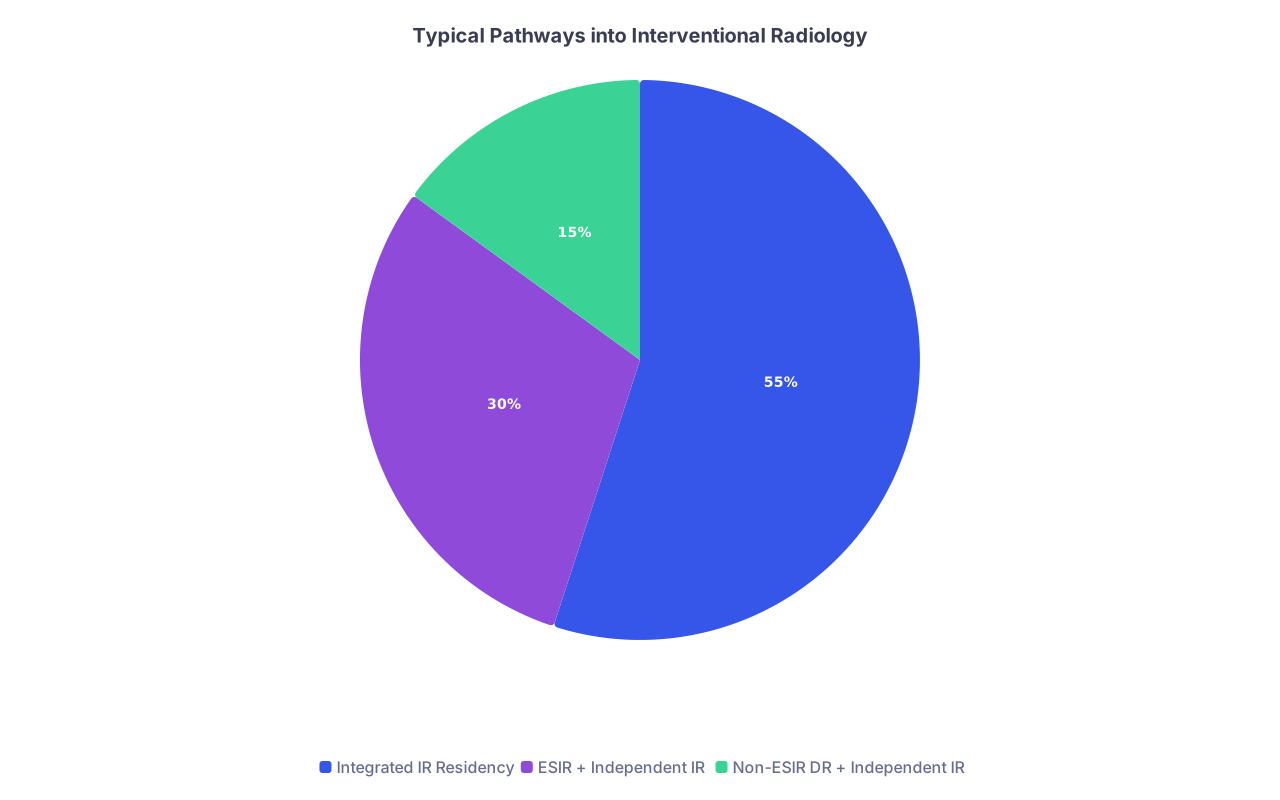
| Category | Value |
|---|---|
| Integrated IR Residency | 55 |
| ESIR + Independent IR | 30 |
| Non-ESIR DR + Independent IR | 15 |
That pie is approximate, but directionally correct. The field is moving harder toward integrated and ESIR pipelines.
A. Priority order for IR‑minded applicants
If IR is truly your top goal, your rank list should prioritize in this rough order:
Integrated IR programs where:
- You liked the culture.
- Residents genuinely seem supported and not burned to ashes.
- IR faculty are present, teaching, and not just procedural machines.
DR programs with robust ESIR + strong track record of independent IR placement:
- ESIR spots are not reserved for pets of a single attending.
- At least 1–2 ESIR residents per year.
- Graduates consistently match independent IR, not just random jobs.
DR programs without ESIR but very strong IR section:
- You get a lot of IR exposure.
- Faculty are willing to advocate and help you find independent IR.
Generic DR with minimal IR presence:
- This is where people say “I’m open to IR or diagnostic” and 3 years later they are fully diagnostic and somewhat disappointed.
If you know you want IR, that fourth category should be way down your list.
B. Specific questions to ask on interview day
Ask IR residents and DR residents, not just the PD.
- “Of your DR class, how many are planning on IR vs diagnostic?”
- “How competitive is it to get ESIR here?”
- “Have any residents who wanted IR failed to get it?”
- “Do integrated IR residents feel like second‑class citizens or part of the residency?”
If people dodge, that is telling. In healthy programs, IR residents will tell you exactly how many IR spots they have, how they assign them, and what their last few match years looked like.
C. How to rank DR vs IR at the same institution
Classic dilemma: You loved University X. They ranked you for both DR and IR. How do you order them?
My general stance:
- If you are ≥80% sure you want IR as a career: rank IR above DR at that institution.
- If you are truly ambivalent (and not just anxious), and you liked the DR program more, put DR higher but only if ESIR or IR access is clearly there.
What you should not do:
Rank DR higher just because you are afraid of the integrated workload, while still telling yourself IR is your dream. That is how you get three years into DR, realize you are late to the IR party, and you are competing for independent positions from the back foot.
Step 5: Ranking strategy for GI and Heme‑Onc
GI and heme‑onc are very similar strategically. Both are heavily bottlenecked; both care about clinical performance plus research plus letters. The subtleties differ, but your rank logic is parallel.
A. Big question: academic vs community
There are three broad habitats for GI/heme‑onc:
Big academic centers with in‑house GI/heme‑onc:
- Pros: built‑in fellowship, research, name recognition, networking.
- Cons: heavily stacked classes, fierce internal competition, you may be one of 20–30 residents chasing 2–4 in‑house spots.
Mid‑sized academic / university‑affiliated:
- Pros: often more accessible mentorship, less saturated competition, some research infrastructure, place decent number into GI/heme‑onc.
- Cons: external name maybe weaker, may need stronger self‑advocacy.
Strong community programs:
- Pros: tons of autonomy, you may be the “star” resident quickly, close relationships with a small heme‑onc or GI group.
- Cons: variable research support, fellowship directors elsewhere may not recognize the program name, match outcomes depend heavily on a few attendings’ advocacy.
If your goal is a high‑end academic GI or heme‑onc fellowship, you generally want category 1 or a strong category 2 program, unless you have special circumstances.
B. How many fellowship applicants vs slots?
You care about internal competition. That is usually obvious if you ask this way:
- “In your class, how many want GI/heme‑onc?”
- “How many in‑house spots are there per year?”
- “Over the past few years, do more people who want those fields match internally or go elsewhere?”
If a program has:
- 24 residents per year
- 8–10 commonly chasing GI or heme‑onc
- 2 in‑house GI spots, 3 heme‑onc
You are in a knife fight. Not impossible. But expect heavy emphasis on research, networking, and politics.
Conversely, I have seen smaller university programs where 2–3 residents per year want GI, and they have 2 GI fellows per year plus excellent external matches. Much more favorable environment.
Step 6: Research, mentorship, and letters — not optional for niche fields
For GI and heme‑onc especially, “just be a good resident” is not enough at competitive fellowships. You need some academic currency.
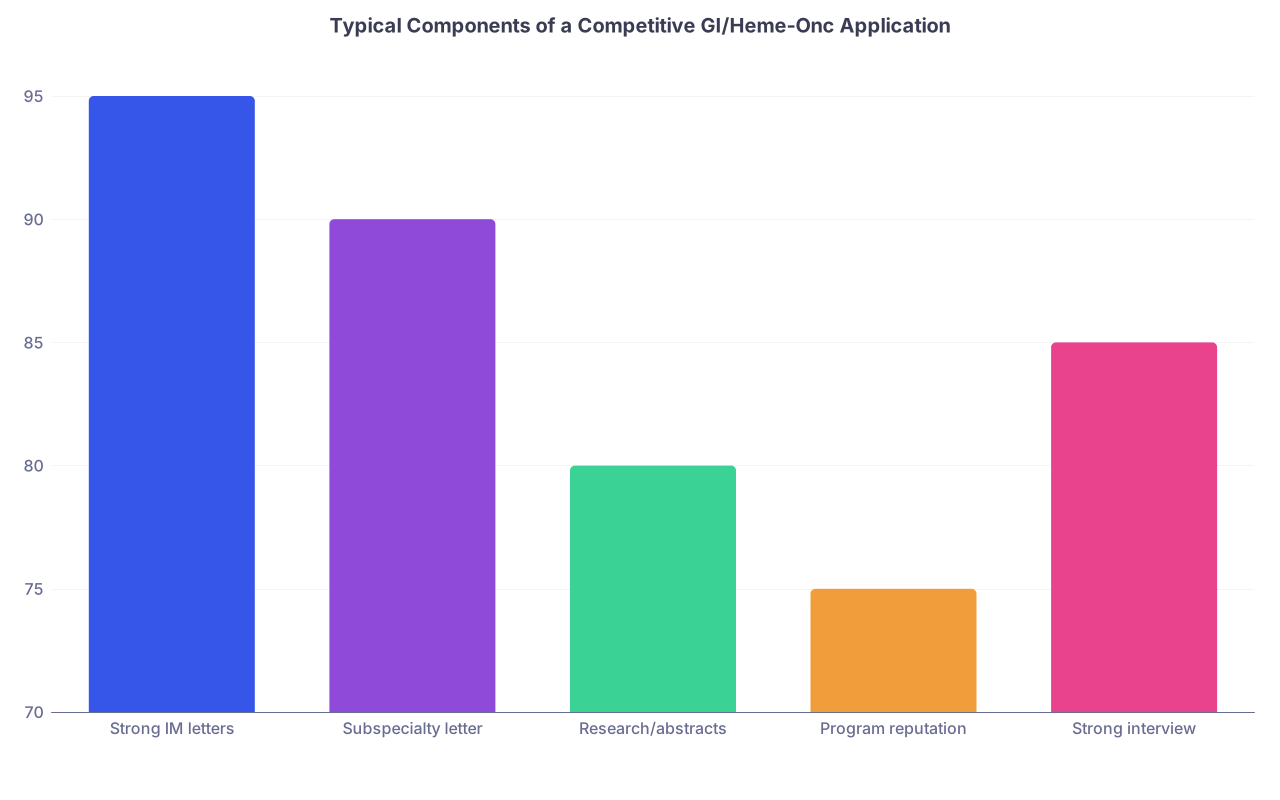
| Category | Value |
|---|---|
| Strong IM letters | 95 |
| Subspecialty letter | 90 |
| Research/abstracts | 80 |
| Program reputation | 75 |
| Strong interview | 85 |
Those numbers are illustrative, but here is the point: you cannot ignore the subspecialty letter and research.
When ranking programs, ask:
- “Do residents get dedicated research time?” If yes, how much, and is it actually protected or frequently cannibalized by service?
- “Are there ongoing GI/heme‑onc clinical trials where residents are on the papers?”
- “How many residents each year present at national meetings (DDW, ASCO, ASH)?”
- “Do GI/heme‑onc attendings take residents as first authors?”
A red flag: a big academic program where oncology and GI brag endlessly about R01s, but the residents cannot name a single co‑authored paper or abstract with them. That means you are a service, not a trainee in their academic world.
Step 7: Weighing prestige vs positioning
This is the part nobody likes to talk about honestly.
A lot of you are sitting with this choice:
- Option 1: Mid‑high tier university program (reputation strong, large class, middle of the fellowship feeding chain).
- Option 2: Lower‑tier university or strong community program that, for whatever reason, has an excellent track record of getting motivated residents into GI/heme‑onc.
There is no one correct answer, but I will tell you how I think about it.
When I favor the bigger‑name program
- They have an in‑house fellowship in your niche and multiple residents match it each year.
- Their external match list for your subspecialty is consistently strong.
- You are reasonably confident you can be in the top third of the class academically and politically.
- You want optionality: maybe GI, maybe heme‑onc, maybe cards. Big programs give more branching paths.
When I favor the smaller or less famous program
- You met residents who clearly “should not” be that competitive on paper who still matched GI/heme‑onc because the faculty went to bat for them.
- The PD and subspecialty chiefs know exactly how many applicants they have for those fields and can tell you where they placed each one by name.
- You personally felt more seen and less like “Resident #17 of 28” there. Motivation and relationships predict your output better than brand does.
If prestige is ~1–2 tiers apart but the smaller program demonstrably launches residents into your niche field every year, I would not penalize it excessively on your rank list. You are not ranking for cocktail‑party prestige. You are ranking for a fellowship slot.
Step 8: Concrete method to build your rank list
Enough theory. Here’s a nuts‑and‑bolts way to force yourself to think clearly.
You are going to score each program for your specific niche goal, not “overall vibe.”
Make a simple table (you do not need to over‑engineer this):
Columns:
- Program name
- Fellowship presence in your niche (0–3)
- Track record of matching residents into your niche (0–3)
- Mentorship/advocacy culture (0–3)
- Resident competitiveness saturation (invert this; 0 = saturated, 3 = moderate/favorable)
- Research and CV‑building support (0–3, more important for GI/heme‑onc than IR)
- Personal fit / wellness / location (0–3, weighted but not dominating)
For an IR‑focused DR applicant, maybe weight as:
- Fellowship presence (IR infrastructure): x3
- Track record into IR: x3
- Mentorship: x2
- Resident saturation: x1
- Research: x1
- Fit: x2
For a GI/Heme‑Onc aspirant:
- Fellowship presence: x2
- Track record: x3
- Mentorship: x3
- Saturation: x2
- Research: x2
- Fit: x2
You do not need to pretend this is precise math. The point is to stop your brain from obsessing over “But Program X had nicer apartments on the tour” and force it toward, “Program Y put four people into GI last year and three the year before, and I clicked with the GI PD.”
Once you have rough scores, order them, then sanity‑check with your gut:
- If Program Z scores high but you felt it was toxic, do not ignore that. Move it down.
- If Program Q scores a bit lower but you walked away energized and impressed by their fellows, consider nudging it up.
You are not a spreadsheet. But the spreadsheet should inform you, not the other way around.
Step 9: Common mistakes I see every year
I have watched several classes go through this. The missteps repeat.
Ranking on generic prestige alone
“This place is big‑name; everything else is details.”
Translation: “I have not actually looked at GI/IR/heme‑onc outcomes, but I like their logo.”Ignoring fellowship culture
You can have a famous cancer center with a malignant fellowship culture. Residents survive, not thrive. Look at how the fellows behave. Burned‑out, bitter fellows are a bad sign.Over‑weighting one outlier match
“They had someone match MD Anderson heme‑onc!”
Great. One person. You have no idea if that resident was the national superstar who would have matched anywhere.Underestimating the value of being a big fish in a smaller pond
In subspecialty match, the PD letter and subspecialty chief letter are gold. Being their go‑to resident at a less prestigious place can be more powerful than being the 14th-best resident in a huge program.Telling yourself you are “flexible” when you are not
If you will be quietly devastated not to get IR or GI, you should rank in a way that reflects that. Do not build a rank list for some imaginary more laid‑back version of yourself.
Step 10: How to reconcile “I loved this program” with “It may hurt my fellowship odds”
You will likely have 1–2 programs where your emotional ranking does not match your rational fellowship ranking.
Example:
You adored a coastal mid‑tier community‑heavy program. Amazing residents. Friendly PD. But:
- They have no in‑house GI or heme‑onc.
- In the last 5 years, 2 people matched GI, one matched heme‑onc. Total.
- Most graduates go into hospitalist jobs.
Can you still rank it high? Yes, if:
- You are genuinely okay with a high probability of being a generalist.
- You trust yourself to hustle for research and away electives and take on that uphill battle.
Should you rank it above a solid academic program that matches 2–3 people per year into your field just because you “vibed” there? Probably not, if fellowship is a non‑negotiable goal.
Flip scenario:
Big academic name. Terrible interview vibe. Residents seem tired, a bit defeated. But the GI match list is undeniably impressive.
Can you rank it lower? Absolutely. If you burn out or hate your life, you will not be productive enough to be a star GI candidate. Misery erodes performance.
I tell people to make two lists:
- “Fellowship‑maximizing order.”
- “Life/happiness‑maximizing order.”
Then ask: where is the sweet spot where both are acceptable, even if neither is perfect? That is usually your final rank list.
Key takeaways
- Do not rank “residency programs”; rank pathways to your specific niche fellowship, using hard data: in‑house fellowships, real match patterns, mentorship, and research.
- IR, GI, and heme‑onc each have distinct pipeline dynamics; your rank strategy must match the field’s structure (integrated/ESIR for IR; research and letters for GI/heme‑onc).
- Choose environments where you can realistically be a top performer and build strong advocacy, even if that means picking a slightly less famous program that actually launches people into the fellowship you want.


