

It is late January. Your NRMP rank list window is open on one screen, FREIDA is on the second, and you have a half-finished Excel sheet where you are trying to match every anesthesia advanced position to some combination of prelim and transitional year programs. Your co-intern just walked by and said, “Yeah, I just ranked everything together, it all works out.”
That is how people end up unmatched in weird ways.
Let me break this down precisely. If you are dealing with advanced positions (A), categorical (C), preliminary (P), and transitional year (T) spots, the NRMP matching rules are not intuitive. The devil is in:
- How the algorithm links PGY‑1 and PGY‑2 positions
- How “supplemental” rank lists actually work
- What happens if you do not list a compatible PGY‑1 for an advanced spot
- How to protect yourself from partial matches that you do not actually want
We will go through all of that, with explicit “if you do X, the algorithm will do Y” explanations.
1. Core Definitions: You Cannot Rank Safely If You Fuzz These Terms
Before you try to be “strategic,” you must use the NRMP vocabulary correctly. Otherwise you get bad advice from well-meaning people.

Types of Positions
Here is the minimal taxonomy:
Categorical (C)
A full sequence. You start PGY‑1 and stay in the same program through completion of residency. Example: Internal Medicine Categorical, General Surgery Categorical, Pediatrics.Preliminary (P)
One-year positions. Typically PGY‑1 only. Often in Internal Medicine or Surgery. Intended as the “clinical base year” for advanced specialties like Radiology, Anesthesia, Derm, Rad Onc, etc. Can also be stand-alone for people going into non-NRMP specialties or who just need a year.Transitional Year (T)
Another flavor of one-year PGY‑1, broader and more “rotational.” More elective time, more balanced, often considered “cushier” (not always true, but the stereotype). Designed as a base year for advanced specialties.Advanced (A)
Positions that begin at PGY‑2. You show up after having completed a qualifying PGY‑1 in something. Examples: Anesthesiology (A), Diagnostic Radiology (A), Dermatology (A), PM&R (often A), Radiation Oncology.
| Specialty | Common Position Types | PGY-1 Needed Separately? |
|---|---|---|
| Internal Medicine | C | No |
| General Surgery | C, P | For P, yes |
| Anesthesiology | C, A | For A, yes |
| Diagnostic Radiology | A | Yes |
| Dermatology | A (sometimes C) | Often yes |
| PM&R | A, C | For A, yes |
Crucial Concept: “Coupled” vs “Uncoupled” Years
If you match a categorical program, your PGY‑1 and PGY‑2+ years are inherently coupled within that match.
If you match an advanced program, your PGY‑1 and PGY‑2 are not automatically coupled unless you have correctly used supplemental rank lists. Otherwise, the algorithm will happily match you to an advanced PGY‑2 without giving you a PGY‑1 at all.
Yes, that is allowed. You then scramble for a PGY‑1 in SOAP or go unmatched for that year. I have seen this happen. More than once.
2. The NRMP Engine: How the Algorithm Treats C, A, P, and T
Forget the marketing language about “applicant-proposing algorithm.” You need to know how it behaves technically with these different slots.
Categorical Slots: Straightforward
For a categorical program:
- You rank it on your main ROL (rank order list)
- If you match there, you are done; the system does not need to find a separate PGY‑1
- It uses that choice as a complete package (PGY‑1 through completion)
No supplemental list. No pairing. Nothing fancy.
Advanced Positions: Where Things Get Complicated
For an advanced position:
- You rank each advanced program on your primary ROL
- Separately, for each advanced program, you can create a supplemental rank order list (SROL) of PGY‑1 programs that you would accept if and only if you match that specific advanced spot
Mechanically:
- The main list chooses the advanced program
- Once the algorithm tentatively matches you to an advanced position, it then looks at that program’s supplemental list to find a compatible PGY‑1
- If no compatible PGY‑1 from that SROL matches, you still remain matched to the advanced program (unless you used special structures like reorderings; more on “insurance” later)
Preliminary / Transitional Spots: Independent unless linked
Prelim and TY programs:
- Are ranked on the main ROL like any other program, or
- Are ranked only in supplemental lists (tied to an advanced program)
On the main ROL, a P or T program is independent. The algorithm does not care whether it lines up with any advanced program you ranked.
Which yields a common disaster: ranking a high-prestige but brutal prelim medicine year in Boston high on your main list while your radiology advanced programs are all in the Midwest. The algorithm sees no conflict. You end up with a PGY‑1 in Boston and a PGY‑2+ in St. Louis. Logistically miserable, and sometimes impossible for your life.
3. How Supplemental Rank Lists Actually Work
This is the part everyone hand-waves: “Just do a supplemental list.”
No. You need to understand what the supplemental list is and what it is not.

| Step | Description |
|---|---|
| Step 1 | Start Main ROL Evaluation |
| Step 2 | Check Program Rank & Capacity |
| Step 3 | Match to Categorical Slot |
| Step 4 | Check Advanced Rank & Capacity |
| Step 5 | Go to Supplemental List |
| Step 6 | Match PGY-1 + Advanced |
| Step 7 | Stay Matched to Advanced Only |
| Step 8 | Categorical Choice? |
| Step 9 | PGY-1 on SROL Available? |
Technical Properties of the Supplemental List
It is attached to a specific advanced program, not to you in general.
- Anesthesiology Program A in City X has its own SROL
- Anesthesiology Program B in City Y has a different SROL
- They do not share lists automatically.
It is only evaluated if you match to that advanced program on the main list.
If you do not match that A program, its SROL is irrelevant.It contains only PGY‑1 positions (P or T or categorical positions that agree to count as PGY-1 base—rare scenario, ignore for now).
It is ordered by your preference, exactly like your main list.
Concrete Example
You rank on your main list:
- Anesthesia A in City X (Advanced)
- Anesthesia B in City Y (Advanced)
- TY Program T1 (stand-alone PGY‑1)
- Prelim IM P1 (stand-alone PGY‑1)
You also build two supplemental lists:
- For Anesthesia A (A‑X): T1 > P1
- For Anesthesia B (A‑Y): P1 only
Match behavior:
If you match A‑X:
- System goes to A‑X supplemental list
- Tries T1 first. If you also matched or can match there (based on its own ROL): you get A‑X + T1.
- If T1 is not available, it tries P1.
- If no option works, you match A‑X alone (PGY‑2 spot only).
If you match A‑Y instead:
- System looks at A‑Y SROL, tries P1 only.
- If P1 is unavailable: you end with A‑Y alone.
Notice what is missing here: the algorithm never forces you to get some PGY‑1. It only attempts the specific ones you listed for that advanced program.
Key Misconception: “If I do not match a prelim, I will not match the advanced”
False. Matching to the advanced does not depend on you securing a prelim or TY. The advanced match is primary. The PGY‑1 pairing is secondary and conditional.
So you must plan as if the system will happily give you an advanced without a PGY‑1. Because it will.
4. Constructing a Rational Main List: Categorical vs Advanced + PGY‑1
Now we get into ranking strategy. You basically have to think in “packages”.

Packages: How Real People Think (and How NRMP Does Not)
Your brain does this:
- “I would most like: Categorical Anesthesia at Home University.”
- “Second choice: Advanced Anesthesia at Big Name X + TY nearby.”
- “Third choice: Any Anesthesia + any tolerable prelim I can stand.”
The match algorithm, however, does not understand packages on the main list. It sees each line as an independent object. You must use your own ranking to simulate your package preferences.
Best Practice: Rank “Complete Solutions” In Preferred Order
You want to approximate:
- Best categorical option(s)
- Best advanced + compatible prelim/TY combos
- Less-desirable categorical
- Less-desirable advanced + prelim/TY combos
- Prelim-only backstops (if you truly want a prelim-only outcome rather than unmatched)
But the system only accepts:
- Individual programs on the main list,
- Plus program-specific supplemental lists for advanced choices.
So you simulate “package preference” this way:
- If you strongly prefer categorical Anesthesia at Program C over any advanced+TY combo, put Program C above all advanced options on your main list.
- Then rank your advanced options based on the best possible pairing achievable with your PGY‑1 lists.
Example partial main ROL:
- Anesthesia Categorical – Home University
- Anesthesia Advanced – City X
- Anesthesia Advanced – City Y
- TY – T1 (stand-alone)
- Prelim IM – P1
- Prelim IM – P2
Plus:
- SROL for City X A: T1 > P1
- SROL for City Y A: P1 > P2
If you want to “protect” yourself from an advanced program without a good PGY‑1 nearby, you do not rank that advanced program above your acceptable PGY‑1 options. Or, more precisely, you may choose not to rank that advanced program at all if a PGY‑1 gap or geographic separation would be unacceptable.
5. Common Failure Modes (And How to Avoid Them)
Now we get into where people routinely screw this up.
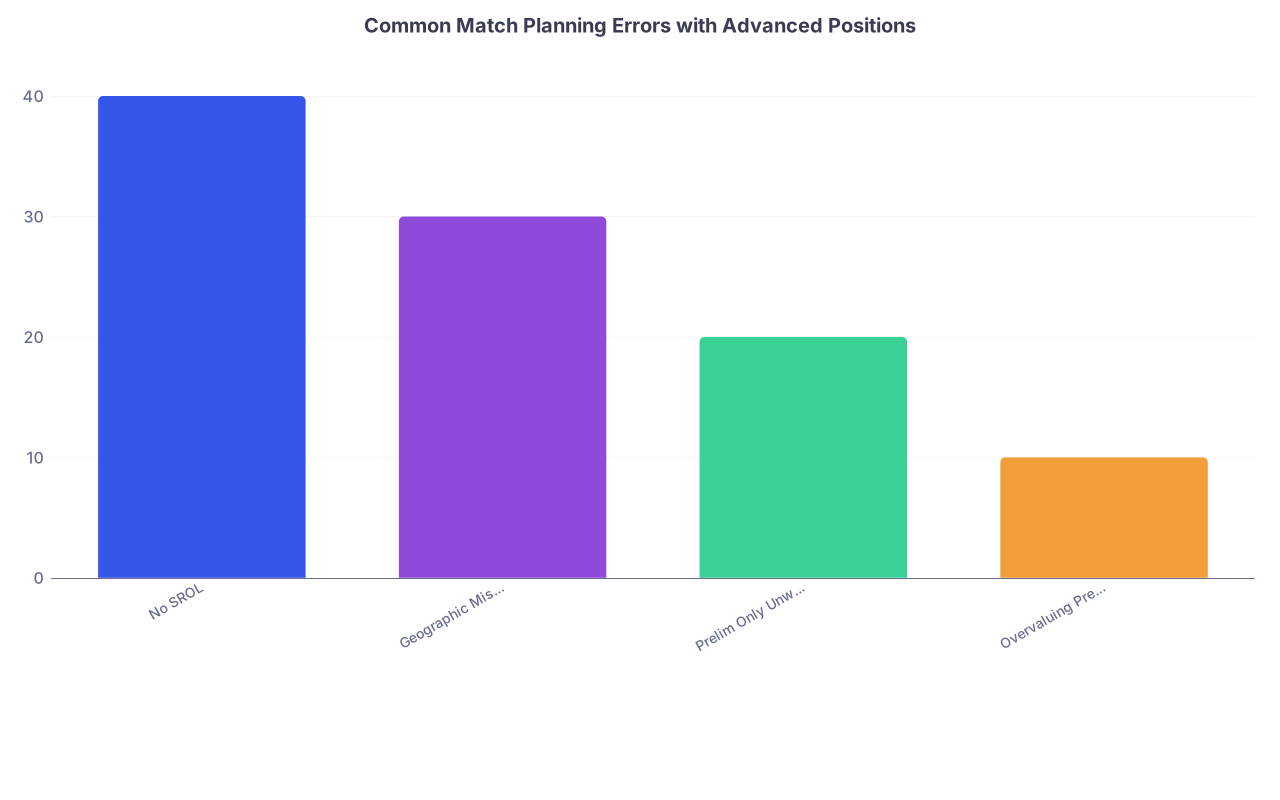
| Category | Value |
|---|---|
| No SROL | 40 |
| Geographic Mismatch | 30 |
| Prelim Only Unwanted | 20 |
| Overvaluing Prestige | 10 |
Failure Mode 1: No Supplemental List for an Advanced Program
“I thought the advanced program would place me in a prelim.”
No. That is not how the NRMP works.
Risk:
You match A‑Program in July 2027 start. No PGY‑1 match. You must SOAP or reapply for prelim/TY, hoping to line up dates and visa/logistics.
Fix:
For every advanced program you rank that you would actually want, create a non-empty SROL of every PGY‑1 program you would realistically accept with that advanced program. If that list is empty, you are telling the algorithm: “I am fine taking this advanced position even if I have no secured PGY‑1.”
Sometimes people truly are fine with that (strongly SOAP-able candidates, military deferment, etc.). Most are not.
Failure Mode 2: Geographic Separation You Never Really Accepted
Example I have seen:
- Advanced Radiology in California ranked high
- Prelim IM in NYC ranked high on main list because “great training”
- Minimal or no overlap in SROLs
- Outcome: PGY‑1 in NYC, PGY‑2+ in California
Completely avoidable.
Fix:
- Decide whether you are actually willing to live on opposite coasts for PGY‑1 vs PGY‑2+.
- If not, then:
- Do not rank a prelim/TY that is geographically incompatible with your advanced programs above those advanced programs on the main ROL, and
- In SROLs, emphasize local or commutable PGY‑1 options.
Failure Mode 3: Listing Stand-Alone Prelim/TY Too High Without Real Intent
You “just throw in” some preliminary medicine programs high on the main list “for backup.” Except you do not actually want a prelim-only year if you fail to match your advanced specialty.
The system does not know that.
If your main list is:
- DR Advanced – Program 1
- DR Advanced – Program 2
- Prelim IM – Very Strong Academic Center
- TY – Somewhere else
You can easily end up with #3 or #4 and nothing advanced. And the algorithm will be extremely proud of itself for matching you.
Fix:
- Only rank a stand-alone P/T program on your main list above all advanced options if you truly prefer “prelim only” over being unmatched and trying again.
- If you only want prelims linked to specific advanced programs, keep them mostly or entirely on SROLs.
Failure Mode 4: Assuming Categorical vs Advanced + PGY‑1 Are “Equivalent”
They are not.
Categorical:
- Single institution, integrated curriculum
- Simpler logistics, internal politics sometimes easier
- You are locked into that program; changing institutions is harder
Advanced + PGY‑1:
- Flexibility in where you do your base year
- Risk of misalignment, moving between years
- Two separate political ecosystems, two onboarding cycles
Your ranking must reflect your personality and risk tolerance. Some people absolutely should favor categorical options even if they are less prestigious on paper.
6. Step-by-Step: Building a Coherent Rank Strategy If You Have Advanced Positions
Let us walk through a realistic workflow.

Step 1: Decide Your “True Preference Packages”
On scratch paper (or Excel, not in NRMP yet), list your ideal outcomes as full packages:
Example:
- Categorical Anesthesia – Home University (full residency, no move)
- Advanced Anesthesia – City X + any PGY‑1 within 1 hour commute
- Advanced Anesthesia – Big-Name Y + any reasonable prelim in that metro area
- Categorical Anesthesia – Lesser Reputation Z
- TY only near partner’s job if all Anesthesia fails
- Otherwise, prefer going unmatched and reapplying over random toxic prelim elsewhere
This is your “real preference” baseline.
Step 2: Classify All Programs You Interviewed At
Make separate columns:
- Column A: Categorical positions
- Column B: Advanced positions
- Column C: Prelim/TY programs considered acceptable with A‑Program X
- Column D: Prelim/TY programs acceptable with A‑Program Y
- Column E: Stand-alone prelim/TY you would only take if you fail to match advanced
Step 3: Order Categorical Programs First Against Your Best Advanced Packages
Ask:
For each categorical anesthesia program, would you rather have that, or your top realistic advanced+PGY‑1 combination?
If yes → categorical goes above those advanced programs.
If no → advanced program+its SROL packages go higher.
You are comparing lifelines, not just PGY‑2 reputations.
Step 4: For Each Advanced Program, Build a Thoughtful SROL
For Anesthesia Advanced – City X, for example:
- List every prelim/TY in or near City X that:
- You interviewed at
- Would accept you
- You could tolerate for a year
Then rank them in your true preference order.
Do not omit one “because I did not like the residents as much.” That is how you end up with no PGY‑1 at all even though you had an okay option that you just did not love.
Step 5: Decide What To Do With Stand-Alone Prelim/TY
You have three honest choices:
“I definitely prefer prelim-only (in X location) over going unmatched.”
- Rank that prelim/TY on your main list above the point where you are willing to risk no match.
“I only want this prelim/TY if it links to a specific advanced program.”
- Use it only on the SROL of that advanced program, or put it very low on the main list.
“I am okay with prelim-only, but only in these specific cities.”
- Rank prelims in those cities near the bottom of your main list, above programs you truly dislike or would not rank.
7. Concrete Example Lists (With Commentary)
Let me give you a sample set that actually mirrors what I see in real life.
Scenario
You interviewed at:
- Categorical Anesthesia: Home U (Home-Cat), Regional-Cat
- Advanced Anesthesia: BigName‑A (BN-A), MidCity‑A (MC-A), SmallCity‑A (SC-A)
- TY programs: TY‑Home, TY‑MidCity, TY‑FarAway
- Prelim IM: P‑Home, P‑MidCity, P‑FarAway
Your real preferences:
- Home-Cat
- BN-A + any acceptable PGY‑1 in BigName’s metro (but you did not get TYs there)
- MC-A + TY‑MidCity
- Regional-Cat
- SC-A + TY‑Home or P‑Home
- TY‑Home as stand-alone backup
- Otherwise, prefer unmatched to moving multiple times for P‑FarAway, TY‑FarAway
How To Rank
Main ROL (simplified):
- Home-Cat
- BN-A
- MC-A
- Regional-Cat
- SC-A
- TY‑Home
- P‑Home
(Leave TY‑FarAway, P‑FarAway off or rank at very bottom)
Then SROLs:
For BN-A:
- Probably nothing local if you did not interview at PGY‑1s in that city.
- So: either leave SROL empty intentionally (accepting PGY‑1 SOAP risk) or add remote prelims only if you truly would do that.
For MC-A:
- SROL: TY‑MidCity > P‑MidCity > TY‑Home > P‑Home (depending on how far you are willing to move before coming back)
For SC-A:
- SROL: TY‑Home > P‑Home only, because you decided you do not want to move to SmallCity for PGY‑1.
This structure reflects your actual preferences: you strongly prioritize location and integration over prestige.
8. Edge Cases and Nuances People Ask About
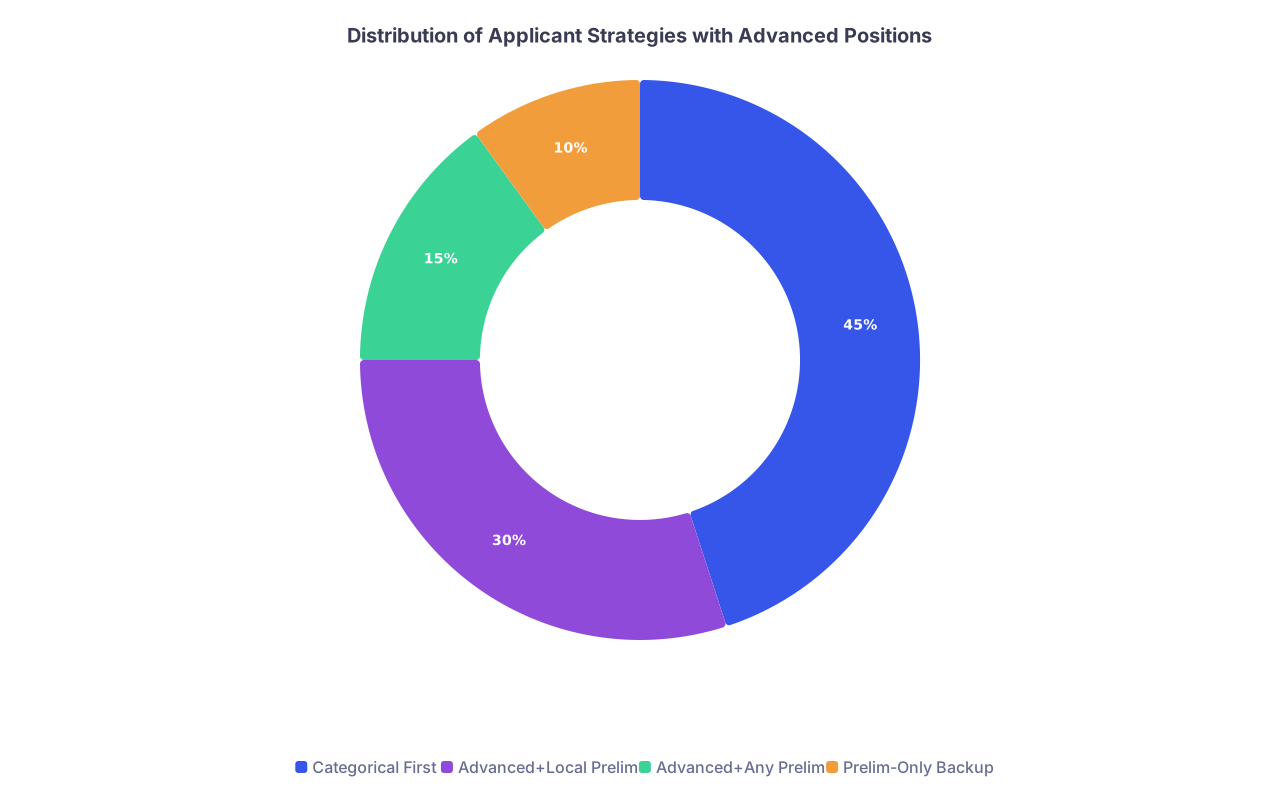
| Category | Value |
|---|---|
| Categorical First | 45 |
| Advanced+Local Prelim | 30 |
| Advanced+Any Prelim | 15 |
| Prelim-Only Backup | 10 |
What if I Match an Advanced Program With No PGY‑1?
You are formally committed to that PGY‑2+ position. You then:
- Enter SOAP (if eligible) to find a PGY‑1 in the same or later year, or
- Arrange an off-cycle PGY‑1, or
- Delay start of your advanced position (if program allows, not guaranteed)
It is stressful and logistically messy. Hence all this planning.
Can I Use One PGY‑1 Program in Multiple SROLs?
Yes. A given prelim/TY can appear on:
- Your main list, and
- Multiple different SROLs (for different advanced programs)
The system will only match you to one instance, obviously, but it is allowed to be in multiple lists.
What If My Advanced Program “Guarantees” A Linked Prelim?
Some programs informally guarantee that all their advanced positions come with built-in PGY‑1s. There are a few patterns:
- They truly have integrated C+A structures but still list A for NRMP reasons
- They informally coordinate with a prelim program that ranks you highly
Even then, you still protect yourself by:
- Ranking their preferred prelim(s) at the top of that advanced SROL
- Asking specifically how they handle candidates who fail to match the prelim
Verbal assurances are not part of the algorithm.
What About Couples Match With Advanced Positions?
This gets brutal quickly. Short version:
- Each line on a couples rank list represents two positions (one for each partner)
- When advanced positions are involved, your packages multiply
- You must check that your PGY‑1 years line up geographically for both partners simultaneously
If you are couples matching with advanced positions, you do not wing it. You sit down with:
- NRMP couples documentation
- A spreadsheet mapping combinations
- At least one faculty mentor who has done couples advising
9. Quick Visual: How a “Bad” vs “Good” Plan Looks
| Aspect | Bad Plan | Good Plan |
|---|---|---|
| SROL use | None or incomplete | Every advanced has a thoughtful SROL |
| Prelim/TY on main ROL | Ranked high “just in case” without real intent | Only ranked where you truly accept prelim-only outcome |
| Geographic consistency | PGY‑1 and PGY‑2+ scattered without consideration | Cities deliberately paired or excluded |
| Categorical vs advanced | Random mix, prestige-driven | Ordered by true “life package” preference |
| Backup planning | SOAP assumed to fix everything | Explicit backup paths in main ROL and SROLs |
FAQ (Exactly 4 Questions)
1. If I only rank categorical programs and no advanced positions, do I need to worry about prelim or TY at all?
No. If you only rank categorical positions, the match will handle your PGY‑1 and later years within that single program. You do not touch supplemental lists. Prelim and transitional year concepts are irrelevant to you unless you are also ranking those independently as alternative options.
2. Should I ever rank a stand-alone prelim or TY higher than an advanced position in my main list?
Only if you genuinely prefer “PGY‑1 only then reapply” to taking that advanced position. For example, if the only advanced program you have left is in a location where you or your family cannot realistically live, you might rather match a good prelim near home and take your chances reapplying. If you would not actually choose that path when facing it in real life, do not put it that way on the list.
3. Can I be penalized or look bad if I create long supplemental lists for my advanced programs?
No. Programs do not see or evaluate your SROLs. They only see their own rank lists and match outcomes. Your SROL is purely between you and the algorithm. Longer, well-thought-out SROLs help avoid unmatched PGY‑1 situations and do not harm you.
4. What happens if the duration of my prelim or TY does not match the start date of my advanced program?
The system does not automatically check for off-cycle mismatches beyond standard PGY‑1 to PGY‑2 timelines. If both positions follow typical July start cycles, you are fine. If there is an off-cycle arrangement, that must be pre-arranged with both programs and often kept out of the standard NRMP structure. In normal match scenarios, you should only rank prelim/TY programs whose PGY‑1 year lines up with your advanced program’s PGY‑2 start year.
Key points to walk away with:
- Advanced positions do not automatically include a PGY‑1; your supplemental rank lists are the wiring between them.
- Rank “packages,” not individual programs in isolation: categorical vs advanced+PGY‑1, in the order you would truly live with.
- Any stand-alone prelim or TY that you place high on your main list is a real outcome the algorithm will happily give you; do not rank it unless you actually want that path.


