

Only 27% of residents end up in the type of program (clinical vs research‑heavy) they said they wanted when they were MS3s. Most changed direction late. Some never consciously chose at all.
That is what you are trying to avoid.
You are not just ranking “good” programs. You are choosing a training environment: concrete day‑to‑day realities, not abstract prestige. The biggest fork in that road for many specialties is this one: clinically focused vs research‑heavy programs.
Let me break this down specifically.
1. What “Clinical” vs “Research‑Heavy” Actually Means (Not the Brochure Version)
Programs almost never say, “We are a research‑heavy place; you will live in the lab.” They say “strong clinical training with abundant research opportunities” on every single website. Useless.
You have to decode.
Here is how I define it in real‑world terms.
Clinically focused programs
These programs are built around patient care volume and service. Research exists, but it is not the center of gravity.
Typical signals:
- High patient volume, often safety‑net or county hospitals
- Faculty bios: most are “Clinician‑Educator” track
- Research electives are optional and not protected time
- Promotion of residents based on clinical excellence, teaching awards, board pass rates
- Residency leadership talks about “hands‑on experience,” “ownership,” “autonomy”
Your calendar in a true clinical program:
- 90–95% of residency in direct patient care
- Research time sliced into electives, nights, weekends
- QI projects more common than R01‑level bench or major database studies
Research‑heavy programs
Here the ecosystem is built to produce academic faculty, grant writers, and subspecialists. Clinical care still happens and can be excellent, but the program’s identity is academic output.
Typical signals:
- Residents have 3–6+ months of protected research time
- Many faculty on tenure track, with “Associate Professor of X, NIH‑funded” all over the website
- Program director sits on major specialty society committees, authors guidelines
- There is a T32 or physician‑scientist training pathway
- Grand rounds: lots of visiting researchers; journal clubs are serious, not checkbox exercises
Your calendar in a research‑heavy program:
- 70–85% direct patient care
- 15–30% dedicated research/QI/education time, sometimes front‑loaded or back‑loaded
- Scholarly output baked into graduation requirements (poster, paper, or equivalent)
To make this concrete:
| Feature | Clinically Focused Program | Research-Heavy Program |
|---|---|---|
| Protected research time | 0–1 month total | 3–6+ months total |
| Resident pubs at graduation | 0–1 common | 3–10 common |
| Faculty track mix | Mostly clinician-educator | Many tenure/research track |
| Primary hospital type | Community/safety-net | Tertiary/quaternary academic |
| Typical career outcome | Community practice, some fellowships | Academic fellowships, faculty |
If you do not see at least three columns clearly favoring one side in your program, it is probably a “hybrid” (most university‑affiliated programs fall here). Hybrids are fine, but you still need to know which way they lean.
2. The Only Question That Matters: What Problem Are You Trying To Solve With Residency?
You cannot set rank priorities intelligently without a target. Not a fantasy. A specific “likely self” in 5–10 years.
Do this quickly:
Answer this:
“If I had to lock in today, my most likely career is:
(a) community clinician, maybe some teaching
(b) subspecialist in academic center, doing clinical work with some research/teaching
(c) physician‑scientist or heavyweight academic (R01‑type, major trials, guideline work).”Then answer this:
“How much do I honestly like research process itself (not just the outcome line on my CV)?”
Scale 1–10.
Now match:
- Community clinician, research interest ≤ 3/10 → Bias toward clinical programs
- Subspecialist in academic center, research interest 4–7/10 → Strong hybrid or light research‑heavy
- Physician‑scientist, research interest ≥ 7/10 → Research‑heavy, ideally with formal pathways
The trap: many students circle (c) because it sounds impressive, but hate the day‑to‑day grind of data cleaning, IRB forms, and revisions. Loving the idea of research is not enough.
3. How Program Type Affects Your Career Options (With Trade‑Offs, Not Platitudes)
Let’s talk outcomes. Here are the three big knobs residency turns: fellowship chances, academic career potential, and day‑to‑day clinical strength.
Fellowship competitiveness
There is a myth that only research‑heavy programs place into top fellowships. False. I have seen residents from county IM programs match GI and cards at big‑name places because they had brutal clinical training and 1–2 well‑chosen research mentors.
But research‑heavy programs change the default:
A research‑heavy IM program at a major academic center:
– 60–80% of residents match into fellowship
– Many go to top‑tier programs, often at the same institution
– They apply with multiple abstracts, 1–3 first‑author papersA strong clinical IM program:
– 30–50% go to fellowship, often regionally
– Applications lean heavier on letters emphasizing clinical strength, one or two small projects
The big lever is visibility. In a research‑heavy environment, you are automatically around the attendings who run fellowships, edit journals, sit on selection committees.
Academic vs community career
Look at where graduates end up 5 years out. Not slide decks. Actual alumni.
Rule of thumb:
- If >40–50% of graduates end up on faculty at academic centers → that is a research‑heavy leaning environment.
- If most graduates are in community practice with a few fellowship‑trained folks scattered → clinically oriented.
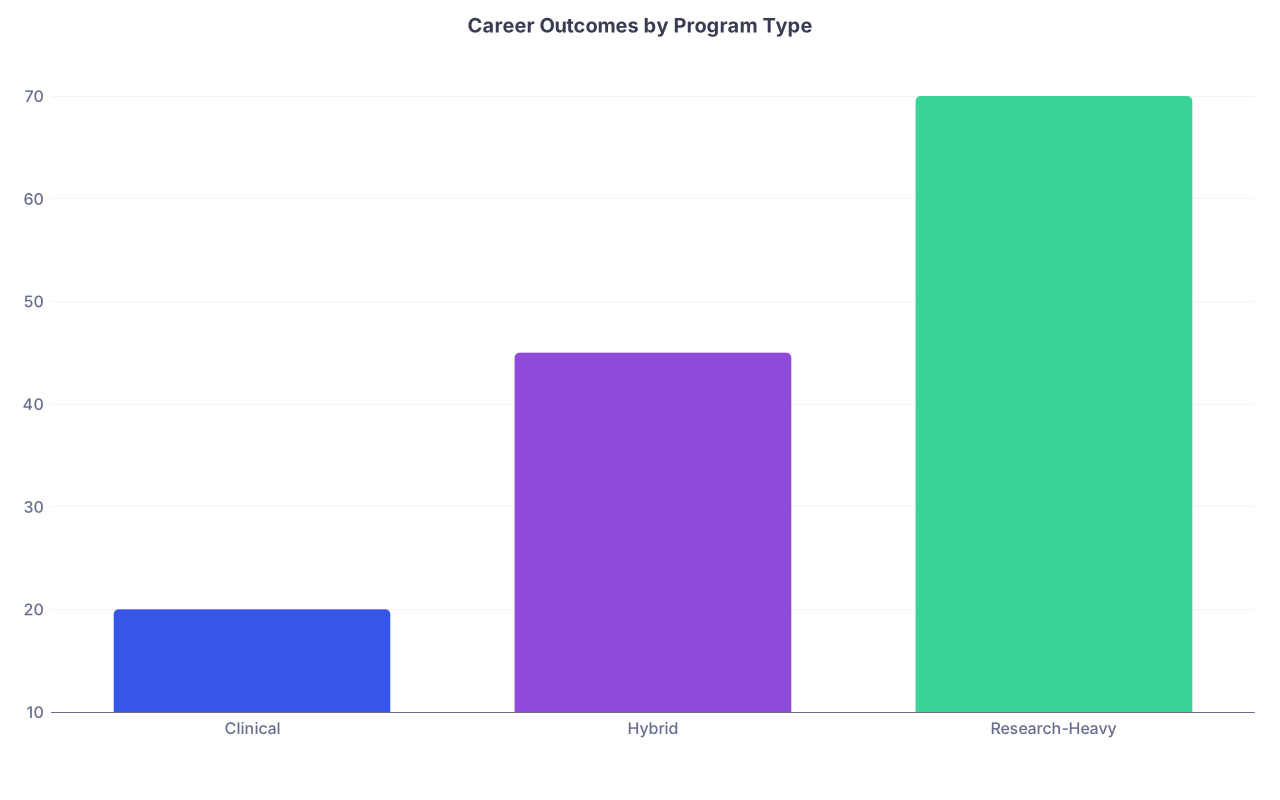
| Category | Value |
|---|---|
| Clinical | 20 |
| Hybrid | 45 |
| Research-Heavy | 70 |
(Values above: rough percentage of graduates in academic jobs 5+ years out.)
Can you jump from clinical residency to academic faculty? Yes. But you will work harder post‑residency to build the research and academic portfolio.
Quality of day‑to‑day clinical training
Here is where many research‑heavy programs quietly underperform, and where many clinical programs shine.
Typical patterns:
Clinical programs:
– Higher patient loads
– More independent decision‑making earlier
– More procedural exposure in some fields (EM, surgical subs)
– Attendings comfortable giving autonomy because service needs itResearch‑heavy programs:
– Often more subspecialized, layered services with fellows buffering everything
– You may be “clerk to the fellow” on some rotations rather than first operator
– Oversubscribed procedural training in some environments because everyone is chasing the same high‑yield cases
There are exceptions. Some research factories also crush clinical training. But do not assume that because a place has Nobel laureates your bread‑and‑butter training will be superior. Often the exact opposite.
4. Hard Metrics You Can Use To Classify Programs (Without Guessing)
You do not have time to psychoanalyze every program. Use hard, observable metrics. Think of this as a quick‑and‑dirty classification tool.
Metric 1: Protected research time
Direct question to residents on interview day:
“How many months of protected research time do most residents get?”
Protected means: you are not on call, not covering clinics, not “available to help out on the floor.”
Rough cut:
- 0–1 month → Clinically focused
- 2–3 months → Hybrid with some real investment
- 4–6+ months → Research‑heavy or very academic hybrid
Metric 2: Expected scholarly output
What is normal for a graduating resident?
Listen for phrases like:
- “Most residents do at least a QI project, a poster or two at local/regional meetings.” → Clinical / light hybrid
- “We expect at least one submission to a peer‑reviewed journal by graduation.” → Solid hybrid
- “Typical graduates have 5–10 abstracts and a few first‑author papers.” → Research‑heavy
If the PD cannot answer this with concrete numbers, that is a warning sign about structure, regardless of type.
Metric 3: Formal research infrastructure
You are looking for systems, not vibes.
Ask:
- Is there a designated research director or vice chair for research who works with residents?
- Is there a list of ongoing projects or mentors ready for residents, or is it “find your own thing”?
- Are there standing research conferences (works‑in‑progress, journal clubs with stats input)?
The more formal the structure, the more likely you will actually get something done without burning all your vacation on SPSS.
Metric 4: Alumni data
Programs that care about outcomes will show it. On websites or in slide decks:
- Maps of where recent grads matched for fellowship
- Lists of former residents now on faculty at X/Y/Z academic centers
- Numbers: “Over the last 5 years, 65% of graduates have pursued fellowship, 40% entered academic practice.”
No data? Either they are disorganized or the outcomes are not flattering.
5. Specialty‑Specific Nuances (Internal Medicine ≠ EM ≠ Surgery)
“Clinical vs research‑heavy” looks very different depending on specialty. I will give you the stripped‑down version.
Internal Medicine
Classic split:
- County‑heavy clinical programs (e.g., LAC+USC, Denver Health for the county side of things)
- NIH‑magnet research programs (Brigham, MGH, UCSF, Hopkins, etc.)
If you are aiming at cards/GI/heme‑onc and want national‑level academic careers, a truly research‑heavy IM program is a strong accelerator. But a strong clinical program plus 1–2 serious projects with big‑name mentors can still get you there.
For hospitalist/community primary care: a county or clinically intense university‑affiliated program often produces more confident day‑one attendings.
General Surgery
Surgery has an extra complication: dedicated lab years.
Research‑heavy surgery programs will:
- Strongly encourage or practically require 1–2 years of dedicated research between PGY‑2 and PGY‑3/4
- Have many residents doing basic science or outcomes research, leading to 10–20+ pubs
- Explicitly link this to matching competitive fellowships (peds, surg onc, CT, etc.)
Clinically heavy surgery programs:
- Push you straight through 5 clinical years (some with optional lab time but not default)
- Often more autonomous OR experience earlier, particularly in community or VA settings
- Graduates are comfortable community surgeons with good operative logs
Ask yourself bluntly: do you want to spend 2 years in the lab? If your rank list has programs where 80% of residents do lab years and you have no interest, you are setting yourself up for conflict.
Emergency Medicine
EM research is more niche. Clinically oriented EM programs:
- High‑volume EDs, tons of procedures, trauma exposure
- Research more QI/ED operations‑focused
- Graduates mainly community ED or regional academic centers
Research‑heavy EM programs:
- Often attached to research networks (PECARN, NETT, etc.)
- Expect residents to publish, sometimes have research tracks
- Better springboard for health services research, admin, or academic EM
If your vision is community EM with side‑gigs in administration or ultrasound, prioritize clinical monsters. If you are thinking funded health services research, hospital‑wide quality leadership, or major trial work, you want an academic EM shop with established investigators.
Pediatrics, OB/GYN, Psychiatry, etc.
Same pattern, smaller scale:
- Most programs: hybrid with clinical tilt
- A minority: true research powerhouses at big children’s hospitals or major academic campuses
Core rule still holds: if you want to be the person designing trials or writing guidelines in your subspecialty, your life is easier if residency gives you early structure and output.
6. How To Rank When You Are Truly Unsure (And Most People Are)
Here is the honest part: a lot of MS4s have no idea what they want. Your stated goal is “maybe fellowship, maybe academics, maybe community.” Which tells me nothing.
If that is you, use this algorithm.
Step 1: Avoid over‑fitting to a fantasy
Do not rank a program #1 solely because “it will keep doors open.” That line gets repeated to justify misery.
You need both:
- Doors open for future options
- A day‑to‑day you can stand without burning out or becoming bitter
A classic mistake: someone who hates research ranks a brutal research program first “for the name.” Then spends three years dodging projects and feeling like a second‑class citizen.
Step 2: Small lean toward clinical if you are truly 50/50
If you are genuinely uncertain and your research interest score from earlier was 4–6/10, I usually recommend this:
- Choose a strong hybrid or clinical‑leaning program with real academic options, not a maximal research factory
- Why? Clinical skills are non‑negotiable. You cannot fix a weak clinical foundation later. Research skills and credentials are far easier to build with a decent mentor at any halfway academic place.
Step 3: Use “pain test” questions on interview day
Ask residents:
- “What is the most annoying thing about this program?”
Clinical sites: they will talk about patient volume, documentation, overnight admits.
Research‑heavy: they will complain about pressure to publish, mandatory research meetings, expectations to continue projects on nights.
Note which annoyances you would rather live with.
- “If I came here and did zero research, what would happen?”
– Healthy answer at clinical/hybrid: “Totally fine, you might miss some fellowship advantages, but no one will punish you.”
– Concerning answer at research‑heavy: “Well, the PD really wants everyone to do something… people would notice.”
7. Concrete Rank‑List Tuning: Scenario‑Based Examples
Let me show you how I would think about real‑world rank decisions. These are synthetic but realistic composites.
Scenario A: IM applicant, maybe heme‑onc, research‑curious but not obsessed
Program X: Big‑name coastal academic center, 4 months protected research, heavy emphasis on publication, fellows on every service.
Program Y: Strong regional university‑affiliated county program, heavy clinical workload, 1 month elective research, solid but not flashy fellowship matches.
Applicant: strong Step 2, 2 posters in med school, likes the idea of research but hates data entry and sitting in front of R.
My recommendation: rank Program Y above Program X unless they absolutely loved the vibe and mentorship at X. Why? They can match heme‑onc from a strong county program with a couple of good projects. But they will be miserable at a place where research is religion if they only half‑like it.
Scenario B: Surgery applicant dead‑set on CT surgery, wants academic career
Program A: Top‑tier academic gen surg with 2 mandatory lab years, many residents doing CT research, pipeline to same‑institution CT fellowship.
Program B: Excellent clinical gen surg in a large community system, no lab years, sends occasional grads to CT but mostly to community general surgery.
Applicant: has loved bench research since undergrad, already co‑authored a cardiovascular paper, happy to spend time in the lab.
Here the answer is easy: Program A goes above B, even if B has “more cases.” Long‑term career alignment and network outweigh short‑term extra lap choles.
Scenario C: EM applicant wants community practice, maybe a bit of admin
Program M: Academic EM with NIH‑funded PI in resuscitation, strong research culture, moderate trauma.
Program N: Busy county EM with brutal volume, big trauma load, minimal research.
Applicant: No meaningful research background, dreads the thought of manuscripts, loves procedures and fast‑paced shifts.
Rank N above M. The extra stress of living in a research culture that you do not care about is not compensated by theoretical “prestige.”
8. How To Extract Real Signal From Interviews and Second Looks
Programs are selling. You need to cut through the sales pitch.
Listen to how residents describe their colleagues
- Research‑heavy: “People are very motivated, lots of folks doing big projects, it can feel intense but we support each other.”
- Clinical: “We are in the trenches together; everyone helps with admissions and cross‑cover, less competition.”
If residents keep mentioning “productivity,” “CV,” “projects,” you know the axis of value.
Ask about the median resident, not the superstar
Question to ask:
“What does the typical resident do here in terms of research or clinical focus, not the outliers?”
If they only talk about the one person who had 40 publications, they are showing you the exception.
Look for how they treat non‑academic career paths
Pay attention when you say, “I am considering community practice” or “I am not 100% sure about an academic career.”
Healthy answer at a research‑heavy place:
“We have people who go that route too, and they are supported. Here is where they are now.”
Red flag answer:
Awkward pause, then rerouting to fellowship talk. That program does not value non‑academic choices.
9. Quick Self‑Audit Tool To Finalize Your Rank Order
Before you certify your list, run your top 5–8 programs through this simple checklist. Do not overthink; answer instinctively.
For each program, score 1–5:
- Clinical intensity and autonomy (1 = low, 5 = very high)
- Research expectations/pressure (1 = none, 5 = heavy expectation)
- Research infrastructure/support quality (1 = chaotic, 5 = very structured)
- Alignment with my likely career (1 = mismatch, 5 = strong match)
- Gut “dread factor” thinking about a tough month there (1 = strong dread, 5 = minimal dread)
Then look at patterns:
- If you consistently give “career alignment” scores of 4–5 to research‑heavy programs and your dread factor is not low, you are an academic animal. Lean into it.
- If clinical intensity 4–5 and dread factor also 4–5 at clinical programs, that is your tribe.
- Any program with alignment ≤ 3 and dread ≤ 3 should not be in your top tier just because it looks nice on paper.
You can even throw the numbers in a minimal spreadsheet and sort by (alignment + dread + clinical fit) if you want to be mechanical.
10. Three Core Realities You Should Not Ignore
I will end with the things people usually learn the hard way.
You cannot retrofit passion for research.
If you hate the day‑to‑day grind, a research‑heavy program will feel like constant low‑grade failure, no matter how shiny the name.You cannot retroactively fix a weak clinical foundation.
You can add research later in fellowship, as junior faculty, or through additional degrees. You cannot easily unlearn timid decision‑making or lack of procedural comfort that came from years of over‑sheltering.The environment will drag you toward its norm.
Go to a research‑heavy place and you will probably end up more academic than you planned. Go to a pure service machine and you will likely deprioritize scholarship. That is not weakness; it is how human beings adapt.
So choose the gravity well that matches the person you are likely to become, not the fantasy version you think might impress strangers.
Key Takeaways
- “Clinical vs research‑heavy” is not a slogan; it is a concrete pattern of time allocation, expectations, and career outcomes. Classify programs based on protected time, infrastructure, and alumni data, not website adjectives.
- If you are undecided, favor strong clinical/hybrid programs that still offer structured research. Clinical competence is harder to fix later than a thin CV.
- Rank programs by alignment with your likely career and your tolerance for their daily demands, not abstract prestige. The Match locks in a lifestyle and identity, not just a line on ERAS.


