

It is late January. Your interview trail blur has finally lifted, and now you are staring at two very different programs on your rank list:
- A gritty urban safety‑net, county‑affiliated, 900‑bed behemoth where you saw three gunshot wounds on your interview tour alone.
- A gleaming suburban “community” program, heavy on private‑practice attendings, strong fellowship match boards in the hallway, and free parking that actually exists.
You are not just choosing where to be miserable or happy for three years. You are choosing what kind of physician you are training yourself to be.
Let me break this down specifically.
1. First, get the archetypes straight
Before comparing program by program, you need clean mental models. Right now you are probably mixing together 5 different variables:
- Academic vs community
- Urban vs suburban vs rural
- Safety‑net vs general hospital
- Employed vs independent private‑practice attendings
- Fellowship‑heavy vs “straight to practice” cultures
For this article, I am going to simplify into two training archetypes that sit at opposite poles of one spectrum:
Urban safety‑net–dominated residency
Think: county hospital, major public system, or big non‑profit that is the primary care destination for uninsured/underinsured patients and “no one else will take you” transfers.Suburban private‑practice–leaning residency
Think: community hospital or small academic affiliate, heavily staffed by private groups, catchment of insured, employed patients in a stable suburb.
Most programs are some hybrid, but the culture usually leans one way. You felt it on interview day whether you named it or not.
Here is a quick side‑by‑side to anchor your thinking.
| Dimension | Urban Safety-Net | Suburban Private-Practice |
|---|---|---|
| Patient mix | Uninsured, Medicaid, undocumented, high acuity | Commercially insured, Medicare, lower acuity |
| Pathology | Tons of “zebras”, advanced/end‑stage disease | Earlier stage, guideline‑driven chronic disease |
| Attendings | Academic + county staff, hospital-employed | Private groups, productivity-driven |
| Workflow | Chaotic, high volume, limited resources | Streamlined, more consults, better ancillary support |
| Career tilt | Academics, hospital employment, public health | Community practice, private groups, lifestyle focus |
If your gut already knows which column feels more “like my people”, pay attention. That instinct is usually more accurate than your pros‑and‑cons spreadsheet.
2. Core trade‑off: intensity of training vs replication of future practice
Let me be blunt:
- Urban safety‑net programs tend to over‑train your raw clinical muscles.
- Suburban private‑practice programs tend to replicate the environment you will actually work in if you end up in community practice.
You have to decide which risk you are more afraid of:
- Risk A: Feeling underprepared managing very sick, complicated patients because residency did not push you hard enough.
- Risk B: Being technically and cognitively strong but culturally misaligned with the style of medicine you actually want to practice (productivity, patient expectations, resources).
I usually see 3 types of applicants:
“I want to be a clinical beast.”
These people tolerate pain now for long‑term confidence. They belong closer to the urban safety‑net pole.“I know I want suburban/community practice and a stable life.”
These people should lean toward environments that look like what they want at the end.“I have no idea, but I might want academics/fellowship.”
Generally safer to bias toward urban/academic/safety‑net settings; they keep more doors open.
3. How the patients change your training
You will spend 70–80% of residency engaged with one thing: patients. Abstract arguments about “academics vs private practice” are meaningless if you ignore who you are treating.
Urban safety‑net: pathology and chaos
You know this intellectually, but it lands differently when you live it:
- Decompensated cirrhotics in their 40s.
- Uncontrolled diabetics with HbA1c 14+ who have never seen an endocrinologist.
- Trauma, violence, substance use, severe mental illness, language barriers, homelessness.
You learn:
- To manage end‑stage disease without every tool.
- To treat sepsis, DKA, GI bleeds, status asthmaticus in your sleep.
- To document and advocate for patients who have no one else.
You also learn the ugly operational side:
- Boarding patients in the ED for 24+ hours because there are no beds.
- Having to discharge someone who obviously needs more care because there is literally nowhere to send them.
- Arguing with case management about rehab placement when the patient has zero insurance.
The upside: when you leave, nothing rattles you.
The downside: this environment does not reflect how a well‑resourced suburban system works.
Suburban private‑practice: expectations and refinement
Different world.
Patients:
- Have primary care.
- Are on 7 meds, not 0.
- Google you before the visit and complain if they wait 40 minutes.
Pathology is still real—strokes, STEMIs, cancer—but often:
- Earlier in disease course.
- Better documented.
- Already partially “worked up.”
You learn:
- Polished communication with higher‑expectation patients and families.
- Scheduling follow‑ups, coordinating outpatient services, and consulting specialists in a system that works.
- How private attendings balance care with RVUs, patient satisfaction scores, and “the business side.”
You may see less absolute chaos and fewer “I have never seen this before” cases. But you will become very comfortable in the exact environment most physicians work in after training.
4. Attendings and culture: who you are copying for 3+ years
You will unconsciously imitate the attendings you grow up under. That matters more than you think.
Safety‑net attendings
Typical mix:
- Academics who chose county for mission and pathology.
- Hospital‑employed clinicians with heavy teaching responsibilities.
- Some brilliant, some burned‑out, some both.
Cultural signals you absorb:
- “We take everyone.” No divert, no cherry‑picking. You see human beings, not payers.
- Strong emphasis on evidence‑based medicine and teaching conferences, morbidity and mortality rounds, QI projects.
- Less talk of RVUs, more talk of social determinants and policy.
You pick up:
- Confidence to manage complexity.
- Comfort with limited resources and making trade‑offs.
- An ethos of service and advocacy—often at your own expense.
Private‑practice attendings
Common pattern:
- Groups that contract with the hospital for ED coverage, inpatient medicine, surgery, anesthesia, etc.
- Many are excellent clinicians, but their main incentives are business: referrals, patient satisfaction, productivity.
Cultural signals:
- “Efficiency matters.” Notes short, throughput high, discharges early.
- Discussion of contracts, buy‑ins, partnership tracks, ancillaries (imaging, ASC ownership).
- Less formal didactics, more “learn by doing, like we do in practice.”
You pick up:
- How to structure your day to see 20–30 patients without drowning.
- How to interact with staff, schedulers, and administrators in a non‑academic power structure.
- What partnership, income structures, and lifestyle look like when you are not in a university.
Neither culture is “better.” They produce different kinds of physicians.
5. Fellowship and long‑term options: what each prepares you for
You cannot ignore how your environment will look on paper and in your letters when you apply for the next thing.
Urban safety‑net: academic adjacency and fellowship capital
Most strong safety‑net programs:
- Are either the main teaching hospital or a major teaching affiliate of a med school.
- Have robust in‑house fellowships (cards, GI, heme/onc, critical care, etc.) or tight pipelines to nearby programs.
That translates to:
- Easier access to research, QI, and subspecialty mentors.
- PDs and chairs whose names are recognized by fellowship directors.
- Letters that can say, “We see everything; this resident is top 10% in a very high‑acuity environment.”
If you are even considering cards, GI, heme/onc, critical care, surgical subspecialties, academic EM, or hospital leadership, training in an urban/safety‑net/academic hybrid usually gives you more leverage.
Suburban private‑practice: straightforward path to community jobs
Many suburban programs:
- Are newer ACGME programs.
- Have weaker or no in‑house fellowships.
- Have less structured research.
Their strength is different:
- Attendings are plugged into local/regional private groups.
- Your residency is literally a 3‑year interview for those jobs.
- They train you in billing, documentation, and workflow that make you economically useful on day one.
If your clear goal is:
- Outpatient IM or FM in a suburb.
- Hospitalist in a community system.
- EM in a community ED.
A strong suburban private‑practice program can get you there directly and comfortably.
Here is a blunt snapshot of how I see it when advising residents:
| Goal | Urban Safety-Net Tilt | Suburban Private-Practice Tilt |
|---|---|---|
| Competitive fellowship | Strongly favorable | Sometimes limiting |
| Academic career | Natural pipeline | Possible but harder |
| Community hospitalist | Very good | Very good |
| Outpatient primary care | Good | Excellent |
| Private‑practice subspecialty | Good if fellowship strong | Good if local network strong |
6. How each setting shapes your identity as a physician
This is the part almost nobody talks about on interview day because it is not in the brochure.
Urban safety‑net identity
You start to see yourself as:
- The person for the sickest, most complex patients.
- The doctor who will not turn people away.
- Someone comfortable working in flawed systems—and occasionally fighting them.
Upsides:
- Deep pride in clinical skill and resilience.
- A sense of mission and meaning.
- You are not intimidated by “big” hospitals.
Downsides:
- Higher risk of burnout and cynicism if you do not set boundaries.
- You may become suspicious of “shiny” medicine that prioritizes comfort over access.
- You might struggle emotionally if you move later to a highly resourced environment where patients complain about wait times while you are still thinking about the uninsured cirrhotic who slept in your ED.
Suburban private‑practice identity
You start to see yourself as:
- A service professional balancing quality care with efficiency.
- Someone who values predictability, family time, and financial stability.
- A negotiator in a system defined by contracts, insurance, and patient satisfaction.
Upsides:
- Realistic integration with how most of U.S. medicine is actually delivered.
- You do not internalize martyrdom as the default mode of practice.
- You learn to value your time and your worth in dollar terms (which is not evil).
Downsides:
- You may feel underpowered if you encounter very sick or socially complex patients later.
- It can be easy to slide into complacency if the culture is anti‑academic.
- Some residents later feel “guilty” that their training was not as intense as their friends at county programs—whether or not that guilt is justified.
7. Daily life differences you should actually care about
Enough abstraction. Let’s talk about the day‑to‑day you will live for years.
Workload and scut
Urban safety‑net:
- Higher patient caps, more night float, more ICU exposure.
- Paperwork nightmares: social work notes, petitions, complicated discharges.
- You do more procedures because there are fewer midlevels and more sick patients.
Suburban private‑practice:
- Slightly lower patient volumes (not always, but often).
- Better ancillary support: case managers, discharge planners, more PAs/NPs.
- Fewer procedures in some fields, more consult‑heavy in others.
Environment and logistics
Urban:
- Parking is a joke. Commutes can be painful.
- Neighborhood may not feel safe at 2 a.m. walking to your car.
- Food options better. Cultural diversity is real, not performative.
Suburban:
- Actual parking lots. You can own a car and not hate yourself.
- Safer surrounding area, better for partners/kids who want schools and backyards.
- Less nightlife and diversity, depending on the region.
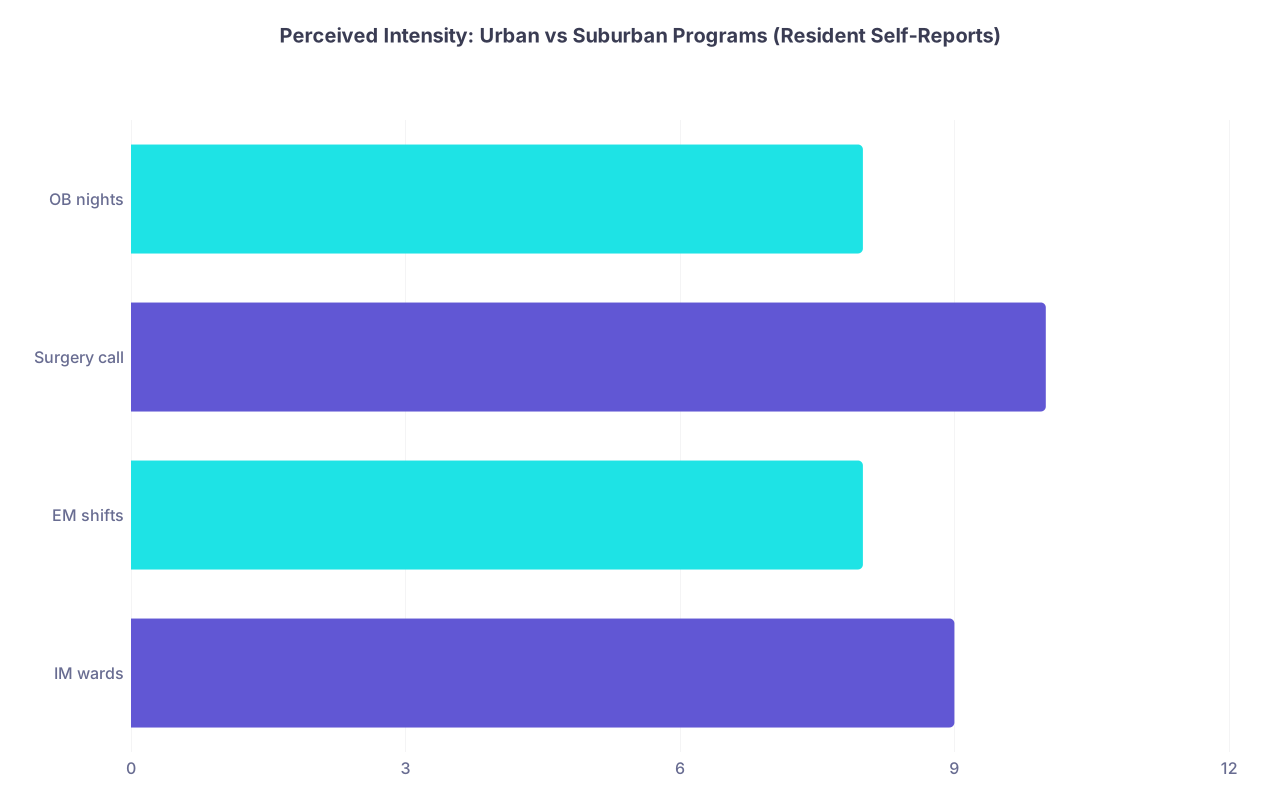
Here is how call and acuity sometimes feel by specialty:
| Category | Value |
|---|---|
| IM wards | 9 |
| EM shifts | 8 |
| Surgery call | 10 |
| OB nights | 8 |
(This is illustrative, not an actual survey, but it matches what residents report informally: county/urban programs feel like an 8–10 most of the time.)
Teaching and structure
Urban safety‑net, especially with strong academic affiliation:
- Morning report, noon conference, journal club, M&M, grand rounds.
- Protected education time that attendings actually respect.
- Residents present cases and research. There is a culture of “being good at medicine.”
Suburban private‑practice programs vary wildly:
- Some are excellent with structured didactics and invested private attendings.
- Others pay lip service to teaching while the attending’s primary concern is “I need to get out to clinic.”
You should have asked specifics on interview day. If you did not, email current residents and ask:
- “How often are didactics truly protected?”
- “How much bedside teaching versus ‘just do what I do’?”
- “Who runs M&M—residents, or is it just faculty lecturing?”
8. Decision frameworks by specialty and personality
Time to get concrete. I am going to lay out patterns I have seen, and I am not going to sugarcoat them.
Internal Medicine
Want cards/GI/onc/CCM?
Lean urban safety‑net / academic, unless the suburban program has truly stellar fellowship placement and research mentors.Want outpatient IM or hospitalist in a suburb?
A high‑quality suburban private‑practice program is absolutely fine—maybe even better if it has strong hospitalist leadership and exposure to real productivity models.
Emergency Medicine
Want high‑volume, high‑acuity EM, maybe academics or trauma center?
Urban safety‑net wins. You need to know what a 3 a.m. penetrating trauma actually feels like.Want community EM in a stable group, possibly long term in the same region?
A strong suburban ED with good volumes, CT surgery backup, and strong ultrasound will prepare you well.
General Surgery and OB/Gyn
For surgical disciplines, volume and autonomy matter. Most of that lives in urban or busy community hospitals.
- Urban safety‑net often means more penetrating trauma, more advanced cancers, more complex OB.
- Some suburban hospitals are surgical workhorses, but you have to see the actual case logs.
If your choice is:
- Busy urban safety‑net with high case numbers vs.
- Cushy suburban low‑volume OR,
Ceteris paribus, I tell surgical candidates to favor the place where you will operate more. Your future patients do not care what your lounge looked like.
Family Medicine, Psychiatry, Pediatrics
These are more nuanced.
Family medicine: if you want underserved care, migrant health, addiction, urban FM is gold. If you want suburban outpatient FM, then training in that exact setting has obvious advantages.
Psychiatry: safety‑net psych exposes you to severe mental illness, involuntary holds, comorbid homelessness. Suburban psych is more mood/anxiety, well‑insured, outpatient emphasis. Match your training to your desired patient population.
Pediatrics: urban peds means severe asthma, complex congenital issues, child protection cases. Suburban peds is more well‑child, bread‑and‑butter, school concerns. Again—who do you want to be comfortable with?
9. How to interrogate programs now, post‑interview
You did your interviews. You cannot go back. But you can still clarify.
Here is how I would probe residents and faculty of your top urban vs suburban contenders:
Pathology and autonomy
“By PGY‑2, what are you doing independently that you could not do as an intern?”
“Describe the sickest thing you handled mostly on your own this year.”Where grads actually end up
“In the last 3–5 years, how many grads went to fellowship? Where? How many went directly into community practice? Any regrets?”
Ask for names. Look them up.Culture toward vulnerable patients vs paying ones
“How does the program talk about uninsured or ‘difficult’ patients?”
You will hear it in the language: contempt vs compassion. That matters.Real didactics vs fake ones
“How often are you pulled from conference for ‘patient care needs’?”
If the answer is “frequently”, put a mental asterisk.Burnout reality
“What have been the worst months for you, and why?”
“If you could change one thing about this program, what would it be?”
If residents sound guarded or like they are reading a script, you already have your answer.
10. How to actually rank: scenarios
Let us walk through a few typical head‑to‑heads.
Scenario A: IM, wants cards, torn between big county + mid‑tier academic vs small suburban community with nice vibe
My bias: rank the big county + academic higher.
Reason:
- Cards is competitive. You will need exposure, letters, and research.
- Safety‑net IM will make you clinically strong and marketable anywhere.
- “Nice vibe” for 3 years is not worth a permanent ceiling on opportunities.
Scenario B: FM, wants suburban outpatient, options are intense urban safety‑net FM vs suburban community FM embedded in a large employed network
I would nudge you toward the suburban community FM if:
- They truly train you in outpatient efficiency, chronic disease management, and team‑based care.
- They have decent inpatient exposure so you are not clinically fragile.
The marginal extra “grit” from the urban program may not change your future practice much.
Scenario C: EM, unsure about academic vs community, has:
- Urban county Level I center, heavy trauma, academic affiliation.
- Suburban high‑volume community Level II, strong reputation, lots of grads in big community groups.
If you have even a 20–30% itch for academic EM, I would rank the urban county Level I higher. It is easier to go from high‑acuity to community than the other way around.
11. A quick self‑audit before you lock your list
Do this honestly. No one else will see it.
- On a 1–10 scale, how much do you value being the most clinically robust in your class vs having a more balanced, “normal” residency life?
- On a 1–10 scale, how strongly do you feel drawn to serve underserved / complex populations?
- On a 1–10 scale, how certain are you that you want suburban community practice long term?
Plot yourself mentally on this spectrum:

- If you are far left (urban‑lean), your top ranks should be safety‑net or academic‑heavy.
- Far right (suburban‑lean), private‑practice and community‑based programs can dominate your list.
- In the middle, I tend to bias slightly toward urban/academic because it usually leaves more doors open, as long as you are not obviously at risk of burning out.
12. Final filters that should override everything else
There are three reasons I tell people to ignore all of the above and choose differently:
Toxicity or unsafe culture
If a program, urban or suburban, shows you bullying, retaliation, lack of support, or clear ACGME red flags—drop it. No mission or lifestyle is worth three years of psychological damage.Support system and life constraints
If your partner’s job, your kids’ schools, or your own health demands a certain geography or intensity, do not be a hero. Choose the place where you and your life can survive.Gut dread
If you dread the idea of waking up at one program and feel oddly excited about the other, trust that. I have watched too many residents ignore this and regret it within 6 months.
Key takeaways
- Urban safety‑net programs generally train you harder, expose you to more pathology, and keep academic and fellowship doors wider open—but at a cost in lifestyle and emotional load.
- Suburban private‑practice–leaning programs mirror the environment of most real‑world community jobs, connect you to local groups, and often support a more stable life—but may limit certain academic or high‑acuity pathways.
- Rank based on who you want to be as a physician, not just where the residents looked happiest on interview day. Your future practice setting and patient population should guide how far you tilt toward urban safety‑net versus suburban private‑practice on your list.


