

It is late January. Your interview trail is over. You are sitting with a half‑finished rank list for ortho / ENT / urology / neurosurgery / IR / EM / OB — some procedure‑heavy field — and you keep cycling the same question:
“Do I rank the big‑name, insanely academic place… or the slightly ‘less famous’ program where residents never leave the OR?”
You are not confused about whether you want to operate. You are confused about how much to sacrifice for the name on your badge.
Let me break this down specifically.
1. First Principle: What Actually Matters in Procedure‑Driven Fields
In procedure‑heavy specialties (orthopedics, ENT, urology, neurosurgery, general surgery, IR, EM, OB/GYN, some GI fellowships), three pillars actually change your life:
- Technical skill and case volume
- Independent decision‑making and graduated responsibility
- Future doors: fellowships, jobs, geography
Academic prestige interacts with all three. So does operative volume. But not the way most MS4s think.
The mental mistake I see over and over: students equate “prestige” with “better training” and “volume” with “manual labor.” That is wrong. Some elite places train monsters in the OR. Some community‑heavy places run residents ragged but under‑educate them. The axis is not simply “name vs knife time.” It is more like this:
- How much complex, high‑acuity work do you see?
- How much of that are you actually allowed to do?
- Who notices your training when you graduate?
You are building two things:
- A skill set that lets you walk into an OR/procedure room and not flinch.
- A CV that lets someone, five years from now, say “yes” when your name crosses their desk.
Your rank list should be built around those two outcomes. Not your classmates’ opinions or Doximity’s nonsense ranking.
2. What “Academic Prestige” Really Buys You (And What It Does Not)
Let’s be concrete about what “prestige” actually means.
When people say “top program” they are usually talking about a cluster of things:
- NIH dollars, publications, landmark trials
- Famous attendings who write guidelines and textbook chapters
- High subspecialization (fellowships in everything)
- Strong national presence at meetings (AAOS, AES, SAGES, SAEM, etc.)
- Alumni in leadership and high‑profile jobs
That bundle buys you three real advantages and a few overrated ones.
Real advantages of academic prestige
Fellowship access, especially in hyper‑competitive niches
If you want peds ortho at CHOP, skull base at Mayo, complex spine, fetal surgery, advanced endoscopy, IR at the big names — yes, the “brand” of your residency matters.
People at top fellowships are honest about this over drinks and guarded at the podium. But the pattern is obvious.Research firepower and mentorship
At real academic centers, you can crank out 8–15 publications in residency if you have any initiative. Not case reports — cohort studies, multi‑center trials, database work.
You also get letters from people whose names are instantly recognized when they write, “This is the best trainee I have worked with in 10 years.”National visibility & network
You get exposed to the politics and structure of the specialty: committee work, society meetings, guideline writing.
You meet future PDs, chair search committee members, exam writers, and the random person who later forwards your CV to their friend in a great private practice.
Overrated or flat‑out illusory “benefits”
“Prestige = better surgeon / proceduralist”
I have seen technically mediocre graduates from top‑5 places and absolute killers from “no‑name” programs.
Volume, autonomy, and your personal work ethic matter far more than the sticker on the ID badge.“Prestige = automatic dream job”
Outside of highly academic jobs or elite fellowships, private groups care about:- How hard you work
- Whether your partners like being around you
- Whether you can handle a full call night without imploding
The name helps get you an interview. It does not save you from a bad reputation.
“Prestige = better lifestyle in residency”
Sometimes the exact opposite. Big academic centers can be brutal: more consults, more layers of bureaucracy, more service lines. Prestige does not protect your sleep.
So when should “academic prestige” actually swing your rank list?
- You are already research‑heavy and want to stay academic.
- You are aiming for a top‑tier, narrow fellowship.
- You genuinely like the academic environment and want the meetings, papers, politics.
If the answer to all three is “no,” prestige still matters — but it is not the trump card.
3. Operative/Procedural Volume: Numbers, Autonomy, and Hidden Traps
On the other side you have volume. The tempting promise: “Our chiefs log 2300 cases.” “Our EM residents do 40+ central lines, 50+ intubations, 100+ sedations.” That kind of talk.
Raw numbers matter, but they can mislead you.
What volume actually should mean
Good operative/procedure volume is not just “how many clicks in ACGME.” It is:
- Repetition of core bread‑and‑butter procedures so they become automatic.
- Escalation to more complex cases with real responsibility.
- Enough variety that fellowship or practice does not feel like Mars.
For example, in ortho you want a massive base of:
- Primary joints, bread‑and‑butter trauma, sports arthroscopy, spine decompressions, hand emergencies.
Then, layered complex cases with real participation: revisions, tumor resections, pelvic fractures.
In EM:
- Real procedures done independently on sick patients: airways at 3 am, chest tubes without anesthesia hovering, resuscitations you run, not just observe.
The autonomy question
Volume without autonomy is just glorified scut. Watching 300 Whipples from the corner is useless. Doing 75–100 with progressive responsibility is gold.
Red flags:
- Attendings scrub in for every skin stitch on straightforward cases even with senior residents.
- Fellows take all the good portions while residents close and write notes.
- Senior residents talk about “seeing” a lot and “doing” very little.
You need to keep asking current residents specific questions like:
- “As a PGY‑3, what part of a standard [lap appy / ORIF ankle / TURP / sinus surgery] do you actually do?”
- “By chief year, what is a straightforward case you do skin‑to‑skin entirely alone (with attendings unscrubbed or out of the room)?”
If they cannot answer concretely, I do not care what the volume numbers say. The training is weak.
Where volume backfires
There is a flip side. I have seen residents at small, high‑volume community programs who operate a ton. Great. But:
- No exposure to complex revision work.
- Weak didactics.
- Little research or national presence.
- Narrow case mix: huge hernia volume, but almost no oncologic resections or complex recon.
Those graduates can be technically very solid but less competitive for big‑name fellowships. Also, they may struggle the first time they see more complex pathology.
So you are aiming for a sweet spot:
Enough volume and autonomy to be technically sharp, plus enough academic backbone and complexity so your training travels well.
4. How These Two Axes Interact by Specialty
Let’s get granular. The prestige vs volume equation is not the same for ortho vs EM vs OB.
| Specialty | Prestige Weight | Volume/Autonomy Weight | Notes |
|---|---|---|---|
| Neurosurgery | Very High | Very High | Need both if at all possible |
| Orthopedics | High | Very High | Volume/autonomy edges out, but barely |
| ENT (Otolaryngology) | High | Very High | Head & neck/skull base fellowships care |
| Urology | Moderate-High | Very High | Oncologic exposure matters |
| General Surgery | Moderate | Very High | For complex fellowships, prestige rises |
| EM | Moderate | Very High | Procedures & resus experience dominate |
| OB/GYN | Moderate | Very High | MIGS/MFM fellowships care some about name |
Do not obsess over “very high vs high” like it is scripture. Use it to shape your bias.
A few concrete patterns
Neurosurgery:
You pretty much want both. Case complexity is huge, fellowship paths are academic, and the field is small enough that reputations are very sticky.
I would almost always take a high‑prestige neurosurgery program with slightly lower volume over a low‑prestige with scattered volume, as long as autonomy is present.Orthopedics / ENT / Urology:
Technical skill is king. You will not be trusted with a complex joint revision, cochlear implant, or robotic cystectomy as an attending if you are shaky with basics.
For these, I lean toward:
“Choose the program where chiefs walk into the OR and the scrub nurse says, ‘Oh good, this will go fast,’ even if the name is mid‑tier.”General Surgery:
Classic split. Big academic shops: huge complex oncology, lots of transplant, massive ICUs, often fellow‑heavy.
Community‑heavy: tons of bread‑and‑butter cases, sometimes fewer fellows, but weaker research.
If you know you want HPB, surg onc, CT, transplant at a top place — prestige matters more. If you want to operate and then go to a mixed community / regional referral job — volume and autonomy trump.EM:
Name brand matters less unless you are gunning for academics or specific fellowships (TOX, ultrasound at certain powerhouses).
For EM, bad volume and soft sick‑patient exposure genuinely cripple you. I strongly favor:- Busy ED
- Real trauma or high‑acuity medical population
- Procedures done by residents, not “protected” by other services
OB/GYN:
Same story: you want to be comfortable with C‑sections, operative deliveries, hysterectomies, and complications.
Academic prestige starts to matter more if you want MFM, Gyn Onc, or MIGS at a competitive place.
5. How to Actually Compare Two Programs Side‑by‑Side
Let me give you a framework instead of platitudes.
You are choosing between:
- Program A: Big‑name academic, slightly lower logged volume, fellows on every service.
- Program B: Regional but busy, high volume, limited research footprint.
Here is how I would systematically compare them.
Step 1: Look at graduated chief case logs (or procedure logs)
Do not trust “our residents are busy” without numbers.
- Ask for de‑identified chief logs or average case numbers.
- Focus on bread‑and‑butter categories required by ACGME and by your future practice.
- Look at distribution, not just total (“2200 cases” where 800 are skin lesions is not impressive).
Step 2: Ask blunt autonomy questions
To several different residents, at different levels:
- “In your last call, what was the sickest patient or most complex case you personally ran or did most of?”
- “Tell me about a case last month you did mostly alone.”
- “What do interns actually do here, in the OR/procedure room and on call?”
If answers feel scripted or vague, you have your data: low autonomy culture.
Step 3: Track fellowship match and first jobs over 5–10 years
This is critical and almost no applicant does it properly.
- Ask for a list of where graduates went for fellowship for the last 5–10 years.
- Note patterns: do they match consistently at strong places in the fellowships you care about?
- For those who did not do fellowship, ask: “What are they doing now?” Academic? Strong private groups? Struggling?
This is where prestige often shows its teeth.
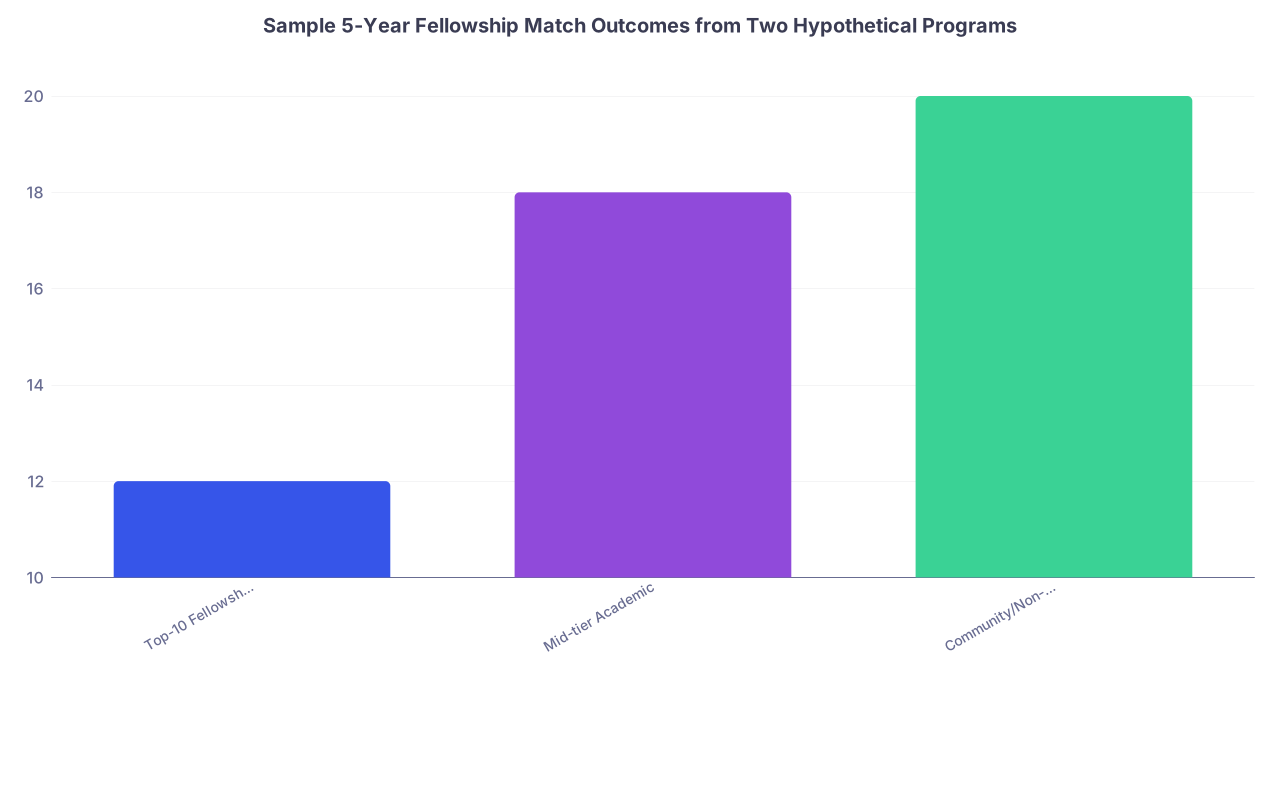
| Category | Value |
|---|---|
| Top-10 Fellowships | 12 |
| Mid-tier Academic | 18 |
| Community/Non-fellowship | 20 |
Interpretation example: If Program A places a steady stream into top‑tier fellowships and Program B rarely does, and you are hungry for that path, prestige may be decisive.
Step 4: Research culture vs checkbox
I am not talking about one QI project and two poster presentations. Ask:
- “How many first‑author manuscripts have recent grads had by chief year?”
- “Do residents get protected research time? Funded projects?”
- “Who is the strongest research mentor for residents?” (If they hesitate, that tells you a lot.)
If you have zero interest in academics, still care a little. Research culture often parallels rigor and curiosity in the program.
Step 5: Daily grind and support
Volume can cross the line into abuse. You want to avoid the “we operate a ton because we staff every other hospital in the region with minimal backup” situation.
Ask:
- “How often are you physically unsafe driving home post‑call?”
- “What non‑clinical support do you have (advanced practice providers, scribes, ancillary staff)?”
- “Who has your back when you are drowning on a bad call night?”
A program that boasts crazy volume but leaves you hanging with no support and no teaching will burn you out and stunt your growth.
6. Strategy: How You Should Weight Prestige vs Volume
Time to stop being abstract. I will give you four common applicant profiles and how I would bias the decision for each.
Profile 1: “Pure operator,” not academically inclined
You: mediocre interest in research, no desire for a narrowly elite fellowship, want to be a high‑functioning, busy proceduralist in community or regional referral practice.
You should usually:
- Favor higher volume and higher autonomy programs, even if they are “mid‑tier” academically.
- Still avoid places with zero academic activity or extremely narrow case mix.
- Use visiting rotations/interviews to find where seniors behave like young attendings in the OR.
Your nightmare scenario: finishing residency with prestigious letterhead but feeling slow, hesitant, and underexposed to core procedures.
Profile 2: “Academic surgeon/proceduralist” trajectory
You: already have 5–10 pubs, like conferences, see yourself in a faculty job, want academic promotion.
You should usually:
- Lean heavily toward academic prestige with adequate (not necessarily maximal) volume.
- Ensure there is real autonomy and resident‑first culture on at least some services.
- Pick a place where your mentor’s phone call can get you a slot in a good fellowship.
Your nightmare scenario: a volume‑heavy but academically invisible program where you have no path to big‑name fellowships or protected research.
Profile 3: Undecided, open to either path
You: do not know yet; enjoy procedures and some research; could see yourself in either private or academic world.
You should:
- Prioritize “balanced” programs: solid volume, real autonomy, legitimate (not token) research, mid‑to‑high reputation.
- Avoid extremes: low‑volume hyper‑academic ivory towers or pure workhorse community mills with no mentorship.
- Ask: “Do graduates from here successfully do both? Some straight to practice, some to strong fellowships?” You want that split.
Profile 4: Non‑traditional constraints (geography, family, visas)
You: constrained by partner job, kids in school, visa issues, or aging parents.
Here, the calculus changes. Program geography and support structure may outrank everything. But the internal trade‑off between prestige and volume is the same.
If you are stuck in one city with two options:
- Academic powerhouse with moderate volume.
- Community heavy‑hitter with big numbers but no name.
Re‑run all the earlier criteria with your personal goals. And be honest about what you will actually do: grind out research vs lean into procedures.
7. Tools: Specific Questions to Ask and Data to Track
To make this less theoretical, here is a practical interrogation list. Use it.
On interviews or second looks, ask:
“What are three things your graduates are known for, compared to other programs?”
Listen for: “They operate a ton,” “They are very strong clinically,” “They match great fellowships,” “They publish a lot.”“If someone just wants to be a technically great generalist, how well does this program prepare them?”
Good programs have a clear answer and examples.“If someone here wants a top‑tier fellowship in [X], what do they usually do to get there?”
You want concrete paths, not vague “work hard and we support you.”“Tell me honestly—do you ever feel like fellows take away cases you should do?”
Ask the junior and the chief. Compare answers.“Describe your worst call month this year.”
You are probing how volume feels on the ground.
Things to collect and compare on your spreadsheet
- Average chief case volume and distribution.
- Presence and number of fellows in your subspecialty of interest.
- Number of residents per year (too many can dilute operative opportunities).
- Last 5–10 years of fellowship match lists.
- Geographic spread and quality of first jobs for non‑fellowship grads.
- Genuine research output by residents.

| Step | Description |
|---|---|
| Step 1 | Start Rank List |
| Step 2 | Prioritize prestige + adequate volume |
| Step 3 | Balanced: strong volume + recognizable name |
| Step 4 | Prioritize volume + autonomy |
| Step 5 | Drop program down list |
| Step 6 | Keep high on list |
| Step 7 | Be cautious: community mill |
| Step 8 | Strong training environment |
| Step 9 | Do you want academic career? |
| Step 10 | Need competitive fellowship? |
| Step 11 | Autonomy present? |
| Step 12 | Any complex pathology & research? |
Print that mental flowchart into your skull. It keeps you from chasing name alone or fetishizing volume at the cost of everything else.
8. How to Break a Tie: When Two Programs Feel Equal
Sometimes you will have two places that, on paper, are almost identical. Here are the tie‑breakers that actually matter long‑term:
- Quality of senior residents: Do you want to become them? Watch how they run a list, talk to nurses, handle complications. That is your future.
- Mentor fit: Is there at least one attending whose career you can point to and say, “Something like that”?
- Culture around complications: When residents talk about bad outcomes, do they sound supported and learning‑oriented, or hunted? You will have complications. The environment matters.
- Your own gut on belonging: If you already feel like “their people” on interview day, that is not trivial. You will work 70–80 hours a week with these folks.
If you truly cannot decide, here is my bias for procedure‑driven fields:
All else equal, go where seniors are clearly more confident at the table/bedside. Technical confidence is hard to fake.
FAQ (Exactly 5)
1. If I want a community job, does academic prestige still matter at all?
Yes, but less. Prestige mainly helps you on the front end: getting interviews, especially in competitive markets or desirable locations. Private groups sometimes like the branding, but what they really care about is how quickly you can function independently, how you handle call, and whether you are pleasant to work with. For a pure community trajectory, I would place far more weight on operative/procedure volume, autonomy, and the reputation of graduates as “strong clinicians” than on NIH funding or national rankings.
2. How low can case volume be at a top academic place before I should worry?
You should worry whenever residents consistently graduate near ACGME minimums in core categories. Being slightly below some ultra‑high‑volume community programs is fine if autonomy is good and complexity is high. But if you hear chiefs say things like “I barely met my numbers for [bread‑and‑butter procedure]” or “we had to scramble to fill my log,” that is a red flag, regardless of how big the name is. Ask for ballpark numbers and compare across interviews.
3. Is it a problem if a program sends almost everyone to fellowship?
Not automatically. In some fields (ortho, ENT, urology, general surgery) fellowship is now so common that “everyone subspecializes” is just reality, especially at academic centers. What you want to see is: are those fellowships strong and in the areas you care about, or are people doing extra training because they do not feel ready for practice or cannot get jobs? Also ask what happens to the few residents who do go straight to practice — that tells you something about baseline training quality.
4. How do I factor in fellow presence when comparing prestige and volume?
Fellows are double‑edged. They can steal cases, or they can create layered teaching where junior residents get basics and seniors get advanced portions under an expert. At highly prestigious centers with many fellows, ask explicitly: “Who actually does what in the OR?” If seniors still get true attending‑level autonomy by the end, the presence of fellows is not a problem. If everyone hints that “the fellow does the cool part and we close,” that undermines both your volume and your growth, no matter how fancy the place.
5. What if my home institution faculty keep pushing me to rank big‑name programs higher than I feel comfortable with?
They usually come from an academic mindset and are biased toward brand because they live in a world where institutional reputation is currency. Listen to them on fellowship and academic doors; they are often right about that. But they do not have to live inside your residency. If your gut and your data say a slightly less prestigious program will make you far more technically confident and less miserable for 5–7 years, give that serious weight. You can build an excellent career from a strong “mid‑tier” program with great training. You cannot easily fix a weak technical foundation built under a famous logo.
Key points:
- For procedure‑driven fields, choose programs that produce technically confident, autonomous graduates; name alone does not guarantee that.
- Academic prestige matters most for competitive fellowships and academic careers; operative volume and autonomy matter most for how it feels to actually do the job.
- Use concrete data — case logs, autonomy stories, fellowship/job outcomes — instead of vibes or rankings when building your rank list.


