

It is late January. Your email is still pinging with the occasional interview offer. Your partner’s email? Dead quiet.
You have 18 interviews across three regions. They have 5. Maybe 3. Maybe 1.
You both want to match. You both want to stay together. And ERAS and NRMP do not care about your relationship.
Let me break this down specifically: this is one of the most stressful variants of the couples match. The asymmetry. You are not “two strong applicants choosing among 15+ shared programs.” You are trying to rescue a match plan where one person’s options massively outnumber the other’s.
This requires a different strategy than the usual couples match advice.
1. Understand the Real Problem You Are Solving
You are not ranking programs. You are solving a constrained optimization problem with a human cost.
The constraint is simple:
Your couple’s outcome is limited by the weaker application’s interview list.
If Partner A (stronger applicant) has 18 interviews and Partner B (fewer interviews) has 4, your real menu of viable “together” options is, at best, those 4 geographic / institutional footprints. Everything else is either:
- Long‑distance
- Lottery wishful thinking
- Or mathematically irrelevant
Most couples do not internalize this early enough. I have watched very good applicants torpedo their partner’s chances because they refused to rank aggressively around the weaker list.
So anchor your thinking:
- Identify which partner is “capacity‑constrained” (fewer interviews).
- Identify where that partner has interviews: exact programs and cities.
- Accept that the core of your couples rank list must be built around those locations.
Everything else you do is optimizing around that core.
2. Profile Your Situation Precisely (No Hand‑Waving)
Do not treat all “one strong / one weaker” couples as the same. They are not. There are at least four common patterns, and the right rank strategy differs.
| Pattern | Strong Partner | Weaker Partner | Typical Risk |
|---|---|---|---|
| A | 15–20 interviews | 0–3 interviews | Catastrophic mismatch / SOAP |
| B | 15–20 interviews | 4–7 interviews | Lopsided options, workable with discipline |
| C | 8–12 interviews | 3–5 interviews | Both at risk, must be aggressive |
| D | 20+ interviews | 10+ interviews | Classic couples match, lower risk |
You are probably in Pattern A, B, or C if you are reading this.
Now, get granular. You need a table like this on your own spreadsheet:
| City / Region | Partner A (Stronger) | Partner B (Weaker) |
|---|---|---|
| City 1 | IM, Cards‑track | None |
| City 2 | IM, Neuro | FM |
| City 3 | IM | IM, FM |
| City 4 | IM | None |
Once you see it laid out, the logic gets harsher but clearer:
- City 3 is gold. Multiple programs, both interviewed.
- City 2 is workable. Same city, different hospitals and specialties.
- City 1 and 4 are landmines for the couple but great for the strong partner individually.
You cannot design a rational rank list if this table only exists “in your head.” Put it on a screen. Stare at it together.
3. How the Couples Algorithm Punishes Optimism
The NRMP couples algorithm is brutally indifferent to your story. Here is the only rule that matters:
Each line on your couples rank list is a pair of programs.
You either match to that pair, or you move down.
That means:
- If one of you ranks a program without a corresponding realistic option for the other in that city / region, you are effectively betting on a long‑distance or SOAP rescue.
- If you over‑prioritize “dream programs” for the strong partner that have no viable counterpart for the weaker partner, you are trading your partner’s job for your prestige.
The algorithm will:
- Walk down your combined list.
- At the first line where both of you can be placed, it stops.
- It does not care that 10 lines higher you could have matched individually in “amazing” programs if you were not coupled.
So, the whole game when one partner has many more interviews is this:
How do we structure the list so that:
- The weaker partner has an acceptable chance to match at all.
- The couple stays together in at least one reasonably acceptable arrangement.
- The stronger partner does not unnecessarily throw away their floor.
4. Step‑by‑Step Rank List Construction When One Partner Is Stronger
Let me walk you through a concrete method. Not vibes. Process.
Step 1: Decide Your Default Priority Hierarchy
You must decide the truth:
If push comes to shove, which is more important to both of you:
- Staying geographically together at all costs, even if one takes a weaker program?
- Maximizing each individual’s training quality, tolerating the risk of LDR or SOAP?
- Absolute priority on the weaker partner matching somewhere, even if the stronger partner slides lower than they like?
If you do not articulate this, you will build a confused rank list that tries to do all three. That usually fails all three.
Common “honest” hierarchies I see:
- Couple 1: “We prioritize staying together; prestige is secondary.”
- Couple 2: “We prioritize both matching somewhere; being together is next; prestige last.”
- Couple 3: “We prioritize the stronger partner not wasting their trajectory; if we end up apart, we deal with it.”
There is not one “correct” answer. But you need one.
Write it down in one sentence.
Step 2: Build a “Together‑First” Skeleton
Start with cities / regions where both have interviews. This might be thin. That is fine.
For each shared city/region:
- List all program options for each partner.
- Rank internal preferences within that city first (for each person separately).
- Then cross‑pair them into “best realistic combinations.”
Example, City 3:
- Partner A: IM‑University > IM‑Community
- Partner B: IM‑University > FM‑Community
You construct pairs like:
- (A: IM‑University, B: IM‑University)
- (A: IM‑University, B: FM‑Community)
- (A: IM‑Community, B: IM‑University)
- (A: IM‑Community, B: FM‑Community)
Now globally merge all cities:
- Higher preference cities go higher.
- Within each city block, keep that internal logic.
When one partner has many more interviews, this “together skeleton” might only be 5–15 lines. That is fine; it is your spine.
Step 3: Add Asymmetric “Strong‑Leaning” Pairs (If Philosophically Allowed)
Here is where many couples screw up. They either:
- Never add lines that risk separation (overly conservative, may under‑match or SOAP), or
- Add them too early and too high, wrecking the weaker partner’s odds.
If your hierarchy supports it (Example: “We prioritize both matching and are willing to risk some distance”), then:
After you finish the “good together” section, you can add:
- Pairs where the strong partner is at a higher‑tier or solo city, and the weaker partner is at:
- A less desirable program in a nearby city, or
- A “safety” program, or
- A placeholder (like a lower‑ranked program elsewhere)
These are usually structured as:
- (Strong: dream program, Weaker: acceptable distant program)
- They go after the more balanced “we are together in target cities” pairs, but before true desperation.
If your priority is absolutely “we do not want distance in PGY‑1,” skip this step.
Step 4: Decide Where to Place “Weaker‑Centered” Safety Lines
This is the key for your situation.
The weaker partner must have some realistic floors:
- Programs where their application is truly competitive.
- Often smaller, community‑based, or less in demand cities.
- Sometimes prelim/transitional years if specialty allows.
You deliberately construct lines where:
- The weaker partner is at one of their best realistic safety programs.
- The stronger partner matches anywhere reasonably decent in or near that city, even if it is below their prestige potential.
Example:
- Partner B’s best chance: FM‑Community in a mid‑tier city.
- Partner A in the same city: IM‑Community, or even prelim with plans to reapply.
You rank:
- (A: IM‑Community‑X, B: FM‑Community‑X)
- Above many of A’s solo‑prestige options in other cities if you have decided “we prioritize both matching and/or being together.”
This is where the stronger partner has to be an adult:
You may be “wasting” your 245 Step 2 at a community program. But you are saving the couple from SOAP or forced separation.
5. Specialty‑Specific Reality Checks
Not all couples are created equal. The dynamic is very different if one is applying Derm and the other FM versus both doing IM.
High‑Demand + Bread‑and‑Butter
Examples:
Derm + IM, Ortho + FM, Plastics + Peds
Here the strong partner is often in a hyper‑competitive field with few spots per program and a very limited geographic spread. The weaker partner may have more geographic flexibility but overall weaker application.
Rules of thumb:
- You cannot expect many shared institutions. You are mostly chasing shared cities.
- Often the only way to stay together is for the weaker partner to anchor around the few cities where the competitive specialty exists.
- The stronger partner must accept that if they overshoot (ranking only elite programs), they may match “away” while the weaker partner does not match or ends up in SOAP far away.
In practice, for these couples:
- Build city‑based pairs first, even if at different hospitals.
- The strong partner may deliberately rank mid‑tier or “safety” programs in the cities where the weaker partner actually has an interview.
- If the strong partner is “too strong” to go unmatched realistically, the main risk is geographic split, not unemployment.
Both in Moderate‑Competitiveness Specialties
Examples:
IM + IM, IM + Peds, Peds + FM, Psych + IM
Here, your flexibility is higher:
- More programs per city.
- More realistic chance of building robust same‑city pairs.
- Weaker partner can often still land something reasonable in the same metro.
For you:
- You should almost always be heavily city‑and‑program‑aligned, with relatively fewer “distance‑tolerant” lines.
- The strong partner’s sacrifice is usually about tier of hospital, not geography.
6. How Aggressive Should the Stronger Partner Be?
This is the million‑dollar question.
You have to decide:
“How far down am I willing to push my solo dream programs to protect our togetherness and my partner’s match probability?”
Let me give you a very concrete way to think about this. Suppose:
- Partner A: 18 IM interviews including 5 strong academic, 7 mid academic, 6 community.
- Partner B: 4 FM interviews in smaller metros, none in A’s top 3 cities.
Brutal math:
- If you rank A’s strong academic dream programs high but they are in cities where B has no options:
- At best: A matches dream, B may go SOAP or be unmatched. You are apart.
- If you build a list that focuses on the 4 cities where B interviewed:
- A will likely slide to a mid/community program.
- Both match. Together.
My bias, after watching multiple cycles:
Over‑correct toward protecting the weaker partner’s odds and the couple’s togetherness. Especially if:
- The strong partner is in a field with abundant fellowship or lateral move options.
- The weaker partner is realistically at risk of SOAP or unmatched.
IM, Peds, FM, Psych, Anesthesia? There is life after a community program. Faculty positions, fellowships, lateral transitions. I have seen multiple people trade prestige for stability and then “upgrade” at fellowship or first job.
On the other hand, there are rare times to protect the stronger partner:
- Hyper‑competitive specialties where landing any categorical spot is hard.
- Situations where the weaker partner has a viable alternate path (research year, prelim + reapply, etc.).
But those are edge cases. Most couples massively underestimate the psychological and practical toll of ending up separated with one partner in SOAP‑land.
7. Practical Workflow: How to Actually Sit Down and Build the List
Stop trying to memorize the theory. Here is a pragmatic sequence you can literally follow on a Sunday afternoon.

| Step | Description |
|---|---|
| Step 1 | List all interviews by city |
| Step 2 | Mark shared cities |
| Step 3 | Rank programs individually within each city |
| Step 4 | Build city-based pair combinations |
| Step 5 | Order cities by couple priority |
| Step 6 | Insert weaker-partner safety city blocks |
| Step 7 | Decide if any distance-tolerant lines are acceptable |
| Step 8 | Review against your written priority hierarchy |
Key tips I have seen work:
- Do the first draft separately. Each of you builds your own ideal solo list first. Then reconcile.
- Color‑code:
- Green: Shared city with programs for both.
- Yellow: City where only one has interviews.
- Red: Programs so distant / incompatible you agree not to include.
- Do one pass together focusing only on cities, not individual hospital names. Decide your city ranking: “If we could magically both be placed in City X vs City Y, which would we prefer?”
- Then refine within each city block.
8. Avoiding the Classic Disasters
I have watched enough couples match post‑mortems to tell you the moves that reliably lead to pain.
Disaster 1: Pretending the Weaker Partner Is Not Weaker
You both have egos. You both worked hard. You both want to believe “we are competitive.”
Reality check:
- If one partner has 16 interviews and the other has 3, programs have already told you how they see you. Denying that will not change the algorithm.
Fix:
Take the weaker partner’s list as the main constraint. Build outwards from that, not the other way around.
Disaster 2: Overloading the Top of the List With Strong‑Partner Fantasy Pairs
Example:
- (A: Top‑5 U IM, B: City 2 FM‑Community 3 states away)
- (A: Top‑15 IM, B: City 4 FM‑Community opposite coast)
- (A: Mid‑tier IM, B: No program in that city)
This kind of list effectively says: “We do not care about being together or about B matching strongly.”
Fix:
If your real priority is togetherness or protecting B from SOAP, then those lines, if they exist at all, belong way lower.
Disaster 3: Not Having a Contingency If We Match Apart
You might do everything “right” and still land apart. If one of you has many more interviews, the probability of a mismatch outcome goes up slightly.
You should, at minimum, discuss:
- Are you both willing to do distance for one year? For all of residency?
- Is one of you willing to reapply after a prelim year to re‑align geographically?
- Will you consider one partner taking a research year in the other’s city next cycle?
No, you do not build this into the rank list directly. But couples who have not discussed this are the ones who melt down when the unlikely happens.
9. Data‑Grounded Perspective on Risk
Let us anchor this with some general trends (based on NRMP data patterns and what I have seen).
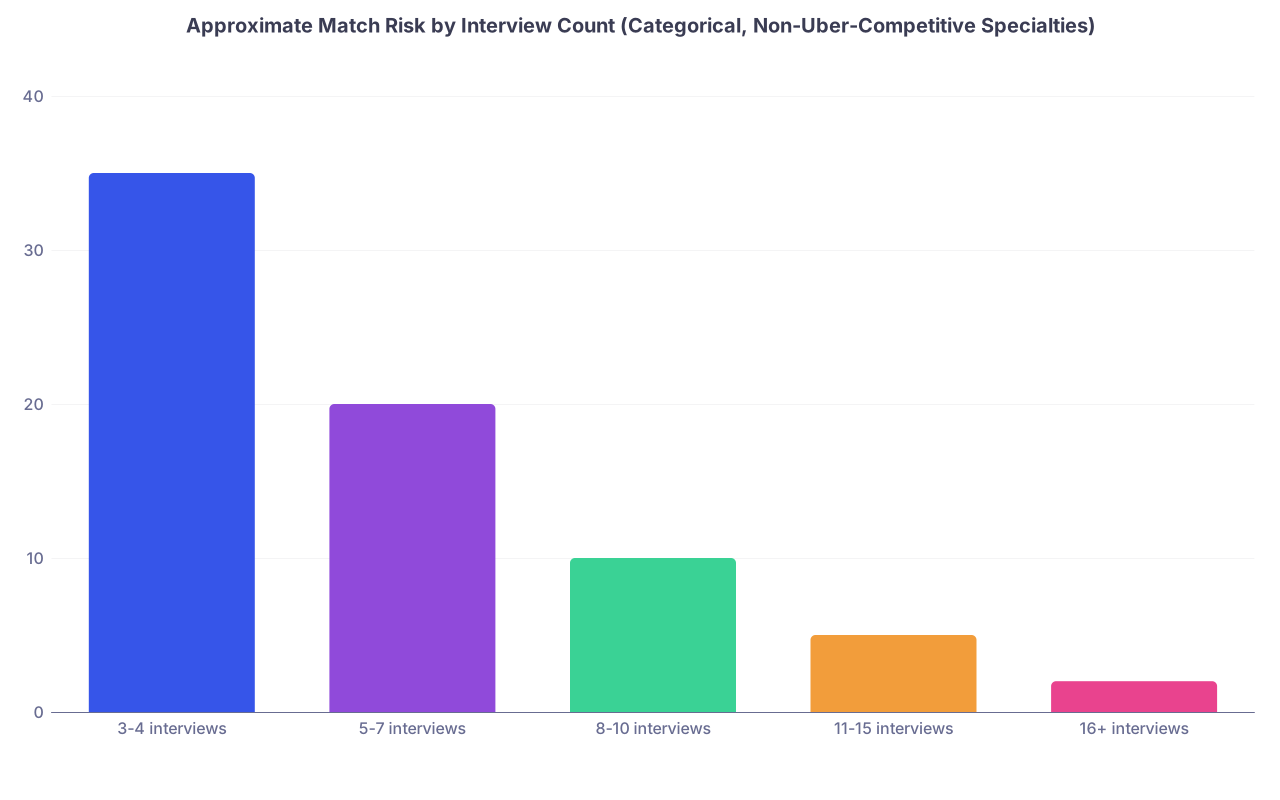
| Category | Value |
|---|---|
| 3-4 interviews | 35 |
| 5-7 interviews | 20 |
| 8-10 interviews | 10 |
| 11-15 interviews | 5 |
| 16+ interviews | 2 |
Interpretation (rough, but directionally correct):
- Weaker partner with 3–4 interviews sits in a non‑trivial unmatched risk zone, especially if those programs are competitive or poorly chosen.
- Stronger partner with 15+ interviews has a very high individual match probability, even if they rank some less prestigious programs.
So from a risk management standpoint:
- The weak link dictates failure probability.
- Sacrificing a bit of the strong partner’s upside to push the weaker partner’s odds out of the danger zone is often rational.
10. A Concrete Example: Walking Through a Couple’s List
Let me storyboard a realistic case.
Partner A (Stronger, IM):
- 16 interviews:
- 4 top academic (Cities Alpha, Beta)
- 6 mid academic (Cities Gamma, Delta, Epsilon)
- 6 community (Cities Gamma, Delta, Zeta)
Partner B (Weaker, FM):
- 4 interviews:
- FM‑Community in Gamma
- FM‑Community in Delta
- FM‑Community in Zeta
- FM‑Community in RemoteTown
You two decide your priority hierarchy:
“We prioritize both matching and being in the same city if at all possible. Partner A is willing to go community to make that happen.”
You build:
1–4: City Gamma combinations
- (A: IM‑Mid‑Academic‑Gamma, B: FM‑Gamma)
- (A: IM‑Community‑Gamma1, B: FM‑Gamma)
- (A: IM‑Community‑Gamma2, B: FM‑Gamma)
- (A: IM‑Community‑Gamma3, B: FM‑Gamma)
5–8: City Delta combinations
5. (A: IM‑Mid‑Academic‑Delta, B: FM‑Delta)
6. (A: IM‑Community‑Delta1, B: FM‑Delta)
7. (A: IM‑Community‑Delta2, B: FM‑Delta)
9–11: City Zeta combinations
9. (A: IM‑Community‑Zeta1, B: FM‑Zeta)
10. (A: IM‑Community‑Zeta2, B: FM‑Zeta)
12–13: RemoteTown safety city (only B has interview)
You may choose not to include pairs here at all if A has nothing nearby. Or:
12. (A: IM‑Community‑FarCity1, B: FM‑RemoteTown) – if you are willing to consider distance.
Only after that do you consider:
14–18: A’s dream academic programs in Cities Alpha and Beta paired with B’s weakest acceptable options elsewhere, if both of you explicitly accept the risk of being apart.
That is a disciplined list. You have:
- Maximized the chance of being together in Gamma, Delta, or Zeta.
- Given B their best realistic pathways to a match.
- Preserved some very low‑probability, strong‑leaning dream scenarios at the bottom.
Not perfect. But rational.
FAQ (exactly 6 questions)
1. Should the stronger partner ever rank programs where the weaker partner does not have any interview in that city?
Yes, but sparingly and low on the list, and only if you both explicitly accept the risk of geographic separation. These lines function as “if all our together options fail, at least one of us lands somewhere solid.” They should not crowd out higher‑probability together options in cities where the weaker partner actually interviewed.
2. Is it smart for the weaker partner to apply or signal to prelim or transitional year spots in the strong partner’s preferred cities?
Sometimes. If the weaker partner’s specialty and career goals allow for a prelim or TY followed by re‑application, this can be a reasonable hedge to get both of you into the same metro area for at least a year. But this should be planned explicitly with an advisor, not improvised, because reapplication logistics and visa / board exam timing can get messy.
3. How often do couples with one strong and one weak applicant both go unmatched?
If the stronger partner has 12+ interviews in a non‑hyper‑competitive specialty, both going unmatched is very uncommon. The real risk pattern is: the stronger partner matches somewhere; the weaker partner does not. That outcome is driven far more by the weaker partner’s small interview number and program choices than by the couples match mechanism itself.
4. Should we uncouple if our interview asymmetry is extreme (e.g., 20 vs 2 interviews)?
Sometimes that is the least bad option, especially if the weaker partner’s chances are extremely low and you both agree that protecting the stronger partner’s trajectory is critical. But uncoupling does not magically fix the weaker partner’s underlying competitiveness; it only removes the coupling constraint. I would only seriously consider uncoupling after detailed discussion with advisors from both specialties and after you model what each person’s solo list would look like.
5. How much should we worry about program “tier” when protecting the weaker partner’s match chance?
Far less than most people do. For bread‑and‑butter specialties (IM, Peds, FM, Psych, Anesthesia), long‑term career outcomes are heavily influenced by what you do after residency: fellowships, jobs, faculty mentors, geography, personal drive. Trading a top‑20 academic name for a solid community program in the same city where your partner can also match is usually a rational decision if your core goals are stability and togetherness.
6. Can we change our couples status or rank list philosophy after we submit if we get cold feet?
No. Once the rank list deadline passes, your couples status and list are locked. That is why you have to do the uncomfortable conversations now—about priorities, risk tolerance, and what you will do if you match apart or one of you goes unmatched. The algorithm will not adjust for second thoughts in March.
You are in an ugly, very specific situation—a dual‑physician couple with asymmetric power in the interview game. If you face it honestly, quantify it, and build your list around the weaker partner’s anchor points, you can still land a match that works.
From here, your next job is not to stress‑refresh your inbox. It is to sit down with your partner, put the spreadsheets on the table, and make a rank list that actually reflects the life you want over the next five years. The interviews are done. Now you prove you can think like a team. The rest—Match Week, SOAP, contingency plans—comes next.


