

Couples who treat the Match like two solo applications taped together get burned.
If you are couples matching, the logic of your rank list is a different game. The algorithm is the same, but the way your choices interact is not. And most couples underestimate that until it is too late.
Let me walk you through the actual mechanics, the math, and the strategy of building interlocking rank lists step‑by‑step—like I actually would with a pair of MS4s in November staring at a shared spreadsheet and quietly panicking.
1. The Core Rule: The Algorithm Treats You As One Giant Applicant
The couples match is not “two independent matches that try to keep you together.” That misconception ruins rank lists every year.
In couples match, NRMP treats you as a pair unit when filling positions. The algorithm tries to find a combination of positions—one for Partner A, one for Partner B—such that:
- Each of you is placed into a ranked position
- And the combination (Program X for you, Program Y for your partner) is the best available pair on your joint list
- If no acceptable combination exists, both can go unmatched (including one matched / one unmatched scenarios, depending on how you rank them)
Here is the crucial shift:
You do not rank programs individually. You rank pairs of outcomes.
That includes:
- Program A at School 1 + Program B at School 1
- Program A at School 1 + “No match” for partner
- “No match” for you + Program B at School 2
- Program C at School 3 + Program D at School 4
- Etc.
Those combinations become your couples rank list. That is what the algorithm reads.
If you do not internalize that, you will make a rank list that looks “logical” in your heads but is algorithmically incoherent.
2. What “Interlocking Rank Lists” Actually Means
Interlocking rank lists means that every line on Partner A’s list corresponds exactly to the same line on Partner B’s list. Line 1 defines Pair Outcome #1, line 2 defines Pair Outcome #2, and so on.
For example:
Line 1:
- Partner A: Internal Medicine – MGH
- Partner B: Pediatrics – MGH
Line 2:
- Partner A: Internal Medicine – BWH
- Partner B: Pediatrics – Boston Children’s
Line 3:
- Partner A: Internal Medicine – MGH
- Partner B: Pediatrics – Boston Children’s
The algorithm checks line 1 first. If both positions are available and both programs want you, it assigns you there. If not, it moves to line 2, and so on.
The logic is:
You are ordering combined realities of both of your lives, not just programs.
There is no global “Partner A list” and “Partner B list” that match independently. For couples, the only thing that matters is the paired lines.
3. The Building Blocks: Possible Outcomes You Can Rank
Before we go into strategy, you need to know the “atoms” you can build with. Every line on your couples list is one of these four categories:
- “Together, Same Institution / City”
- “Together, Different Programs / Nearby Cities”
- “One Matched, One Unmatched” (sacrifice options)
- “Both Unmatched” (explicitly, as terminal options)
Let’s be specific.
3.1 Same institution / same city pairs
This is the classic high-priority set for most couples.
Examples:
- A: EM – Denver Health / B: IM – Denver Health
- A: OB/GYN – U Chicago / B: Pediatrics – U Chicago
- A: Surgery – UTSW / B: Psychiatry – UTSW
These combinations typically go near the top of your joint list if you had strong interviews there.
3.2 Different programs in the same metro or drivable distance
When one of you did not interview at the same hospital, but interviewed nearby.
Examples:
- A: IM – Northwestern / B: Pediatrics – Lurie (same system, but say separate tracks)
- A: IM – Yale / B: Pediatrics – UConn (commutable but not identical)
- A: Psychiatry – Kaiser LA / B: FM – UCLA Santa Monica
These require more thought. How far is “ok”? 30 minutes? 90 minutes? Different states? Your list must translate that into actual line-by-line priorities.
3.3 One matched, one unmatched (or scrambled elsewhere)
Here is where many couples get squeamish and end up making unrealistic lists.
You can rank:
- A: IM – Mayo / B: No match
- A: No match / B: Orthopedics – HSS
These lines tell the algorithm: “We believe this outcome (one matched here, one unmatched) is still better than anything below it on the list.”
Couples often severely underuse (or refuse) these lines, creating an all-or-nothing list that tanks one or both careers.
3.4 Both unmatched
You can also effectively end your list with:
- A: No match / B: No match
That says: “We prefer both unmatched over any lower-ranked combination.” Some couples do this when they are geographically rigid and willing to reapply together.
For most couples in standard specialties, I think making “both unmatched” a preferred outcome over many realistic “one matched” options is a mistake. Harsh, but true.
4. Step‑by‑Step: How To Build Interlocking Lists From Scratch
Let me break down the process I use with couples on a whiteboard. Not theory. The actual sequence.
Step 1: Make solo preference lists first (independent of each other)
Each partner builds their own individual preference list with no couples logic yet:
- Rank every program you interviewed at in true order of your preference
- Pretend you are single and the match is completely solo
This does two things:
- Exposes how much your preferences align or conflict
- Provides a “ground truth” baseline to compare against your final couples list
You will later distort this for the sake of the couple, but you need to know what you are distorting from.
Step 2: Categorize programs by geography and overlap
Now, map out the geography.
Make a primary table with each program you both interviewed at and your cities.
| Region / City | Partner A Program (Specialty) | Partner B Program (Specialty) |
|---|---|---|
| Boston | IM - MGH | Peds - Boston Children's |
| Boston | IM - BWH | Peds - Boston Children's |
| Chicago | IM - U Chicago | Peds - Lurie |
| Midwest Other | IM - Univ of Iowa | Peds - Univ of Iowa |
| West Coast | IM - OHSU | Peds - OHSU |
Then, create zones:
- Zone 1: Same hospital / same city overlaps
- Zone 2: Same city / metro, different programs
- Zone 3: Same region, different cities (commutable?). Be honest.
- Zone 4: Completely different regions (long-distance or “sacrifice” options)
You should literally mark these in a spreadsheet. Color-code if you need to.
Step 3: Identify your joint Tier 1 priorities
Tier 1 = “If we match here together, we will be thrilled. Career-wise and life-wise.”
You only get 3–7 of these typically.
Common examples:
- Boston academic pairs
- Chicago academic pairs
- Your home city / region if both have strong programs there
- That one city you both secretly want more than you admit
Go back to your individual solo lists. Where do these shared programs fall?
If both of you have “MGH / Boston Children’s” in your individual top 3, that probably becomes line 1 or 2 on the couples list.
If one of you has “MGH” as #1 and the other has “Boston Children’s” as #10 (hates Boston, wants West Coast), you have a conflict you need to resolve explicitly, not by vague compromise.
Step 4: Start writing the actual paired lines from the top down
Now you stop thinking in terms of separate lists and start thinking in pairs of lines.
Let us do a small, concrete example.
Partner A (IM) solo top 5:
- MGH
- BWH
- U Chicago
- OHSU
- Univ of Iowa
Partner B (Peds) solo top 5:
- Boston Children’s
- Lurie (Northwestern)
- OHSU
- Univ of Iowa
- UCSF Benioff
Geography overlaps:
- Boston: MGH/BWH + Boston Children’s
- Chicago: U Chicago + Lurie
- Portland: OHSU + OHSU
- Iowa City: Iowa + Iowa
Now we start drafting coupled lines.
Line 1:
- A: MGH / B: Boston Children’s
Line 2:
- A: BWH / B: Boston Children’s
Why this order? Because for Partner A, MGH > BWH. For Partner B, both combos give them their #1. So we preserve A’s true preference at the top.
Next, we deal with Chicago:
Line 3:
- A: U Chicago / B: Lurie
Next, Portland:
Line 4:
- A: OHSU / B: OHSU
Next, Iowa:
Line 5:
- A: Iowa / B: Iowa
You have just built your Tier 1–2 couples outcomes.
Step 5: Add “mixed city” but still acceptable combinations
Here is where most lists remain underdeveloped. They stop after the obvious “same city” pairs and ignore realistic cross-city pairings.
Should you rank:
- A: MGH / B: Lurie
- A: BWH / B: OHSU
- A: OHSU / B: Lurie
Maybe. Depends on your tolerance for distance, finances, and careers.
You have to ask:
- Is 2–3 years of long-distance acceptable for one of us to be in a dream program?
- Or must we be within X miles, no exceptions?
And then you must be brutally consistent.
If you would, in real life, choose A@MGH + B@Lurie over both unmatched, that combination belongs above any “both unmatched” option. Same for “one matched, one unmatched.”
You may not want to think in those terms. The algorithm does not care. It reads your ordered lines as revealed preference.
So: build out a block of “mixed city but good enough” lines in descending order of realism and desirability.
6. Where “No Match” Lines Fit In — And Why Avoiding Them Is Dangerous
This is the part couples flinch at: intentionally ranking options where one partner goes unmatched.
Here is the uncomfortable truth I have seen repeated:
Couples that refuse to rank any sacrifice options often create an artificially short, top-heavy list. And then both go unmatched when one could easily have matched at several solid programs alone.
Let us use a real-ish structure.
Assume Partner A is very competitive (e.g., IM with strong research, great Step 2, AOA). Partner B is moderately competitive (e.g., Peds with average Step 2, no AOA, weaker letters).
If you say:
“We either both match in Boston/Chicago/Seattle or we both go unmatched. We will reapply together next year.”
You are effectively discarding:
- Numerous mid-tier but solid programs for Partner B
- Numerous top and mid-tier for Partner A
- A year of income
- Momentum in both careers
Sometimes that is acceptable. Many times, it is not remotely rational.
So how do you use “No match” lines properly?
6.1 Examples of rational “sacrifice” lines
Use lines like:
- A: OHSU (dream program for A) / B: No match
- A: No match / B: Lurie (dream program for B)
However, you should only insert these where:
- You have decided that one partner matching at a dream or high-priority program is truly better than any lower-ranked combination where you are together in a much less desirable setting
- And you are prepared for that outcome emotionally and practically
These lines go below all combinations where you are both in places you can live with long-term, even if they are not ideal.
7. How The Algorithm Walks Through Your Couples List (Mechanically)
You do not need to memorize the NRMP algorithm math, but you must understand the sequence logic.
Let me show you with a simplified flow.

| Step | Description |
|---|---|
| Step 1 | Start with Line 1 of Couple List |
| Step 2 | Couple tentatively assigned to this pair |
| Step 3 | Move to next line on couple list |
| Step 4 | One or both unmatched |
| Step 5 | Are both positions available and do both programs rank you high enough? |
| Step 6 | Reached end of list? |
Simplified explanation:
- The algorithm considers a tentative match for both of you at the program pair in line 1.
- If either program cannot accept you (because they prefer other candidates they ranked higher), that line fails.
- The algorithm moves to line 2, then line 3, and so on.
- Eventually, it either finds a pair that both programs will take you for, or it reaches the end of your list.
Now extend that across thousands of applicants and programs updating tentatively; the key point remains:
- Every time a higher-preferred applicant displaces you from a program, the algorithm revisits your next line.
- It always tries to get you the highest-ranked feasible pair on your list, not what programs prefer most globally.
This is why you must rank in true preference order. “Gaming” it (putting “safety” pairs at the top) only harms you.
8. Common Failure Patterns I See In Couples Match Lists
Let me be blunt. These are the structural mistakes I see over and over in March when people ask, “What went wrong?”
8.1 The geographic fantasy list
- Only ranks “both in the same major coastal city at top programs”
- Zero long-distance pairings
- Zero one-matched options
- Zero mid-tier regional programs
Result: Both unmatched, particularly if one partner is in a competitive specialty or had a weaker interview season.
8.2 The “mirrored” but not interlocked lists
Partners make their own lists, then try to roughly mirror them:
- Partner A: Ranks Boston > Chicago > West Coast
- Partner B: Ranks Chicago > Boston > West Coast
- They do not actually build joint lines line-by-line
Result: Their final couples list does not reflect either partner’s true preferences. You end up with:
- Weird inversions (e.g., both would have been happier in Chicago, but Boston combo ranked above)
- Hidden resentment because the compromise was unexamined
8.3 Over-weighting future fellowship over present life
Classic scenario:
- One partner obsessively focuses on “best fellowship pipeline” and pushes for pairs in hyper-competitive programs in miserable cities for the other partner.
- Their own individual rank list would actually put some balanced programs higher, but “prestige pressure” dominates.
Result: They match in a city / program combo one partner quietly hates, which is miserable for both.
8.4 The “anchor drag” effect
One partner is much less competitive but insists on only ranking “top” locations they are unlikely to match at.
Result: The more competitive partner’s outcomes get dragged down; instead of a great program + weaker program, you both end up at mid-tier or unmatched.
The honest fix: Accept that asymmetric competitiveness demands some asymmetric sacrifice lines. Not easy. Necessary.
9. Quantitative Sanity Checks: Are You Overreaching?
You can sanity-check your couples list with a bit of simple logic and, frankly, humility.
Ask:
How many total pairs did we rank?
- Under ~15–20 lines in a couples match with different specialties is usually thin unless you are both super-competitive and broadly marketable.
How many include at least one “safety-moderate” program for each partner?
- If the bottom half of your list still looks like a USNWR top 20 brochure, you are overreaching.
Let me frame it via a visual.
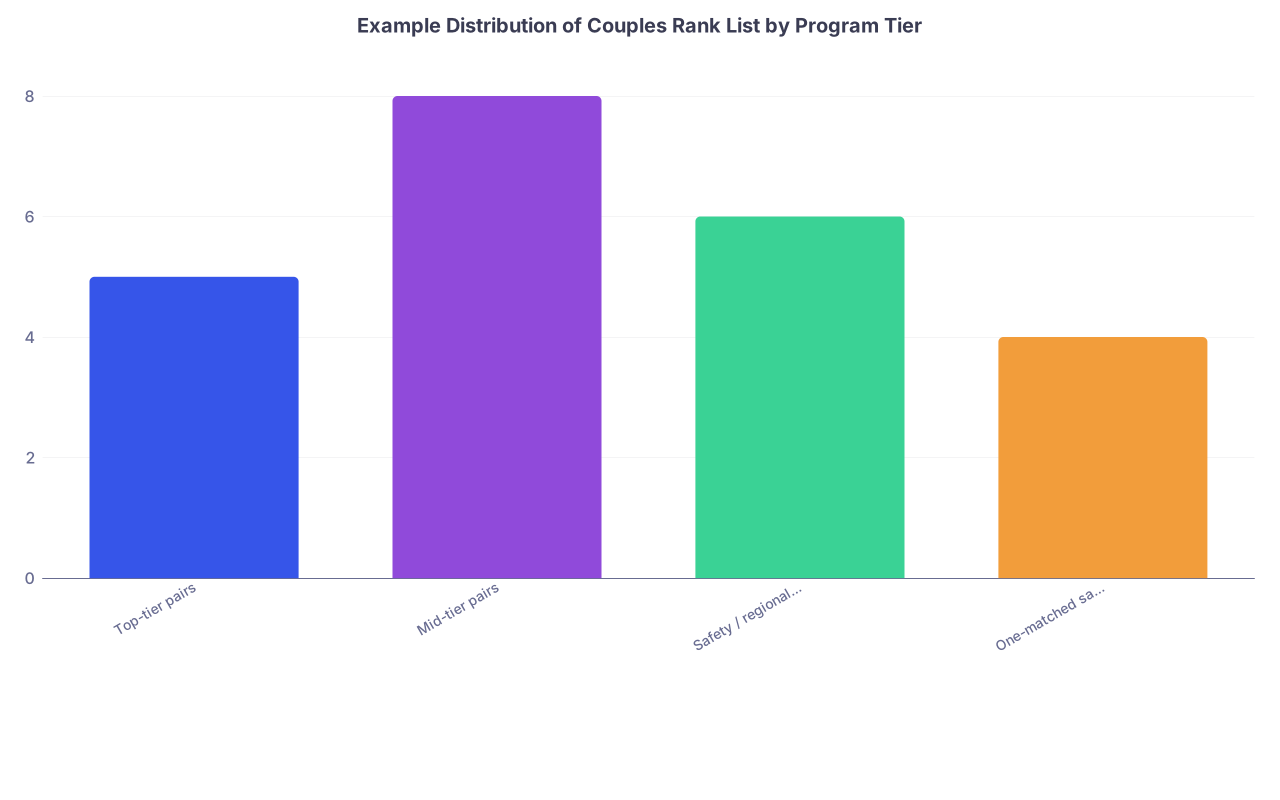
| Category | Value |
|---|---|
| Top-tier pairs | 5 |
| Mid-tier pairs | 8 |
| Safety / regional pairs | 6 |
| One-matched sacrifice pairs | 4 |
A healthy couples list for most average-strong applicants might have something like:
- 3–7 top-tier pairs
- 5–10 mid-tier but strong geographic / lifestyle fits
- 5–10 “safety / regional” pairs where you could be happy enough
- 2–6 one-matched sacrifice pairs near the bottom
That does not mean you must match this exact pattern. It means if you have 20 top-tier pairs and 0 mid/safety/sacrifice, you are not building with reality.
10. Special Scenarios: Different Specialties, SOAP Risk, and Length Mismatches
Some couples have extra complexity. Let me hit a few patterns.
10.1 Different competitiveness levels (e.g., Derm + Peds, Ortho + Psych)
If one partner is in a highly competitive field (Derm, Ortho, ENT, Plastics) and the other is in a less competitive field:
- The less competitive partner should have a wider geographic and tier range to accommodate.
- The more competitive partner must accept that they may land in a high-quality program that is not their #1, but ties geographically with the partner’s options.
You often end up with blocks like:
- Lines 1–5: Competitive partner in dream programs + less competitive partner in their best city options
- Lines 6–15: Competitive partner in solid but not top-5 programs; less competitive partner in good regional programs
- Lines 16+: Sacrifice and partial-match lines
10.2 Mismatched program lengths (e.g., EM 3 years + Neurosurgery 7 years)
Here the question is not only “Where do we match?” but “What is the 7–10 year plan?”
You should think beyond PGY‑1 happiness and ask:
- Do we want to be in a city where the shorter program partner has viable fellowships, jobs, or additional training options when they finish?
- Does your couples rank list reflect that, or are you only thinking about where you start?
It is rational to rank slightly less “prestigious” pairs in cities with deep long-term opportunities above isolated powerhouse programs.
10.3 SOAP (Match Week) implications
Couples match and SOAP is another layer of chaos.
If both of you go unmatched, your SOAP strategy must be realistic. Matching both into SOAP in the same city in desirable specialties is rare.
So when building your rank list, ask yourselves:
- If we both go unmatched, are we genuinely prepared to SOAP independently, possibly in completely different states and in prelim / transitional / off-specialty spots?
- Or would we prefer having one matched and one unmatched to reduce that chaos?
Your answer to that question should shape how aggressively you use “one matched, one unmatched” lines.
11. A Practical, Concrete Workflow: From Spreadsheet To Final List
Let me lay out a very literal sequence you can follow over a weekend.

| Step | Description |
|---|---|
| Step 1 | Create individual solo rank lists |
| Step 2 | Build overlap & geography spreadsheet |
| Step 3 | Identify joint Tier 1 pairs |
| Step 4 | Construct same-city pairs in true preference order |
| Step 5 | Add mixed-city but acceptable pairs |
| Step 6 | Discuss & insert one-matched sacrifice lines |
| Step 7 | Sanity check tiers & list length |
| Step 8 | Enter final pairs into NRMP as interlocked lists |
Then, for the spreadsheet, structure it roughly like this (columns):
- Column A: Line # (1, 2, 3, …)
- Column B: Partner A Program
- Column C: Partner B Program
- Column D: City/Region
- Column E: Tier (Top / Mid / Safety / Sacrifice)
- Column F: Notes (e.g., “better for A career”, “closer to B’s family”, etc.)
This kind of table lets you visually see where your list is top-heavy or irrational.
You can also sketch your priority distribution.
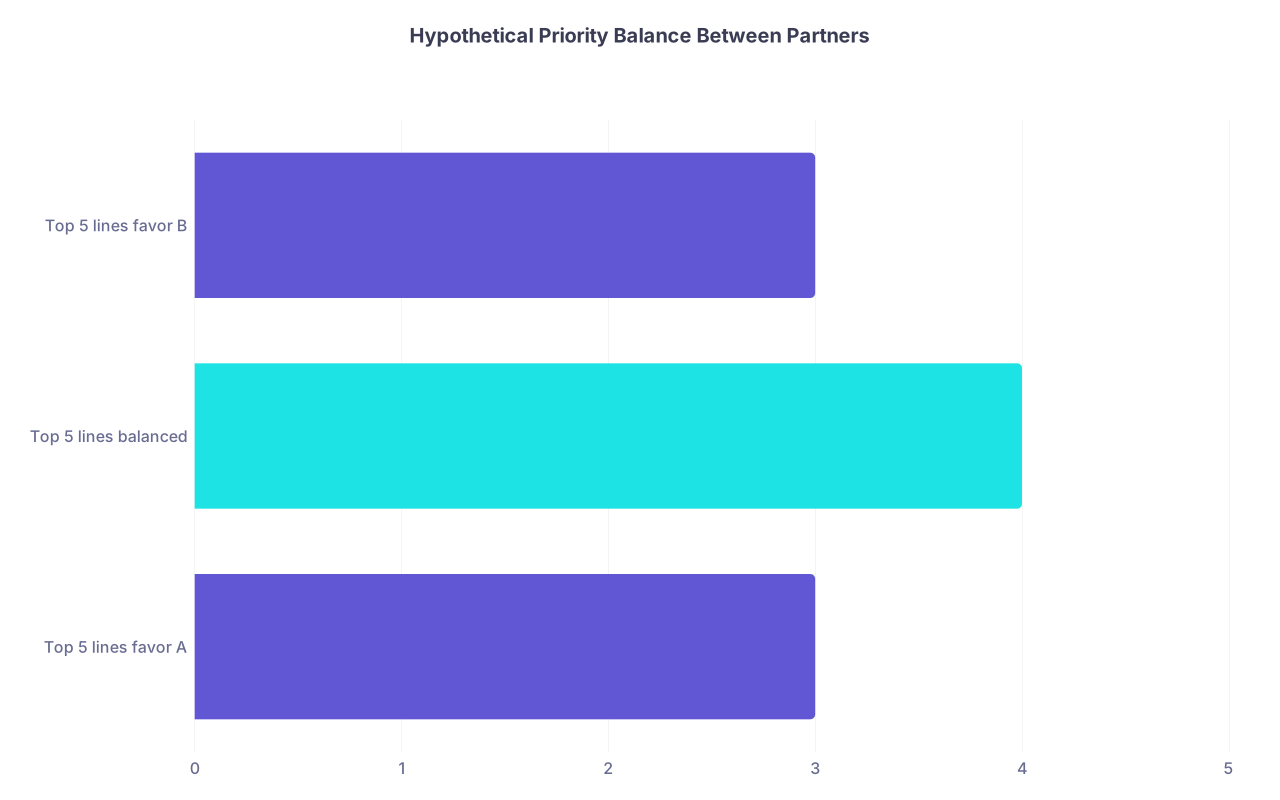
| Category | Value |
|---|---|
| Top 5 lines favor A | 3 |
| Top 5 lines balanced | 4 |
| Top 5 lines favor B | 3 |
If you discover that almost your entire top 10 heavily favors only one partner’s individual list, you need a conversation. That imbalance is exactly where couples later say: “I compromised way more than you did.”
12. How To Handle Disagreements Without Wrecking The List
This is not therapy, but I will say this: unresolved resentment leaks into rank lists as irrational structures.
Tactically:
- Each of you privately writes your “ideal 5 joint outcomes” on paper.
- Compare. Where they overlap, those are automatic high ranks.
- Where they diverge, you negotiate explicitly: “I will move my #2 city down if we move your #4 city up,” etc.
- Lock decisions in writing. No revisiting every night for 3 weeks.
Use the data:
- Batch your top 10 lines and check: Is each partner getting at least 3–4 lines that strongly reflect their solo preferences?
- If one partner has effectively zero representation, you have not built a couples list. You have just moved one person’s solo list to NRMP and stapled the other partner onto it.
13. A Worked Mini-Example: From Solo Lists to 12-Line Couples List
Let us run a compact, but realistic example to fix the ideas.
Partner A: EM
Partner B: IM
A’s solo top 6:
- Denver Health
- UW Seattle
- U Chicago
- UMich
- OHSU
- U Colorado
B’s solo top 6:
- UW Seattle
- UMich
- U Colorado
- U Chicago
- OHSU
- Univ of New Mexico
Overlap by city:
- Seattle: UW / UW
- Denver: Denver Health / U Colorado (nearby, but not same system); U Colorado is in Aurora but essentially same metro.
- Chicago: U Chicago / U Chicago
- Portland: OHSU / OHSU
- Ann Arbor: UMich / UMich
Now: build the couples list in order.
- A: Denver Health / B: U Colorado (A’s #1 city + B’s #3, both like Denver a lot)
- A: UW / B: UW (B’s #1, A’s #2)
- A: U Chicago / B: U Chicago
- A: UMich / B: UMich
- A: OHSU / B: OHSU
- A: U Colorado / B: U Colorado (slightly less desireable for A than Denver Health, but still strong)
Now mixed city but acceptable options:
- A: Denver Health / B: UMich (if they are willing to do long-distance 2–3 years for A’s dream program)
- A: UW / B: U Colorado
- A: U Chicago / B: UMich
Now sacrifice options:
- A: Denver Health / B: No match (if A and B decide A’s dream is worth that risk)
- A: No match / B: UW
- A: No match / B: UMich
Finally, you could end with:
- A: No match / B: No match
Only if you truly prefer reapplying together over any of the lower sacrifice outcomes.
You can see how each line represents a deliberate trade-off, not random mixing.
14. The Real Point: Your List Should Match How You Would Actually Choose In Real Life
Strip away the formality and think of a simple question.
If an omniscient dean came to you the week before Match and said:
“I will tell you exactly which pairs of outcomes are available to you. You can pick only one of them. Here is the list.”
Would your couples rank list order exactly match the order in which you would pick from that menu?
If not, your list is wrong.
The NRMP algorithm is designed to reward honest preference order. The couples twist does not change that. It only means your “preference” structure is over pairs of lives.
Key Takeaways
- The couples match does not care about your two separate lists. It only reads your paired lines—each line is one combined reality you are ranking against all others.
- A strong couples list is built systematically: solo lists first, then same-city pairs, then mixed-city pairs, then carefully chosen one-matched sacrifice lines, all in true order of combined preference.
- Avoid fantasy lists. Use enough lines and a realistic spread of tiers, geography, and sacrifice options so that your final rank list reflects what you would genuinely choose if every option on it were offered to you.


