

It is late January. Your ERAS interviews are mostly done. You have a solid advanced spot in anesthesia (or radiology, or PM&R), and now you are staring at a mess of TY and prelim programs on your NRMP screen. Every website claims “strong medicine training,” “supportive environment,” and “excellent preparation for advanced specialties.”
You know you need an intern year. You do not want to hate your life. You also do not want to show up to PGY‑2 undercooked.
Here is the problem: most applicants rank TY vs prelim based on superficial labels. “TY = chill, prelim = malignant.” Wrong. Or at least, incomplete. The devil is in rotation structure, call rules, culture, and how well that PGY‑1 plugs into your actual advanced specialty.
Let me break this down specifically.
1. Transitional vs Preliminary: What They Actually Are (Not the Myths)
Quick reset, because the terminology trips people.
- Transitional Year (TY): A 1‑year, broad‑based internship. Mix of internal medicine, electives, often some surgery/ER. Designed to be flexible and “general.”
- Preliminary Year (Prelim): A 1‑year internship that is part of a categorical program, usually:
- Preliminary Medicine
- Preliminary Surgery
- Less commonly: prelim in other specialties
Here is the first nuance: labels do not predict lifestyle. Structure does.
I have seen:
- A “Transitional” year that is basically a medicine prelim with one extra elective block. Residents miserable.
- A medicine prelim at a smaller community hospital where interns have tons of autonomy, reasonable call, and elective time. Residents fine, some actually happy.
So you do not rank by name. You rank by what the year actually looks like on paper and in practice.
2. The Single Most Overlooked Document: Rotation Block Schedule
If you remember nothing else, remember this: do not rank a TY or prelim program without seeing a sample rotation schedule for PGY‑1.
Ask for it explicitly if it is not on the website.
You want something like:
| Month | TY Program A | Prelim Med B | Prelim Surg C |
|---|---|---|---|
| Jul | Inpatient Medicine | Inpatient Medicine | General Surgery |
| Aug | ICU | ICU | ICU |
| Sep | Outpatient | Inpatient Medicine | Vascular Surgery |
| Oct | Elective | Night Float | Night Float |
| Nov | EM | Inpatient Medicine | General Surgery |
| Dec | Elective | Clinic | Trauma |
The questions you should be asking when you look at those blocks:
How many months of:
- Inpatient medicine?
- ICU?
- Nights / night float?
- True electives (not “medicine consults” disguised as elective)?
- Required clinic?
How much continuity with one service vs bouncing constantly?
Are there any rotations that are notorious “black holes” (brutal months everyone complains about)?
Programs love to show you the nicest version. On interview day, talk to interns and ask: “What was your true rotation breakdown this year?” Then compare.
3. Lifestyle vs Training: What Different Specialties Actually Need
You are not picking this year in a vacuum. You are picking it for a particular PGY‑2.
Let me be blunt: the “best” intern year for interventional radiology is not the same as for neurology, and definitely not the same as for neurosurgery.
For anesthesia, radiology, PM&R, ophtho, rad onc
You want three things:
- Solid internal medicine foundation: so you are not lost managing comorbidities, fluids, basic ICU issues
- Enough exposure to acute care to handle sick patients
- Protection of time and bandwidth to study your advanced field and Step 3
So for these, a strong TY or a medicine prelim with:
- 4–6 months inpatient medicine
- 1 month ICU (maybe 2 if well-structured)
- 2–4 months legitimate electives
- Reasonable nights/call
That is ideal. Overly surgical, trauma-heavy prelims are usually a bad fit. You will work hard, learn less of what you actually use later.
For neurology
You benefit more from:
- Medicine-heavy prelim or TY with robust medicine exposure
- Significant stroke / neuro exposure is a plus, but not mandatory
- ICU months are genuinely useful
A pure “cush TY” with mostly outpatient and minimal inpatient medicine can hurt you when you hit neurology wards full-time. I have seen prelim neurology interns who coasted through a very light TY and then got steamrolled PGY‑2.
For radiation oncology, dermatology, pathology
Here, the calculus shifts. Most of your real training starts PGY‑2. For you:
- A relatively lighter TY with reliable elective time, lower call burden, and room to read is often the smart move.
- You still need to be safe with basic inpatient medicine, but you do not need 8 months of wards.
The mistake I see: future rads/derm folks picking “hardcore” prelim medicine hoping to be “well prepared,” then burning out and resenting the whole year. Not smart.
For advanced surgical fields (e.g., integrated programs aside)
If you are in a scenario where you need a prelim surgery year (or strongly surgery-flavored prelim):
- You choose training over comfort. You need OR time, floor management, and to show you can survive surgical culture.
- A TY loaded with clinic and medicine is not aligned with your future.
Different game.
4. Call, Nights, and “Hidden” Workload: Questions That Actually Expose Reality
The PGY‑1 life you get is not just blocks. It is what nights, cross-cover, and scut look like.
On interview day, ask residents specific questions:
- How many weeks of night float total in PGY‑1?
- On average, how many 24‑hour calls per month? On which rotations?
- What is the worst rotation and why?
- What does a “typical” ward call night look like? How many cross-cover patients?
- Do you get post‑call days off consistently, or is that flexible only on paper?
And then the big one: “If you had to repeat PGY‑1, would you stay here?”
If more than one person hesitates or says “honestly, probably not,” listen.
5. Electives: Real vs Fake Flexibility
Transitional Years advertise “lots of electives.” That phrase is almost meaningless until you interrogate it.
You need to know:
How many months of true elective?
- Four months on paper can be “elective,” but locked into hospitalist, GI, cardiology, etc. where you are still essentially a medicine intern.
Can you do electives in:
- Your own advanced department (e.g., anesthesia, rads, PM&R, derm)?
- Outside institutions?
- Research?
Are elective requests honored or assigned?
- “We try our best” = you get whatever is left.
If you are matching to an advanced program in the same institution, an ideal TY / prelim lets you:
- Do 1–2 months in your future department
- Meet faculty
- Join ongoing projects
- Get comfortable in that system
That kind of embeddedness can make your PGY‑2 dramatically smoother.
6. Same-Institution vs Different-Institution: Completely Different Equation
This is a nuance most people underestimate.
Situation A: TY or Prelim in the same institution as your advanced program
Advantages:
- You learn the EMR, paging system, who to call for what
- You meet the nurses, consultants, and your own attendings early
- You can do rotations in your future department
- You do not have to move between PGY‑1 and PGY‑2
For many people, this is worth a lot.
Disadvantages:
- Harder to reinvent yourself if MS3/MS4 was rough; your reputation follows you
- If the institution has a malignant culture, you are trapped for multiple years
In this setting, a slightly harder internship that is co‑located with your advanced program is often better than a super cush TY across the country. Particularly for anesthesia, rads, neuro, PM&R.
Situation B: TY or Prelim somewhere else
You have more freedom to:
- Optimize quality of life for one year
- Live near family or in a city you want to enjoy short-term
- Separate your identity from undergrad / med school
But the downsides:
- Move twice in two years (plus licensing and logistics)
- New EMR, new system, new everything PGY‑2 when your learning curve is steep again
Rank lists need to factor this hard. People overvalue “cushion” and undervalue the cost of two cross‑country moves while exhausted.
7. Reputation vs Reality: Reading Through the Marketing
Let me decode some common phrases you see on websites or hear on interview day.
“Close‑knit program”
Often: small program, limited resources, maybe understaffed. Could be great. Could be you covering too many patients.“Strong clinical exposure”
Translation: high volume. Sometimes unreasonably high. Ask about caps and cross-cover numbers.“Residents feel very prepared for any career path”
Usually means heavy inpatient and ICU time, limited electives. Preparation is real, but you pay.“Excellent work‑life balance”
Sometimes true. But if no one mentions specific numbers (e.g., average hours/week, days off) and just vibes, be cautious.
You want data. Numbers. Examples. “We average 60–65 hours per week as PGY‑1, with 1–2 golden weekends per month.” That is real information. Vague adjectives are not.
8. Matching Strategy: How Many TY vs Prelim, and How to Mix Them
You are not just ranking individual programs. You are building a pair of rank lists: one for advanced / categorical, one for TY/prelim.
This part gets complicated quickly.
Here is the basic structure for someone with an advanced anesthesia spot, for example:
- Advanced anesthesia programs ranked in order.
- A mix of:
- TYs
- Medicine prelims
- Possibly a derm/rads/PM&R‑friendly prelim med if mislabeled
The priority questions:
- If I match to my #1 advanced program, which PGY‑1 is best aligned?
- If I match to my #3 advanced program in a different city, which PGY‑1s are realistic and not miserable?
I usually recommend:
- Rank your truly malignant‑sounding prelims very low or not at all. Matching into a toxic intern year can poison your whole progression.
- Put same‑institution TY/prelims above equivalent‑quality external ones, unless lifestyle is dramatically worse.
9. Specific Red Flags and Green Flags
You want a short internal checklist. Let me give you one.
Hard red flags
- Interns openly warn you off a program when attendings are not around.
- No one can tell you the actual duty hours with a straight answer.
- Chronic violation of post‑call days “because we are short‑staffed.”
- You hear: “The interns do all the scut because the upper levels are too busy.”
- Program proudly states “we never violate 80‑hour rules” but interns look exhausted and nonverbal.
Soft red flags
- “We are in a transition” (new PD, new leadership) without clear structure.
- Residents say “it depends on what team you are on, some are great, some are terrible” and name 2–3 notorious attendings.
- Vague answers about elective flexibility.
Strong green flags
- Interns are candid: “These two months are rough. The rest are quite manageable. Overall I would come here again.”
- Clear, posted rotation schedules with specific elective options.
- Evidence that advanced residents (anesthesia, rads, etc.) are actually happy with how well the intern year prepared them.
- Same‑institution advanced residents lobbying you: “If you are coming here for rads/anes, do this TY; we love having our future residents with us early.”
10. TY vs Prelim Medicine vs Prelim Surgery: Who Should Choose What?
Let’s get more concrete.
When a Transitional Year is usually best
- You are going into: radiology, radiation oncology, dermatology, ophthalmology, PM&R, pathology, anesthesia (depending on your risk tolerance).
- You want: real elective time, less grinding ward time, ability to explore or research in your field.
- You still want: at least 4–5 months of real inpatient medicine and ICU combined.
I would favor a TY when:
- It is in the same institution as your advanced program, or
- It has a clearly lighter schedule than medicine prelims with no drop in basic training
When a Medicine Prelim is usually better
- You are going into: neurology, sometimes anesthesia (if you want to be bullet‑proof clinically), cardiology-focused futures (rare, but happens).
- You want: heavy medicine exposure, confidence with floor codes, sepsis, respiratory failure, basic ICU thinking.
I would favor a strong but not malignant medicine prelim when:
- You are worried about your clinical foundation.
- You know you handle higher volume well.
- You are OK sacrificing some comfort PGY‑1 for smoother PGY‑2.
When a Surgery Prelim makes sense
- You are pursuing a categorical surgery spot afterward, or required by an advanced surgical pathway.
- You need to prove yourself in that environment.
If you are anesthesia/rads/PM&R and ranking a prelim surgery year high, you are almost certainly making an error. You will be overworked in the wrong content area.
11. How Programs View TY vs Prelim Interns (Subtle but Real)
Another nuance: your PGY‑2 program will have an opinion, even if they do not state it publicly.
Patterns I have seen:
- Neurology PDs quietly prefer candidates who did medicine prelims over ultra‑cush TYs, if everything else is equal.
- Some anesthesia PDs love TY‑trained residents who are not burned out and show up energized, especially if the TY had enough ICU.
- Radiology PDs are usually fine with either, but they notice when someone’s medical knowledge or comfort with sick inpatients is weak.
If you can, ask your future advanced program:
- “Do you have a preference between TY and prelim medicine for your residents?”
- “Are there particular programs that have historically produced strong PGY‑2s for you?”
The answers are often very candid and immensely useful.
12. Decision Flow: How to Actually Finalize Your Rank Order
Here is a way to think through your final TY/prelim ranking logically.

| Step | Description |
|---|---|
| Step 1 | Start: Know your advanced specialty |
| Step 2 | Evaluate same-site TY/Prelim first |
| Step 3 | Compare external TY vs Prelim |
| Step 4 | Rank same-site high |
| Step 5 | Favor Prelim Medicine |
| Step 6 | Favor strong TY with electives |
| Step 7 | Screen for red flags, call burden |
| Step 8 | Order programs by: safety, fit, lifestyle |
| Step 9 | Same institution option? |
| Step 10 | Reasonable schedule & culture? |
| Step 11 | Need heavy medicine training? |
And parallel to that, remember to adjust your advanced list with this in mind:

| Step | Description |
|---|---|
| Step 1 | Rank advanced programs |
| Step 2 | Identify top 3 likely cities |
| Step 3 | Within those, prioritize aligned TY/Prelims |
| Step 4 | Then add backup TY/Prelims in other cities |
13. A Quick Reality Check: You Cannot Optimize Everything
You will not get:
- The cushiest schedule
- The best clinical training
- In the exact city you want
- Co‑located with your dream advanced program
All at once.
You have to decide what you value most, and be honest about your own bandwidth.
If you are already hanging by a thread after MS4, choosing a brutal medicine prelim “to be tough” is ego, not wisdom. If you know your medicine base is shaky and you are anxious about it, a more rigorous prelim might be exactly what you need.
I have seen both mistakes:
- Overachievers burning themselves down with macho prelim choices.
- People chasing maximum cushion and then flailing as PGY‑2s when they finally hit real volume.
You know your tolerance better than anyone.
14. Example: How I Would Compare Two Realistic Options
Let me give you a concrete scenario.
You matched advanced anesthesia at Big Academic Center A.
You have two PGY‑1 options:
Transitional Year at Community Hospital 1 (40 minutes away)
- 4 months inpatient medicine
- 1 month ICU
- 1 month EM
- 4 months true electives (can do 2 months anesthesia at Center A)
- Call: q4 on wards, no 24‑hour calls, night float system
- Residents say: “Busy on wards, but overall very livable.”
Prelim Medicine at Big Academic Center A
- 6 months inpatient medicine
- 2 months ICU
- 2 months night float
- 2 months clinic / consults (no true elective)
- Very sick patients, big name, strong rep
- Residents say: “You work a lot, but you know your stuff once you are done.”
If you are:
- Average resilience, want time to read about vents, anesthesia basics, and take Step 3
- Not aiming for critical care or cardiac fellowship from day one
I would rank the TY at Community Hospital 1 higher. You still get real medicine and ICU, plus more direct anesthesia exposure and mental space.
If you are:
- Very motivated to be as strong as possible clinically
- Comfortable with heavy workload
- Anxious about managing sick patients solo
Then I would flip it and put the prelim at Big Academic Center A first.
Same data, different applicant, different optimal choice. That is how nuanced this really is.
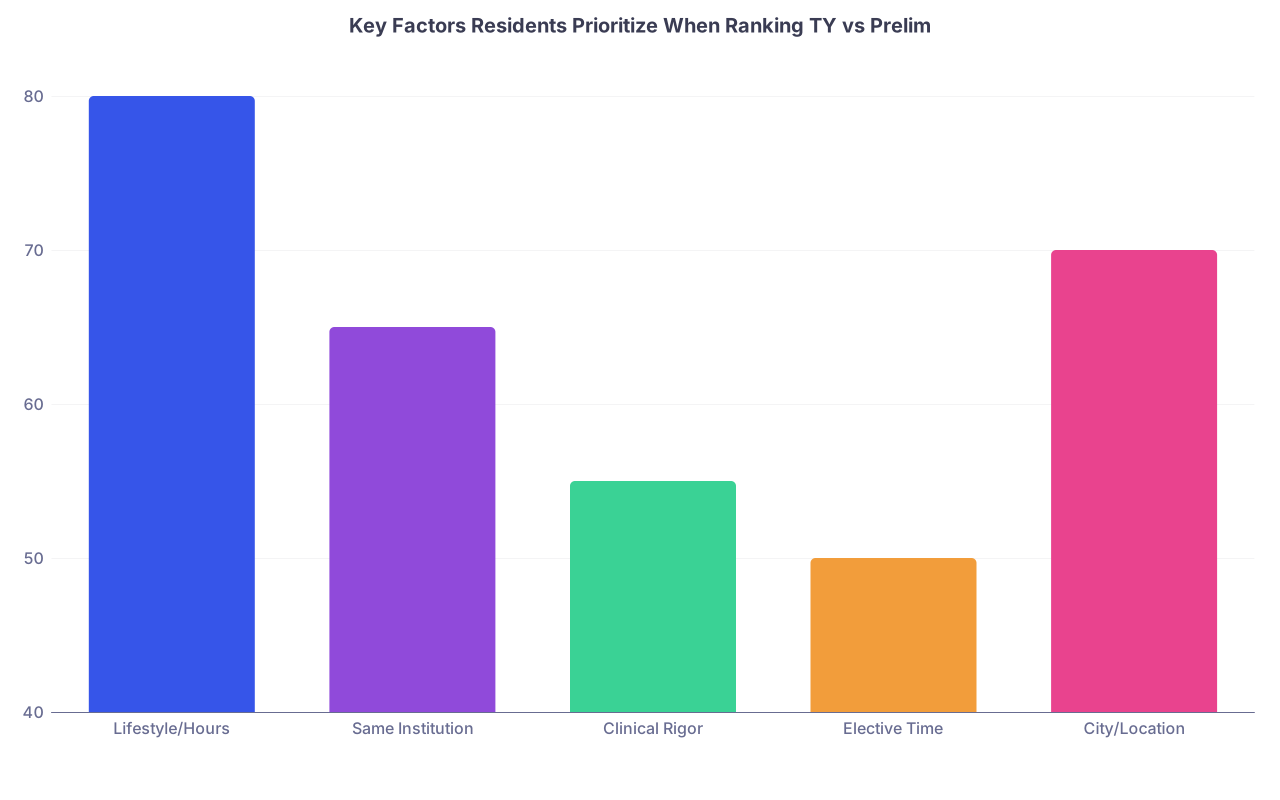
| Category | Value |
|---|---|
| Lifestyle/Hours | 80 |
| Same Institution | 65 |
| Clinical Rigor | 55 |
| Elective Time | 50 |
| City/Location | 70 |
FAQ (Exactly 5 Questions)
1. Is a Transitional Year always easier than a prelim medicine year?
No. Some TYs are just rebranded medicine prelims with minimal elective time. Others are genuinely lighter. You have to look at block schedules, call structure, and resident reports. The label alone tells you almost nothing about workload.
2. Will doing a “cush” TY hurt me when I start my advanced residency?
It can, if “cush” means minimal inpatient and ICU exposure. For specialties like neurology or any field that manages acutely ill patients, a very light TY may leave you underprepared. For radiology, derm, path, or rad onc, a somewhat lighter year is usually acceptable as long as you can manage basic inpatient issues safely.
3. Should I always prioritize a PGY‑1 in the same institution as my advanced program?
Not always, but it is a strong tiebreaker. Same‑site PGY‑1 means no move, early familiarity with the system, and often electives in your future department. I would choose a slightly harder same‑institution internship over a marginally cushier external one in most cases, unless the culture is clearly toxic.
4. How many TY or prelim programs should I rank to feel safe?
If you already have an advanced position, you still need enough TY/prelim options to secure a PGY‑1. Many applicants rank 8–15 TY/prelim programs, depending on competitiveness and geography flexibility. I would not rank a program you would be truly miserable at “just for safety”; a malignant intern year can do real damage.
5. What is the single best question to ask interns on interview day about the program?
“Would you choose this program again for intern year, knowing what you know now?” Then stay quiet and watch their face. The tone, the pause, the side comments they add after the “official” answer—those tell you more than any brochure or PD speech.
Key Takeaways
- Do not rank TY vs prelim by label; dissect rotation blocks, call, electives, and how they align with your specialty.
- Same‑institution internships with decent culture are usually worth a lot, even if slightly harder on paper.
- Optimize for fit with your future field and your personal bandwidth, not for prestige or bravado.


