

Only 41% of applicants say they would “seriously consider” ranking a brand‑new residency program highly—yet those same new programs sometimes end up matching applicants who could have gone to long‑established, name‑brand places.
So someone is miscalculating risk.
Let me break this down specifically: how you should treat new programs on your rank list, when they are smart upside plays, and when they are career landmines.
1. What “New Program” Actually Means (And Why It Matters)
First distinction people mess up: “new” does not always mean “chaotic startup with no idea what they are doing.”
ACGME labels and real‑world function can be very different.
| Type of Program | Practical Meaning for You |
|---|---|
| Brand‑new, started from scratch | True unknown; no senior residents |
| Spin‑off site of a big-name department | New label, old infrastructure |
| Former fellowship-only site adding resid | Strong subspecialty base, new core training |
| Existing program with new ACGME number | Administrative/merger change, functionally stable |
| Rapidly expanded program (more spots) | Same program, growing pains and resource strain |
The risk level is not “new vs old.” It is structure vs chaos.
Here is how those categories behave in real life:
Brand‑new, from scratch
No graduating seniors. No legacy. Often new PD.
Risk: highest. But also sometimes remarkable attention to residents and flexibility.Spin‑off of a well‑established department
Example: Big academic center starts a community track at an affiliated hospital across town.
On paper: “New program.”
In reality: Same faculty group, same didactics, shared conferences, sometimes same name on your diploma.Former fellowship hub adding residents
Example: Cancer center that has had heme/onc fellows for decades now adds IM residents.
Strength: superb subspecialty exposure, research.
Weakness: general medicine, continuity clinic, bread‑and‑butter inpatient volume might be weaker or more fragmented.New ACGME number / merger / relocation
This confuses applicants constantly. A long‑standing program changes its institutional sponsor, adds a satellite site, or restructures. ACGME calls it a “new program.” Everyone inside treats it as “same program, new paperwork.”Rapid expansion
Program doubles intake from 6 to 12 residents per class “to meet workforce needs.”
Translation: same number of attendings, same number of ICU beds, twice the learners. This is where you see over‑extension, blocked procedures, and resentment.
You are not ranking a “new program.” You are ranking a specific operational reality. And that reality is predictable if you ask the right questions.
2. The Core Risk–Benefit Equation: What You Actually Trade Off
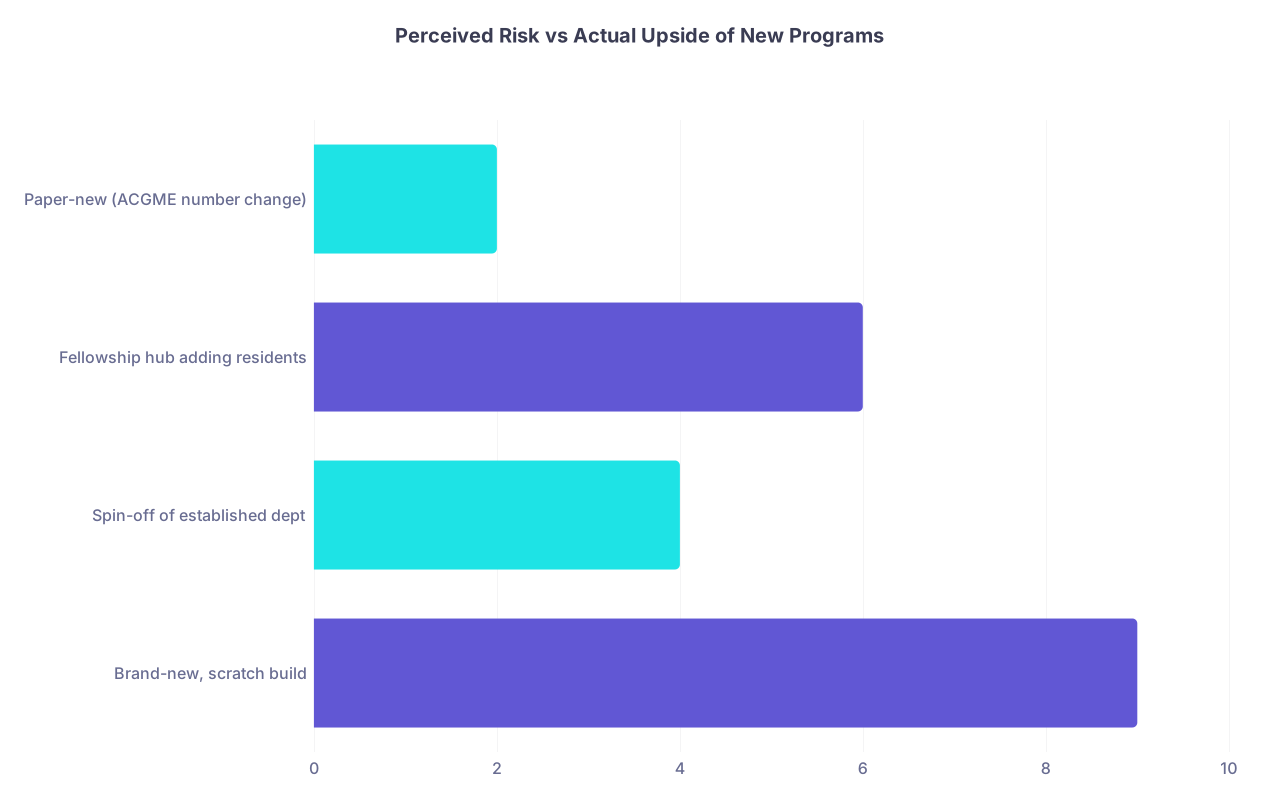
| Category | Value |
|---|---|
| Brand-new, scratch build | 9 |
| Spin-off of established dept | 4 |
| Fellowship hub adding residents | 6 |
| Paper-new (ACGME number change) | 2 |
The decision is not emotional (“new scares me”). It is a trade‑off between 3 buckets.
Bucket A: Academic / Training Risk
Questions you are really asking:
- Will I get enough volume and acuity?
- Will I be ready for boards?
- Will fellowship directors respect this place?
The real risks in new programs:
- Unstable curriculum: Conference schedule changes every few months. No rhythm. Residents are “guinea pigs” for new evaluation systems.
- Uneven volume: Early years can be feast or famine. One month you are slammed with sick patients and procedures. Next month you are fighting the ED for admissions because community docs do not know the service exists yet.
- Board prep unknowns: No historical board pass rate. The PD may promise “we are committed,” but they have not actually shepherded a cohort through boards yet.
On the other hand, the upside:
- Hyper‑invested leadership: New PDs with something to prove will personally track your milestones, help you design electives, sponsor your posters. I have watched brand‑new PDs help residents rewrite fellowship personal statements line by line.
- Customizable training: Want a global health elective? Or a QI project turning into a publication? A new program with flexible leadership may say “yes” faster than a huge legacy bureaucracy that takes 18 months to approve anything.
Bucket B: Structural / Operational Risk
This is where many new programs quietly hurt you.
- EMR not tuned to graduate medical education. Order sets missing. You will be clicking around like a lost intern every rotation.
- Call schedules written by a chief who has never actually run a 24/7 coverage grid before.
- No backup systems when things go wrong (illness coverage, ED surges, attending no‑shows).
Conversely, you may see:
- Lower patient caps early on because leadership is nervous about new learners.
- Extra attending presence on the wards because faculty are also proving themselves to ACGME.
Bucket C: Reputation & Outcomes Risk
Applicants obsess over this part and often misjudge it.
True kinds of reputational risk:
- Program fails site visit. Put on probation. That does happen.
- Program has poor job placement / fellowship placement in the first few years.
- Program closes. Rare, but not zero.
What matters for you:
- Will your program remain ACGME‑accredited through your graduation?
- Will your faculty and PD be able to vouch for you in the national fellowship / job community?
- Will your case log and letters actually place you where you want to go?
Here is the blunt reality: for most core specialties (IM, FM, peds, psych), a new but solidly run program will not destroy your career, especially if you are aiming for general practice. For hyper‑competitive fellowships or fields (like derm, plastics, ENT), ranking a brand‑new program high is a much bigger gamble.
3. Red Flags vs Green Flags: How to Actually Evaluate a New Program
Most applicants ask the wrong questions: “What is your board pass rate?” (They do not have one.) “Where did your graduates match?” (They have none.)
You need questions tailored to the early years of a program.

Structural Green Flags
These are strong positives that lower your risk:
Shared infrastructure with an existing program
Same didactics, same Morning Report, same M&M, same simulation center. Maybe just a new “track” code in NRMP.Clear, written rotation schedule for all 3–4 years
With actual block schedules, clinic assignments, ICU timing. If the PD cannot pull up a formal schedule on your interview day, that is a problem.Named, stable PD and APD with prior GME experience
A PD who has previously been an APD or clerkship director runs a very different program from a random hospitalist handed the title 6 months ago.Dedicated coordinator who knows what they are doing
You want the veteran coordinator who can tell you how duty hours are logged, how visas are handled, how electives get approved.Documented GME leadership support
If the DIO (Designated Institutional Official) and GME office are clearly involved and present on interview day, the program is less likely to be left to sink or swim.
Structural Red Flags
I get nervous when I see:
- Leadership turn‑over before first class graduates. PD “left for other opportunities” in year 1 or 2. That is a big, loud problem.
- Vague answers about clinic: “We are still working out the continuity clinic site.” Translation: no established ambulatory base.
- Faculty spread too thin: same 6 attendings covering wards, ICU, clinic, and didactics. This is how burnout and poor teaching happen.
- Overly optimistic growth: “We plan to double the class size next year.” With no mention of adding faculty or inpatient capacity.
Educational & Culture Signals
Ask focused questions:
- Who teaches your weekly didactics? Are these protected or regularly canceled for service?
- Have interns ever been pulled to cover nursing shortages or pure scut (transport, sitter duty, etc.)?
- How are resident concerns handled? Tell me about the last time residents pushed back on something and what changed.
Watch how residents answer. Hesitation. Side‑glances. The classic: “We are still working through some issues, but it is getting better.” That usually means “Everyone is miserable but we are scared to say it.”
Hard Questions to Ask Explicitly
You should not be shy. Use the words:
- “Have there been any ACGME citations yet, and what were they about?”
- “What concrete changes did you make between first and second cohorts based on feedback?”
- “If I match here, what guarantees do I have that my program will remain accredited through my graduation?”
If they dodge, that alone is data.
4. Where to Place New Programs on Your Rank List: Practical Scenarios
This is what you actually care about: “I have interviews at three newish programs and four established ones. How do I order them?”
Let us structure this by risk tolerance and career goals.
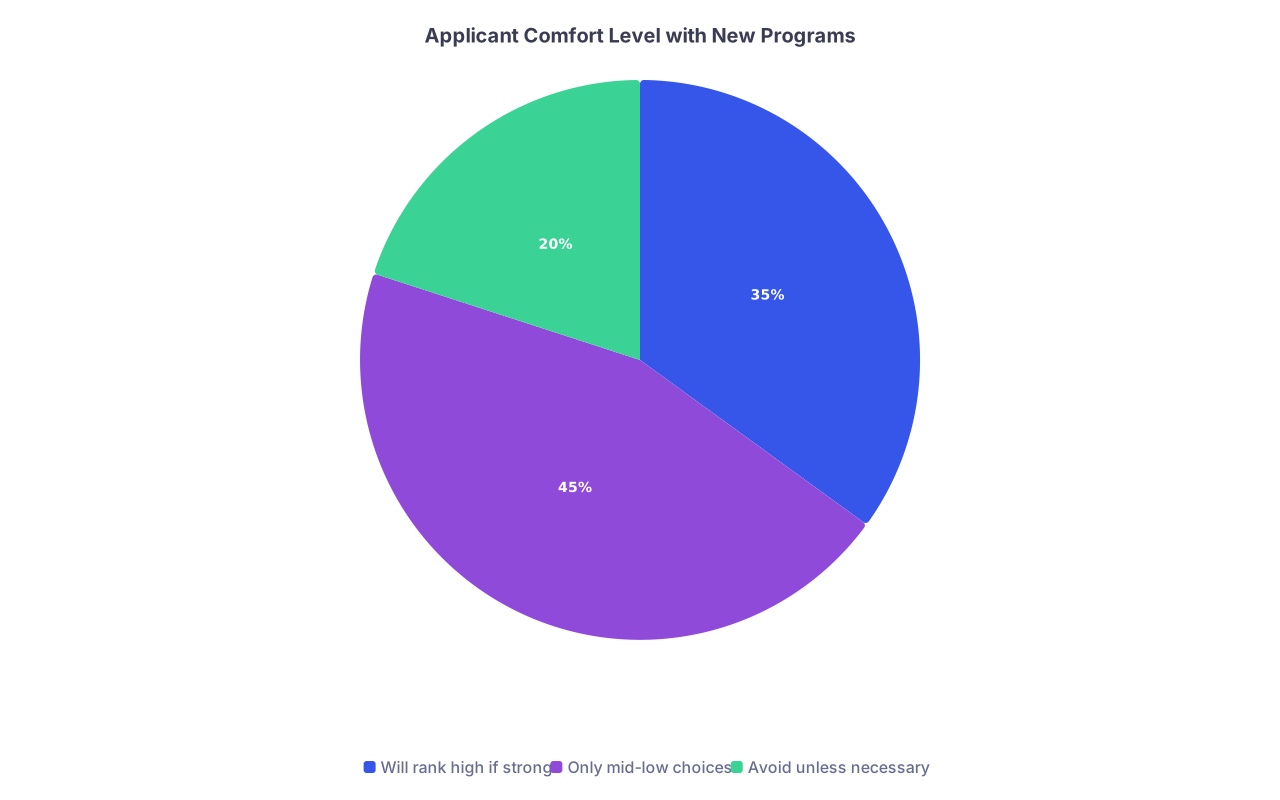
| Category | Value |
|---|---|
| Will rank high if strong | 35 |
| Only mid-low choices | 45 |
| Avoid unless necessary | 20 |
Principle #1: Always rank in true order of preference
NRMP algorithm is applicant‑favorable. Ranking a new program lower “to be safe” when you genuinely like it more than an established mid‑tier program is mathematically and strategically wrong.
So if a new program clearly checks more of your boxes than an older one, you rank it higher. Period.
Scenario A: You want a competitive fellowship (cards, GI, heme/onc, ortho, ENT, etc.)
You should be conservative. High‑level breakdown:
Established, known program with strong fellowship match history
These go at the top unless the culture is truly toxic.New program with:
- PD and faculty with national reputations
- Strong research infrastructure
- Affiliation with a big‑name university hospital
These can be mid‑to‑high on your list, especially if your Step scores and CV are strong enough that you will stand out as a “big fish.”
Isolated community new program with little specialty depth
This is a last‑resort if fellowship is your goal. You may still get there, but the slope is steeper.
Scenario B: You care most about location / family
You are willing to trade some academic strength for being near a partner, kids, parents, or simply not being miserable.
In that case, a new but well‑structured program in your desired city can justifiably rank very high—even #1—over older programs in cities you actively dislike.
What you must ensure:
- Program has stable accreditation and backing of a major health system.
- Faculty depth is enough that you will not be the only resident on nights covering 300 beds.
- Their first alumni are actually landing jobs you would be OK with (even if not top‑tier fellowships yet).
Scenario C: You are okay being a generalist, not chasing big academic dreams
If your realistic future is community IM/FM/peds/psych, and you want to be a solid clinician, the bar is different.
Here a new program’s biggest determinants:
- Bread‑and‑butter volume.
- Balanced workflow (not chronic understaffing).
- Teaching culture that is not malignant.
A good new program in a reasonable city can rank quite high. Many community attendings have trained at programs that were “unknown” or young when they went through; their lives are fine.
Scenario D: You have a weaker application and limited interviews
This is where game theory matters.
If you have, say, 6–8 interviews total and 3 are at new or newer programs, those programs may actually be your best shot at matching. They often have slightly more flexibility in who they rank.
You still rank programs by preference. But you should be brutally honest with yourself about:
- How likely you are to match at the one or two “big name” places.
- Whether a solid but newer community program is better than scrambling through SOAP into something truly dysfunctional.
For many borderline applicants, a new but decent program ranked reasonably high is the correct play.
5. Concrete Risk‑Benefit Grids: How to Think Like a Program Director
Let us make this explicit. Here is how I would classify common situations.
| Program Type | Training Risk | Operational Risk | Career Upside |
|---|---|---|---|
| Brand-new, no affiliation | High | High | Moderate |
| New track of major academic center | Low | Low–Moderate | High |
| Community hospital with strong university tie | Moderate | Moderate | Moderate–High |
| Fellowship hub adding residents | Moderate | Moderate | High (niche) |
| Rapidly expanded existing program | Moderate | High | Moderate |
Now translate that to rank list decisions.
If your top three realistic goals are:
- Fellowship in a competitive subspecialty
- Strong teaching culture
- Reasonable lifestyle
You prioritize:
- Established academic or hybrid programs
- Followed by new tracks of major academic centers
- Then fellowship hubs adding residents
- With isolated, brand‑new community programs toward the bottom unless other factors dominate (location, family, etc.)
If your top three are:
- City / geography
- Supportive, non‑toxic culture
- Solid generalist training
You could absolutely put a newer, well‑run community program at #1 over a miserable legacy name‑brand place three time zones away.
6. How to Vet Stability and Accreditation Without Guessing
You should verify, not hope.

| Step | Description |
|---|---|
| Step 1 | Identify new program |
| Step 2 | Lower structural risk |
| Step 3 | Higher need for scrutiny |
| Step 4 | Ask about rotations & didactics |
| Step 5 | Moderate risk, rank by preference |
| Step 6 | High risk, push down list |
| Step 7 | Shared infrastructure? |
| Step 8 | Transparent about ACGME status? |
Steps you can actually take:
Check ACGME and institutional history
Search the institution, not just the program. If the hospital has 10 other accredited residencies that have been stable for 20 years, they know GME. If yours would be their first and only program, risk goes up.Ask explicitly on interview day
- “What is your accreditation status now?”
- “Have you had any site visits since initial accreditation?”
- “Any citations or required action plans?”
They are allowed to tell you. A confident PD will.
Look for early alumni outcomes
Even a 3–4 year‑old program should now have at least one graduated class. Ask:- “Where did your last class go?”
- “Any recent fellowships?”
- “What proportion took jobs in the local system?”
Talk to current residents with targeted questions
Ask: “What surprised you in a bad way after starting here?”
The first instinctive answer is often very revealing.Study call schedules and duty hour compliance
Chaotic scheduling almost always signals deeper structural issues.
7. How Many “New” Programs Is Too Many on Your List?
You asked about rank strategy, not just evaluation. So here is the hard calculus.
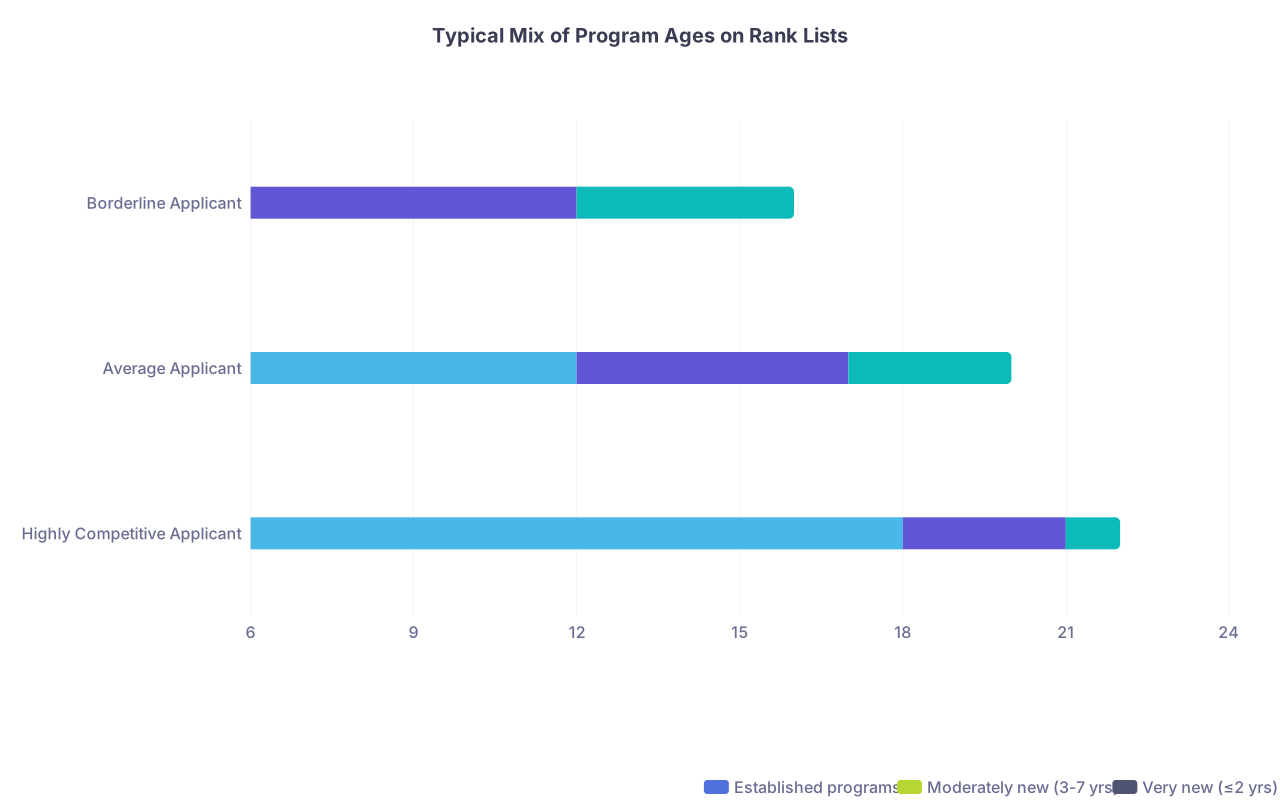
| Category | Established programs | Moderately new (3-7 yrs) | Very new (≤2 yrs) |
|---|---|---|---|
| Highly Competitive Applicant | 18 | 3 | 1 |
| Average Applicant | 12 | 5 | 3 |
| Borderline Applicant | 6 | 6 | 4 |
A reasonable mix for most applicants:
- Majority established or at least 5+ years old.
- A few “younger but safe” programs (spin‑offs, academic affiliates).
- A small number of truly young programs, unless your interview pool is heavily skewed that way.
If you find that 50–70% of your interviews are at very new programs:
- That is already telling you something about how programs are evaluating your application.
- You will likely need to rank some of those new programs relatively high to have a realistic shot at matching.
- You should be ruthless about eliminating the worst‑looking ones rather than simply ranking every interview.
One more point nobody says out loud: There is a meaningful difference between “ranked low” and “ranked not at all.” If a program seems unstable, malignant, or unsafe, you simply do not rank it. Matching is not worth three years of misery and compromised training.
8. Summary: How to Treat New Programs, In One Page
You are trying to answer three questions:
- Is this program structurally sound and backed by a competent GME system?
- Will I get enough clinical volume and mentorship to become the physician I want to be?
- Will graduating from here still serve my career goals 5–10 years from now?
Newness increases uncertainty, not doom. The real variables:
- Leadership quality and stability
- Infrastructure sharing with established programs
- Hospital volume and service lines
- Early alumni outcomes once they exist
Your rank list should:
- Follow your genuine preference order, not fear, as long as baseline safety and accreditation look solid.
- Place newer but structurally strong programs ahead of older but clearly toxic ones.
- De‑prioritize isolated, chaotic startups if you have realistic alternatives, especially when chasing competitive fellowships.
You are not just choosing a name for your CV. You are choosing who will answer the phone for you when a fellowship PD calls and asks, “Is this resident actually good?”
Treat new programs like calculated startup investments, not lottery tickets. Some will outperform the legacy giants. Some will fold. Your job is to tell which is which before March.
With this framework in your pocket, you are ready to assemble a rank list that actually reflects your goals and risk tolerance. The next step is more subtle: refining that list when you are torn between programs that all look “pretty good” on paper. But that is a story for another day.
FAQ (Exactly 5 Questions)
1. Is it dangerous to rank a brand‑new program as my #1?
It is risky, not automatically dangerous. If the program has strong institutional backing, experienced leadership, clear rotation schedules, and a reasonable volume of patients, ranking it #1 can be rational—especially if location or personal circumstances matter a lot. The main risks are unknown board pass rates, untested culture, and potential growing pains. If you see red flags in leadership stability or infrastructure, it should not be #1.
2. Can a new residency program close before I graduate?
Yes, but it is uncommon, and closures usually do not come out of nowhere. Warning signs include major financial problems at the hospital, repeated ACGME citations, rapid leadership turnover, and difficulty filling positions year after year. If a program did close, other programs are typically obligated to help absorb displaced residents, but it is massively disruptive. That is why you should ask directly about accreditation status and GME support.
3. Will doing residency at a new program hurt my fellowship chances?
It can, depending on the field and the program’s connections. For competitive specialties and fellowships, lack of reputation and fewer known faculty can be a real disadvantage. However, a strong applicant with good research, solid letters from well‑known mentors, and strong clinical performance can still match into good fellowships from a young program. The key is whether the PD and faculty are plugged into national networks and actively advocating for their residents.
4. Should I rank every program where I interviewed, including bad fits?
No. You should not rank programs you believe are unsafe, malignant, or so structurally dysfunctional that you would be miserable training there. Matching somewhere you dread going is not “better than nothing” if it sabotages your training and mental health. Once you exclude those, you rank the rest strictly in order of where you would actually want to train, regardless of “prestige.”
5. Do new programs exploit residents more because they are still building systems?
Some do. You will see interns acting as unofficial administrators, fixing workflows, or covering holes in staffing that should be solved at the institutional level. Others are very protective of residents and over‑staff early years to avoid exactly that. The difference shows up in resident answers about workload, cross‑coverage, and whether they feel listened to. If residents consistently describe being “the glue holding everything together,” that is a bad sign for work–life balance and educational quality.


