

It is late January. Your kid finally went down after a 40‑minute negotiation about the color of the toothbrush. You open your laptop, pull up your rank list, and realize every program blurb looks the same: “Supportive culture.” “Family‑friendly.” “Reasonable call.” Completely useless.
You are not asking “Is this a good program?” anymore. You are asking something much more specific:
Can I actually do this job and not blow up my family?
Let me break this down the way most people do not: how to rank programs as a physician‑parent with a laser focus on call schedules, backup coverage, and real support (not the brochure version).
Step 1: Get Brutally Clear on Your Constraints
Before you analyze programs, you need a hard, non‑negotiable list. Not vibes. Not “I prefer.” Actual constraints.
Think in four buckets:
- Coverage for your child
- Your commute and geography
- Your partner’s schedule (if applicable)
- Your own physical limits
You are not building a dream list. You are stress‑testing survival.
1. Childcare Realities
Questions you should be answering on paper, not in your head:
Do you have:
- Another parent/partner with flexible or inflexible hours?
- Local family who can realistically help (not “if we really needed them”)?
- The budget for a nanny, night nanny, or backup care?
What are your actual childcare windows?
- Daycare 7:30–5:30?
- School 8:00–3:00 plus aftercare to 5:30?
- No reliable after‑hours coverage?
How much emergency buffer do you have?
- If your child has a fever and daycare says no for 24 hours, what happens?
Write this down. If daycare closes at 5:30, a program with regular 6–7 pm sign‑outs is not “suboptimal.” It is a structural problem.
2. Commute and Geography
Here is the part people lie to themselves about.
A 40‑minute commute without traffic magically becomes 60–75 minutes when:
- You leave at 6:30–7:30 a.m.
- You leave at 5–6:30 p.m.
- There is snow or rain or construction.
If you are the primary daycare pickup, you should be extremely suspicious of anything beyond 30 minutes door‑to‑door in real life, not Google Maps at 11 pm.
3. Your Partner’s Schedule and Job
If you have a co‑parent, your rank list is a joint logistics document, not just your professional fantasy.
Common traps I have seen:
- Two shift‑work jobs (e.g., EM + ICU nurse) with no stable anchor for childcare.
- Both partners picking jobs with frequent nights and weekend calls.
- Assuming grandparents can reliably bridge 2–3 nights a month when they actually cannot.
Sit down with your partner and map:
- Their typical weekly schedule.
- Their on‑call expectations.
- Their commute.
- Which parent is “first call” when daycare calls at 10:30 a.m. about a sick child.
You want to quickly see which kinds of call models are even remotely viable.
4. Your Own Limits
Be honest:
- Are you someone who can function on 3–4 hours of broken sleep for multiple nights?
- Do you have medical conditions (migraine, autoimmune disease, depression, etc.) that flare when sleep‑deprived?
- Are you already running on fumes from pregnancy, postpartum, or years of pre‑residency chaos?
If you already know you deteriorate badly post‑call, a program with Q3 home call + frequent late admits is not “challenging.” It is a setup for failure.
Step 2: Understand Call Models in Real Life, Not in Brochure Language
Program websites are uselessly vague:
- “Home call”
- “Night float”
- “Q4 call”
- “Reasonable workload”
You need to translate each call structure into what it does to your life as a parent.
Common Call Models and What They Mean for Parents
| Call Model | Parent Impact Summary |
|---|---|
| Traditional Q4 | Predictable but intense, post-call recovery |
| Night Float | Rough on body clock, can align with childcare |
| Home Call (Busy) | Unpredictable sleep, high stress |
| Home Call (Light) | Interruption risk, but sometimes manageable |
| Shift Work (EM) | Variable but plan-able if schedule predictable |
Traditional In‑House Q4/Q5 Call
Internal medicine, surgery, OB/GYN, some others still run this.
Pattern: Day shift → 24‑hour call → post‑call.
For parents:
- The call day is gone.
- The post‑call day is mostly gone. You may technically get off at 11 a.m., but you are wrecked.
- If you are breastfeeding, pumping on a Q4 call is its own logistical circus.
- If your child is an infant/toddler, realistically you are functionally absent 2 days out of every 4–5.
This model can still work for some physician‑parents, but only with real backup:
- Partner with stable, largely daytime hours and high flexibility.
- Local family or consistent backup nanny coverage.
- Tolerance for you missing a lot of bedtimes, weekends, and school events.
Night Float
Typically:
- 5–6 nights in a row (or 7), often Sunday–Thursday or Monday–Friday.
- Repeated every 4–6 weeks in IM, sometimes harsher in surgery/OB.
Upside for parents:
- You can cluster childcare support. For one week, your partner/family covers evenings and nights, and you might still be around some mornings.
- You are not flip‑flopping every few days like with intermittent 24‑hour calls.
- Some residents use daycares plus a sitter who covers late afternoon/evening while they sleep.
Downside:
- Your sleep during the day may overlap entirely with daycare hours; you will not see your child much that week.
- If you have a baby at home who is not in daycare yet, sleeping during the day becomes a fantasy unless someone else completely takes over.
Night float is often better than Q4 call for parents as long as the rest of the schedule is somewhat humane.
Home Call
Home call is the most misleading phrase in residency.
The real questions:
- How often are you actually called in?
- How many calls per night?
- Can you safely be alone with a child while on call?
If you are on “home call” for a surg onc service that calls you in 3 times a night, you are not parenting; you are simply physically located in your home when the pager goes off.
For parents, home call splits into two realities:
Light / consultative home call
- Rarely called in.
- Mainly phone advice or orders.
- You might actually be able to do bedtime, sleep at home, and function.
Heavy / de facto in‑house home call
- Driving in multiple times per night.
- Fielding calls constantly.
- Unpredictable; absolutely cannot be sole caregiver for a child while on call.
Treat heavy home call like 24‑hour call. You need backup childcare every time.
Shift‑Based Specialties (EM, Anesthesia in some programs, Radiology, etc.)
These can be very workable for parents, but only when:
- The schedule is released far in advance (month+).
- The program is not constantly changing shifts last‑minute.
- There is at least some predictability in nights vs days.
Emergency Medicine is a classic example. People assume it is family‑friendly because of shifts. The reality:
- You will work evenings, nights, weekends, and holidays.
- If the group or program loves short‑notice swaps, your childcare planning blows up.
When EM is good for parents, it is because the department respects you as a human with a life, not because “shifts” are inherently easier.
Step 3: Interrogate Programs about Call and Support like a Parent, Not a Generic Applicant
Now to the meat: how to actually extract real information from programs before you rank them.
You cannot show up to a resident Q&A and ask, “Are you family‑friendly?” Everyone will nod and say yes. Meaningless.
You need precise questions that force concrete answers.
Call Schedule: Exact Questions to Ask
You should ask these to multiple residents, preferably parents if you can find them.
“For [your specialty], what is the actual call pattern on your busiest inpatient service as a PGY‑2/3?”
You are looking for:- Q3 vs Q4 vs night float blocks.
- Variation between rotations.
- Known “killer” months.
“For home call rotations: How many times per week are you realistically called in?”
Acceptable answer sounds like:- “On average maybe 0–1 times per week. Some weeks none, some weeks twice.”
Red flag answer: - “It depends” (followed by vague stories, nervous laughter).
- “On average maybe 0–1 times per week. Some weeks none, some weeks twice.”
“What time do people usually leave on non‑call weekdays on your main inpatient service?”
“Sign out is at 5” is not an answer. You want:- “Most days I am out by 6, worst‑case 7–7:30, maybe 8 on really bad days.”
“What percent of your colleagues have kids right now?”
The higher that number, the more likely someone has thought about childcare logistics.“Do any of the current residents have toddlers or school‑age kids?”
Pediatric residents with kids under 2 and no local family are in a different universe than someone with a teenager.
Support and Backup Coverage: What Actually Matters
Programs love to say “We are very supportive of residents with families.” That means nothing unless it cashes out into coverage and policy.
You want to dig in four directions:
- Backup when your kid is sick or your childcare collapses.
- Flexibility around prenatal/postpartum needs.
- Formal vs informal part‑time / schedule modifications.
- Culture around asking for help.
Concrete Questions You Should Use
Use these directly, or close to it:
“If my child wakes up sick and I have no childcare that day, what actually happens? Do you have backup jeopardy or am I just begging co‑residents to cover?”
Good answer:- “We have a jeopardy system. You call the chief by 5:30–6 a.m.; a jeopardy person covers and you use a sick day. It happens. No one gets punished.”
Red flag: - “People just help each other out” with no structure. That translates to guilt and drama.
- “We have a jeopardy system. You call the chief by 5:30–6 a.m.; a jeopardy person covers and you use a sick day. It happens. No one gets punished.”
“Have any residents here taken maternity or paternity leave in the last few years? What did that look like in reality?”
If they cannot name a single example, that tells you a lot.“How does the program handle pumping during shifts for postpartum residents?”
You want them to talk about:- Scheduled coverage for pumping during ICU/OR/ED months.
- A non‑hostile attitude from attendings.
“Do chiefs/program leadership actually protect residents who request schedule adjustments for family reasons, or is it seen as ‘special treatment’?”
Listen very carefully to hesitation, tone, and side comments.
Step 4: Know the Hidden Structural Variables That Will Make or Break You
Call schedule is obvious. The more subtle stuff is where families crack.
1. Start and End Times That Don’t Match Childcare
Many daycares open at 7:00–7:30 a.m. and close at 5:30–6:00 p.m.
Now compare that with:
“We round at 6:30.”
Translation: You need someone else for drop‑off. Every. Single. Day.“Sign‑out is 5–5:30 but we usually finish notes and leave by 6:30–7:00.”
Translation: You probably can never do pickup yourself without heroic rushing or chronically being late and paying late fees.
For a single parent, or a resident whose partner also has early fixed hours, those start and end times might be the only variable that matters.
2. Commute Reality vs Ideal
Let me spell this out.
If:
- Daycare opens at 7:00.
- You need to be at the hospital by 6:30–6:45.
- Commute is 25–30 minutes.
You have a geometry problem. It does not matter how “supportive” the program is. You cannot be in two places at once.
Highly rank programs where:
- Housing is walkable/bikeable to the hospital; or
- Public transit is simple and fast; or
- There are reliable early/late childcare options near the hospital.
Programs that look “equivalent” on paper diverge massively here.
3. In‑House vs Hospital‑Adjacent Childcare
Hospital‑based childcare is very hit or miss, but when it works, it is gold.
Things to ask:
- “Is there on‑site or affiliated childcare?”
- “What are the hours?” (7–5 is not helpful for a resident who signs out at 6–7.)
- “Is there priority for residents or just attendings/hospital staff?”
- “Do residents with kids actually use it, or is it impossible to get a spot?”
On‑site childcare with extended hours can shift a program up your rank list by several spots. It removes an entire layer of logistical chaos.
4. How Many Residents Are Parents—and Surviving?
You want to see a critical mass. Not one heroic PGY‑3 with twins and a stay‑at‑home partner and grandparents three blocks away.
Ask:
- “How many residents in your class have kids?”
- “Do they mostly have local family, or are they doing it on their own?”
Gold standard scenario:
- There are multiple residents with kids.
- At least one or two are doing it without extended family nearby.
- They are not obviously destroyed or bitter.
That tells you the system can handle it, not just that a few superhuman individuals are compensating.
Step 5: Comparing Programs Systematically (Without Losing Your Mind)
You have gut feelings. Good. Keep them. But put some structure around them.
Here is how I tell people to do it: assign rough scores on a few high‑yield dimensions and let that guide your tie‑breaking.
| Factor | Score 1 (Bad) | Score 5 (Excellent) |
|---|---|---|
| Call Burden & Predictability | Frequent Q3/4, chaotic | Night float, predictable |
| Childcare Compatibility | No options, misaligned | On-site, extended hours |
| Commute & Housing | >40 min, expensive | <25 min, walkable options |
| Culture Toward Parents | Rare, stigmatized | Many parents, normalized |
| Backup & Coverage Systems | Ad hoc, guilt-based | Formal jeopardy, used |
No, you are not going to run actual statistics. But when Program A “feels” nice and Program B “feels” nice, and one clearly does better on commute + childcare + backup, your ranking should reflect that.
Example: Two Programs That Look Similar on Paper
Internal Medicine Program X:
- Night float model, but with occasional 28‑hour weekend calls.
- Commute ~20 minutes from several affordable neighborhoods.
- On‑site daycare 6:30 a.m.–6:30 p.m., residents use it.
- 30–40% of residents have kids. One of the chiefs is a parent.
Internal Medicine Program Y:
- Q4 28‑hour calls throughout PGY‑2 and PGY‑3.
- No hospital daycare; community options open 7:30–5:30.
- Commute ~40 minutes from where you could afford to live.
- Only one resident has a child; they warn you it is “really hard.”
Academically, they might be comparable. For a physician‑parent, they are not equivalent at all. X should leapfrog Y on your list unless there is some extraordinary counterweight.
Step 6: Special Populations – Pregnancy, Postpartum, Single Parents, and Dual‑Physician Couples
Not all “physician‑parents” are in the same boat. Some groups have extra constraints.
Pregnant or Planning Pregnancy During Residency
You need three things from a program:
Precedent
“Have residents here taken maternity leave? How long? Did they have to extend residency?”Coverage and attitudes
- Do people roll their eyes and say “We had to cover so much”?
- Or do they say “It was busy that month, but leadership helped distribute coverage”?
Pumping and postpartum realities
For procedural fields, this is especially critical.Ask:
- “Where do postpartum residents pump? Are there protected times, or are they sneaking out when they can?”
- “Any stories of people being shamed or blocked from pumping?”
Residency is already physically punishing. Pregnancy on top of Q3 call at a malignant program is how you end up with near‑miss disasters.
Single Parents
I have seen single parents succeed in residency. It is possible. But the margin for error is very small.
You should strongly prioritize:
Programs with:
- On‑site childcare with long hours.
- Formal jeopardy/backup explicitly used for family emergencies.
- Reasonable call models (night float, predictable weekends).
Cities where:
- There is a deep bench of childcare options (nannies, sitters, agencies).
- You can live very close to the hospital.
I would de‑prioritize:
- Heavy Q3 call programs in cities with poor childcare infrastructure.
- Programs with macho “we never call in sick” cultures.
- Tiny programs with no backup or cross‑coverage capacity.
A single parent in one of those environments is constantly one phone call away from crisis.
Dual‑Physician Couples
This is where real strategy comes in.
If both partners match in the same city (or hospital), you need staggering and complementarity:
- At least one of you in a specialty with:
- Less night call.
- More control over elective time.
- Some flexibility in schedule.
You also want:
- Programs whose leadership know you are a dual‑physician couple and are willing to coordinate rough schedules when possible:
- Avoiding both partners on nights repeatedly at the same time.
- Not scheduling both of you for ICU at the same exact block if it can be helped.
You should explicitly ask chiefs and PDs during rank list season:
- “Are you open to some minor coordination around rotations for couples who both have heavy inpatient months, especially when kids are involved?”
If they bristle at that idea, that tells you what you need to know.
Step 7: Reading Between the Lines on Interview Day and Beyond
Some of what you need, no one will say out loud. You have to observe.
Signs a Program Actually Supports Physician‑Parents
During interview and second looks, watch for:
Residents openly talking about:
- Daycare drop‑offs.
- School pickups.
- Kids being sick.
- Pumping or pregnancy stories.
Faculty or PD mentioning:
- “We have several residents with young children and we work with them on schedules.”
- “We extended one resident’s training by a few months so they could take a longer maternity leave.”
Infrastructure existing already:
- Lactation rooms that are not locked or hidden.
- Visible childcare flyers.
- Resident handbook policies about parental leave.
Also look at the schedule template if they show it. Do you see:
- Explicitly labeled jeopardy residents?
- Clear indications of night float vs 24‑hour calls?
- Or just a hand‑wavy “you will see when you get here”?
Red Flags To Take Seriously
These come up all the time and people ignore them because the program is “prestigious.”
- A resident whispers: “Honestly, I would not try to have kids during this program if you have any choice.”
- You ask about maternity leave and there is an awkward silence, then they mention one person from 8 years ago.
- Program leadership jokes about “the good old days when we did Q2 call and no one complained.”
- Residents say “We never call in sick unless we are basically dying.”
You cannot fix culture from the inside as an intern with a toddler. Choose your battlefield.
Visual: How Different Call Models Shift Your Weekly Life
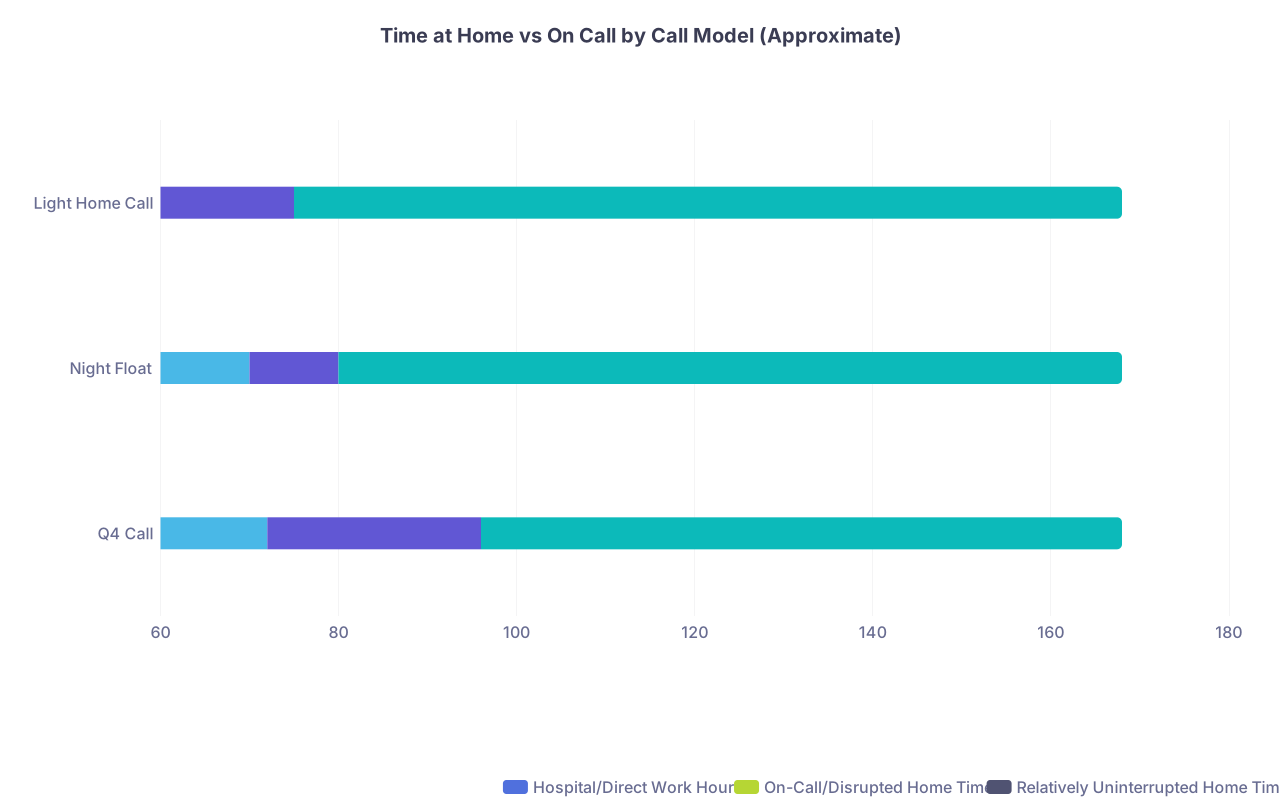
| Category | Hospital/Direct Work Hours | On-Call/Disrupted Home Time | Relatively Uninterrupted Home Time |
|---|---|---|---|
| Q4 Call | 72 | 24 | 72 |
| Night Float | 70 | 10 | 88 |
| Light Home Call | 60 | 15 | 93 |
You are not optimizing only for “time at home.” You are optimizing for predictable blocks of uninterrupted time with your child and some margin for childcare failure.
Step 8: How to Weigh “Prestige” Versus Family Survival
This is where people get stuck.
Program A:
- Top‑tier name.
- Heavy Q3 call.
- Hostile culture to leave and coverage.
- City with expensive housing and poor childcare.
Program B:
- Solid mid‑tier.
- Night float.
- On‑site daycare.
- Reasonable commute.
- Multiple resident parents.
If you are a physician‑parent, in 99% of cases you should rank B over A. Strong language, yes. I stand by it.
Reasons:
- You are not choosing between being a doctor and not. You will still graduate and be board‑eligible.
- The marginal benefit of “renown” does not outweigh three years of family chaos, strained marriage, or physical breakdown.
- Many fellowships and jobs care far less about the line on your badge than you think. Work ethic, letters, and actual performance matter.
There are rare exceptions—hyper‑competitive fellowships, very niche academic careers—but if you are reading this as a physician‑parent already worried about call schedules, you are probably not aiming to sacrifice everything for a slightly shinier program logo.
A Simple Ranking Algorithm for Physician‑Parents
To make this actionable, here is a crude but effective approach:
Split your list into three buckets:
- Absolutely viable as a parent.
- Possibly survivable with lots of support.
- Probably incompatible with your actual life.
Only rank within the first two buckets. Do not rank programs that, if you match there, you already know will destroy your family situation.
Within each bucket, sort primarily by:
- Call model sanity.
- Commute + childcare feasibility.
- Presence of other resident parents + backup systems.
Use reputation, fellowship opportunities, and research alignment as tie‑breakers once the logistics boxes are checked.
That is the inversion: logistics first, prestige later. Not the other way around.
Quick Flow: Should This Program Be High on Your List?

| Step | Description |
|---|---|
| Step 1 | Program Being Considered |
| Step 2 | Rank Low or Not At All |
| Step 3 | Moderate Risk - Proceed Cautiously |
| Step 4 | Good Candidate for High Rank |
| Step 5 | Call model workable with your childcare? |
| Step 6 | Commute + typical hours compatible with drop-off/pickup? |
| Step 7 | Any resident parents here now? |
| Step 8 | Formal backup/jeopardy in place? |
If you run through this mentally and hit “No” on the first two decision points repeatedly, that program has no business in your top tier, no matter what their NIH funding looks like.
Key Takeaways
- Rank programs based on logistical survivability as a parent—call structure, commute, childcare compatibility, and backup coverage—before prestige or vague culture claims.
- Ask concrete, uncomfortable questions about home call frequency, backup for sick‑kid days, maternity/paternity leave precedent, and how many residents are actually parenting there now.
- Do not rank programs that are structurally incompatible with your real life and childcare constraints. You cannot “out‑willpower” a schedule that breaks your family.


