
Research-heavy CVs are not killing your chances at community programs. Your messaging is.
The idea that “too much research” scares away community PDs has become one of those zombie myths in residency advising. It gets repeated on Reddit, in hallway gossip, and by that one attending who matched in 1998 and has been recycling the same advice ever since.
Let me be blunt: there is no credible evidence that community programs systematically reject applicants because they have a strong research CV. What does happen is this: your CV says “physician-scientist,” your personal statement says “I want to do R01-level work and be the next [insert big-name PI],” and you applied to a community-heavy list “just in case.” Programs read that as: flight risk, poor fit, and probably ranking us as a safety.
That is not a research problem. That is a narrative and targeting problem.
Let’s dismantle this properly.
The Myth: “Community Programs Don’t Want Research People”
You’ve probably heard some version of this:
- “If you have too much research, community PDs will think you’re not serious about clinical work.”
- “They’ll assume you’re using them as a backup.”
- “You should hide publications or leave off some projects.”
I’ve watched students literally ask if they should delete first-author PubMed papers to “look more community-focused.” That’s insanity.
Here’s what the data and actual PD behavior show instead.
What community PDs actually screen for
Most community programs are not sitting there categorizing applicants into “too academic” and “just right.” They are looking at:
- Can this person safely take care of patients?
- Will they show up, work hard, and not cause drama?
- Are they likely to stay in our region or practice community medicine after residency?
- Do they seem like they will be happy here, or are they going to resent spending three years without robust research infrastructure?
Research volume is noise compared to those questions.
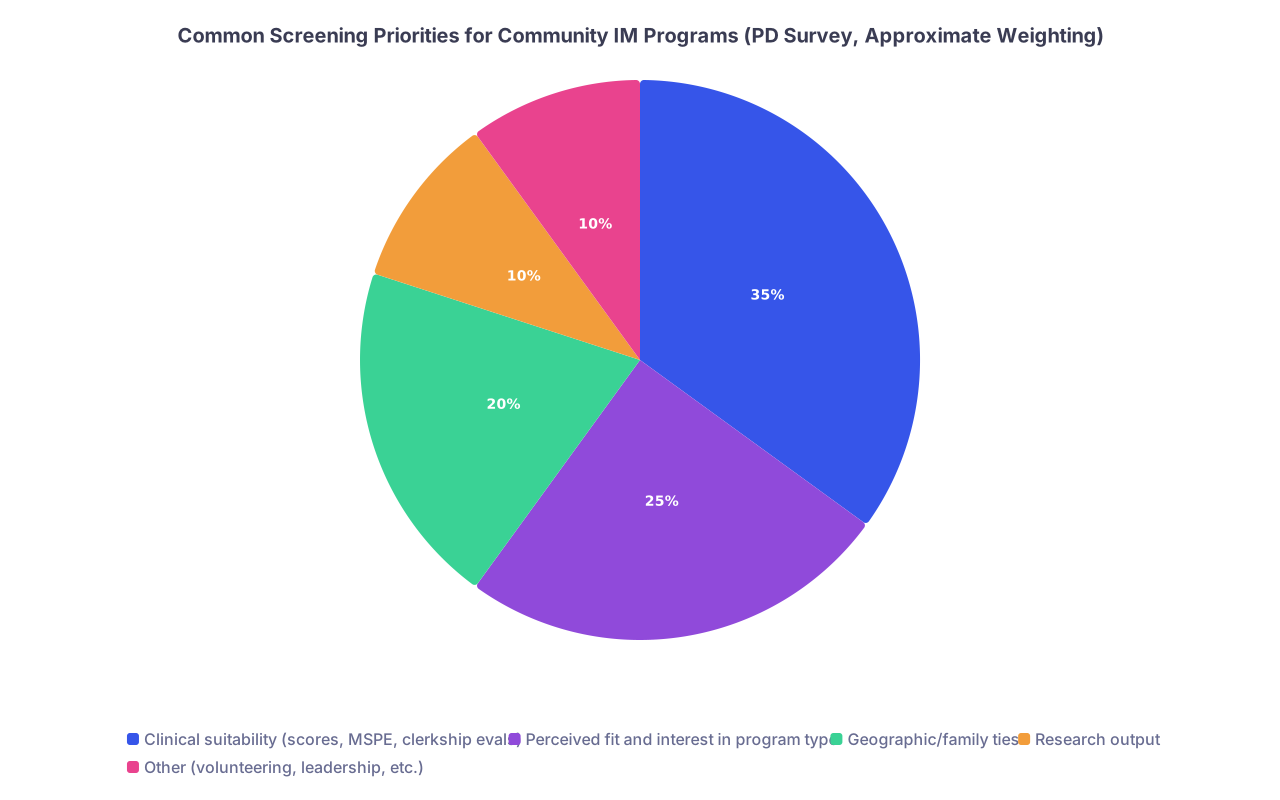
| Category | Value |
|---|---|
| Clinical suitability (scores, MSPE, clerkship evals) | 35 |
| Perceived fit and interest in program type | 25 |
| Geographic/family ties | 20 |
| Research output | 10 |
| Other (volunteering, leadership, etc.) | 10 |
Does research matter? Sure. But not the way the myth says it does. It’s not a negative; it’s just rarely a strong positive for community-heavy programs unless they explicitly brand themselves as “community-based with strong academic ties.”
What raises eyebrows is not the number of publications. It’s the story you tell around them.
The Real Red Flags: Mismatch, Not Merit
Where people get burned is not from the CV itself, but from being wildly misaligned with the program’s identity.
Pattern 1: The “I bleed R01” personal statement
I’ve seen this exact pattern multiple times:
- Applicant: 10+ pubs, couple of first-author papers, year-out research fellowship at a big-name academic center.
- Personal statement: “My ultimate goal is to lead an NIH-funded translational lab and spend the majority of my time on research with a subspecialty focus.”
- Application list: 40 programs, including 10 high-Octane academic powerhouses and 20 small community programs that have no research infrastructure and maybe one IRB.
Then they’re surprised when:
- Academic programs are interested.
- Some mid-tier university-affiliated community programs bite.
- Smaller community programs either ghost them or grill them in interviews: “So…why us?”
Because if your stated endgame is 70% research time and a K award, what are you realistically doing applying to a place whose biggest academic undertaking is a quality-improvement project on reducing unnecessary labs?
The PD doesn’t think, “Too much research = bad.” They think, “This applicant will be miserable here and leave at the first opportunity. Pass.”
Pattern 2: The “Safety school” attitude
Community PDs talk to each other. They know which programs are commonly treated as backups.
What they do not appreciate is the applicant who:
- Can say everything about their RCT but nothing specific about the program.
- Has zero mention of community practice, underserved care, or regional ties anywhere.
- Does not even bother to adapt their personal statement for community vs academic program types.
That reads as: “I don’t want to be here, but I need somewhere to land.”
Is that because of research? No. But a heavy research CV amplifies the impression that your real home should be at a big university.
What the Data and Match Outcomes Actually Suggest
We do not have a giant database labeled “rejected because too much research.” But we do have enough signal from NRMP data, specialty match trends, and PD surveys to say this much confidently:
- Research is net-positive for competitive specialties and academic tracks.
- Research is neutral-to-slight-positive for most community programs.
- The key determinant for community interview invites is still exam performance, clinical evaluations, and fit.
Look at the NRMP Program Director Survey (various years). Research output is consistently below Step 2, clerkship grades, MSPE comments, and perceived interest in the program on the list of factors PDs rank as “very important.” It’s not high enough to be a major positive discriminator. It’s definitely not flagged as a negative discriminator.
The bigger story is fit.
, [Clerkship grades/evals](https://residencyadvisor.com/resources/residency-application-guide/what-pds-actually-weigh-more-ms3-clerkship-grades-vs-step-2-ck), Personal statement/fit, Letters of recommendation, Research experience](https://cdn.residencyadvisor.com/images/articles_svg/chart-ranked-importance-of-application-components-in-com-5089.svg "Ranked Importance of Application Components in Community vs Academic Internal Medicine Programs (Simplified)")
| Category | Value |
|---|---|
| [Step 2 CK score](https://residencyadvisor.com/resources/residency-application-guide/is-matching-only-about-step-2-ck-data-on-holistic-review-vs-scores) | 95 |
| [Clerkship grades/evals](https://residencyadvisor.com/resources/residency-application-guide/what-pds-actually-weigh-more-ms3-clerkship-grades-vs-step-2-ck) | 90 |
| Personal statement/fit | 80 |
| Letters of recommendation | 85 |
| Research experience | 40 |
Those numbers are illustrative, not literal, but they match survey trends: research matters far less than clinical and professionalism indicators. And nowhere do PDs say “we reject strong research applicants because…research.”
What does show up in conversations with community PDs is concern about:
- Applicants who sound like they “settled” for community training.
- Applicants whose future goals obviously demand heavy academic support they simply do not offer.
- Applicants whose geography and life story don’t line up with realistic retention.
This again is narrative, not CV content.
When a Research-Heavy CV Is Actually an Asset
Here’s the part no one bothers to tell you: many community programs like having a few residents who are research-inclined. They just do not want everyone to be that person.
Why? Because:
- Those residents often drive QI, M&M changes, and small projects that look good for accreditation.
- They help the program claim “scholarly output” on applications and reviews.
- Applicants with research experience often have better habits with data, documentation, and systematic thinking.
I’ve watched this play out:
- A community IM program with minimal research history starts pushing residents to present at local ACP/state conferences.
- They match a research-heavy applicant who didn’t land their dream academic spot but genuinely wanted a community setting near family.
- That resident becomes the go-to person for figuring out basic QI methodology, abstracts, and posters.
- Three years later, the program has a small but visible presence at state/regional meetings and starts advertising “academic opportunities” on their website.
Was the research CV a liability? No. It was one of the more valuable things that applicant brought—because they framed it right:
“I’ve done significant research and I’m proud of it. But I’m not chasing a 70% protected time academic job. What I want now is to become an excellent clinician, ideally in a community setting like this, and use my research skills for QI and occasional projects, not as my primary identity.”
That’s alignment. And PDs can work with that.
Fixing the Real Problem: How You Present Yourself
If you have a research-heavy CV and you’re applying to community programs, you do not need to “hide” your publications. That looks weird and dishonest anyway. You need to control the story.
1. Clean up the CV, don’t erase it
Do not invent busywork or pad fluff to “dilute” research. Just format wisely:
- Group small abstracts/posters together so your CV doesn’t look like a 5-page NIH biosketch.
- Highlight clinical/QI/education-themed projects more prominently.
- Put clinical and teaching experiences above research if you are worried about the initial impression.
You’re not apologizing for research. You’re just making it obvious you’re a clinician first.
2. Rewrite your personal statement for community programs
If your personal statement screams “physician-scientist” and then you apply to 25 community programs, that’s on you.
For community-focused versions, you should explicitly:
- Emphasize patient care as your primary motivation.
- Mention any real local or regional ties, family, or long-term plans aligned with community practice.
- Reframe your research as tools you bring to improve care, not as your main career goal.
Bad line for a community PS:
“My long-term goal is to run an independent translational lab while practicing subspecialty medicine in a large academic center.”
Better line:
“My research training has given me a framework for asking questions and analyzing data, but my primary goal is to be a strong clinician in a community setting, where I can apply those skills to improve everyday patient care and local quality initiatives.”
Same CV. Very different message.
3. Anticipate the “Why us?” question and stop giving academic answers
If a community PD asks, “Why this program?” and all you can manage is:
“Well, I know you have some research opportunities, and I really want to continue my research…”
—you just torpedoed your fit.
A research-heavy applicant who gets this right says something like:
“I’ve done plenty of research and I’m glad I did. But for residency, I want high-volume, broad clinical exposure and close-knit mentorship. This program’s patient population and teaching reputation match that. If research or QI opportunities come up, I’d be excited to help, but that’s secondary to training as a clinician.”
Notice: same history. Different framing. One sounds like a future PI forced to be here. The other sounds like a serious clinician who happens to have extra skills.
Where Research Can Actually Hurt You
There are scenarios where your research might legitimately backfire with community programs—just not for the reason you think.
1. Obvious “I’m reapplying only to upgrade” vibes
If you did TY/prelim, spent a year doing research at a big academic name, and now only tacked on a handful of community categoricals “just in case,” PDs can smell the strategy.
If your whole year out is branded as, “I wanted to strengthen my profile for more academic options,” and now you’re applying to places that look nothing like your stated dream jobs, they will question whether you’re going to stay or try to scramble somewhere else.
2. Unrealistic future plan given the program’s resources
If you keep telling people you want high-powered bench or outcomes research, submit K-award-style goals, and apply almost exclusively to programs that literally do not have the infrastructure to support that, you look naive at best and disingenuous at worst.
It’s like telling a rural family medicine program that your goal is to do multi-organ transplants. It’s not offensive. It’s just…off.
So, Should You “Tone Down” Research for Community Programs?
No. You should stop being lazy about your narrative.
You do not solve a fit problem by mutilating your CV. You solve it by:
- Applying to programs that actually match your realistic goals.
- Writing a personal statement that reflects those goals consistently.
- Communicating in interviews like someone who chose those programs deliberately, not out of desperation.
If your real, honest career vision demands a strong academic environment, then yes—go chase that. Do not expect community-only programs to magically morph into something they are not. But if you truly want a solid, clinically heavy training with maybe some light research or QI on the side, your research-heavy CV is not a liability. It is a bonus—if you make it clear you are not using them as a stepping stone to somewhere you’d rather be.
To put it in perspective:
| Program Type | How Research Is Usually Viewed |
|---|---|
| Top academic, research-intensive | Strong positive, often expected |
| Mid-tier university-affiliated community | Mild-to-strong positive, extra plus |
| Pure community with minimal research | Neutral to mild positive, not required |
| Community with academic aspirations | Strong positive if fit is believable |
And in reality, the gatekeepers are thinking about timelines, capacity, and survival:

| Step | Description |
|---|---|
| Step 1 | Research-heavy CV |
| Step 2 | Perceived flight risk -> Lower rank or reject |
| Step 3 | Research seen as asset -> Interview/rank favorably |
| Step 4 | Stated goals align with community practice? |
| Step 5 | Willing to prioritize clinical training? |
Your job is to get yourself into the “Yes/Yes” box.
Final Takeaways
- Research-heavy CVs are not inherently a liability for community programs; misaligned goals and “backup” vibes are.
- You do not fix the problem by deleting publications—you fix it by applying strategically and telling a consistent, believable story about why you want a community-focused, clinically heavy residency.
- If you truly want community training, your research is an asset. Frame it as tools you’ll use to be a better clinician and to contribute to local QI, not as the center of your identity.