
The worst way to build a rank list with a long-distance partner is to pretend it’s a solo decision and “figure it out later.”
You are not just ranking programs. You’re ranking lives. Your life, their life, and the version of both of you that exists in the same zip code instead of on FaceTime at 11:30 p.m. after call.
Let me walk you through how to structure this like adults who actually want it to work—because I’ve watched couples do this well, and I’ve watched some blow it up in spectacular fashion.
Step 1: Decide What Kind of Couple You Are for the Match
Before you touch a rank list, you and your partner need a definition. Not vague “we’re serious.” I mean: what kind of application couple are you this year?
There are four basic categories:
| Type | Core Situation |
|---|---|
| Both in the Match | Two applicants in NRMP, can formally couples match |
| One in Match, One in Training | Applicant + resident/fellow already somewhere |
| One in Match, One Non-Medical | Applicant + partner in non-med job/school |
| Both Non-Couples Match | Serious but not linking lists in NRMP |
Here’s what they actually look like on the ground.
Both applying to residency (or fellowship)
You’re eligible for the NRMP couples match. If you’re not using it, you’d better have an unusually good reason. Your decisions are structurally linked, whether you admit it or not.You’re applying; they’re already in residency/fellowship
Classic: you’re MS4, they’re PGY-1 or PGY-2. Their program location is essentially a fixed point. Your options orbit that point within some realistic radius.You’re applying; they’re non-medical (job, grad school, etc.)
Their flexibility matters a lot. Can they relocate? Remote work? Or are they truly location locked? You need explicit constraints, not vibes.You’re “serious” but not willing to couple or relocate yet
Fine. Then say that out loud. Own that you’re prioritizing training/location over co-location for now, and stop pretending otherwise. The rank list will reflect that.
Pick which bucket you are in. Say it out loud to each other. That choice shapes everything else.
Step 2: Lock Down Your Non-Negotiables (Individually, Then Together)
Most couples start here wrong. They jump straight to: “OK, where could we both live?” Too vague. Too emotional. You need constraints first.
Do this in two phases.
2A: Each of you makes a solo list
Alone, no screen sharing, no softening answers to be nice.
For the person in the Match, list out:
- Minimum program quality you’ll accept (sorry, you have one, even if you’re pretending you do not).
- Regions you’ll not live in (weather, family, politics, whatever; be honest).
- Lifestyle constraints:
- Must be near airport?
- Not willing to live rural?
- Cost-of-living ceiling?
- Deal-breakers:
- No trauma-heavy county program?
- Must have strong subspecialty exposure?
- Cannot handle malignant reputation?
For the partner (whether medical or not):
- Job/training realities: where can you realistically work or train? With what timeline?
- Immigration/visa issues (this gets ignored until it explodes).
- Ties you truly will not break: dependent family, custody issues, contract penalties.
- Personal deal-breakers: absolutely won’t move to X, can’t handle Y.
Then trade lists.
You’re not negotiating yet. You’re exposing reality. If you discover your lists are in different universes (you want West Coast only, they’re locked East Coast), you’ve got a relationship conversation before you have an NRMP conversation.
2B: Build a shared constraint set
Now, together, make a joint set of rules:
- Regions that are viable for both of you.
- Regions that are dead (for either of you, therefore for both).
- Maximum acceptable distance if you do end up long-distance (e.g., must be direct-flight reachable; not > 6 hours; not different coasts).
If you skip this and jump straight to obsessing over specific programs, you’re going to have circular, exhausting conversations and last‑minute panic.
Step 3: Use a Simple, Ruthless Framework for City Tiers
The core question with a long-distance partner or spouse is not just “Which program is best?” It’s “Which cities work best for us?”
You can’t do this in your head. Build tiers.
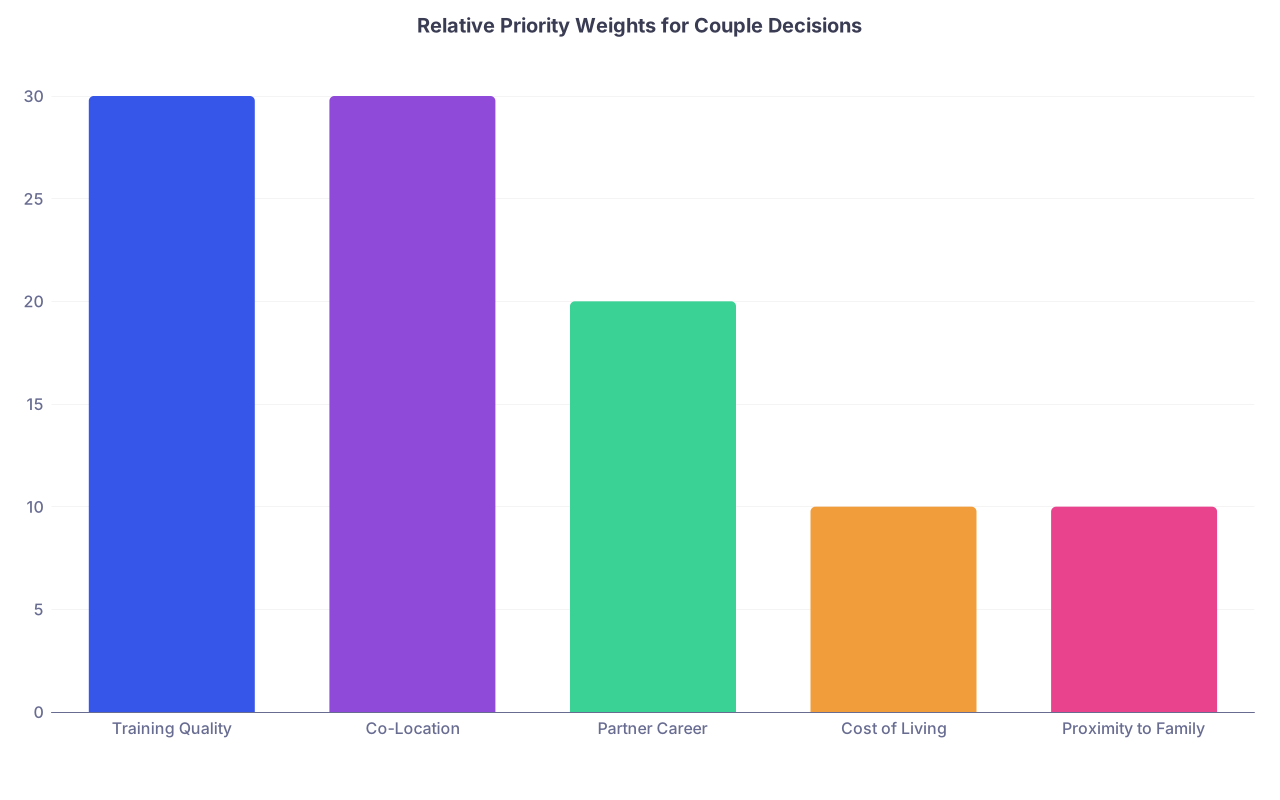
| Category | Value |
|---|---|
| Training Quality | 30 |
| Co-Location | 30 |
| Partner Career | 20 |
| Cost of Living | 10 |
| Proximity to Family | 10 |
Those numbers are an example. You need your own. But you get the idea.
Now:
- List all cities/regions where you have interviews (for the applicant) and realistic options (for the partner).
- For each city, rate 1–5 on:
- Program quality for the applicant
- Immediate or near-term job/training options for the partner
- Long-term life appeal (do you actually see yourselves there for 3–7 years?)
- Force cities into tiers:
- Tier 1: Strong for both people
- Tier 2: Strong for one, acceptable for the other
- Tier 3: Only works if everything else fails
- Tier X: No. Even if it’s the only match.
Once you have tiers, your rank list is not built program-by-program from scratch. It’s assembled inside city tiers, with program quality driving order within those tiers.
Step 4: If You’re Couples Matching: How to Structure the Actual Lists
The couples match seems complicated. It is. But the logic is actually straightforward when you stop panicking.
Think in pairs:
- Every rank is (Your program choice, Their program choice).
- The algorithm tries pair #1 first; if it cannot match you both in that pair, it goes to pair #2, and so on.
Most couples mess up in two ways:
- They don’t rank enough combinations.
- They don’t intentionally plan their “break glass in case we can’t be together” options.
4A: Start with “together in Tier 1 cities”
Take your Tier 1 cities where you both have programs.
Inside each city:
- List all realistic programs for you.
- List all realistic programs for them.
Rank all the combinations you’d be happy enough with—best joint outcome first.
Example for both applying in the same metro:
- (You: University Hospital IM, Them: University Hospital EM)
- (You: University Hospital IM, Them: County EM)
- (You: Community IM A, Them: University Hospital EM)
- (You: Community IM A, Them: County EM)
Do that for each Tier 1 city, ordered by how much you both want that city.
4B: Then “together in Tier 2 cities”
Same logic, but you’re both admitting: this city is a compromise for at least one of you.
You still list every viable combination, but you warn yourselves: if we’re here, it’s not ideal. You only put these below all the Tier 1 pairs you both clearly prefer.
4C: Now the hard part – planned “apart” scenarios
You need to answer this blunt question:
“If we can’t both match in the same city, how far are we willing to separate rather than not match at all?”
This is where couples either get honest or get hurt.
Two structured options:
Option 1: Together or bust
You only rank pairs where you’re in the same region. No long-distance scenarios. This is higher risk for one or both not matching, especially in competitive specialties.Option 2: Together if possible, else long-distance
After all “same city” pairs, you start ranking:- (You: Good solo option, Them: No match)
- (You: No match, Them: Good solo option)
- or “different city” pairs, if that’s allowed by your agreement.
You two must answer:
- Who, if anyone, is willing to not match if the other can match somewhere good?
- Are you willing to do 1–2 years apart and then aim for transfer/fellowship alignment?
Write that answer down. In plain language. Then build pairs that reflect it.
I’ve seen couples say “We’ll never do distance” and then secretly rank solo outcomes anyway. That’s how you end up with betrayal on Match Day. Do not do that.
Step 5: If Only One Partner Is in the Match
This is more common than pure couples match, and often messier. Two main flavors:
5A: Partner already in residency/fellowship
Reality: their program is a mostly fixed point for the next 2–5 years.
Here’s the move:
Draw a realistic radius:
- Same city = ideal
- Same metro region/commutable = doable
- Short‑flight distance = acceptable long-distance
Be specific. “Same time zone” is not a plan.
Inside that radius, categorize your interviews:
- “Best training + near partner”
- “OK training + near partner”
- “Better training, but long-distance”
Decide your hierarchy:
You’re essentially choosing between two statements:
- “I’d rather train slightly worse but be with you.”
- “I’d rather train better and accept long-distance for X years.”
You can’t have both as your #1 priority.
Once you pick, your rank list becomes straightforward:
If together > prestige:
Rank all solid-near-partner programs above any far‑away program, unless the far‑away program is truly career-changing (think: dream specialty track you can only get there).If training > location:
Rank your dream programs first, regardless of distance. Then, among the remaining programs of similar tier, prefer ones closer to your partner.
But do not lie to yourself. If your actions say “training first” but you’re saying “you’re my priority,” resentment will show up by October of PGY-1.
5B: Partner is non-medical but mobile (or semi‑mobile)
Their flexibility matters. But it is not infinite.
Tactically:
- Have them research: remote roles, transfers within their company, grad programs in your potential cities.
- For each city where you have interviews, ask them:
- “Could you realistically be working or in school there within 12–18 months?”
- Not “in theory.” Real job postings, real programs, real visa options.
Rank list logic becomes:
- Tier 1: Great training + partner can realistically relocate.
- Tier 2: Great training + partner has thinner but still real options.
- Tier 3: Great training, but no realistic path for them in next 2–3 years (these go lower, unless you’re both consciously choosing a high‑sacrifice period).
Step 6: Use a Real Tool, Not Vague Mental Tracking
Do not do this in your head or in an endless text thread.
Build something simple and concrete:

| Step | Description |
|---|---|
| Step 1 | List all interview cities |
| Step 2 | Assign city tiers |
| Step 3 | Rate program quality per city |
| Step 4 | Assess partner options per city |
| Step 5 | Create draft rank order |
| Step 6 | Compare against joint priorities |
| Step 7 | Finalize lists in NRMP |
You can use:
- A Google Sheet with:
- Row = program
- Columns = city, your rating, partner rating, distance from partner, tier, notes
- Color coding:
- Green = both like
- Yellow = one compromised
- Red = basically only if you’re desperate to match
You sit down together (same room if possible, video if not) and literally go row by row. No phones, no multitasking. And you ask:
“For this program, in this city, what does our life look like day-to-day?”
You want concrete, not abstract:
- “I’d be on q4 call, you’d be driving 45 minutes to a job you kind of hate.”
- “We’d share a 1‑bedroom in a walkable area, you’d have 3 job options, my commute is 20 minutes.”
When you both can picture the life, ranking that program becomes easy.
Step 7: Plan for the Emotional Fallout Before Match Day
Most couples wildly underestimate the emotional weight of this process. You’re making trade-offs between:
- Career vs relationship
- Proximity vs training
- Short-term sacrifice vs long-term plan
Someone is going to feel like they gave up more.
So you pre‑empt that in three ways.
Say explicitly what you’re each sacrificing.
Literally: “I’m giving up X (prestige, location, family proximity) to prioritize us.” Both of you should have at least one sentence like that on the table.Agree on a review point.
Example: “At the end of PGY-1, we’ll reassess geography and career plans and see if any adjustments (transfers, jobs, fellowships) make sense.”Decide how you’ll talk about “if this doesn’t work.”
No one wants to think about breaking up or divorce while planning a rank list. But ignoring that possibility makes people act insane. So you say:
“If we end up apart despite our plan, or this really hurts one of us, we’ll handle that like adults—not by blaming the algorithm or pretending the decision was forced.”
You don’t need a full relationship contract. But you do need some shared language about what you’re trying to do together.
Common Dumb Moves to Avoid (I’ve Seen All of These)
Let me be blunt for a second.
Saying “We’ll figure it out after we match.”
Translation: “We’re avoiding hard conversations until reality hits.” That’s how engagements end on Match Day.Letting parents drive location priorities.
Your mom’s opinion of your fiancé is not an input for your rank list.Pretending competitiveness doesn’t matter.
If you’re applying derm and your partner is applying FM, you cannot pretend you have equal leverage. You talk about it. You respect it.Secret backup lists.
If you or your partner are building a “just in case” rank order they don’t know about, that’s not “being practical.” That’s lying.Using the Match to test the relationship.
“If we match near each other, it was meant to be; if not, it wasn’t.” No. The algorithm is not your therapist. You make a decision about the relationship first; then you write a list that matches that decision.
A Concrete Example: How This Plays Out
Let’s say:
- You: Applying Internal Medicine, mid-high competitiveness, interviews in: Boston, Philly, Chicago, Denver, random Midwest town.
- Partner: Already PGY-1 in Psychiatry in Chicago, contract solid for 3 more years.
Joint reality:
- Tier 1 city: Chicago (they’re already there, plenty of IM programs for you).
- Tier 2: Nearby Midwest city you could both drive between on weekends.
- Tier 3: Cool places for you (Denver, Boston) that would mean long-distance.
Joint decision:
- You both say: “We prioritize co-location, but if you can get a top-tier academic IM spot in Boston or Denver, we’d consider long-distance for 3 years.”
Rank logic:
1–6: All reasonable Chicago IM programs, ordered by your preference.
7–9: Nearby Midwest city programs (partner could maybe transfer later or commute on some weekends).
10–11: Boston and Denver powerhouse programs where you’d accept distance.
12: The random Midwest town community program you’d honestly hate (or you drop it entirely).
You’re not hand-waving it. You’ve spoken the trade-offs out loud. If you end up in Boston while they’re in Chicago, that isn’t “the algorithm did us dirty.” It’s: “We agreed that this level of training was worth a few years of distance, and we’ll reassess at fellowship.”
What You Should Do Today
Do not open ERAS. Don’t open NRMP yet.
Do this instead:
Text or call your partner and say this exact line:
“Let’s set aside 60–90 minutes this week to decide what kind of couple we are for the Match and what our non‑negotiables are. No rank list editing, just decisions.”
Then put that on the calendar as if it’s a real meeting. Because it is.