
The NRMP Match does not care about your visa problems—but every program director does.
If you get this wrong, you can match and still lose the spot. I’ve seen it: ecstatic emails on Match Day, followed by panic when GME tells them, “We can’t get your visa in time.” Your rank list, your interviews, your Step scores—none of that will matter if your immigration situation is a mess.
Let’s fix that.
This is a survival guide for managing visa and immigration issues specifically in the context of the NRMP Match timeline. Not generic “talk to a lawyer” fluff. We’re going month-by-month, scenario-by-scenario.
1. First, figure out what kind of applicant you are
Before you look at visas, you need to know what bucket you fall into. Different bucket, different landmines.

Your situation is probably one of these:
- US Citizen or Permanent Resident (green card)
- Non-US Citizen IMG currently in the US on F‑1 (student visa)
- Non-US Citizen IMG currently in the US on another status (J‑2, H‑4, etc.)
- Non-US Citizen IMG living abroad with no current US status
- Current J‑1 clinical trainee (e.g., prelim year, research, or other training)
Here’s the blunt truth for each.
US Citizen / Green Card
You can skip 80% of the immigration stress. Your key tasks:
- Make sure programs know you do not need visa sponsorship.
- Answer ERAS questions correctly—do not accidentally flag yourself as needing sponsorship.
- Have your documentation ready (passport, green card, naturalization certificate).
You’re here mainly to understand why everyone else is freaking out.
F‑1 Student (US med school or US grad program)
Your whole game is about timing and work authorization (OPT/STEM OPT) vs. when residency starts.
Key questions:
- When do you graduate (exact date)?
- When does your program start (exact date—usually July 1)?
- Do you qualify for:
- Regular post-completion OPT (12 months)
- STEM OPT extension (additional 24 months for STEM degrees)
Your main risk: a gap between when you can legally start working and when residency starts—or graduating too late to get your EAD card in time.
IMG in the US on other status (H‑4, J‑2, etc.)
Sometimes you can get work authorization through your spouse’s status. Sometimes you cannot. And each has traps:
- J‑2: eligible for EAD, but that doesn’t solve long-term residency visa issues.
- H‑4: may or may not be eligible for EAD depending on spouse’s situation.
- B‑1/B‑2: you’re basically not allowed to work or train. This won’t work for residency.
You need a long-term plan—you will still likely end up needing J‑1 or H‑1B sponsored by the hospital.
IMG abroad / no US status
Your only realistic paths for residency:
- J‑1 (ECFMG-sponsored)
- H‑1B (program-sponsored), if they offer it
- Rare categories (O‑1, etc.)—ignore these unless an attorney specifically says you’re a fit.
Your problem: programs are risk-averse. If they think your visa is going to be a headache or impossible, you slide down the rank list.
Current J‑1 clinical trainee
If you’re already on a J‑1 for training, you’re in a trickiest category:
- You’re usually subject to a 2-year home residency requirement.
- That can limit your ability to change to H‑1B later.
- Extensions, transfers, and waiver timing are all critical.
You absolutely should have an immigration lawyer. Not “maybe”. This gets ugly fast if you try to DIY.
2. Understand the visa options in residency language, not theory
Forget generic descriptions. You need to know how these visas behave in the Match context.
| Visa Type | Who Sponsors It | Common Use |
|---|---|---|
| J-1 | ECFMG via hospital | Most IMGs in residency |
| H-1B | Hospital/program | Some IMGs, esp. in IM/Neuro/FM |
| F-1 OPT | USCIS (school-recommended) | US grads bridging to J-1/H-1B |
| O-1 | Hospital with heavy attorney input | Rare, for exceptional CVs |
J‑1 (ECFMG-sponsored)
Reality: This is the default for most IMGs.
Pros:
- Common. Hospitals know the process.
- ECFMG controls much of the paperwork, so GME offices are familiar with it.
- Multiple specialties accept and expect J‑1 trainees.
Cons:
- 2-year home-country physical presence requirement afterward, unless waived.
- Some specialties or states strongly prefer H‑1B for people planning to stay.
- J‑1 extensions and transfers have hard timelines.
Match implication: You must show programs you are J‑1 ready—meaning ECFMG certified, exams done, documentation in order.
H‑1B (cap-exempt, hospital-based)
Not the tech-company lottery version. Hospital H‑1Bs are cap-exempt, which helps.
Pros:
- Dual intent (easier for long-term immigration planning).
- No 2-year home requirement like J‑1.
- Often preferred by applicants who want to stay in the US.
Cons:
- Fewer programs sponsor H‑1B.
- Must have all USMLE Steps (including Step 3, in most cases) by a certain date.
- More expensive and more paperwork for programs.
Match implication: If you insist on H‑1B but don’t have Step 3 by interviews, you’re hurting yourself. Programs will quietly pass.
F‑1 + OPT
This is a bridge, not a destination.
Used when:
- You’re graduating from a US medical school or grad program on F‑1.
- Residency wants you to start while your long-term status is being arranged (often J‑1 or H‑1B).
The catch: USCIS processing time. EAD cards can be late. I’ve seen residents start a month late because their OPT was stuck in processing.
O‑1, others
Ignore unless:
- You have crazy research output (e.g., 40+ publications, major awards).
- A program explicitly suggests it and offers their attorney.
These are niche. They’re not your starting plan.
3. Anchor everything to the NRMP Match timeline
You can’t manage immigration stress without anchoring it to actual dates.
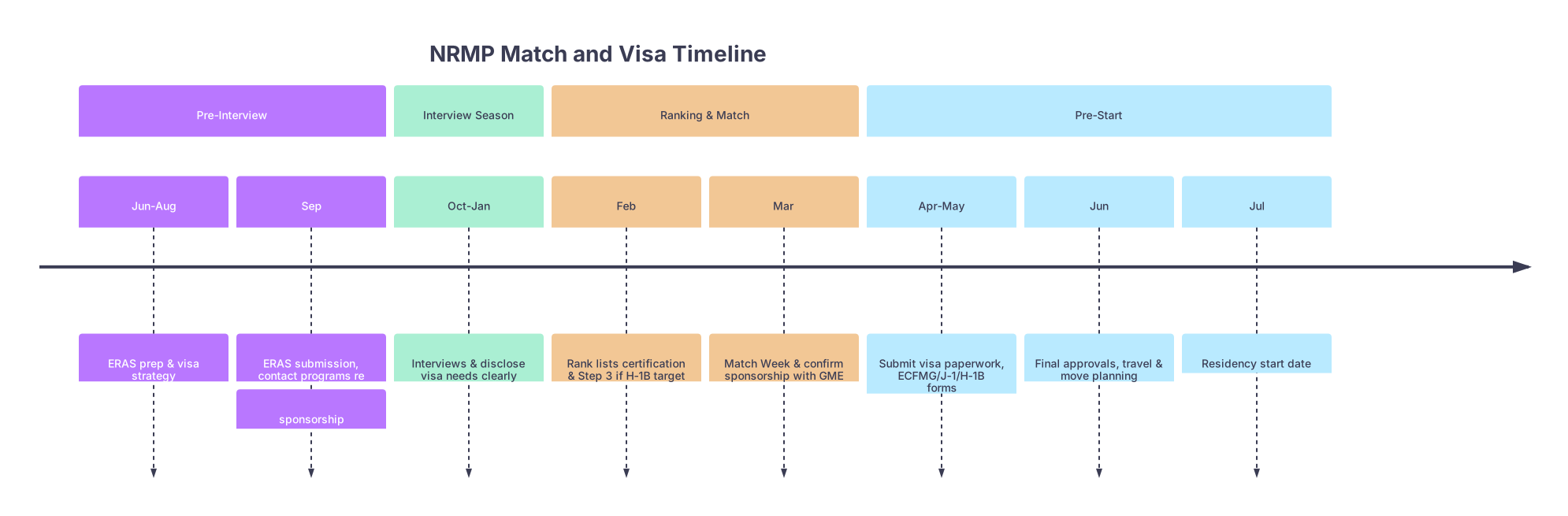
| Period | Event |
|---|---|
| Pre-Interview - Jun-Aug | ERAS prep & visa strategy |
| Pre-Interview - Sep | ERAS submission, contact programs re |
| Interview Season - Oct-Jan | Interviews & disclose visa needs clearly |
| Ranking & Match - Feb | Rank lists certification & Step 3 if H-1B target |
| Ranking & Match - Mar | Match Week & confirm sponsorship with GME |
| Pre-Start - Apr-May | Submit visa paperwork, ECFMG/J-1/H-1B forms |
| Pre-Start - Jun | Final approvals, travel & move planning |
| Pre-Start - Jul | Residency start date |
Let’s walk what you should be doing, step-by-step.
4. June–September (before ERAS opens / just opened): Set your visa story
This is the most underrated time for visa planning. People waste it.
Here’s what to do in this window:
Decide your preferred visa path
- If you’re an IMG abroad: assume J‑1 unless you have Step 3 and strong H‑1B-friendly programs.
- If you’re on F‑1: decide if OPT is your bridge or if you’re going straight to J‑1/H‑1B.
Audit your status and documents
- Passport validity (do not start this process with a passport expiring in under a year).
- USMLE transcripts, ECFMG status, degree verification.
- I‑20s, DS‑2019s, I‑94s if you’re already in the US.
Update your ERAS application accurately
- Question: “Do you require visa sponsorship?” If you need J‑1 or H‑1B, answer yes.
- Don’t play word games. Programs hate surprises. A candidate who “forgot” they need a visa moves down the list fast.
Build your “visa script” You will be asked about your visa status. Repeatedly. Have a clean 2–3 sentence answer.
Example for IMG abroad:
- “I’m currently living in India and will require J‑1 sponsorship. I’m ECFMG certified and will be fully prepared to start the ECFMG J‑1 process immediately after Match.”
Example for F‑1:
- “I’m currently on an F‑1 visa at [School]. I’m planning to use post-completion OPT to begin residency and am open to either J‑1 or H‑1B sponsorship as your institution prefers.”
If you’re fuzzy or vague in September, you’ll be in chaos by March.
5. October–January (interview season): What to say and what to ask
This is where most people mess up. They either overshare their visa drama or hide it entirely.
You need a middle path: clear, calm, low-drama, solutions-oriented.
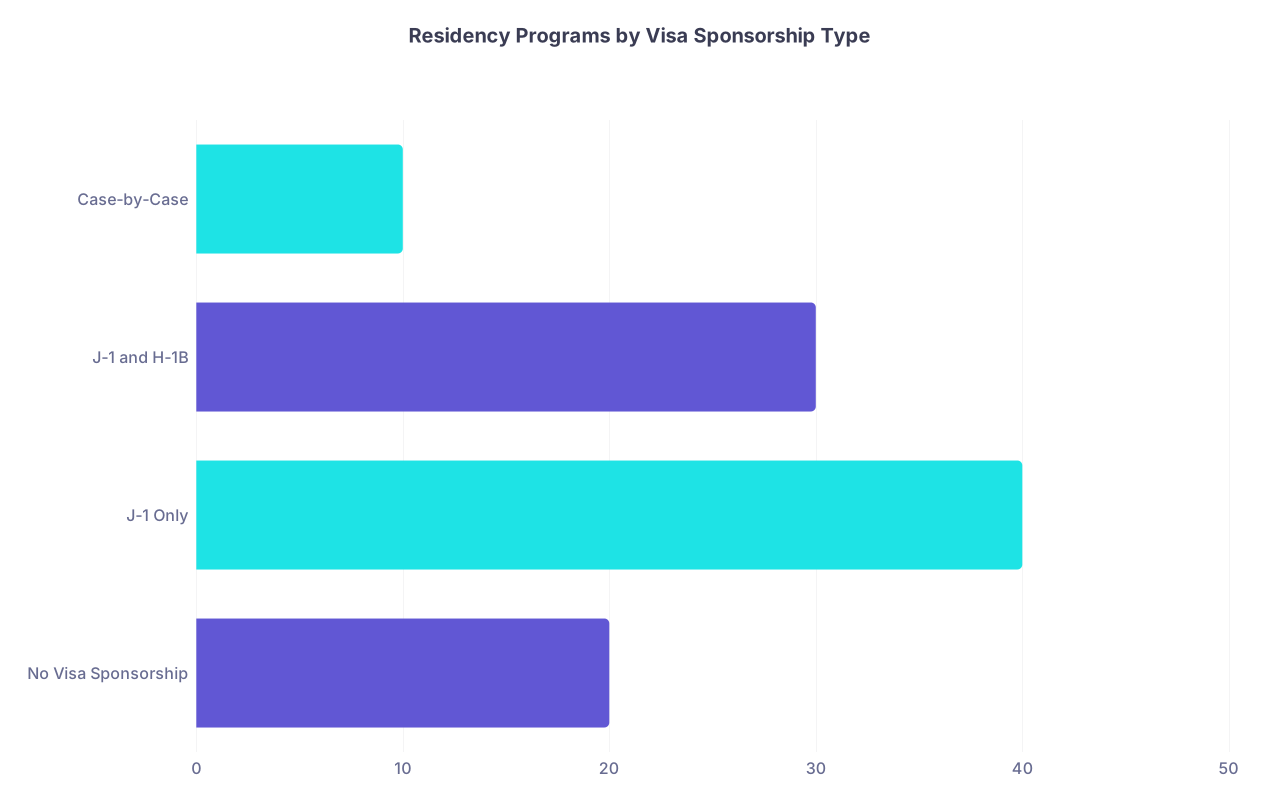
| Category | Value |
|---|---|
| No Visa Sponsorship | 20 |
| J-1 Only | 40 |
| J-1 and H-1B | 30 |
| Case-by-Case | 10 |
When they ask: “What’s your visa status?”
Your answer should include:
- What you are now
- What you will need
- Why you’re low risk
Example (IMG abroad, J‑1 plan):
- “I’m currently living in Pakistan and have no US immigration status. For residency I’ll need J‑1 sponsorship. I’m ECFMG certified, my documents are up to date, and I understand the ECFMG J‑1 process and timeline well.”
Example (H‑1B hopeful with Step 3 done):
- “I’m currently on F‑1 status, graduating in May. I’ve completed Step 3 and am eligible for H‑1B. I understand some programs don’t sponsor H‑1B, and I’m open to J‑1 if that’s your institutional policy.”
Questions you should be asking programs
Don’t ask it like a random anxious applicant. Ask like someone who knows what they’re doing.
You can ask the program coordinator or PD (pick who feels more appropriate):
- “Does your institution sponsor J‑1, H‑1B, or both for residency?”
- “Do you have any internal deadlines by which exams must be completed for H‑1B sponsorship?”
- “Have there been any recent delays or issues for residents starting on visas?”
That last question is key. If they say, “Yeah, last year two residents started late because of paperwork,” that’s your warning.
What not to do in interviews
- Don’t argue for H‑1B if they clearly say they don’t sponsor it.
- Don’t spend 10 minutes dumping your entire immigration backstory.
- Don’t sound unsure: “I’m not really sure, I think maybe H‑1B? Or J‑1? I’ll see…”—that’s death.
You’re not required to be a visa expert. But you must sound like you can follow a process and meet deadlines.
6. February–Match Week: Lock your plan and prepare to move fast
By February, you should know:
- Which programs on your list actually sponsor your needed visa.
- Whether they are J‑1-only, H‑1B-friendly, or flexible.
- What each institution’s internal deadlines are (Step 3 by X date, paperwork by Y date).
If you don’t know this and you’re entering rank list certification week, you’re gambling.
If you’re targeting H‑1B
By February:
- Step 3 should be done or scheduled with realistic result timing.
- Confirm with programs: “If I match here, and my Step 3 result is available by [date], would that meet your H‑1B requirement?”
If a program says:
- “We require Step 3 before ranking” and you don’t have it—assume they will not rank you for H‑1B.
- “We’re flexible; as long as you have it by May, we can work with that”—write that down.
If you’re shaky on Step 3 timing, don’t bet your career on H‑1B. Prioritize J‑1-safe programs higher on your list.
If you’re planning J‑1
By February:
- Make sure your ECFMG certification is either already done or clearly on track.
- Know what documents ECFMG will need from you (degree verification, forms from your school, etc.).
- Understand your country’s US consulate wait times—for summer visa appointments.
Many people forget that J‑1 also requires a consular interview if you’re abroad. Some countries have ridiculous wait times. Check now, not in June.
7. Match Week and Post-Match: The critical 2–4 weeks
This is where the clock starts really ticking. The hospital wants you on July 1. Visa processing and consular appointments may not care.

Match Day to 1 week after
You matched. Good. Now move.
Within 48–72 hours of the Match, you should:
Receive onboarding instructions / contact from GME.
If they do not mention visas, reply politely and immediately:
- “Thank you for the onboarding information. As discussed during interview season, I will require [J‑1 / H‑1B] sponsorship. Could you please share the timeline and next steps for the visa process so I can prepare all documents promptly?”
If you’re abroad, ask explicitly:
- “By what date do you aim to have visa documents ready so I can schedule my consular interview?”
If you’re doing J‑1
You’ll typically go through:
- Program → GME → ECFMG system → DS‑2019 issuance → Consular appointment.
Your job:
- Return every form immediately. Not “next weekend”. Now.
- Make sure your passport, photos, and degree documents match exactly what ECFMG expects.
- Monitor your email daily; ECFMG and GME will send critical questions by email.
If you’re cutting it close (e.g., consular backlogs), talk with your program coordinator honestly:
- “I’m seeing that the next available visa interview in my city is [date]. I’m checking neighboring consulates and emergency appointment options. I’ll update you daily until it’s resolved.”
Programs will tolerate bad luck. They will not tolerate silence and disorganization.
If you’re doing H‑1B
Hospital attorneys will drive this, but you must:
- Provide all documents (diplomas, USMLE scores, prior immigration records) quickly.
- Clarify your current status and any gaps.
- Confirm with them: “Is this a cap-exempt H‑1B tied solely to this hospital?” (It almost always is.)
If Step 3 results are late:
- Tell GME the day you get your results.
- If you fail Step 3 (yes, it happens), immediately ask: “Is J‑1 sponsorship an option, or is there any alternative path for me to begin training?”
Do not disappear. The resident who goes silent after a failed exam usually loses their spot.
8. What if things go wrong?
They will for some of you. Let’s talk through the ugly scenarios.
Scenario 1: Your visa is delayed and you can’t start July 1
Common with:
- Late ECFMG paperwork
- Slow consulates
- Delayed USCIS processing
What to do:
- Tell your program as soon as you suspect a delay, not once it’s guaranteed.
- Ask: “What’s the latest possible start date you can accommodate?” Some programs can handle a 1–4 week late start.
- Keep proof of every attempt you made (emails to consulate, rescheduling attempts, etc.). It shows good faith.
I’ve seen residents start July 15 or even August 1 and still be okay. I’ve also seen offers rescinded when the hospital felt misled.
Scenario 2: Program says, “We actually don’t sponsor your visa type”
This happens when communication was poor on both ends.
If you’re J‑1-ready and they say they don’t sponsor H‑1B:
- Ask: “Do you sponsor J‑1? I’m fully able to proceed with J‑1 as well.”
- If no to both J‑1 and H‑1B, then realistically, you’re finished with that program. You will likely enter the SOAP or have to reapply next cycle.
Scenario 3: You’re on a J‑1 and realize the 2-year home requirement is a bigger deal than you thought
If you’re still in the Match window (MS4 or pre-residency), your options:
- Accept J‑1 and plan for a waiver later (e.g., underserved area jobs).
- Pivot aggressively to H‑1B-friendly programs if Step 3 and timing allow.
If you’re already in residency, this is long-term strategy territory. Get an immigration lawyer familiar with physician waivers. Not your cousin’s generic lawyer.
9. Country-specific and red-flag issues
I’m going to say what a lot of people dance around.
Certain passports and backgrounds trigger more scrutiny. Not fair, but real.
If you’re from a country under:
- Security advisory
- Political conflict
- High visa fraud rate
…you should assume:
- Longer administrative processing at consulates.
- Extra background questions.
- Higher chance of “administrative processing” 221(g) delays.
Your response is not to panic—it’s to adjust timeline expectations:
- Try to get the earliest possible consular appointment.
- Prefer consulates with historically faster processing if you have a choice.
- Keep your program informed so they’re not blindsided.
10. When you absolutely should get an immigration attorney
Not everyone needs a lawyer for residency visas. But some situations are not DIY.
You should seriously consider hiring an attorney if:
- You have previous visa denials or status violations.
- You’re subject to the J‑1 2-year rule and are trying to move to H‑1B.
- You have complex history: multiple prior US statuses, out-of-status periods, unlawful presence, or any removal/deportation history.
- Your home country’s situation is volatile and consular services are unreliable.
Important: Coordinate your attorney with the hospital’s legal team. You do not want two lawyers giving conflicting strategies. Tell each side clearly who is doing what.
11. The mindset that keeps you out of trouble
Here’s how people get wrecked:
- They treat visas as an afterthought rather than a parallel priority to interviews and ranking.
- They’re vague with programs and hope it “just works out.”
- They answer ERAS questions inaccurately to look easier to deal with.
Do this instead:
- Be transparent but solution-focused. “I’ll need J‑1, and I’m fully prepared to handle the process quickly.”
- Be fast. The resident who returns documents in 24 hours always has more goodwill than the one who needs three reminders.
- Be organized. Save every email, tracking number, USCIS receipt, and consular confirmation in one folder.
You do not need to be a visa expert. You just need to not be a mess.
Open your calendar right now and map your personal situation onto the NRMP timeline: write down your graduation date, probable Match year, and when your current status ends—then mark where J‑1 or H‑1B steps would actually have to happen. If those dates are fuzzy or overlapping, that’s your signal to fix your visa plan this week, not after you match.