
The biggest lie about switching residencies after PGY-1 is that “you’re stuck” or “you’ve ruined your career.” You’re not stuck. But if you handle this badly, you can absolutely make things worse.
If you’re a current PGY-1 or PGY-2 thinking about re-entering the Match, this is a high‑risk, high‑leverage moment. Programs are watching what you do next. Let’s talk about exactly how to do this strategically instead of chaotically.
Step 1: Get Honest About Why You Want to Switch
Do not touch ERAS. Do not email a single program. First, you need a brutally honest diagnosis of why you’re trying to leave.
Here are the main buckets I see:
Wrong specialty fit
You’re in surgery and you hate the OR. You’re in psych and miss procedures. You’re in IM and feel dead inside every time you do another CHF admission. This is the most defensible reason to switch—if you can show insight and a thoughtful pivot.Wrong program, right specialty
Malignant culture, zero support, unsafe staffing, bait‑and‑switch on schedule or education. These stories are real, but dangerous in interviews. You must learn to discuss them without sounding like a complainer or a problem resident.Geographic or personal reasons
Partner’s job, sick family member, childcare, immigration/visa issues. These can be legitimate, but if they’re your main reason, you need documentation and a very clear narrative.Performance or professionalism issues
Low evaluations, probation, remediation, leaves of absence, conflict with leadership. This is survivable in some cases, but you have to treat it like a wound you clean thoroughly, not something you hide under a Band‑Aid.
Write down your real reason in one sentence. No fluff. Example:
- “I realized I want a more procedural, ICU-focused career and surgery isn’t the right fit; I want to move into anesthesiology.”
- “This program has significant bullying, no supervision, and I don’t feel safe; I still love internal medicine but need a different environment.”
- “My spouse matched across the country; we need to be in the same region long-term.”
Now ask yourself two questions:
- If a PD asked, “Why didn’t you realize this before?”, what’s your answer?
- If a PD called your current PD today, what version of the story would they hear?
Your strategy lives in the gap between those two answers.
Step 2: Figure Out Your Actual Options (They’re Not All the Same)
Programs do not view all PGY-1 switchers the same. Where you’re coming from and where you’re going matters.
| Scenario | Competitiveness Impact | Risk Level |
|---|---|---|
| Malignant → similar specialty | Moderate | Medium |
| Competitive → less competitive | Favorable | Low/Med |
| Less competitive → more competitive | Difficult | High |
| Same specialty, geographic relocation | Variable | Medium |
| With probation or remediation history | Severe barrier | Very High |
Here’s the blunt reality:
- Switching from a competitive field (ortho, derm, plastics, ENT, rad onc) to IM, FM, psych, peds, path, or prelim → programs may see this as maturity and self-awareness, if framed well.
- Switching from IM or FM to radiology, anesthesiology, or EM after a rough PGY-1 → can be done, but you’re climbing uphill.
- Switching within the same specialty just to “upgrade prestige” → most PDs do not want to be your stepping stone. You’d better have a story beyond “I want a university name.”
Also, two different routes exist:
Re-entering the Match (ERAS + NRMP again)
You apply like a fresh senior but with residency experience. Useful for categorical spots starting PGY-1 again or PGY-2 depending on credit.Outside-the-Match transfers (off‑cycle positions, direct transfer)
Programs quietly fill unexpected PGY-2 spots, or rarely PGY-1, outside the Match. These are often posted late or spread via word of mouth.
You should usually pursue both in parallel.
Step 3: Timing: Don’t Guess, Map It
Your timing determines whether you have clean, continuous training or end up with gaps and red flags.
Here’s a simple reality check timeline:
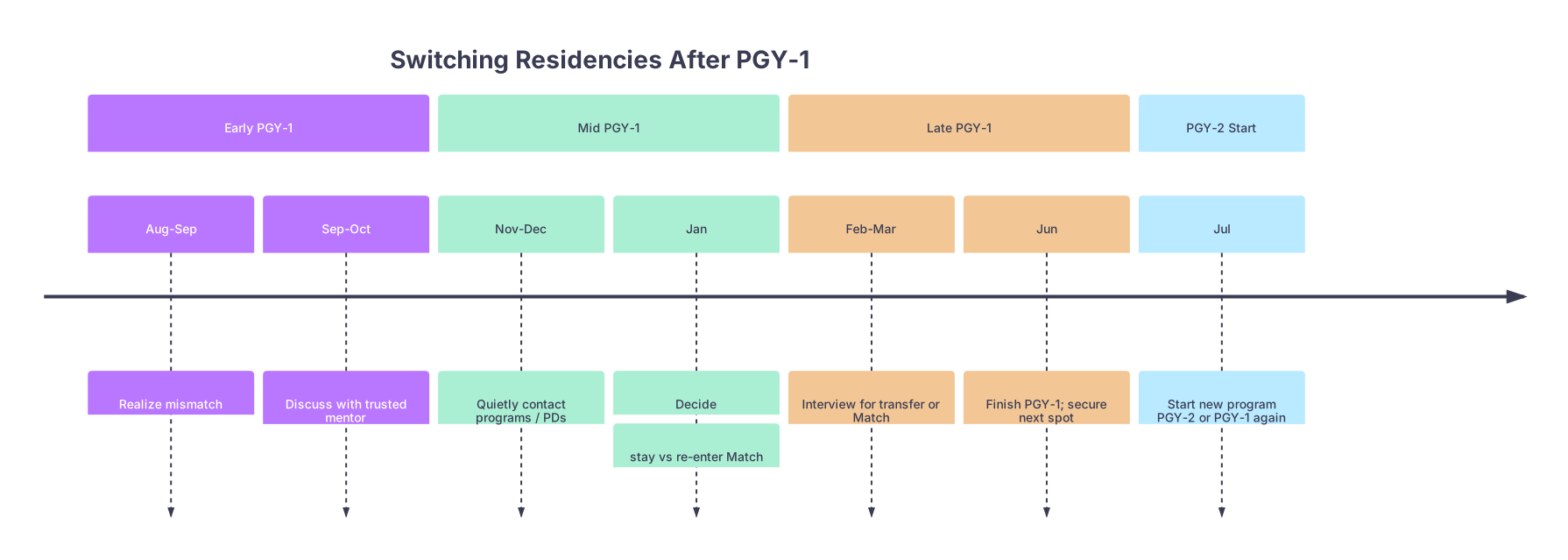
| Period | Event |
|---|---|
| Early PGY-1 - Aug-Sep | Realize mismatch |
| Early PGY-1 - Sep-Oct | Discuss with trusted mentor |
| Mid PGY-1 - Nov-Dec | Quietly contact programs / PDs |
| Mid PGY-1 - Jan | Decide |
| Late PGY-1 - Feb-Mar | Interview for transfer or Match |
| Late PGY-1 - Jun | Finish PGY-1; secure next spot |
| PGY-2 Start - Jul | Start new program PGY-2 or PGY-1 again |
Ideal world: you finish PGY-1 on June 30 and start your new spot July 1. No gap. No break. PDs love continuity.
Reality: sometimes you:
- Start off-cycle (October PGY-2 start).
- Have a short gap (1–3 months).
- Or, worst case, have a longer gap you’ll need to explain.
What you should do now:
- If it’s still early PGY-1 (July–November): You have time to explore quietly, improve evaluations, and line up letters.
- If it’s mid-year (Dec–March): Start contacting programs and watching for unexpected openings. You’re on the clock.
- If it’s late (April+): Look harder at off-cycle transfers and be realistic that you might need to complete PGY-2 before switching—or delay and use a research year.
Do not resign your current program until:
- You have a written contract for the new spot, and
- You’ve reviewed it carefully, including credit for prior training.
Step 4: Managing Your Current PD – Without Torching the Bridge
Your current program director holds more power over your future than you want them to. Their phone call can make or break offers.
The fantasy: “I’ll just apply quietly and not tell them until I match somewhere else.”
The reality: many programs will call your PD before ranking you, and if this blindsides them, that call may not go well.
You need a strategy that balances self-preservation with transparency.
Who to talk to first
I usually advise this order:
- A trusted attending or mentor not directly responsible for your evaluation.
- A senior resident you trust, mainly for local politics intel.
- Program leadership only when you:
- Have a clear story, and
- Are reasonably certain you want to leave.
When you do talk to your PD, script it. Something like:
“Dr. X, I wanted to be upfront with you. Over the last few months, I’ve realized that [core reason] and after discussing with mentors, I’ve concluded that [new specialty/program type] is a better long‑term fit. I’m committed to finishing this year strong and maintaining my responsibilities here. I’d really value your guidance and, if you feel comfortable, your support in this transition.”
Key points:
- You’re not bashing the program.
- You emphasize completion and professionalism.
- You frame this as career alignment, not an escape hatch.
Will every PD react well? No. Some will be defensive, punitive, or cold. I’ve seen PDs suddenly become hypercritical after this conversation. That’s why you get your ducks in a row before going in: evaluations improved, attendings lined up, personal life stable.
Step 5: Documentation: You Need a Clean Paper Trail
If you think you can “hide” a PGY-1 year, forget it. Programs will ask. NRMP will have records. State medical boards definitely care.
You need:
- A current, updated CV with your residency clearly listed, dates included.
- Summative evaluations or Milestones (end-of-rotation and end-of-year).
- Duty hour/compliance or professionalism notes if they’re neutral or positive.
- If you had issues: formal documentation of remediation completion.
If you had real problems—probation, documented concerns—your story must match the paperwork. Nothing kills an application faster than:
You: “I left for geographic reasons.”
PD letter: “Resident left after failing remediation for professionalism issues.”
Step 6: Rebuilding Your Narrative in ERAS
You’re not a typical fourth-year med student anymore. Your ERAS has to do three things simultaneously:
- Show that you’ve grown from PGY-1, not been broken by it.
- Explain the switch crisply, without drama.
- Prove you’ll stay in the new specialty or program.
Personal Statement for a Switcher
Core structure that works:
- One clear, specific moment in residency that exposed the mismatch
(e.g., a service that felt miserable vs a consult or rotation that energized you). - Reflection: what you learned about your strengths, interests, and career goals.
- Concrete exposure to the new specialty (electives, shadowing, projects).
- Positive framing of your current training: what you gained, how it makes you better.
- Brief, calm explanation of the departure. No mudslinging.
Bad: “My program is toxic and unsafe and I refused to tolerate it.”
Better: “While I’m grateful for the clinical exposure I’ve had, I’ve realized I thrive in environments with more structured teaching and multidisciplinary collaboration, which I’ve found more consistently in [new specialty/program type].”
Step 7: Letters of Recommendation: The Make-or-Break Section
Programs want to know one thing: “Is this person a headache?” Letters answer that.
You want:
- At least one letter from your current residency program (ideally PD or APD).
- One or two from attendings in the specialty you’re applying to (or closely related).
- Optionally, a letter from a sub‑specialty or ICU rotation that showcases work ethic and clinical acumen.
If your relationship with your PD is poor, you still often need some form of program verification. In that case:
- Aim for a strong letter from an associate PD or core faculty who knows you well.
- Use them as your primary advocate, even if the official PD letter is more neutral.
And yes, neutral is ok. Damning is not.
Step 8: Targeting Programs Realistically
Don’t spray applications hoping someone will magically ignore context. Targeting matters more for switchers than for MS4s.
Think tiers like this:
| Program Type | Good for Switchers? | Why |
|---|---|---|
| Mid-tier university | Often yes | Need workers + teaching focus |
| Large community with fellowships | Strong option | Flexible, value experience |
| Small community program | Mixed | Some love switchers, some suspicious |
| Super-elite academic | Rarely | Can fill with “clean” applicants |
| Newer or expanding programs | Good | Need residents, more open to non-linear paths |
You’ll also look for:
- Programs explicitly open to PGY-2 transfers in their website language.
- Specialties/regions with known shortages (e.g., certain FM, IM, psych markets).
- Programs where your PGY‑1 experience is directly useful (e.g., switching from IM to anesthesia with strong ICU/ED rotations).
Step 9: Applying vs. Quietly Hunting Transfers
You’re running two parallel campaigns.
1) Standard Match Route
- Submit ERAS as usual.
- Apply a bit broader than you did as an MS4.
- Use Filters: look at programs that mention “prior residency training welcomed” or “PGY-2 openings.”
2) Off-cycle / Direct Transfer Route
This is where people lose opportunities because they’re lazy.
Do this:
- Set up alerts on sites like ACGME, program-specific pages, specialty association job boards, and forums where programs sometimes post PGY-2 spots.
- Email program coordinators directly when you hear about unexpected openings (e.g., “We have a PGY-2 vacancy for July due to resident departure”).
That email should be short, professional, and clear:
Subject: Inquiry Regarding Potential PGY-2 Position in [Specialty]
Dear [Coordinator/Dr. X],
I’m a current PGY-1 in [specialty] at [institution], in good standing, exploring a transfer to [specialty] for the upcoming academic year.I’ve completed strong rotations in [relevant areas], and my PD is aware and supportive of my transition. I’d be grateful to know if your program anticipates any PGY-2 openings or would consider an applicant with prior residency training.
CV and USMLE scores attached. I appreciate your time.
Best,
[Name], MD
You’d be surprised how many spots are filled this way without ever going through a full Match cycle.
Step 10: Handling Interviews as a Switcher
The question is coming: “So why are you leaving your program?”
If you stumble here, you’re done.
Use a simple structure:
- Start with your core reason (15–20 seconds).
- Acknowledge what you gained from your current program (10–15 seconds).
- Bridge to why their program/specialty is a better long‑term fit (30–45 seconds).
- Emphasize that you’re looking for stability and committed to completing training there.
Example:
“I went into general surgery genuinely excited about operative work, but during intern year I found that the aspects of patient care I enjoyed most were perioperative management, critical care, and physiology rather than the time in the OR itself. I’ve had excellent exposure to acutely ill patients and fast-paced environments, and I’m grateful for that foundation.
As I spent more time in the ICU and working closely with anesthesia, it became clear that anesthesiology aligns more closely with how I like to think and work. I’m looking for a program where I can build on my intern-year skills and commit to a long-term home in this specialty.”
Notice what’s missing: blame, drama, vague language like “toxic” or “malignant.”
If things were truly bad, you say:
“The clinical volume and demands at my current program are very high, and while that’s given me a lot of experience, I’ve realized I’m better suited to a setting with more structured teaching and mentorship. I’m happy to discuss details privately if needed, but I want to emphasize that I’ve continued to fulfill my responsibilities and maintain good relationships with my colleagues.”
You keep it factual, contained, and unemotional.
Step 11: Visa, Licensing, and Board Certification Traps
This is the unsexy part that can wreck you if you ignore it.
Watch for:
- Visa issues (IMGs): Some programs cannot or will not transfer H‑1B or J‑1 visas mid‑training. Talk to a real immigration attorney before making moves.
- Board requirements: Some boards limit how much “off-specialty” training counts. You may not get full PGY-1 credit in the new specialty.
- State licensing: If you switch states, PGY-2+ may require a training license or full license with very specific forms from your old PD.
Do not assume “they’ll figure it out.” You’re the one who pays if this gets messy.
Step 12: Mental Health and Pride – The Quiet Part No One Talks About
I’ve watched strong residents fall apart during switches. Not because of the logistics, but because of shame.
You will hear:
- “Why can’t you just stick it out?”
- “You’re going to look flaky.”
- “You’ll never get into [specialty] now.”
Most of that is garbage. Some of it has a grain of truth. Your job is to decide whether staying where you are is actually better for your long-term career and mental health, or if the discomfort of switching is worth it.
Two things I’ve seen help:
- Keep doing good work where you are, even as you plan your exit. People remember how you leave.
- Build a small, tight circle of mentors and peers who know the full story and can reality-check your decisions.
You’re allowed to change your mind. You’re not allowed to implode publicly in the process.
Quick Comparison: Staying vs Switching After PGY-1
| Factor | Stay in Current Program | Switch After PGY-1 |
|---|---|---|
| Short-term stress | Lower once you accept it | High during planning + transition |
| Long-term fit | Poor if wrong specialty/culture | Better if move is well-matched |
| Career risk | Low if you pass boards | Moderate; higher if handled poorly |
| Financial impact | Stable | Possible gap months / relocation costs |
| Reputation risk | Local only | Wider if PD bad-mouths you |
For some of you, the right answer is to stay. Grind it out, finish, and fix your career later (fellowship, niche practice, geography). For others, staying is slow professional death.
Make that decision deliberately, not out of fear.
Visual: How Your Time May Shift During a Switch Year
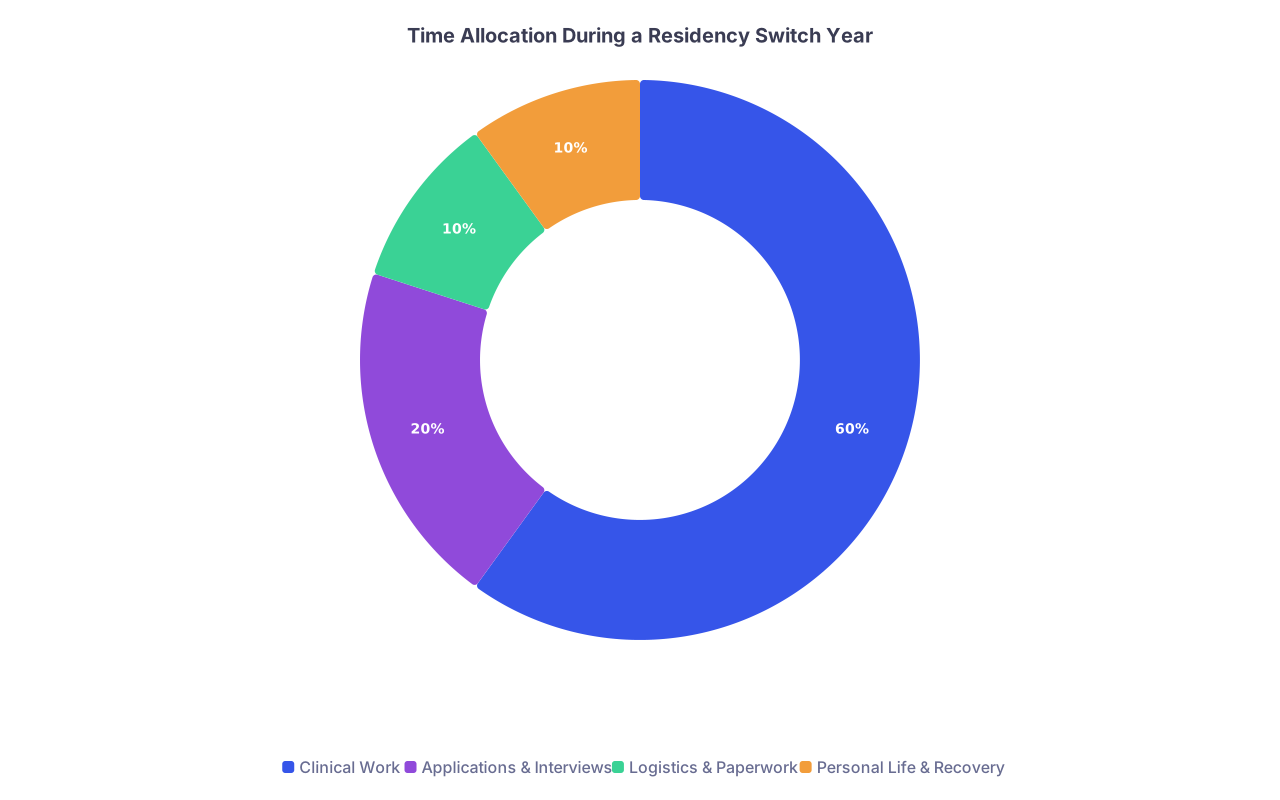
| Category | Value |
|---|---|
| Clinical Work | 60 |
| Applications & Interviews | 20 |
| Logistics & Paperwork | 10 |
| Personal Life & Recovery | 10 |
Process Snapshot: How a Typical Switch Plays Out

| Step | Description |
|---|---|
| Step 1 | Realize Mismatch |
| Step 2 | Talk to Mentor |
| Step 3 | Clarify New Target Specialty/Program Type |
| Step 4 | Quietly Improve Evaluations |
| Step 5 | Collect Letters & Documents |
| Step 6 | Discuss with PD |
| Step 7 | Apply via ERAS & Contact Programs |
| Step 8 | Interviews |
| Step 9 | Offer/Match Received |
| Step 10 | Formal Resignation & Transition |
| Step 11 | Start New Program |
FAQ (Exactly 4 Questions)
1. Is switching residencies after PGY-1 going to ruin my chances at fellowship later?
No, not automatically. Fellowship directors care more about your performance and reputation in your final residency than about a clean, linear path. If you switch once, for a clear reason, and then excel in your new program, many will barely care. What worries them is a pattern of instability, poor letters, or lingering questions about professionalism. So your job is to make sure this is a one‑time, well-executed course correction, not the beginning of a chaotic resume.
2. Do I have to tell programs about problems I had in my current residency (like probation)?
If it’s documented and in your record, assume it will surface. Lying by omission is worse than a clean, honest explanation. You do not need to lead with it in your personal statement, but if asked directly—or if there’s formal documentation—you need a concise, accountable answer: what happened, what you learned, and what’s changed. Programs are more forgiving of a single, owned mistake than of someone they feel is hiding things.
3. Can I switch specialties without repeating PGY-1?
Sometimes, yes, but it depends on the specialty and the board rules. Internal medicine to neurology, IM to anesthesia, surgery prelim to anesthesia—these moves more often allow some PGY‑1 credit, especially if you had ICU, ED, or relevant rotations. Derm, radiology, and some other specialties may require more specific preliminary training. You need to ask each prospective program how much credit they can grant and confirm it aligns with their board requirements. Do not assume your year will automatically count.
4. Should I complete PGY-2 before switching to “look more stable”?
Not necessarily. If you’re absolutely certain you’re in the wrong specialty or an unsafe/malignant environment, waiting longer can just dig you deeper: more time in a field you’ll leave, more burnout, more resentment. Completing PGY-1 is usually the key threshold. After that, the question is: will another year significantly change your competitiveness or letters? If not, and the fit is poor, switching earlier often makes more sense. The main exception is if your record is currently weak and you truly need another year of excellent evaluations to rehabilitate your file.
Open a blank document right now and write one paragraph answering this: “Why am I leaving my current program, and what’s the evidence that the new path fits me better?” If you cannot answer that clearly, you’re not ready to re-enter the Match yet.