
It’s August. ERAS is about to open. You took a research year between MS3 and MS4 (or after graduation), and now you’re staring at that “Experiences” section thinking: Did I do enough? How do I explain what I’ve been doing all year without sounding like I wasted time or just chased pubs?
You’ve got half-finished manuscripts, maybe one poster, a couple of IRB headaches, and a PI who keeps saying “We’ll submit soon.” Meanwhile, your classmates matched already or are going straight through. You’re worried programs will look at your gap year and think: “So… only one paper?”
Here’s the reality: programs do not care about your promises. They care about how you frame your time, your trajectory, and your outcomes in a way that makes sense for residency training.
Let’s sort this out step by step.
1. How Programs Actually Look at a Research Gap Year
Programs are not reading your year like a bench scientist. They’re reading it like: “Does this person use time well? Are they serious about this specialty? Are they trending upward?”
They’re asking three things:
- Why did you take a research year?
- What did you do with it?
- Did it move you forward as a future resident?
If your gap year story can’t answer those three clearly, you’re in trouble, even with 10 publications. If it answers those three well, you can be in great shape with 1–2 solid outputs and a coherent narrative.
Directly: a “research year” with no obvious productivity and no clear reason looks bad. A research year with focused outcomes, skills, and clinical alignment can be a big plus.
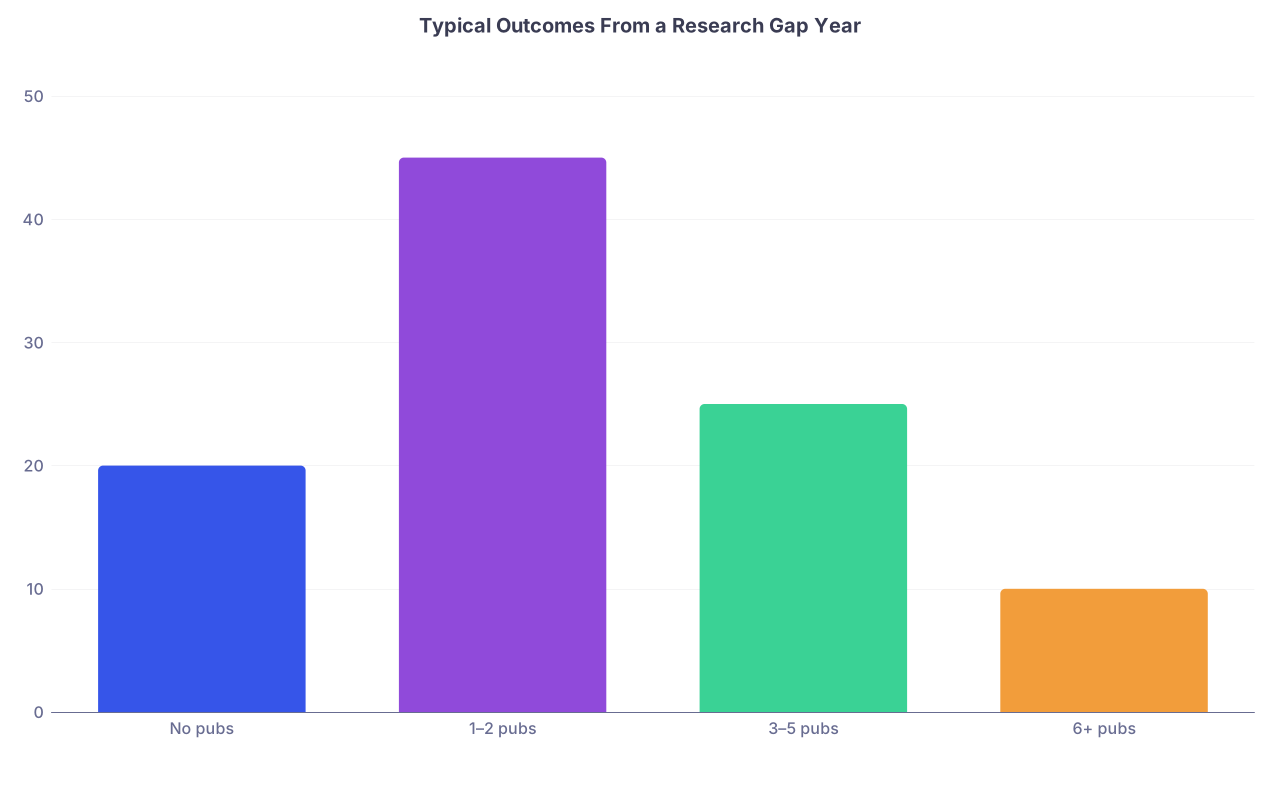
| Category | Value |
|---|---|
| No pubs | 20 |
| 1–2 pubs | 45 |
| 3–5 pubs | 25 |
| 6+ pubs | 10 |
Most students land in the 1–2 publications / a few abstracts / some posters zone. That’s normal. Don’t compare yourself to the unicorn with 18 first-authors at MGH. Programs know those are outliers.
2. First Step: Define Your Year in One Clean Sentence
If you can’t summarize your year in one sentence, you’ll ramble in your PS, ramble in interviews, and ramble in emails. That’s how you sound unfocused.
You need a single controlling sentence that everything else hangs on.
Examples:
- “I took a dedicated research year in orthopedic outcomes at Hospital for Special Surgery to deepen my understanding of value-based care and strengthen my academic profile for an academic career.”
- “I spent a research year in pulmonary critical care at [Institution] focusing on ARDS and ventilator management to better understand ICU care and pursue a future as an intensivist.”
- “After MS3, I completed a funded research fellowship in dermatology studying disparities in melanoma diagnosis in underrepresented populations.”
If your sentence right now is “I did research to be more competitive,” that’s lazy and weak. Fix it. Tie it to:
- A specific field
- A specific topic/theme
- A specific future direction
You’ll reuse that sentence in your personal statement, every interview “Tell me about your research year” answer, and even in emails to programs.
3. Translating a Messy Year Into Clear Outcomes
Your year probably wasn’t clean. Projects died. IRBs stalled. A postdoc left and your dataset vanished. Normal.
Programs don’t see the chaos; they only see what you show them. Your job now: extract and package outcomes.
Think in four buckets:
- Publications / manuscripts
- Posters / abstracts / oral presentations
- Concrete skills and responsibilities
- Relationships and mentorship that show up in LORs
3.1 Publications and Manuscripts
List everything you reasonably can, categorized correctly:
- Published / in press
- Accepted
- Submitted
- In preparation
Don’t lie. Don’t “submitted” something you haven’t actually submitted. But you can list in-prep work in experience descriptions, just not in the publication list.
Example ERAS-style line:
- Smith J, YourLastName J, et al. Predictors of readmission after CABG surgery at a safety-net hospital. J Thorac Cardiovasc Surg. 2024; In press.
If it’s not accepted:
- Manuscript in preparation, anticipated submission to Journal X August 2025. (Include this only in the experience description, not as a formal citation.)
3.2 Posters, Abstracts, Presentations
Do not underrate these. For many programs, seeing your name on abstracts and posters is enough to show you’re productive.
Examples:
- Poster, “Early vs delayed cholecystectomy after gallstone pancreatitis,” American College of Surgeons Clinical Congress, 2024.
- Oral presentation, “Racial disparities in mechanical thrombectomy utilization,” Hospital Medicine Research Day, 2024.
Highlight any awards, distinctions, or selections (top 10% abstracts, best poster, invited talk). Those give weight to a small output portfolio.
3.3 Skills and Responsibilities
This is where most students blow it. They say: “I worked on several retrospective chart reviews,” which is bland and generic.
Instead, spell out what you actually did, in resident-relevant language:
- Designed data collection instruments in REDCap and independently abstracted >600 patient charts.
- Performed multivariable logistic regression in R under biostatistician supervision to identify predictors of 30-day readmission.
- Led weekly research meetings, set agendas, and coordinated between PI, fellows, and med student team.
Now you’re not “a student tag-along.” You’re someone who can manage tasks, run projects, and complete work. That’s what they want in an intern.
3.4 Mentorship and Letters
Your best outcome from this year might actually be one phenomenal letter.
If your PI or research mentor:
- Knows you well
- Has seen you handle setbacks
- Can say “this student functioned at the level of an intern in reliability and follow-through”
…that can outweigh your publication count.
Do not assume they’ll write that on their own. You should:
- Send them a one-page summary of what you worked on
- Include bullet points of specific things you did (ownership, initiative, problem-solving)
- Remind them of any posters, talks, or leadership you took on
Make it easy for them to describe you as productive, independent, and coachable.
4. How to Frame Your Year in ERAS
ERAS is unforgiving. You get limited characters, rigid sections, and too many generic descriptions. You need to be intentional.
4.1 Choosing the “Position Title”
Do not just put “Research assistant” for everything. Use accurate, specific titles:
- Research fellow, Department of Neurosurgery
- Postgraduate research scholar, Department of Cardiology
- Clinical research assistant, Emergency Medicine
If it was a formal gap-year program (e.g., Doris Duke, HHMI, NIH fellowships), say that clearly.
4.2 Writing Experience Descriptions
Each research experience should answer:
- What was the overall focus?
- What were your specific responsibilities?
- What were the outputs?
Bad:
Worked on several projects in cardiology, helped with data collection and learned research methods.
Better:
Full-time research fellow in the cardiology outcomes group focusing on heart failure readmissions and equity in device therapy. Designed and piloted data collection tools, independently abstracted >800 charts, and coordinated with the biostatistics team for analysis. Co-authored one accepted manuscript and two conference abstracts; led weekly check-ins with junior medical students.
Tie it to outcomes right in the description. Do not make the reader hunt through publications to see if anything came out of it.
4.3 Mapping Projects to Publications
If you had multiple projects under one big umbrella, clarify that:
Primary project: Retrospective cohort study of 30-day readmissions after PCI (resulted in 1 first-author manuscript, 1 poster).
Secondary project: Survey study of cardiologists’ perspectives on telemedicine (1 abstract, manuscript in preparation).
That kind of mapping helps the reviewer understand your productivity in context.
5. Personal Statement: Use the Year as Evidence, Not Excuse
Your PS is not where you whine about delays, COVID, or your PI losing interest. It’s where you show that your research year:
- Deepened your understanding of your specialty
- Changed how you think as a clinician
- Improved skills that matter for residency
Structure it simply:
- Briefly state why you took the year. One or two sentences. No drama.
- Highlight one or two concrete projects or experiences that changed your thinking or skills.
- Close the loop: How will those experiences make you a better intern and resident?
Example framing:
I chose to spend a year in pulmonary/critical care research after my third year because I wanted to understand why so many of our ICU patients returned within weeks of discharge. Working on a project examining post-ICU functional decline forced me to look beyond ventilator days and mortality, and instead track which patients could actually return to independent living.
Sitting with families in follow-up clinics, and then matching those conversations to data I had analyzed days earlier, taught me to see beyond “survived vs died.” I now approach every ICU rotation with a more longitudinal mindset: What happens after we extubate, after we discharge, after they leave our EMR? That shift in perspective is what I want to carry into residency.
Notice what this does:
- It shows reflection, not just “I did research.”
- It ties research to clinical mindset, not just career ambitions.
- It doesn’t dwell on how many publications came out. The project itself is the value.
6. Handling the “Why Didn’t You Produce More?” Problem
If you have fewer outputs than you’d like, you must own the story. Do not wait for an interviewer to corner you.
Common landmines:
- Projects stopped at data collection
- No first-author manuscript
- Multiple “in preparation” with no acceptances
You handle this with a combination of honesty + learning + visible momentum.
Example interview answer:
We bit off a big primary project during my research year—a multicenter retrospective study that required several IRB approvals and complex data sharing. A lot of my time was invested in building the dataset and coordinating across sites, which meant the actual writing phase got pushed later than ideal. We’ve since completed the analysis and the manuscript is in final revision with my PI; I’m second author.
One thing I’d do differently now is carve out a smaller, more controllable first-author project earlier in the year. I’ve tried to apply that lesson to my current work—I scoped out a more focused secondary analysis that I could own and submit quickly, which is now under review.
That answer:
- Acknowledges reality
- Avoids blaming everyone else
- Shows you learned something practical
- Demonstrates that you’re not just sitting on unfinished work
What you don’t say:
- “My PI was really slow.”
- “COVID ruined everything.” (Everyone dealt with COVID. Programs are tired of hearing it as the only explanation.)
- “We’re submitting soon!” with nothing to back it up.
7. If Your Gap Year Was Mixed With Non-Research Stuff
Some of you didn’t do a 100% pure research year. Maybe you:
- Did part-time research + part-time clinical work
- Tutored, worked a non-med job, took care of family
- Were abroad for part of it
You need to divide the year cleanly in ERAS:
- One “Research” entry showing your scholarly work
- One or more “Work/Other Experience” entries for the rest
Don’t hide the non-research parts. Programs appreciate reality. But you must still frame it.
Example:
From July–December, I worked full-time as a clinical research assistant in [field]. From January–June, I transitioned to part-time research while taking on additional responsibilities at home to support a family member undergoing cancer treatment. During this time, I maintained involvement in my primary projects and completed data collection for two studies.
You’re showing:
- Time wasn’t just “lost”
- You maintained commitments
- You’re capable of managing competing responsibilities
8. Common Scenarios and How to Handle Them
Let’s hit some very real situations I see over and over.
Scenario 1: “I Have Zero Publications at Application Time”
Not ideal, but not fatal, especially in less research-heavy specialties or community programs.
Your move:
- Maximize posters/abstracts—get anything into a local or regional meeting.
- Lean hard into skills and responsibilities in your descriptions.
- Make sure your PI’s letter says something like “X took the lead on Y, was reliable, and significantly advanced our projects.”
In interviews:
While we don’t have a manuscript accepted yet, I spent most of my year designing and executing a complex dataset that the group will be using for multiple ongoing projects. My major contributions were in study design, data collection, and preliminary analysis, and we recently submitted our first manuscript from this work.
You’re selling the role, not the PubMed ID.
Scenario 2: “I Have Lots of Papers, But I Did Very Little on Most of Them”
Most multi-author outcomes factories work like this. Programs know.
Your move:
- Be very clear about your role on each major paper.
- Claim leadership only where you truly led; otherwise emphasize the cumulative picture.
In an interview:
I was part of a high-volume research group, so a lot of my publications came from contributing to data collection and preliminary analysis across several projects. On two of them, I had a more central role—in one I designed the data abstraction tool, and in another I wrote the first draft of the methods section. So while I’m not first author on most, those experiences taught me how to move multiple projects forward at once and work within a larger team.
Better to be honest and specific than to pretend you single-handedly ran a 15-center RCT.
Scenario 3: “My Research Year Confirmed I Don’t Want Academics”
That’s fine. You still need to frame the year as valuable.
In your PS or interview:
Spending a year full-time in research helped me realize that I’m most fulfilled when I’m seeing patients rather than writing grants. That doesn’t mean the year was wasted—learning to interpret literature more critically and seeing the gap between evidence and bedside care has made me a more thoughtful clinician. I see myself primarily in a clinical role, but I’ll carry those skills into quality improvement and small-scale practice-based projects.
Programs like self-awareness. They dislike people who pretend to be hardcore researchers just to match somewhere fancy.
Scenario 4: “I Took a Research Year Because of a Weak Application”
Common: you had an average Step 1/2, few experiences, needed time to build a stronger app.
Do not lead with your weakness. Lead with growth and momentum.
I chose a research year in EM for two reasons. First, I wanted more exposure to the specialty at an academic center. Second, I wanted a structured way to improve my academic profile after a challenging preclinical period. Over the year, I improved my test performance strategies, built relationships with EM faculty, and contributed to two projects that are now being presented at [Meeting]. The experience reinforced that I want to be in a busy, teaching-focused ED as a resident.
Own it without groveling.
| Situation | How It Looks to Programs | Fix / Best Framing |
|---|---|---|
| Pure research, 1–2 outputs | Moderately productive, fine if story is clear | Emphasize learning, skills, one strong letter |
| Pure research, many outputs | Very productive, strong for academic-leaning programs | Make sure you don't sound like you hate clinical medicine |
| Mixed research + caregiving/work | Real-life responsibilities, understandable | Show continuity and reliability in projects |
| Weak outputs + vague story | Red flag | Tighten your narrative, clarify roles, highlight skills |

| Step | Description |
|---|---|
| Step 1 | Research Gap Year |
| Step 2 | Define 1-Sentence Purpose |
| Step 3 | Extract Outputs |
| Step 4 | Map to ERAS Entries |
| Step 5 | Integrate Into Personal Statement |
| Step 6 | Prepare Interview Answers |
| Step 7 | Consistent, Coherent Story |
9. Final Checklist Before You Submit
Run through this like a pre-op checklist.
- Do I have one clear sentence that explains why I took the research year?
- Does each research entry in ERAS show:
- Focus
- Responsibilities
- Outcomes
- Have I mapped each major project to at least one concrete product (poster, abstract, presentation, manuscript, or clear in-progress work)?
- Does my personal statement use my research year as evidence of growth, not as a plea for forgiveness?
- Have I explicitly briefed my research letter writer with:
- A summary of my projects
- Concrete examples of initiative and reliability
- The specialty and programs I’m targeting
- Do I have two or three ready-made interview answers:
- “Tell me about your research year.”
- “What did you learn from your research year?”
- “If you had to do it again, what would you do differently?”
If you can say yes to those, you’re in much better shape than you feel.

FAQs
1. If my big papers are coming out after ERAS submission, can they still help me?
Yes, but only if you handle it like an adult. List them as “submitted” or “in preparation” accurately in your experiences. If something gets accepted after you submit, you can send a brief, focused update email to programs where you’ve interviewed or are scheduled to interview. One short paragraph, something like: “Since submitting my ERAS application, our manuscript on X has been accepted to Y. I was [role]. I wanted to share this update as it reflects the continued progress of my research year.” Do not spam every program in existence with every minor change.
2. How bad does it look if my research year was mostly negative results or failed projects?
It’s not the results that matter. It’s what you did and what you learned. Negative or null results are still science. What looks bad is silence—no posters, no abstract, no discussion of what you took from the experience. You can absolutely say: “Our main study did not find a significant association between X and Y, but presenting those findings taught me how to interpret and communicate null results, and forced us to re-examine our assumptions about Z.” Programs care that you stayed engaged, finished what you could, and reflected, not that you discovered a new gene.
3. Will programs think I’m only interested in academics if I took a research year?
Some will assume you’re at least open to academic work. That’s not a problem unless you lie. If you’re more clinically oriented, you say so clearly: “I see myself as primarily a clinician, but my research year trained me to be the person on our team who can critically appraise new evidence and contribute to smaller-scale projects or QI.” Community programs like having someone who can manage QI and evidence-based practice even if you’re not gunning for a K-award.
4. I did my research year in one specialty but I’m applying in another. How do I explain that?
You need a clean pivot story. No melodrama, no trashing the old field. Something like: “I completed a research year in neurology focusing on stroke outcomes. During that time, my favorite part of the work became the acute management in the ED and ICU and the procedural aspects, which is what drew me more firmly toward anesthesiology.” Then connect the skills (data analysis, literature review, working in multidisciplinary teams) to your new field. Programs don’t care that you changed your mind; they care that you changed it thoughtfully and you’re not flailing.
Key points to walk away with:
- Your research gap year is only as strong as the story you tell: define a clear purpose, list concrete outputs, and show how it made you a better future resident.
- Programs value reliability, reflection, and momentum more than raw publication count; frame your experience around responsibilities, skills, and growth.
- Be honest, specific, and concise—in ERAS, in your personal statement, and in interviews—and your research year can become a real asset instead of a liability.