
You can apply to two specialties without blowing up your chances in either—but only if you stop trying to be everything to everyone.
This is a surgical problem, not a philosophical one. You have limited time, limited letters, limited interview days, and a personal narrative that cannot be infinitely stretched without tearing. If you’re in that messy middle—“I really like both IM and EM” or “I’m torn between anesthesia and neuro”—this is the playbook.
I’m going to walk you through what to do step-by-step so you do not:
- Accidentally signal the wrong specialty at the wrong time
- End up with a half-baked application to both
- Burn out trying to go “all-in” x2
We’re going to assume you’re serious about both options, not just “I’ll throw a couple apps at this backup specialty and see.” If that’s your mindset, you’ll end up with two weak applications instead of one strong one.
Step 1: Get Brutally Clear on Your “Primary” vs “Secondary” Specialty
Yes, you need one. Even if you swear you “truly love them equally.”
Programs do not care that you are “keeping an open mind.” They care whether you are likely to show up in July and stay for 3+ years. A dual-interest strategy that works starts with you ranking your own interest and competitiveness.
You need to decide:
- Which specialty is your true first choice?
- For which one are you objectively more competitive?
Those might not be the same.
Say you’re:
- Step 2: 247
- Class rank: middle
- Research: 1 poster in cardiology
- Letters: 2 strong IM letters, 1 decent EM letter
- Rotations: Honors in IM, High Pass in EM
You might love EM more, but your actual competitiveness looks better for IM at academic programs. That doesn’t mean don’t apply EM. It means:
- EM = high-risk passion play
- IM = safer, more numerically aligned pathway
Stop calling them “co-equal” in your head. For planning and strategy, you must label:
- Primary specialty = the one that gets your cleanest, most cohesive narrative
- Secondary specialty = the one you apply to deliberately with tailored materials, but accept slightly more risk in depth/volume
You’re not telling programs this. You’re telling yourself this so you can make rational decisions about letters, away rotations, and interviews instead of panicking in November.
Step 2: Build Two Distinct Application Cores (and Where You Can Reuse)
The number one mistake dual-interest applicants make: they try to create “one-size-fits-both” everything—personal statement, experiences, letters. That reads as watered-down and directionless.
You need two cores:
- Core A: For Specialty 1
- Core B: For Specialty 2
Each core needs:
- A specialty-specific personal statement
- A specialty-appropriate mix of letters
- A believable experience narrative that matches that specialty’s values
Personal Statements: Do Not Frankenstein This
You absolutely should write two different personal statements. Not “95% the same with one paragraph swapped.” Two.
Why? Faculty read hundreds of these. They can smell generic from three sentences away.
If you’re applying to, say, Internal Medicine and Neurology:
- IM statement should lean into: complexity, longitudinal care, systems thinking, teaching, breadth
- Neuro statement should lean into: localization, diagnostics, neuroanatomy fascination, patience with uncertainty, neuro-specific patients/interests
Can you reuse some patient stories? Yes, in theory. But if the central story could clearly support either specialty equally, it usually feels thin. Pick different anchor stories if you can.
Here is the rule:
Each personal statement should make total sense even if I have never heard you’re dual-applying. If I read your IM statement and think, “Why is this person not applying IM only?” you’ve done it right.
Experiences: Same ERAS Entries, Different Emphasis
You’re not creating two ERAS accounts. Same activities, different framing in interviews and subtle emphasis in what you highlight.
But you can choose what to emphasize in:
- Your “most meaningful” experiences
- How you talk about things in interviews
- What you highlight in your CV section (presentations, posters, leadership)
If you did:
- A QI project in sepsis management → strong for both IM and EM
- A stroke protocol improvement in the ED → strong for EM and Neuro
- A palliative care elective → can work for IM, FM, Neuro, Psych with different framing
What you don’t do is pretend you’ve always been single-minded for both. That’s impossible. You show a through-line: a type of patient, a kind of problem, or a practice environment you’re drawn to that makes sense in both specialties.
Step 3: Letters of Recommendation: Build Two Clean Sets
This is where most dual applicants get exposed.
You cannot send the same exact letter mix to a surgery program and a psychiatry program and expect both to be impressed. You need to deliberately assign letters in ERAS.
At a minimum:
- Have 3 strong letters that clearly support Specialty A
- Have 2–3 strong letters that clearly support Specialty B
Some letters can be “crossover” letters if written well:
- A medicine letter emphasizing your critical care performance may help EM or anesthesia.
- A neurology letter focused on your detailed neurologic exams may help IM or PM&R.
- A pediatric letter about your communication and family dynamics skills may help FM or psych.
But do not rely solely on crossover letters.
| Specialty | Minimum Specialty-Specific Letters | Crossover Letters | Total Letters Used |
|---|---|---|---|
| Internal Medicine | 2 IM attendings | 1 EM or Neuro (if relevant) | 3-4 |
| Emergency Medicine | 1 SLOE + 1 EM faculty | 1 IM | 3-4 |
| Neurology | 1 Neuro attending | 1 IM | 3 |
| Anesthesiology | 1 Anes attending | 1 IM or EM | 3 |
If you’re in EM, you already know: SLOEs are king. So if you’re dual-applying EM + something else, you must protect enough EM face time to get strong SLOEs and enough exposure to the other specialty to pull at least one solid letter.
Do not half-rotate both and end up with:
- A mediocre SLOE from a program barely saw you
- A generic “pleasant to work with” letter from the other specialty
That is the nightmare scenario.
Step 4: Plan Rotations Like a Chessboard, Not a Calendar
Dual-applying becomes chaotic when you only think in terms of months, not outcomes. You need specific deliverables: SLOE here, specialty letter here, audition exposure there.
Map the year like this:
- What letters do you still need?
- Which specialty needs away rotations more?
- By when must letters be uploaded to be useful?
Then build a rotation Gantt chart in your head (or on paper).
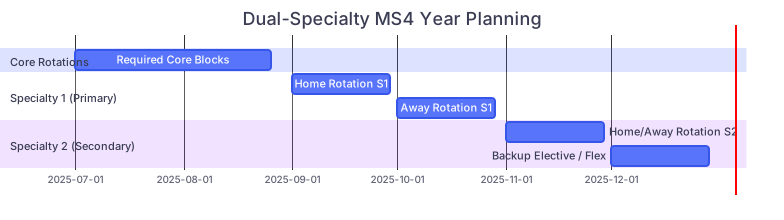
| Task | Details |
|---|---|
| Core Rotations: Required Core Blocks | a1, 2025-07, 8w |
| Specialty 1 (Primary): Home Rotation S1 | a2, 2025-09, 4w |
| Specialty 1 (Primary): Away Rotation S1 | a3, 2025-10, 4w |
| Specialty 2 (Secondary): Home/Away Rotation S2 | a4, 2025-11, 4w |
| Specialty 2 (Secondary): Backup Elective / Flex | a5, 2025-12, 4w |
Examples:
EM + IM:
- July–August: EM home rotation (SLOE #1)
- September: EM away (SLOE #2)
- October: IM sub-I (IM letter #1)
- November: IM elective (IM letter #2) or open for more EM if needed
Anesthesia + IM:
- July: IM sub-I
- August: Anesthesia home
- September: Anesthesia away
- October: ICU (can help both with the right letter writer)
The non-negotiable: each specialty must get at least one rotation where you are clearly “trying out” that field, not just passing through.
Step 5: How Many Programs to Apply to in Each Specialty
This is where people either over-apply wildly or under-apply and get crushed.
You’re working with:
- Your competitiveness in each field
- The competitiveness of the specialties themselves
- Your geographical flexibility
- Your sanity and budget
If you’re dual-applying to two moderately competitive fields (e.g., EM + Anesthesia, IM + Neuro, Peds + Psych), a common structure is:
- Primary specialty: full-strength list (e.g., 40–60+ programs, depending on field)
- Secondary specialty: meaningful but shorter list (e.g., 20–40)
If one field is ultra-competitive (e.g., Derm, Ortho, Plastics, ENT) and the other is not, treat the competitive one as “reach” and the other as where you must secure a match. That usually means:
- Backup specialty: robust application and broader geographic spread
- Competitive specialty: more targeted list where you realistically have some shot
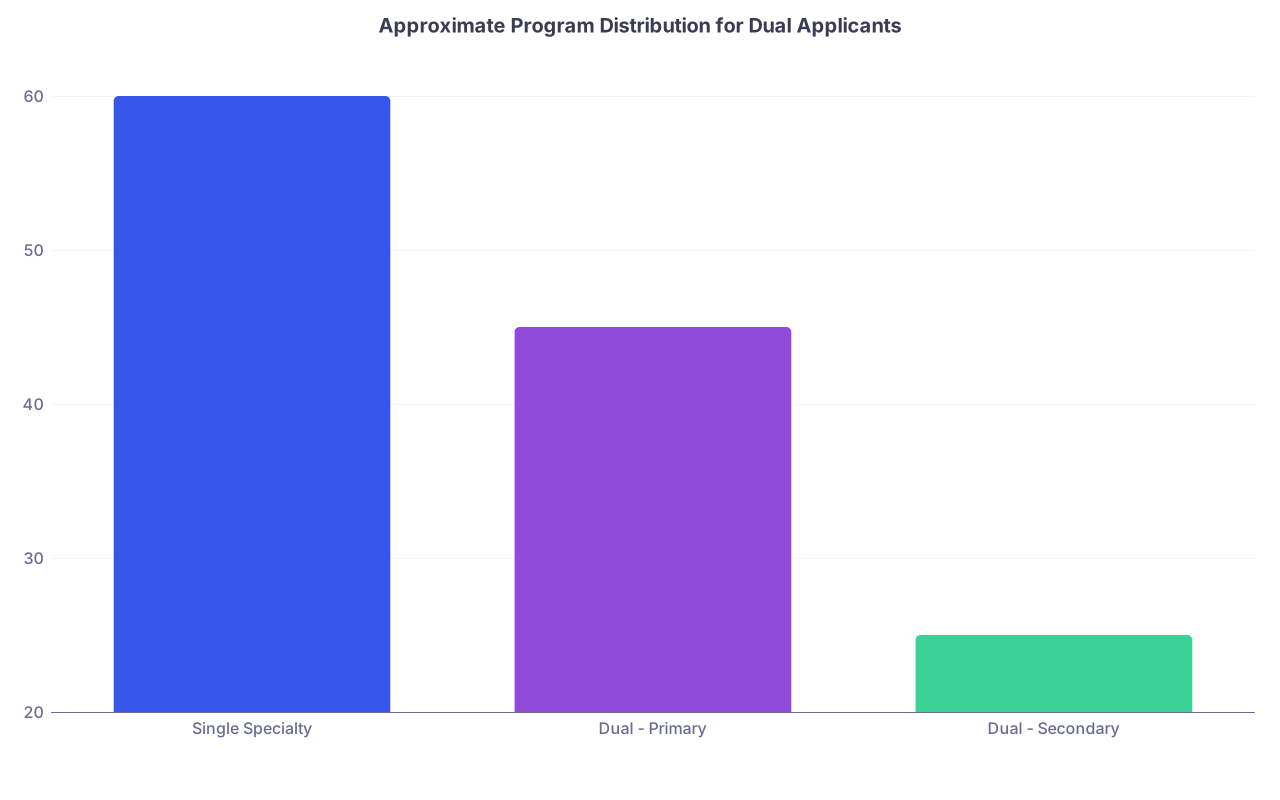
| Category | Value |
|---|---|
| Single Specialty | 60 |
| Dual - Primary | 45 |
| Dual - Secondary | 25 |
Do not do this half-baked thing where you send 10 apps to psych “just in case” with zero psych letters, no psych narrative, and no psych experiences in your MS4 year. That is a wasted $300+ and mental energy.
Step 6: Managing Interviews Without Exposing Yourself
Here’s where dual-interest plans usually fall apart: interview season.
There are three distinct problems:
- Scheduling conflicts between two specialties
- Program directors sniffing out that you’re not “all in”
- You getting exhausted or burned out from over-accepting interviews
Accepting and Prioritizing Interviews
Decide now: if both fields go well, which one would you honestly rank #1? That choice governs:
- Which interviews you always say yes to
- Where you’re willing to double-book and later cancel
- How many total interview days you’re willing to tolerate
As a loose rule of thumb (varies by specialty and your risk tolerance):
- 10–12 solid interviews in one specialty is usually enough to rank with a good chance of matching, if you’re reasonably competitive
- If interviews are more thinly spread (e.g., 7 in one specialty, 6 in another), you are now relying on two medium-short lists instead of one robust one; still doable but riskier
Don’t accept 30+ interviews across two specialties unless you’re prepared for:
- Nonstop Zoom or travel
- Zero bandwidth to prep properly
- Burning out by mid-January and mailing it in
What to Say When Programs Ask If You’re Dual-Applying
They might ask. Especially in IM, EM, Neuro, Anesthesia, FM, or Psych, where people commonly cross-apply.
The wrong answer:
“I’m keeping my options open and seeing what fits best.”
Translation in their head: “I’ll drop you if the other specialty wants me.”
The right answer sounds like this:
- Acknowledge your interest in both
- Ground it in authentic experiences
- Reassure them you’d be happy and committed if you matched there
For example, in an IM interview when you’re also applying Neuro:
“I’m very open about the fact that I love both general internal medicine and neurology. I’ve done serious work in both: IM sub-I, neurology elective, and research bridging the two in stroke. I applied to both because I see different but equally compelling futures in each. If I’m fortunate enough to match in Internal Medicine, my plan is to build a career that keeps me close to complex inpatient care and teaching—possibly with a fellowship that aligns with my neuro interests like stroke or critical care. I’d be very happy training as an internist.”
You’re not lying. You’re anchoring to a real vision if you match there.
Step 7: Rank List Strategy When You Have Two Specialties
This is where panic sets in February: “What if I rank Neuro #1 and don’t match and my IM list is too short?” or the reverse.
Some basics:
- You submit one rank list with everything on it (categorical, prelim, TY, different specialties)
- You are ranked separately by each program based on that program’s list
- The algorithm tries to place you in the highest program on your list that also ranks you high enough
So you must put programs in your true order of preference, not in some tactical mind game.
But you can be strategic about:
- How many programs from each specialty are actually on your list
- Whether you include prelim/TY-only tracks
- Whether you mix specialties or group them
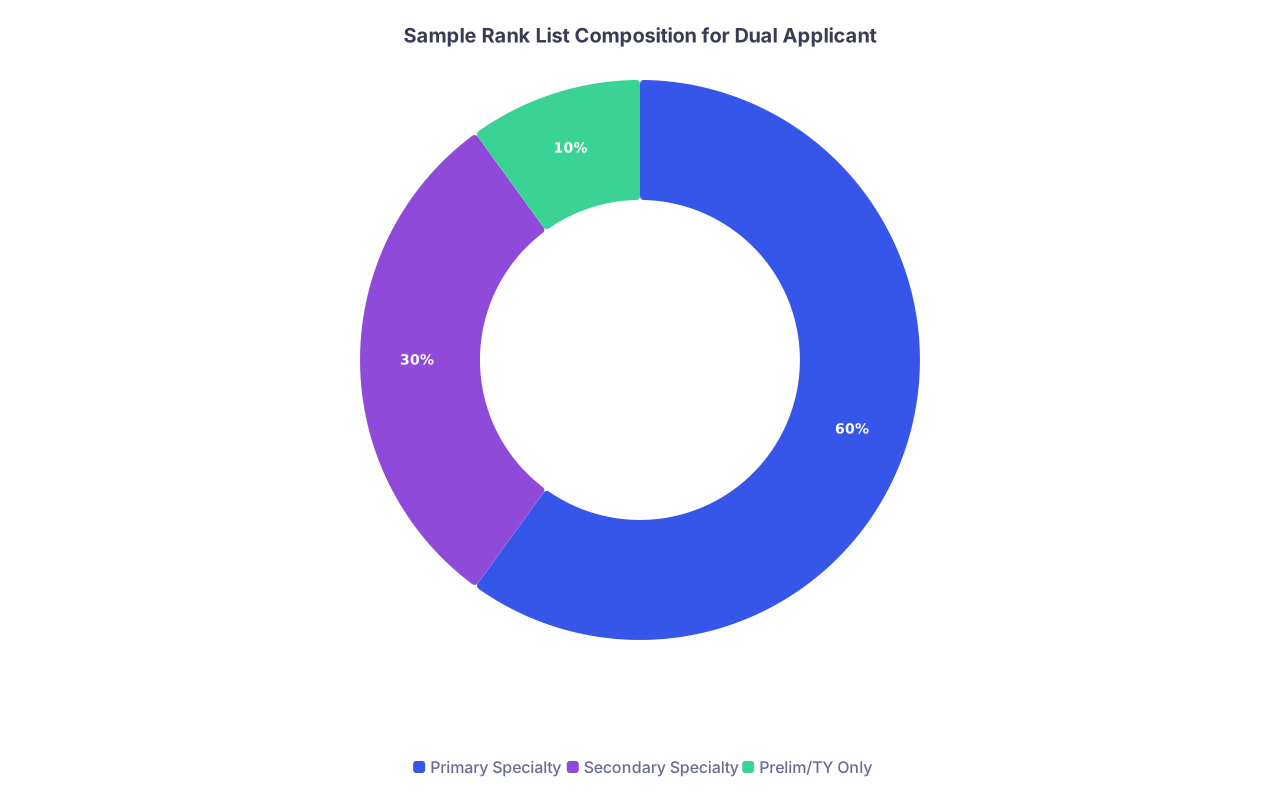
| Category | Value |
|---|---|
| Primary Specialty | 60 |
| Secondary Specialty | 30 |
| Prelim/TY Only | 10 |
For a dual IM + Neuro applicant:
- If your heart: “I want Neuro, but I must match somewhere this year” →
Rank Neuro programs you’d actually attend at the top, followed by IM programs where you’d also be happy. Do not rank any program where you’d truly be miserable just to “not go unmatched.”
Mistakes to avoid:
- Ranking a specialty first where you have only 2–3 weak interviews just to “shoot your shot” and then having a too-short list in the other specialty
- Putting lower-ranked programs in a specialty ahead of strong programs in the other specialty purely out of ego about prestige within one field
The adult move: rank in the order you would actually choose if offered both tomorrow. No fantasy. No ego.
Step 8: How to Talk About Your Dual Interests Without Sounding Flaky
You need one coherent story that can be told two different ways, not two unrelated stories.
What often works:
- A common thread: type of patient (older adults, critical care, underserved communities, kids, neuro patients, psych-complex patients)
- A style of thinking: procedural, diagnostic puzzles, systems-based, communication-heavy, crisis management
- A setting: ED, ICU, continuity clinic, OR, wards
For example:
EM + Anesthesia: “I’m drawn to acute physiology, resuscitation, and procedures. In EM, that looks like front-door stabilization and broad differentials. In anesthesia, it looks like meticulous planning, airway management, and intra-op physiology. I’ve loved both environments in different ways.”
IM + Psych: “I keep ending up interested in patients whose problems are part medical, part behavioral. On medicine rotations, I was drawn to complex diabetics with depression, cirrhotics with addiction. In psychiatry, I saw the same patients from the other side. Both fields give me a way to work in that overlap; they just come at it from different angles.”
You’re not saying, “I have no idea who I am as a doctor.” You’re saying, “Here’s exactly who I am—and I’ve found two honest ways that could play out.”
Step 9: Red Flags and When Dual-Applying Is a Bad Idea
There are situations where dual-applying is smart, and situations where it’s just panic with extra paperwork.
It’s smart when:
- You’re reasonably competitive in both specialties
- You have actual experiences in both
- You’re truly willing to do either long term
- You can realistically build two coherent application cores
It’s bad when:
- You’re applying to your “backup” with:
- No rotations
- No specialty-specific letters
- Zero longitudinal interest
- The fields are wildly different (e.g., Ortho + Psych) and you have no clear narrative bridging them
- You’re only doing it because you’re terrified of not matching in an ultra-competitive field, but you’ve done no meaningful prep for the backup
Dual-apply if you can build two believable futures for yourself. Single-apply with a post-match SOAP/back-up year plan if you’re just hedging without doing the work.
Step 10: Emotional Management So You Don’t Lose Your Mind
Let me be blunt: dual-applying is exhausting. You will:
- Rewrite your personal narrative twice
- Prep for two types of interviews
- Second-guess every decision
To survive:
Decide your rules before the chaos
- How many programs per specialty
- Max interview days you’ll tolerate
- What gets prioritized in conflicts
Stop crowdsourcing your risk tolerance
Your classmates will say insane things like “I applied to 120 programs in three specialties and did 28 interviews.” Ignore them. Design something sustainable for you.Commit: you will not apologize for dual-applying
You made a thoughtful choice to explore two valid futures. Programs may prefer single-minded people, but you’re not a red flag if you present your story clearly, professionally, and honestly.
You’re not trying to “game” the Match. You’re trying to give yourself two real doors you can walk through without chaos.
If you:
- Choose a primary and secondary specialty on purpose
- Build two distinct but honest application cores
- Get specialty-specific letters for both
- Plan rotations around deliverables, not vibes
- Handle interviews and rank lists with clear priorities
You can come out of March with a match in a field that makes sense for who you are—not just where you randomly landed.
With that structure in place, your next jobs are execution and stamina: getting the applications out, surviving interview season, and staying clear-headed enough to build a rank list that reflects your real priorities. And once you match—into whichever of your two futures becomes real—your attention shifts from “which specialty” to “how do I become excellent here?” But that’s a challenge for the first day of intern year, not for today.