It’s May of your third year. You just fell in love with ENT/ortho/derm/neurosurgery (pick your poison) on an away rotation or during a random case. You go back to your school’s website and it hits you like a truck: there is no home residency program in that specialty.
No home department chair. No “our residents” to vouch for you. No institutional letter that everybody else from big-name schools seems to have.
You’re thinking: Am I already dead in the water?
No. But you are playing on “hard mode.” You do not get to be casual or vague. You need a playbook. Here it is.
Step 1: Be Brutally Clear About Your Baseline
Before you start emailing 40 program directors, you need to know where you actually stand.
Do this on paper, not in your head. Right now.
Write down:
- USMLE/COMLEX scores (pass/fail + numeric where relevant)
- Class rank / quartile / AOA / Gold Humanism
- Number of research products in this specialty (and related fields): posters, abstracts, pubs
- Number of people who can write strong letters in your desired specialty (right now, likely zero or one)
- Geographic ties (family, med school state, undergrad, places you’ve lived)
- Real constraints (visa, couples match, family, debt/need for high salary)
Then categorize yourself honestly:
| Category | Strong | Middle of the Road | Needs Work |
|---|---|---|---|
| Scores | |||
| Clinical evals | |||
| Research | |||
| Specialty letters | |||
| Geographic ties |
Fill it in. Literally.
If you are a mid-pack applicant trying for derm or ortho with no home program and no research, you cannot behave like the Hopkins AOA with 10 pubs. Your strategy has to compensate aggressively.
Step 2: Build a “Pseudo-Home” Department
You do not have a home program. So you manufacture one.
You’re trying to create three things:
- A faculty champion who actually knows you
- Specialty-specific mentorship that’s credible
- A small “tribe” of people who will answer emails and open doors
Here’s how.
A. Identify your anchor institution(s)
You need at least one of these:
- A nearby institution (academic center) with your specialty
- A community program with an actively engaged PD or department lead
- A prior undergrad or hometown institution with that specialty
Cold emailing random PDs rarely works. What does work:
- Places where you have any tie
- Places where your med school sends students for other rotations
- Places where your school’s alumni are now faculty
Ask your Dean’s office, clinical education office, or student affairs:
“Which hospitals/institutions do we have affiliation agreements with that have [specialty]?”
Then target there first. Because paperwork already exists.
B. Get a real mentor, not just a “name on my CV”
Send a very specific email. Not that vague “I’m interested in your field and would love to connect” nonsense.
Subject: “MS3 seeking [Specialty] mentorship – no home program – specific goals”
Body (tight version):
Dr. X,
I’m a rising MS4 at [Your School], which unfortunately does not have a [Specialty] residency or department. I’m committed to applying in [Specialty] and am looking for concrete mentorship from someone in the field.
I’m hoping for brief guidance on:
- How to structure my fourth year for [Specialty] given I have no home program
- Which away rotations might make the most sense at my level of competitiveness
- How I can become involved in any ongoing projects (even small ones) to build a track record in [Specialty]
I’m happy to work hard, take on grunt work, and be flexible with timing. If you’re open to it, I’d appreciate even 20 minutes over Zoom or phone.
CV attached for context.
Thank you for considering this,
[Name]
[Year, School]
[Phone]
You send 5–10 of those. Not 100. Carefully chosen people.
Your goal: land 1–2 humans who give a damn.
C. Attach yourself to something ongoing
When someone says, “Sure, let’s talk,” you need an ask ready.
On that first call, say clearly:
“I know I don’t bring much specialty experience yet. I’m very comfortable doing data entry, collecting charts, literature reviews, or building REDCap databases. If there’s any project where you just need someone reliable and fast, I’d like to help.”
You’re not a co-PI. You’re a workhorse. Get on something that will produce a line on your CV before ERAS opens, even if it’s “submitted abstract.”
Step 3: Design a 4th-Year Schedule That Actually Signals Commitment
With no home program, your schedule is your billboard. It tells programs: “I really am serious about this.”
You need:
- 1 “home-like” experience (even if technically away)
- 2–3 targeted away rotations at realistic programs
- 1–2 safety nets (backup specialty / prelim / TY)
A. Timing – don’t screw this up
For competitive specialties, ideal:
- First specialty rotation: early MS4 (May–July)
- First away: July–August
- Second away: August–September
- Avoid doing your first exposure to the specialty in September. That’s late. You want at least one letter ready by ERAS opening.
If VSLO is backed up or you’re late, then:
- Lock in at least one strong away, even if it’s September
- Use earlier months to do visiting observerships or research months at a place with that specialty to build relationships prior to the actual sub-I
B. Choose away rotations like a strategist, not a tourist
Do not just chase brand names. “I want to rotate at MGH and UCSF” is how you burn months and end up with one generic letter and no interview.
You need a spread:
| Slot | Type of Program | Competitiveness Match Level |
|---|---|---|
| Away #1 | Mid-tier academic w/ residents | Slight reach |
| Away #2 | Solid mid-tier / home-state | Target |
| Away #3 | Lower-tier / newer program | Safety / high yield |
Aim to rotate where:
- They actually interview their rotators frequently
- Your scores are above (not below) their usual posted medians
- They have a history of taking DO/IMG/no-home-program students (ask current residents quietly)
Email residents:
“Historically, how often do rotators get interviews here? And what proportion of residents came from schools without a home program?”
They’ll tell you.
Step 4: Letters of Recommendation When You Start at Zero
No home program means no built-in “Department Chair Letter” that many specialties unofficially expect.
You compensate with:
- Multiple strong clinical letters in the specialty
- One credible “surrogate home” letter from a well-known faculty
- 1–2 non-specialty letters that scream “this person is excellent clinically and not a flake”
A. How to get a strong specialty letter on an away
Here’s how people screw this up: they show up, work “fine,” do not explicitly ask for feedback, and then timidly request a letter by email three weeks later.
On day 1–2 of your away, say to your chief or attending:
“I’m applying in [Specialty] and I do not have a home program. This rotation is extremely important for me. I’d really appreciate any direct feedback, including things I need to fix quickly — I want to get to the level where you’d feel comfortable writing me a strong letter.”
Now they’re watching you with the right framing.
Mid-rotation, ask for honest feedback and implement it visibly.
Final week, choose 1–2 attendings who’ve actually seen you work and say in person:
“I’ve really valued working with you. I’m applying in [Specialty] without a home program, and your perspective carries a lot of weight. If you feel you can write a strong, supportive letter for me, I’d be very grateful.”
Strong. Supportive. They know what that means. If they hesitate or waffle, pick someone else.
B. Non-specialty letters that actually matter
If you’re applying ENT, a glowing letter from an IM attending who says:
“Top 5 medical student I’ve worked with in 15 years. Precise, thorough, handles stress well, and residents consistently asked to work with them again.”
is better than a lukewarm ENT letter that says “performed at expected level.”
Do not undervalue strong general surgery, IM, or ICU letters. They speak to your ability to survive residency.
Step 5: Research – Enough to Be Taken Seriously
Reality: in derm, plastics, ENT, ortho, neurosurgery, radiation oncology, anesthesia-pain-type fellowships, research is borderline mandatory at competitive programs.
You don’t need 15 first-author NEJM papers. But you need something.
A. Minimum viable research profile
You want by ERAS:
- At least 1–3 specialty-related: poster/abstract/paper
- A couple more in adjacent fields (surgery, IM, etc.) is a bonus
- Ongoing projects listed as “in progress” with clear roles also help
If you’re coming in late (MS3 end), you prioritize projects with short timelines:
- Chart reviews with existing database
- Retrospective single-center analyses
- Case reports with quick turnaround
- Quality improvement projects with clear endpoints
When you reach out to faculty, say:
“I’m specifically looking for projects that could realistically reach submission/abstract stage within 3–6 months if I put in significant time.”
That sentence separates you from the 100 “I’m interested in research” emails they ignore.
B. What if your med school has zero in this specialty?
That’s where your “pseudo-home” comes in. A few options:
- Remote collaboration: data entry, literature review, stats help (if you have skills)
- Short summer / pre-4th-year research month at a nearby institution
- Multi-center registries that love extra data collectors
You’re selling your time and reliability. Not your genius.
Step 6: Application Strategy – Where and How Many to Apply
Without a home program, you have less built-in protection. Programs like taking their own students; you don’t have that pipeline.
So your list needs to be broad and smart.
A. Numbers
For high-competition specialties, a no-home-program applicant often ends up in this zone:
- Derm / Ortho / ENT / Neurosurg / PRS: 60–80+ programs
- Gas, EM (now more competitive in some regions), Rad Onc, etc.: 40–60 programs
- If DO or IMG + no home program: you may need to push those even higher, plus dual apply
But not random. You’re not playing the lottery. You’re targeting programs where you have at least one of:
- Geographic tie
- Away rotation
- Research or mentorship connection
- DO/IMG-friendly track record (if that’s you)
B. Crafting the “no home program” part of your story
You do not pretend this isn’t a thing. You own it and spin it correctly.
In your personal statement or secondary questions (if present), something like:
“My medical school does not have a [Specialty] residency or department, which has shaped how I’ve pursued this field. Without a home program, I’ve had to be deliberate about seeking mentors, finding research opportunities, and building my exposure to [Specialty] through away rotations and external collaborations. That experience has made me more proactive and adaptable, and reinforced how committed I am to building my career in [Specialty].”
You’re not apologizing. You’re explaining why your path looks different — and why you’re not some dilettante who picked this last week.
Step 7: Compensating With Visibility and Relationship-Building
Students from big programs get seen automatically. You have to create your own visibility.
A. Specialty conferences and societies
If there is a national meeting in your specialty between now and ERAS, you’re going if there’s any way financially possible.
Why?
- You present your poster (even if it’s “meh”)
- You meet residents and faculty from programs you’ll apply to
- You follow up with them later: “We met at [Conference]. I really enjoyed our conversation about [topic], and I’m excited to apply to your program this cycle.”
That line turns a cold application into a warm one.
If money is tight: ask faculty or your school about travel scholarships. Almost every specialty society has them. I’ve seen plenty go unused because nobody applied.
B. Virtual networking that isn’t cringey
Programs and specialty societies run:
- Virtual open houses
- Resident “ask me anything” panels
- Webinars for applicants
You don’t need to attend 50 Zooms. But you should pick:
- All sessions run by programs where you are doing / did an away
- Sessions for your top 10–15 realistic programs
- Any “No home program / DO / IMG” targeted session (some specialties do this now)
When you attend, cameras on, notes ready, 1–2 thoughtful questions.
Afterward, email the PD or coordinator:
“Thank you for the open house today. As a student applying in [Specialty] from a school without a home program, it was very helpful to hear how your residents described the culture and educational support at [Program]. I’ll be applying this year and wanted to express how much I appreciated the transparency about [specific detail].”
Names matter. You’re creating tiny memory hooks.
Step 8: Dual Applying and Backup Planning Without Torching Your Primary Application
This is the part most people mess up. They either:
- Go “all in” with zero safety net and end up SOAPing into something they hate
- Or dual apply so obviously that both specialties can smell it and back away
You have to be surgical.
A. Who should seriously consider dual applying?
- Below-average scores for the specialty
- No research + late decision + no home program
- DO or IMG in ultra-competitive fields without big-name mentors
- Personal or geographic constraints that dramatically limit your list
If that’s you, pick a backup that:
- You could tolerate doing for life if you match there
- Shares some skillset (e.g., gen surg <-> surgical subspecialty; IM <-> cards/hem-onc aspirations; anesthesia <-> critical care interests)
- Actually has positions; don’t back up derm with plastics
B. How to not tank yourself
You need:
- Two personal statements
- Two letter sets (overlap okay from non-specialty attendings, but you need at least 2 strong letters in each field if possible)
- Two narratives that each sound like they’re your first choice
Programs know dual applying exists. They just do not want to feel like they’re your sloppy seconds.
Step 9: Interview Season Tactics When You’re “The No-Home-Program Person”
Once you get in the room (or on Zoom), the question is coming:
“So tell me about your interest in [Specialty] given that your school doesn’t have a home program.”
You want a crisp 60–90 second answer:
- Acknowledge the reality, no whining
- Show how you created your own path
- Tie it to your personality and strengths
Example:
“You’re right, [School] doesn’t have a [Specialty] program, which honestly made the path more complex. I discovered [Specialty] during [specific experience], and from that point I had to be very intentional — finding external mentors, joining projects at [Institution], and building rotations at [Program A] and [Program B] where I could be evaluated alongside students with home departments.
The upside is that it forced me to be proactive and comfortable being the outsider who has to prove themself. I’ve really valued the chance to see multiple different program cultures up close, and it has reinforced that I genuinely want to build my career in [Specialty], not just at a single institution.”
You’re showing resiliency, not victimhood.
Step 10: If You Don’t Match — How to Recover Strategically
Let’s be blunt: no home program + competitive specialty = higher risk of not matching on the first run, even if you do a lot right.
If that happens, you need a 12-month plan. Not flailing.
Options that actually help:
- A dedicated research year in that specialty at a solid institution
- A prelim (surgical) year or transitional year where you can impress people and reapply
- A categorical match in a related specialty you can live with as Plan B-for-real
What doesn’t help much:
- A random IM year in a community hospital with zero ties to your chosen competitive specialty, while you “think about next steps”
If you take a gap/research/prelim year, your pitch the next cycle:
- Clear improvement: new letters, more research, stronger evaluations
- Clear story: you didn’t just wait; you invested
Programs don’t like chaos. They like trajectories.
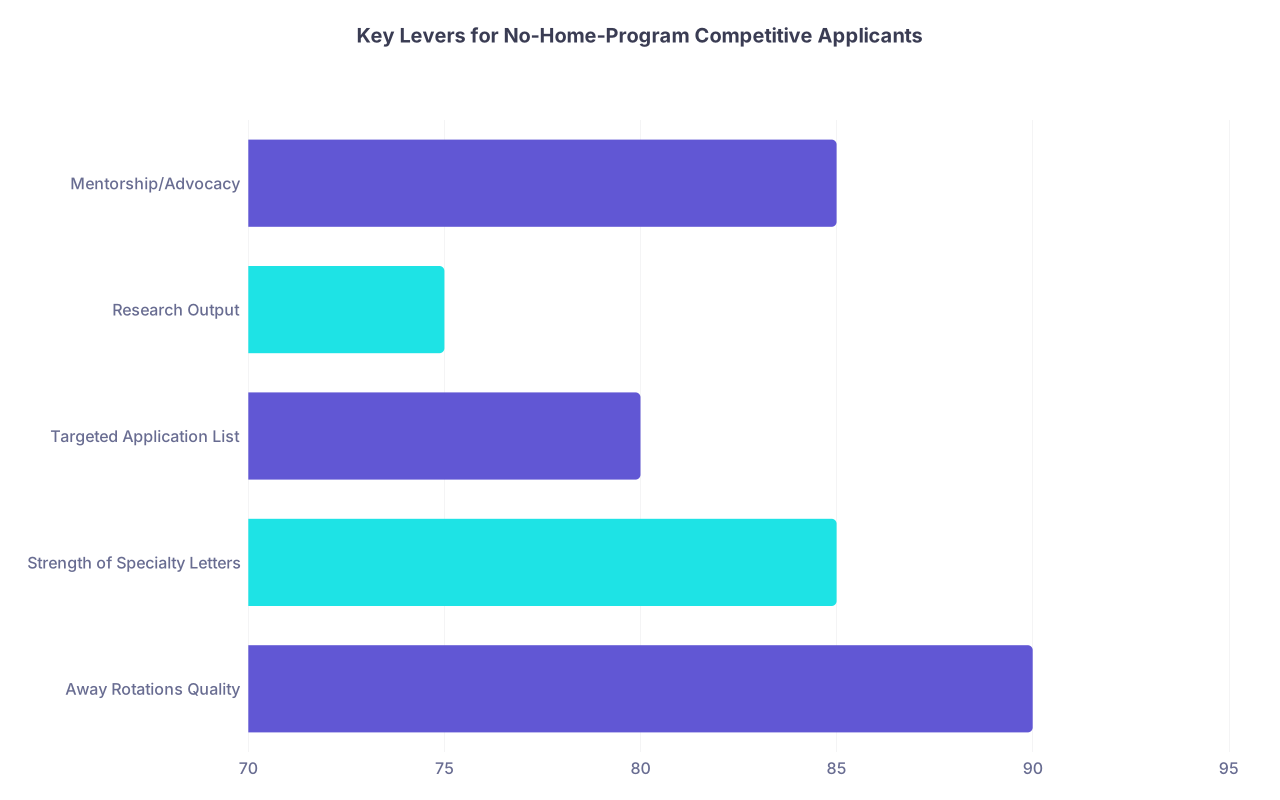
| Category | Value |
|---|---|
| Away Rotations Quality | 90 |
| Strength of Specialty Letters | 85 |
| Targeted Application List | 80 |
| Research Output | 75 |
| Mentorship/Advocacy | 85 |
FAQs
1. I decided on a competitive specialty late in MS3. Is it already too late without a home program?
No, but your margin for error is gone. You need to:
- Lock in at least one early away rotation if at all possible
- Aggressively pursue short-turnaround research projects
- Get one strong specialty letter before ERAS, even if it’s from a visiting/sub-I experience
You also have to be realistic about dual applying. If your scores and CV are solid, you can still match on the first try. I’ve seen it. But those people moved fast and treated every rotation like an audition.
2. How many away rotations should I do if I have no home program?
For truly competitive specialties, usually 2–3 aways is the sweet spot:
- 1 at a slightly reach/mid-tier academic place
- 1 at a strong “target” where your stats fit well
- 1 at a safety / newer program where rotators often match
Doing 5 aways doesn’t quintuple your chances. It tends to just exhaust you and dilute your impact. Three focused, high-effort rotations beat five where you’re mediocre and forgettable.
3. I can’t afford multiple away rotations. What should I prioritize?
If you can only afford one:
- Pick a program geographically realistic for you to attend (you’d actually live there)
- With a track record of interviewing / matching rotators
- Where your scores are at or above their norms
Then: maximize everything else that’s cheap or free.
- Virtual open houses
- Remote research work
- Mentorship via Zoom
- Local observerships at nearby institutions (even if unpaid, even if not official aways)
Also: chase every travel / rotation scholarship your specialty society offers. Many go underused.
4. Will programs hold it against me that my school has no home program?
Most decent programs will not. They understand it’s structural, not personal. What they will judge is:
- Did you still find a way to get specialty exposure?
- Did you secure strong letters from people who know the field?
- Did you show enough initiative to build some research or scholarly activity?
If your application looks like: “No home program” + “no away rotations” + “no specialty letters” + “no research” — yes, you’ll be filtered out quickly. But that’s not because of the school; that’s because you didn’t compensate.
5. Who should I actually talk to at my school if they’ve never sent anyone into this specialty?
Three people:
- Student Affairs / Dean’s Office – They know historical match data and may remember the one student 6 years ago who did ENT or neurosurg. Get that name.
- Clinical Education Office – They know which hospitals you’re already affiliated with and can help with paperwork for new away sites.
- Any faculty who trained in your target specialty, even if they practice something else now. Ex: a hospitalist who did a year of neurosurg, or a gen surgeon with a plastics background. They understand the culture and can help you not make dumb moves.
Bring them a concrete plan, not vibes. Show them you’ve done your homework. People are more willing to advocate when they see you’re already pushing hard.
Today’s next step is non-negotiable: open a blank document and map out your fourth-year calendar month by month — including which months will be away rotations, which will be research, and which will be backup/safety. Then send that draft to one potential mentor (even if you barely know them yet) and ask, “Can I get your 10-minute, brutally honest feedback on this plan?”