What do you actually do when your MSPE has a professionalism “incident” paragraph and you still need to match?
Let’s not sugarcoat it: a professionalism concern or disciplinary action in your record is one of the few things that can genuinely sink an otherwise solid residency application—if you handle it badly.
Handled well? People match every single year with:
- Failed clinical rotations
- Academic probation
- Honor council violations
- Unprofessional conduct notes
I’ve seen it. I’ve also seen people torpedo themselves by lying, minimizing, or freezing and applying like nothing happened.
Here’s how to handle this situation like an adult who programs can trust.
Step 1: Get Completely Clear on What’s Actually in Your File
Before you write a single word in ERAS, you need to know exactly what exists in writing about you.
You’re not guessing. You’re not going off a conversation from M2. You’re getting documents.
What to do this week
Request your full MSPE draft.
Most schools share a draft or will at least read you relevant sections. Ask explicitly:
“Can I see the exact wording of any professionalism or disciplinary comments that will appear in my MSPE?”Ask for the official letter(s) or documentation.
- Student affairs file
- Promotions committee letter
- Honor council outcome letter
- Clerkship director emails that became “professionalism notes”
Clarify status and coding.
You need answers to:- Was this official disciplinary action or just “feedback”?
- Did it go to the dean’s office or just stay at the clerkship level?
- Is this coded as:
- Academic probation
- Disciplinary probation
- Warning / remediation completed
- “Professionalism concern noted and addressed”
Ask how your school reports this to ERAS/NRMP.
Some schools over-report everything. Some under-report. You want the truth.
If you cannot get straight answers, escalate politely:
- Start with your advisor
- Then student affairs dean
- Then dean of education if needed
You’re not being difficult. You’re trying to make sure your application matches the institutional record so you do not look dishonest.
Step 2: Decide Where You Must (and Should) Disclose
You never hide official disciplinary or professionalism actions. Programs cross-check with your MSPE, transcripts, and the institutional form. If there’s a mismatch, you’re done.
Main places this can show up:
| Location | Who Controls It | Typical Content |
|---|---|---|
| MSPE (Dean's Letter) | School | Official narrative of incidents and outcomes |
| ERAS 'Adverse Action' Questions | You | Yes/No + brief explanation |
| Personal Statement | You | Optional context and growth (if needed) |
| LORs | Faculty | Rarely explicit, sometimes allude to growth |
| School's Institutional Form | School | Checkboxes for professionalism/discipline |
ERAS questions
If there was any official action (probation, suspension, dismissal, professionalism sanction), the answer is yes. Then you explain briefly and honestly.
If it was purely local clerkship feedback, not reported to the dean’s office and not in your MSPE or institutional form, then you may not need to report it in ERAS—but you still need to be prepared if it’s verbally mentioned or hinted.
When in doubt:
- Ask student affairs: “Would this be considered a reportable disciplinary action?”
- Get the answer in email if possible.
If your school says they’re reporting it, you report it too. No exceptions.
Step 3: Build a Coherent Narrative: What You’ll Actually Say
You need one clear, consistent story about:
- What happened
- What you owned
- What changed
Not six different versions depending on who asks.
The structure that works
Keep it simple and clinical. Think HPI, not drama.
- One sentence: the situation
- One to two sentences: what you did wrong (own it)
- Two to three sentences: what you learned and what you changed
- One line: evidence it hasn’t recurred
Example for a professionalism lapse on surgery:
During my third-year surgery clerkship, I received a professionalism concern related to repeated tardiness and incomplete notes. I underestimated the expectations for pre-rounding and documentation and did not adjust quickly enough after feedback.
As a result, I completed a formal remediation plan focused on time management, pre-round preparation, and documentation standards, meeting weekly with the clerkship director for three months. Since then, I’ve consistently received strong evaluations in subsequent clerkships, with specific positive comments on reliability, punctuality, and thoroughness. There have been no further professionalism concerns.
That’s the tone you want: direct, factual, no blame shifting, and clearly rehabilitated.
Where to place this narrative
You may use variants of this in:
- ERAS “adverse action” textbox (condensed)
- Personal statement (only if it’s a major event or explains meaningful growth)
- Interview answers (“Tell me about the professionalism note in your MSPE”)
If the issue is significant (probation, suspension, honor council), I like a short mention in the personal statement that matches your ERAS explanation. If it’s something minor that is barely mentioned in the MSPE, you might keep it out of the PS and just be ready to discuss if asked.
Step 4: Match Your Story to How the School Describes It
This is where people get burned: they try to “soften” the reality, and the MSPE contradicts them.
You need to know the exact phrases the MSPE uses. Example:
- “Professionalism concern: repeated late arrivals to required activities leading to remediation”
- “Academic probation: failed internal medicine clerkship, subsequently remediated”
- “Honor code violation: unacknowledged copying in an assignment, resulting in disciplinary probation for one semester”
Your description in ERAS and interviews should track with that language:
Bad:
It was just a misunderstanding about expectations and communication.
Better:
I had repeated late arrivals and delayed documentation despite feedback, which led to a documented professionalism concern and a formal remediation plan. I completed this successfully and have had no further issues since.
You don’t have to parrot their wording verbatim, but it should clearly refer to the same event and level of concern.
Step 5: Get Strategic About Specialty and Program Selection
Here’s where people either save or sink their match.
Not all specialties and programs treat professionalism issues the same way.
Reality check: your competitiveness hit
If you have:
A one-time minor professionalism note, remediated, no recurrence:
You’re dinged, but not dead. Especially if everything else is strong.Academic or disciplinary probation, or suspension:
You’re in a higher risk category. Some programs will auto-screen you out.Honor council or integrity violation:
This is the hardest to overcome. Some PDs will never touch it. Others will listen if the story and rehabilitation are convincing and old enough.
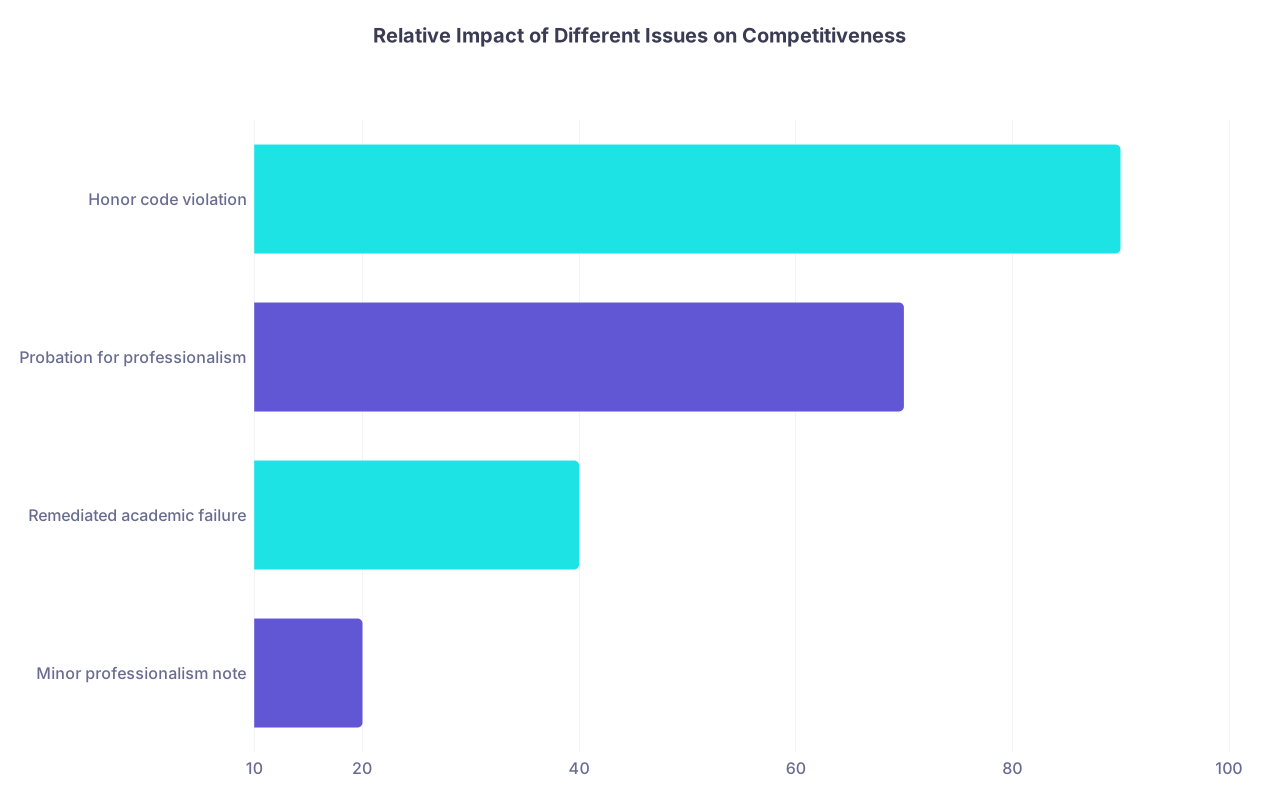
| Category | Value |
|---|---|
| Minor professionalism note | 20 |
| Remediated academic failure | 40 |
| Probation for professionalism | 70 |
| Honor code violation | 90 |
(Think of those values as “percent of programs that will hesitate or screen you out.” Not literal data, but pretty close to how it feels on the ground.)
So what do you do?
Be realistic about specialty.
Highly competitive specialties (plastics, derm, ENT, ortho) are long shots with serious professionalism/disciplinary hits, even with high scores. You can try, but you’d better have a robust backup plan.Find programs that actually read files rather than just screening by checkboxes.
- Community and mid-tier university programs more likely than top 10 ivory towers
- Programs in regions where your school sends a lot of grads
- Places where faculty or alumni know you and can advocate
Increase your application volume.
You’re not applying to 20 programs in IM with a professionalism probation and hoping for the best. You’re in the 60–80+ range, and you’re okay traveling.
Step 6: Use Letters of Recommendation as Damage Control (and Proof of Growth)
Your letters can either silently confirm the concern (by being generic and lukewarm) or actively counter it.
You want at least one letter that indirectly addresses your growth. Not spelling out your dirty laundry, but saying the right things.
For example, if your professionalism note was about lateness/disorganization, you want language like:
- “Always early and well-prepared”
- “Reliable follow-through on tasks”
- “Highly dependable, especially during busy call days”
You might even be explicit when you ask a letter writer you trust:
“Dr. X, as you know, I had a professionalism concern during third year that was remediated. Since then I’ve been working hard to show reliable professionalism. If you feel comfortable, I’d appreciate if you could speak to my reliability, work ethic, and response to feedback in your letter.”
If they hesitate? That’s your signal not to ask them for a letter.
Step 7: Decide Whether to Address It in Your Personal Statement
You don’t have to. But sometimes you should.
You should briefly address it in the PS when:
- The issue is major (probation, suspension, honor violation)
- It directly shaped your professionalism, maturity, or choice of specialty
- Ignoring it would make you look like you’re ducking it
You can skip it in the PS (and keep it to ERAS + interviews) when:
- It’s a minor professionalism note mentioned only briefly in the MSPE
- It was clearly remediated and your record since is spotless
- You don’t have anything meaningful to add beyond what ERAS says
If you include it in the PS:
- One short paragraph, not half the essay
- Middle of the statement, not the first or last thing
- Focus on growth and current functioning, not excuses
Example paragraph:
Early in my third year, I received a professionalism concern related to incomplete documentation and inconsistent responsiveness to feedback. This was a painful but important turning point. Through a formal remediation process and close mentorship, I learned how to manage my workload more effectively, communicate proactively with my team, and prioritize reliability even during fatigue. The experience reshaped how I approach clinical work, and since then, my evaluations have consistently highlighted dependability and accountability as strengths.
Then move on. You’re not writing a confession. You’re showing insight and rehabilitation.
Step 8: Prepare for the Interview Question You Don’t Want
If your MSPE has anything non-trivial, you must assume you’ll be asked directly:
- “Can you tell me about the professionalism concern mentioned in your MSPE?”
- “I see there was a period of probation. What happened?”
- “I’d like to hear your perspective on the disciplinary action described here.”
You cannot wing this. You need a practiced, calm, 60–90 second answer.
Structure again:
- Brief description of situation
- Clear statement of your responsibility
- Concrete steps you took
- Evidence of change
- Short closing line that returns to the present
Example:
In my second year, I was placed on disciplinary probation after an honor code violation related to improper citation on a written assignment. I misjudged what constituted appropriate paraphrasing and failed to seek clarification, and I take full responsibility for that decision. As part of the process, I met with the honor council, completed an academic integrity course, and worked closely with my faculty advisor to develop better research and writing habits. Since that time, I’ve had no further concerns raised, and faculty supervising my research projects have specifically commented on my thoroughness with attribution and documentation. The experience was humbling, but it’s made me much more careful and transparent in all aspects of my work.
Do not:
- Blame others
- Argue the fairness of the process
- Minimize the incident
- Over-share irrelevant emotional details
You’re showing judgment now, not proving you’re innocent back then.
Step 9: Coordinate With Your School Advocate
Most schools assign someone—dean, advisor, “application coach”—to help you apply. If you have any professionalism or disciplinary issue, you want that person fully briefed and on your side.
Tell them:
- How you plan to answer ERAS questions
- Whether you’ll mention it in the PS
- How you’ll address it in interviews
Ask them directly:
- “How do programs typically react to issues like mine?”
- “Are there programs or regions where my file will be better understood?”
- “Can you reach out to any PDs or programs on my behalf if needed?”
Sometimes, a quiet email from a dean vouching for your growth has more impact than anything you write.
Step 10: Protect Yourself From Making It Worse
There are a few ways people accidentally take a manageable issue and turn it into a disaster:
Lying or omitting when the school discloses.
NRMP and state boards do not forgive deliberate dishonesty. This is the line you do not cross.Inconsistency.
If your ERAS explanation, interview story, and MSPE do not match, you look evasive.Defensiveness.
Getting visibly angry or bitter about the incident in an interview is an instant red flag. You can acknowledge that it was hard and still sound mature.Over-emphasizing it.
Your entire application shouldn’t become “The Professionalism Incident Story.” Own it, then move the conversation back to your strengths and fit.
Quick Specialty-Specific Notes
Not all fields react the same way. Rough generalization:
- Family Med / Psych / Peds: Often more open to “late bloomers” and redemption arcs, especially with strong behavioral change and good letters.
- Internal Medicine: Varies. Academic powerhouses more rigid. Community and mid-tier university programs more flexible if they like your story and your mentors.
- Surgery: Very sensitive to perceived work ethic/professionalism issues. You’ll need killer support from surgeons who will vouch strongly for your reliability.
- EM: Professionalism, teamwork, and integrity are core. A serious professionalism or honor issue is a real problem. Not impossible, but you’ll need programs that know you personally.
- Highly competitive subspecialties (derm, ortho, ENT, plastics, neurosurg): Any official professionalism/disciplinary stuff is a major handicap. If you’re determined, work with mentors in that field and build a parallel backup plan in a less competitive specialty.
Visual: Your Year With a Professionalism Issue
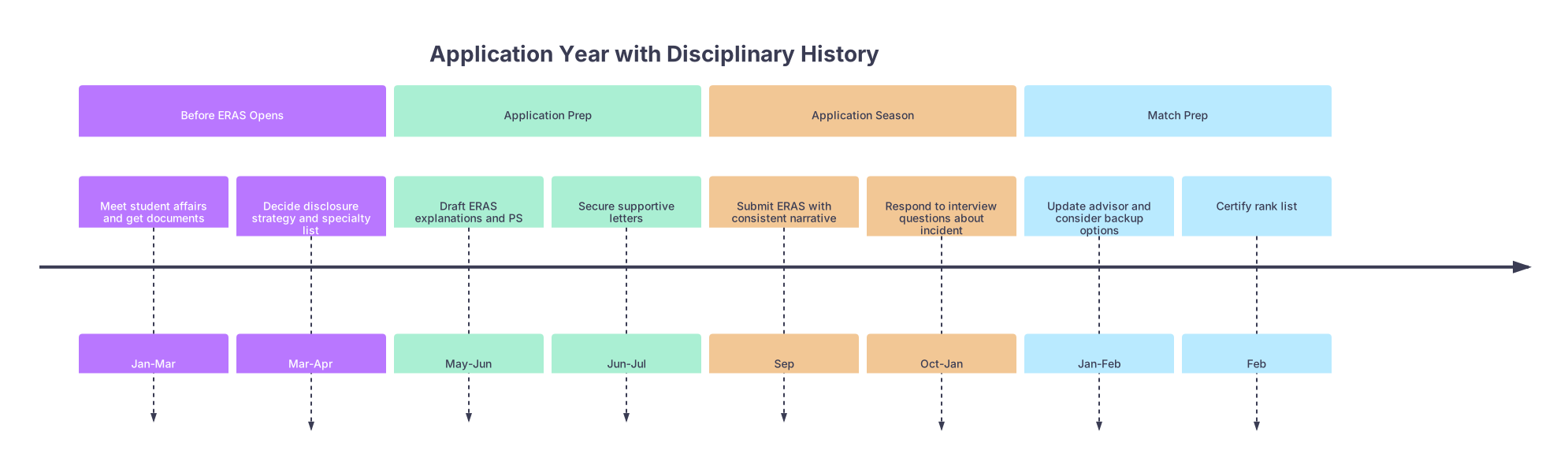
| Period | Event |
|---|---|
| Before ERAS Opens - Meet student affairs and get documents | Jan-Mar |
| Before ERAS Opens - Decide disclosure strategy and specialty list | Mar-Apr |
| Application Prep - Draft ERAS explanations and PS | May-Jun |
| Application Prep - Secure supportive letters | Jun-Jul |
| Application Season - Submit ERAS with consistent narrative | Sep |
| Application Season - Respond to interview questions about incident | Oct-Jan |
| Match Prep - Update advisor and consider backup options | Jan-Feb |
| Match Prep - Certify rank list | Feb |
Mental Side: Getting Out of Your Own Head
This part no one talks about.
A professionalism or disciplinary hit, especially if it felt unfair or humiliating, can leave you:
- Hyper-defensive
- Ashamed
- Convinced everyone is judging you
Programs can smell that from across the Zoom connection.
You need to do some internal work so you can talk about this like a professional, not a wounded student.
That might mean:
- A brutally honest conversation with a mentor who will tell you where you really went wrong
- Writing out the story a few different ways until it feels true and not performative
- Practicing your answer out loud until your voice doesn’t crack or speed up when you mention it
Your goal: calm, grounded, factual. Not cold. Not tearful. Just solid.
Summary: What Actually Matters
If you remember nothing else:
- Do not hide or sugarcoat what your school is officially reporting. Match your story to the record.
- Own the mistake clearly, show specific remediation, and provide evidence of sustained change.
- Align your specialty/program list and letters around your reality, not the one you wish you had.
People match with ugly entries in their file every year. The ones who do it right behave like the physician they want PDs to believe they’ll be: honest, accountable, and clearly better than they were when the problem happened.