
It’s September. You’re staring at your ERAS profile and your stomach sinks a little.
No away rotations at big-name places.
No PhD supervisor writing you a three-paragraph brag email about your Nature paper.
No $3,000 Step 2 prep course, no mission trips, no fancy global health fellowship.
You worked. A lot. Maybe you commuted from home, took care of family, translated for your parents at doctor’s visits, or picked up extra shifts just to pay rent. Your “activities” list looks… thin compared with your classmates who had parents paying their rent and CV.
But you still need to match.
This is that situation: low-resource background, limited extras, and you’re trying to build a residency application that does not get laughed off the pile. Let me walk you through how to make what you do have hit as hard as possible—and how to avoid quietly sabotaging yourself.
Step 1: Get Honest About Your Starting Point
Before you try to “spin” anything, you need a clear inventory. Not the sugar-coated version. The real one.
Grab a sheet and break it down:
- Scores: Step 1 (P/F but still relevant), Step 2 CK, COMLEX if applicable
- Clinical: clerkship grades, any honors, sub‑Is, away rotations (or none)
- Experiences: research, work, leadership, volunteering, tutoring, caregiving, jobs unrelated to medicine
- Context: first-gen, worked during school, major financial hardship, dependent family members, rural/underserved background
Now ask bluntly:
- Did I have to work during school or clinical years?
- Did I reliably have less time or access than peers (no car, no stable housing, caregiving, unreliable internet, etc.)?
- Are there “gaps” on my CV that are realistically due to money/time, not laziness?
If the answer to any of those is yes, then you are exactly the person this article is for.
Your strategy is not “pretend I’m just like everyone else.” Your strategy is:
- Make your constraints explicit but not whiny
- Show how you still produced value under constraint
- Make programs see you as resilient and efficient, not underachieving
Step 2: Reframe “Limited Extras” Into Assets—Correctly
Programs see two kinds of “light” CVs:
- People who had every opportunity and did almost nothing.
- People who obviously had constraints and still produced something solid.
You want to land squarely in category 2.
How to talk about work and life responsibilities
If you worked 20–30 hours a week as a medical assistant, server, tutor, or anything else, that belongs on ERAS. Not in the “shame” pile.
Bad way to present it:
“Had to work a lot so I couldn’t do research.”
Better way:
“Worked 25 hours/week as a certified nursing assistant throughout MS2–MS4 to support myself and family. This limited my ability to participate in traditional research, but strengthened my clinical efficiency, communication with nurses, and time management.”
Notice the order:
- You state the work.
- You quantify it.
- You link it to skills residency cares about.
- You briefly acknowledge tradeoffs without making excuses.
Same for caregiving:
“Primary caregiver for my younger siblings during MS1–MS3, responsible for school logistics, appointments, and translation for my parents. This taught me to manage complex responsibilities and prioritize under pressure, which carried over directly to my clinical performance.”
You are not asking for pity. You are giving context for your trajectory.
Step 3: Build a “High-Yield CV” With What You Can Actually Afford
You probably cannot afford unpaid research for a year, international trips, or multiple aways. Fine. Stop wishing for them and build what you can.
Here’s what’s actually high-yield for most core specialties (IM, FM, peds, psych, neurology, OB/Gyn, prelim/TY):
| Activity Type | High-Yield if Low-Resource | Low-Yield for You Right Now |
|---|---|---|
| Extra rotations | Sub-I at home + 1 away max | Multiple unfocused aways |
| Research | Small, finished projects | Vague 'working on a paper' |
| Volunteering | Long-term local roles | One-off mission trips |
| Work | Clinical or teaching jobs | Unrelated very short gigs |
| Leadership | A few real responsibilities | 10 passive memberships |
Clinical: Milk your home institution
You don’t need 4 away rotations to match most fields. Often you can’t afford that anyway. Here’s what you prioritize:
- Rock your core clerkships. Honors where possible.
- Do at least one sub‑I in your chosen specialty at your home institution.
- If you can budget for one away, make it strategic (geographic region where you want to match, or a place that likes your school).
If you can’t afford any aways, say that once in your application or at interviews, calmly and directly:
“Due to financial constraints, I limited my away rotations and focused on maximizing my performance at my home institution, where I completed a sub-internship in internal medicine.”
That’s it. No apology tour.
Step 4: Turn “Small” Research Into Real Signal
Maybe you do not have a big-name PI. Fine. That’s 80% of applicants.
Programs don’t just care about brand names; they care: Can you start something, stick with it, and finish?
If you’re low-resource, research should be:
- Short-cycle
- Finishable in 6–12 months
- Close to home (literally in your hospital/clinic)
Good options:
- Case reports or small case series with a resident
- Retrospective chart reviews that plug into an ongoing project
- Quality improvement projects with real outcomes (reduced no-shows, improved screening rates, etc.)
Then you push each project as far as it can go:
- Local poster > regional poster > any abstract you can get
- Submit even to small journals—having “submitted” and “under review” is better than “working on a paper” that’s vaporware
And you describe it like this:
“Completed a retrospective review of X patients with Y condition at [Your Hospital], presented findings as a poster at [local/regional meeting]. Collaborated with resident and attending to develop a manuscript currently under review.”
That shows:
- Start → finish
- Teamwork
- Follow-through
If you truly have zero research
Then stop pretending you’ll “add some before ERAS.” You won’t. Focus on being extremely strong clinically and on service/volunteering. Many community and mid-tier academic programs will live with minimal research if everything else lines up.
Step 5: Use Your Background as a Coherent Narrative, Not a Sob Story
You come from a low-resource background. That’s not a liability by default. It’s an explanation for your path and a predictor of who you’ll serve well.
The key is: connect it to your fit for the specialty and your target patient population.
Where to talk about it
- Personal statement
- “Impactful challenge”–type secondary questions
- AAD (additional info) or “context” sections if offered
- Occasionally in interviews when asked “Tell me about yourself” or “Any challenges you’ve overcome?”
How to frame it
Bad version:
“I grew up poor. This made everything harder and limited my ability to pursue opportunities.”
Stronger version:
“I grew up in a low-income, medically underserved community where my family often delayed care because of cost or mistrust. Working part-time throughout medical school to support myself limited my ability to pursue long research fellowships, but it deepened my commitment to practicing in resource-constrained settings and taught me to deliver good care with limited tools.”
You’re doing three things:
- Naming the constraint
- Showing what you did anyway
- Linking it to the type of doctor you will be
And you keep it tight. Two or three sentences. Then move on to what you’ve built.
Step 6: Letters of Recommendation That Actually Show Who You Are
You can’t buy a name-brand letter. But you can earn a strong, specific one.
If you come from a low-resource background, you may also:
- Feel less comfortable self-promoting
- Feel out of place asking attendings for support
You still need to do it.
Who to target
Prioritize:
- Attendings who directly supervised you on wards/clinic and saw you work hard
- Faculty who saw you juggle major responsibilities (work, leadership, QI projects)
- A program director or clerkship director if they know you well
When you ask, give them a short “context” email or document:
- 3–5 bullet points of things you did on their rotation or project
- Brief reminder of your background and what you’re aiming for
For example:
“Dr. X,
As I request a letter, I wanted to briefly summarize my work on your service:
– Took primary responsibility for following up abnormal labs and imaging for our team
– Balanced the rotation with 20 hrs/week of work as a medical assistant
– Consistently received positive feedback from nursing staff on communication and responsiveness
I’m applying to internal medicine with a strong interest in working in underserved settings, in part due to my own low-resource background.”
You’re not begging. You’re making it easy for them to write a specific letter that tells your real story.
Step 7: Be Ruthless and Strategic With Your Application List
You don’t have the luxury of a delusional list.
You need to over‑apply a bit (because the system’s broken), but you also need to choose programs that:
- Actually interview people from your school/background
- Value service and clinical grit, not just research dollars
- Are in regions that like your med school or where you have ties
Look at 3 things:
- Where recent grads from your school matched in your specialty
- Program websites / resident profiles—do they list community service, nontraditional backgrounds, first-gen?
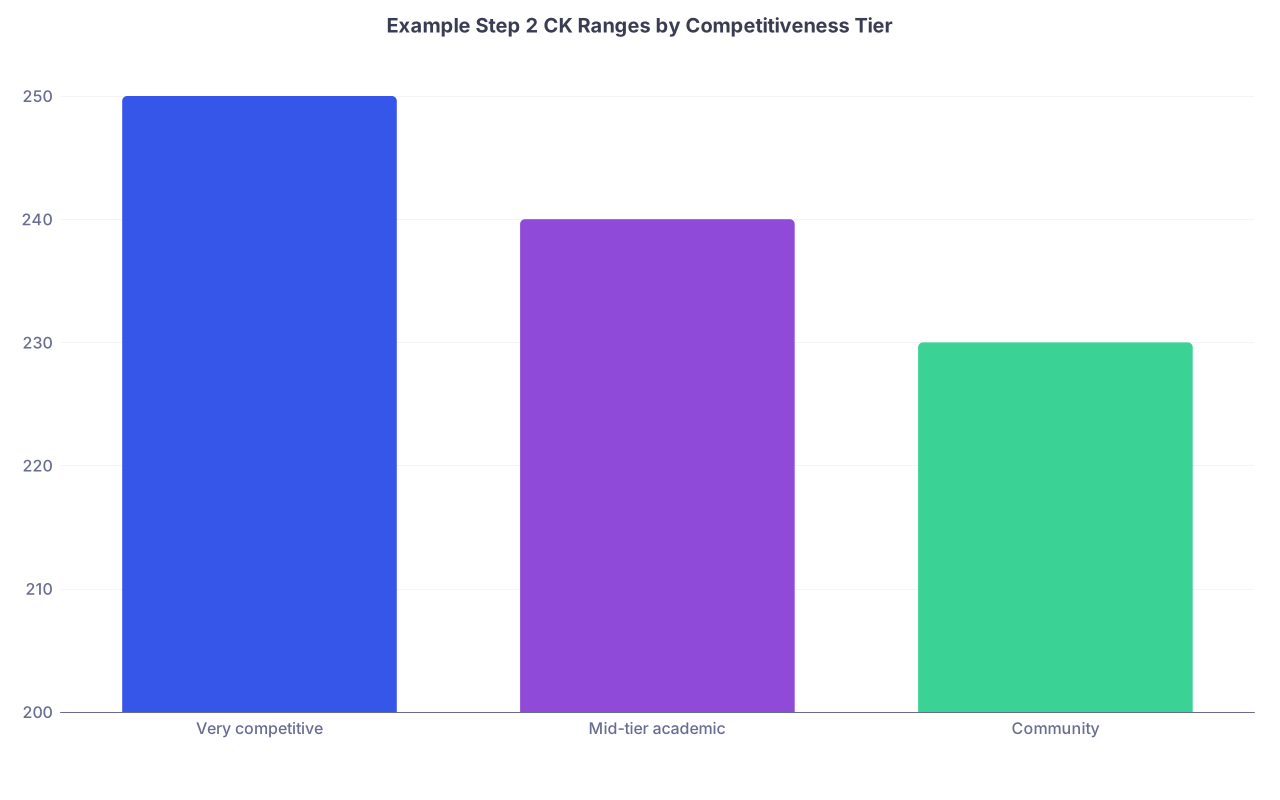
- Your Step 2 CK vs typical ranges for that specialty
| Category | Value |
|---|---|
| Very competitive | 250 |
| Mid-tier academic | 240 |
| Community | 230 |
If your Step 2 is 230, stop planning a list that’s 70% “Very competitive” academic programs in NYC and California with heavy research focus. That’s not grit. That’s self-sabotage.
You should:
- Load up on community and mid-tier academic programs
- Include safety regions (Midwest, South, smaller cities) even if your classmates sneer at them
- Add a few “reach” programs that explicitly value diversity and nontraditional paths—but only a few
Step 8: Prewrite How You’ll Talk About Your Background in Interviews
You don’t want to improvise this live. You’ll either overshare or minimize.
Prepare 2–3 short “modules” you can plug into common questions.
Module 1: “Tell me about yourself”
“Sure. I’m a first-generation college graduate from a low-income family. I worked through school—first in retail, then as a medical assistant during med school—to support myself and help my family. Those experiences pushed me toward internal medicine in underserved settings. On the wards, that’s translated into being very comfortable with high patient loads and limited resources, and I’m excited to train at a program that serves a similar population.”
Short. Context. Direct line to what you bring.
Module 2: “What challenges have you overcome?”
“Balancing medical school with financial responsibilities was the most significant challenge. There were semesters when I worked 20–25 hours a week while taking a full course load. It meant I couldn’t take on year-long research fellowships, but it forced me to become extremely efficient, to plan ahead, and to lean on my team. That same approach is what helped me handle high-volume rotations and keep up with my notes and follow-up.”
Notice: You don’t apologize for not doing glamorous things. You explain the tradeoff and the skill set.
Step 9: Squeeze Everything You Can Out of “Cheap” Opportunities
You can’t buy access, but you can squeeze a lot out of what’s already around you.
Things that cost almost nothing but carry weight:
- Free institutional QI projects (every hospital has them; attend the meetings and volunteer to own a small chunk)
- Teaching (tutoring pre-clinical students, leading small groups, near-peer teaching)
- Longitudinal local volunteering (free clinic, homeless outreach, school-based health project)
You don’t need ten items. You need:
- 1–2 sustained, real commitments
- Clear outcomes or roles
Describe them like this:
“Volunteer Physician Assistant at [Free Clinic] one evening per week MS2–MS4, responsible for triage, vitals, and patient education for uninsured patients. Helped implement a follow-up system that increased return-visit rates from X% to Y%.”
Or:
“Peer tutor for MS1 physiology, meeting weekly with a group of 6 students, focusing on high-yield concepts and test strategies. Several tutees improved from borderline failing to passing the course.”
Those tell a story of reliability and impact, not just “I showed up sometimes.”
Step 10: Common Mistakes Low-Resource Applicants Make (And How to Avoid Them)
I’ve watched these patterns repeat:
Trying to hide their background entirely
Then the application just looks “weak” instead of contextualized. Name the constraints once, clearly.Overcompensating with vague aspirations
“I’m deeply passionate about research/global health” with zero actual evidence. That just looks fake. Align your claims with your record.Writing the trauma memoir personal statement
Five paragraphs of suffering, one sentence about medicine. You are not applying to be a patient; you’re applying to be a doctor.Underselling paid work
Leaving off jobs because they’re “not academic.” Wrong. Paid clinical work especially is gold; even non-clinical work shows reliability and grit.Building a prestige-chasing program list
Half the list is places that literally do not interview people with your profile. Check data. Ask advisors. Look at where people like you actually match.
A Quick Reality Check With Data
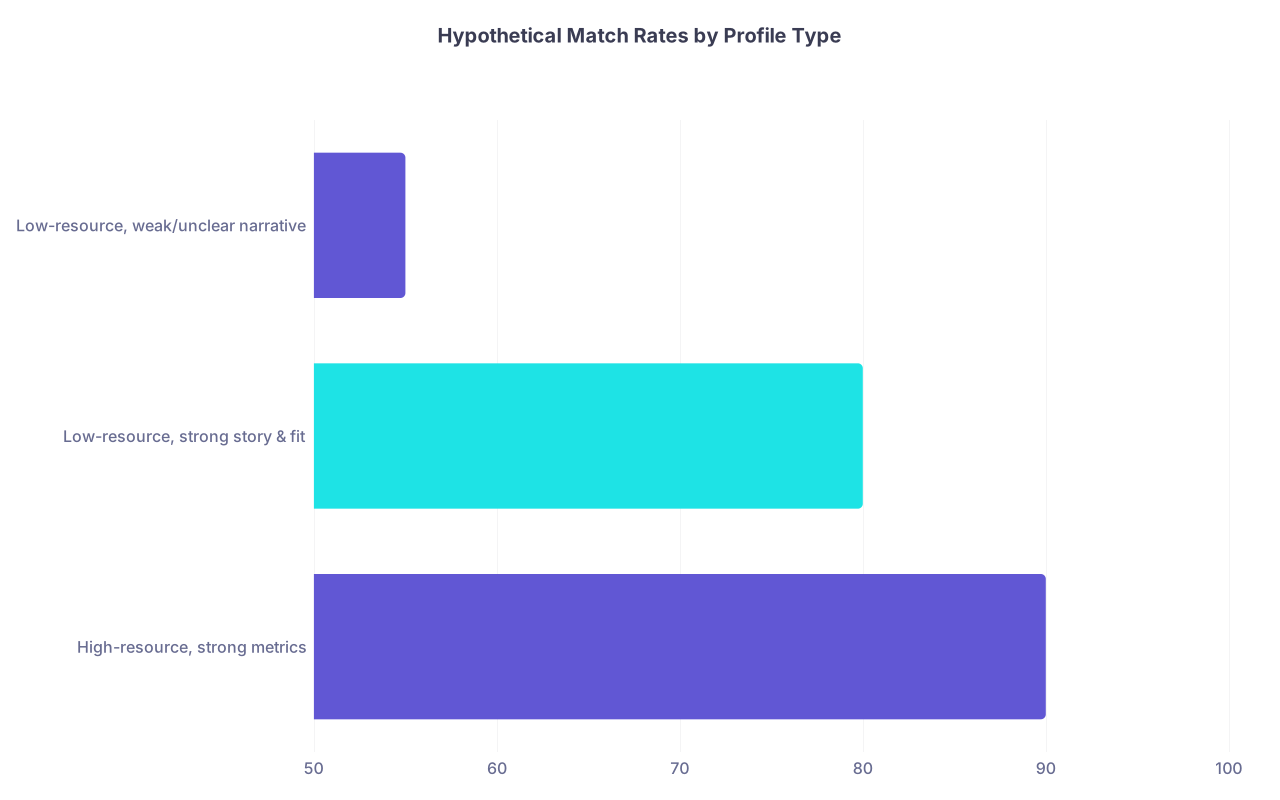
You probably want to know: does this even work? Are people with low-resource backgrounds actually matching?
Yes. Not everywhere, not in every specialty, but yes.
| Category | Value |
|---|---|
| High-resource, strong metrics | 90 |
| Low-resource, strong story & fit | 80 |
| Low-resource, weak/unclear narrative | 55 |
The point is not the exact numbers. The point is: being low-resource does not doom you. Having a poorly explained, inconsistent application does.
If You’re Still Early in Med School
If you’re MS1/MS2 and already know money will be a problem, you’re actually in a good position. You can plan.
Use a rough “portfolio” approach:

| Step | Description |
|---|---|
| Step 1 | MS1 Start |
| Step 2 | Choose 1 long-term volunteer role |
| Step 3 | Find 1 resident/attending for small QI or case report |
| Step 4 | Take on paid work if needed |
| Step 5 | MS3: Aim for strong clinical evals & 1 sub-I |
| Step 6 | MS4: 1 strategic away if affordable |
That’s the skeleton. You don’t need more than that to build a credible, coherent story.
Mental Side: The Quiet Shame Factor
Let’s not pretend this part isn’t there.
When classmates talk about their “summer in Geneva doing WHO policy” and you’re thinking about whether your debit card will work at the grocery store, it’s easy to shrink. To believe your path is lesser.
Programs don’t live in that fantasy world as much as you think. Many PDs grew up working class. They care if you:
- Show up
- Do the work
- Treat people decently
- Grow over time
You coming from a low-resource background and still standing here, applying to residency, already signals something important: you know how to function when things are not handed to you.
Don’t romanticize it. But don’t erase it either.
Three Things to Remember
- You’re not competing on “who had the fanciest opportunities.” You’re competing on what you did with the hand you had. Make that explicit, once, clearly.
- Build a tight, high-yield application: strong clinical performance, a couple of sustained commitments, and honest framing of work and constraints. No fluff, no pretending.
- Choose programs and a narrative that actually fit your record and your background. That combination—honest story, coherent choices, and real work—beats a fragile prestige-chasing application every time.