
The idea that a second leave of absence is automatic death to your application is wrong. It is a bright-red flag, yes. A kiss of death, no.
Programs do not reject “two LOAs” as a line item. They reject what the LOAs signal when they’re unexplained, chaotic, or inconsistent with the rest of your file. That difference is everything.
Let’s pull this out of the melodrama and into reality.
What Program Directors Actually See When They See Multiple LOAs
Here’s the unromantic truth: most program directors are not counting your leaves with a tally mark and then hurling your file in the trash once you hit “2”. They’re doing a risk calculation.
Roughly, they’re asking three questions:
- What happened?
- Is it actually resolved?
- Does this pattern predict future unreliability?
You think they’re asking: “Is two leaves too many?”
They’re really asking: “If I give this person one of my 8–15 spots, are they going to disappear halfway through PGY-2 and blow up my call schedule?”
And yes, they’re thinking about the call schedule. That’s not cynicism, that’s how the job works.
Most applicants never see this side, but when I’ve talked to PDs or sat in on rank meetings, the conversation doesn’t go:
“Two LOAs? Hard no.”
It goes more like:
“Two LOAs. Do we understand them? Are they stable now? Does their performance after the leave match the story they’re telling?”
If the answer to that last question is “no” or “we don’t know because they never explained it,” that’s when your application quietly dies. Not because of the number “2” in a vacuum.
How Common Are Leaves… And Does a Second One Really Make You Toxic?
Let’s ground this in some numbers.
We don’t have perfect national LOA data, but we have decent signals:
- The AAMC has reported roughly 25–30% of med students screen positive for depression at some point.
- Around 10–15% report a significant mental or physical health event that could reasonably justify a leave.
- US med schools themselves typically have 5–10% of students not graduating “on time” with their class — that includes repeats, LOAs, dual degrees, etc.
That already tells you something: being off-cycle is not rare.
Now look at what program directors say bothers them. In the NRMP Program Director Survey (various years), here’s the rough hierarchy of red flags, in practice:
](https://cdn.residencyadvisor.com/images/articles_svg/chart-relative-severity-of-applicant-red-flags-perceived-7179.svg "Relative Severity of Applicant Red Flags (Perceived by PDs)")
| Category | Value |
|---|---|
| Unexplained professionalism issues | 95 |
| Failed Step/COMLEX | 85 |
| Significant unexplained gaps | 75 |
| [Multiple LOAs with clear explanation](https://residencyadvisor.com/resources/residency-application-red-flags/are-all-leaves-of-absence-viewed-the-same-myths-vs-reality) | 40 |
No one runs this exact survey question for “second LOA”, but PD comments and behavior line up with this pattern:
- Unexplained issues and documented professionalism problems are deadly.
- Step failure is serious but survivable with a strong rebound.
- Gaps without explanation get people tossed.
Multiple LOAs with a coherent story sit in the “this makes us nervous but we’ll listen if the rest is strong” zone.
You know who actually looks fine with two LOAs?
- The student who took one LOA for a serious, documented health issue, came back, did fine.
- Then took another planned LOA for a research year or dual degree, got pubs, strong letters, and a mentor vouching for them.
Same number: 2.
Very different risk profile.
The Core Myth: “Two LOAs = You’re Done”
Let’s kill this cleanly.
Myth: A second leave of absence automatically kills your chances at residency.
Reality: A second leave forces programs to scrutinize reliability and stability, but outcomes depend heavily on:
- Type and cause of leave
- Timing
- Documentation
- Trajectory after each leave
- How you explain it
There’s another dirty little secret: lots of students have more “hidden” time-off issues than appear on paper. Some schools quietly convert what should be a leave into “extended curriculum.” Some make you repeat a clerkship rather than formalize a leave. That doesn’t show up as “LOA” but it’s the same underlying story: there was a disruption.
So no, programs aren’t allergic to the number two. They’re allergic to chaos and mystery.
Types of Second LOAs: Not All Created Equal
Instead of panicking about the count, focus on the pattern. Here’s how different combinations actually land.
| LOA Pattern | Typical PD Reaction |
|---|---|
| Health LOA → Full recovery → Research LOA | Concern but open-minded if performance post-LOA is strong |
| Health LOA → Health LOA (same unresolved issue) | High concern about future reliability |
| Academic LOA → Academic LOA | Very high concern; must show dramatic turnaround |
| Health LOA → Unexplained LOA | Red flag; demands very strong, honest explanation |
| Undocumented LOAs / conflicting stories | Almost automatic discard |
Scenario 1: Health then Research
Example I’ve seen more than once:
- M2: 6-month LOA for severe depression/anxiety, treated, documented.
- Returns for M3: solid clerkship performance, no new failures.
- M4: full research year in oncology, 1–2 publications, strong letters.
Is this risk-free? No. Some PDs will still be wary. But this is not automatic rejection. The story is: “I had a serious but time-limited issue, I got care, I recovered, I then chose to take a productive, structured research year.”
Programs care far more about the recovery arc than the raw number of leaves.
Scenario 2: Health then Health (Same Issue)
This is where it gets dangerous.
- M2: LOA for Crohn’s flare, multiple hospitalizations.
- Returns, then M3: another LOA for the same disease, still unstable.
Now the implicit question is: “Will this continue into residency?” If your illness is still poorly controlled, PDs will see this as ongoing and likely to resurface. Some will say no purely out of concern for your well-being. Others because they can’t absorb another trainee going out on prolonged leave.
Here the second LOA is not the problem by itself. The lack of proven stability is.
Scenario 3: Academic then Academic
Brutal but honest: this is near the top of the red-flag ladder.
Two separate academic LOAs (remediation, repeating large blocks, or being pulled from clinical responsibilities twice) scream persistent performance problems. You can still match, but probably not in competitive fields, and only if your post-remediation performance is spotless and someone in authority goes to bat for you.
The Part Everyone Screws Up: Explanation and Documentation
The thing that kills more applicants than the leaves themselves? Vague, evasive, or wildly inconsistent explanations.
I’ve seen all of these:
- Personal statement: “I took time off to care for a sick family member.”
- Dean’s letter: “Leave of absence for personal/medical reasons.”
- Interview: “I was burned out, and then my Step score wasn’t what I wanted, so I took an extra year for research.”
Three different stories. Instant distrust.
Here’s how to handle this like an adult instead of a scared applicant.
1. Make the school’s documentation coherent
Meet with your dean or student affairs office and say, explicitly:
“I know my LOAs are going to be questioned. I want to make sure the MSPE language is accurate, consistent, and doesn’t create confusion.”
You’re not asking them to lie. You’re asking them to pick one true, clear framing and stick to it. If there were multiple factors, choose the primary one that they’re comfortable documenting.

| Step | Description |
|---|---|
| Step 1 | Student with 2 LOAs |
| Step 2 | Meet Student Affairs |
| Step 3 | Review LOA reasons and dates |
| Step 4 | Agree on clear official wording |
| Step 5 | Confirm MSPE draft matches |
| Step 6 | Align personal statement & answers |
2. Your explanation needs three parts
When you talk about your leaves (in a PS, secondary essay, or interview), the structure should be:
Brief reason, in plain English
“I took a medical leave for treatment of major depression.”
“I took a leave to manage a severe flare of my autoimmune disease.”
“I took an academic remediation leave after failing two pre-clinical blocks.”What changed / what you did
“I started medication and regular therapy, learned specific coping strategies, and I’ve stayed engaged in care.”
“My GI and I adjusted my treatment regimen, I had surgery, and my disease has been stable for 18 months.”
“I worked with learning specialists, changed my study approach, and passed subsequent coursework and Step 1.”Evidence of stability and performance afterwards
This is the part people hand-wave. Don’t.
Quote actual facts:- “Since returning from leave, I’ve completed all clinical rotations on schedule with no failures and mostly Honors/High Pass.”
- “I have not required any additional time off, and I’ve taken full call schedules during sub-internships.”
If your story is: “Big problem → intervention → documented stability,” then two LOAs become “an understandable bump with proof of recovery” instead of “unpredictable chaos.”
Your Specialty Choice Matters More Than You Think
Let’s be blunt: two LOAs are not equally survivable in every field.
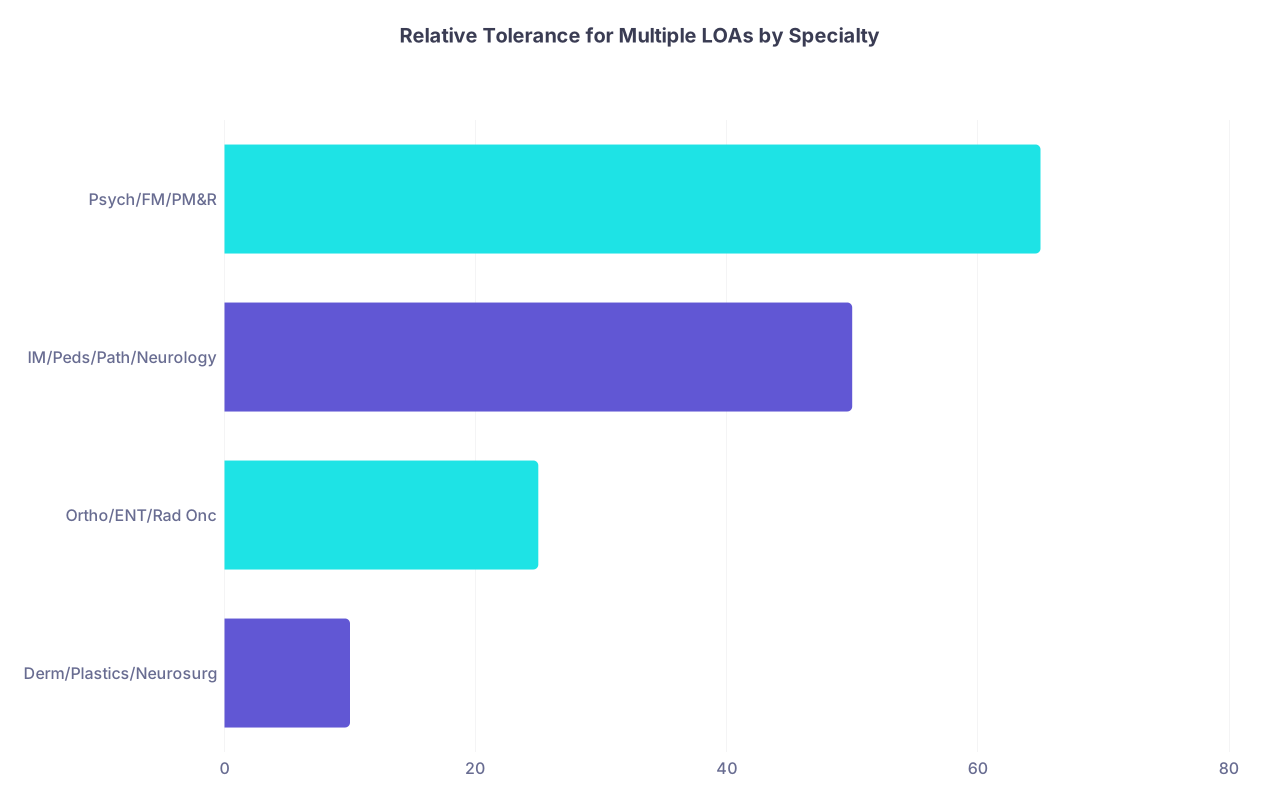
| Category | Value |
|---|---|
| Derm/Plastics/Neurosurg | 10 |
| Ortho/ENT/Rad Onc | 25 |
| IM/Peds/Path/Neurology | 50 |
| Psych/FM/PM&R | 65 |
These are not official scores, but they reflect how PDs act:
Hyper-competitive surgical or lifestyle fields (Derm, Plastics, Ortho, Neurosurg):
Two LOAs + any other weakness (mediocre Step 2, mid-tier school, average letters) is often a nonstarter. You’re fighting an uphill war with zero room for error.Mid-competitive, large-volume fields (IM, Peds, Neuro, Path):
If your Step 2 is solid, clinical grades are good, and your story is clean, they’ll look carefully. You’re not radioactive.Fields that either understand or directly deal with mental/physical health (Psych, FM, PM&R):
I’ve watched applicants with two LOAs match here because their narrative aligned with the field’s core values: insight, recovery, chronic illness management, systems of support.
The question isn’t “Can I ever match with two LOAs?”
It’s “In which lane can I plausibly be competitive given my whole record and known biases?”
What Actually Improves Your Odds (And What’s Fantasy)
People waste time polishing the wrong things. Two LOAs are not erased by “passion” paragraphs in your personal statement.
What does move the needle:
A clean post-LOA performance record
No new leaves. No major professionalism incidents. Solid or improving evaluations. This is non-negotiable.A strong Step 2 score if Step 1 was pass/fail or mediocre
Programs use Step 2 as a stability check. Score trend up? That says “whatever happened before, they’ve stabilized and can handle high-stakes exams.”Letters that explicitly address your reliability
Not just “hardworking, compassionate.” I mean something like:
“Despite prior health-related leaves during medical school, during our medicine sub-internship the student was fully reliable, handled Q4 call, and never missed a single shift or deadline.”A faculty advocate who will say the quiet part out loud
A PD-to-PD phone call that goes, “Yes, they had two leaves, here’s why, here’s how they’ve done since, I’d absolutely take them at my own program,” is more powerful than anything you write about yourself.
And what doesn’t magically fix it:
- A vague “resilience” essay.
- Pretending the leaves were no big deal.
- Applying only to “top programs” hoping research or prestige will overshadow the red flag.
They won’t.
How to Talk About It in an Interview Without Torching Yourself
You will get asked. “Can you tell me about the leaves on your record?” This is not an invitation to a 10-minute monologue or a therapy session.
Do this:
- Answer directly in 2–4 sentences using the three-part structure: reason → intervention → stability.
- Keep it factual, not dramatic.
- Stop talking once you’ve answered. Let them ask a follow-up if they want more.
Bad answer:
“Yeah, I was just really burned out, and my school wasn’t super supportive, and then my family stuff happened, and it was just a really dark time…”
Good answer:
“During M2 I developed severe depression, and I took a medical leave for treatment. I started medication and therapy, worked with my dean and a psychiatrist, and returned after 6 months. Since then, I’ve completed my clinical years on schedule with no further leaves and strong evaluations, and I’ve stayed in regular care.”
If they keep digging inappropriately into details (it happens), you can calmly re-anchor:
“The main thing I want to emphasize is that the condition is well-managed, my last two years have been stable, and I’ve done well with full clinical responsibilities.”
You’re signaling: “I’ve learned from this, I’m stable, I’m not a walking liability.”
When a Second LOA Does Functionally Kill Certain Paths
Let’s be honest about the ceiling here.
Two LOAs combined with any of the following usually do, in practice, kill chances at the most competitive specialties and top-tier academic programs:
- Step 2 score significantly below the national mean
- Third-year failures or repeats
- Multiple professionalism flags
- No clear period of at least 12–18 months of clean, solid performance
In that situation, your real move is not, “How do I convince Mayo Derm to love me?” It’s, “How do I match into a reasonable program in a field where I can function and be trained well?”
And that’s not failure. That’s strategy.
Bottom Line: Two LOAs Are a Serious Red Flag. Not a Death Sentence.
If you’ve skimmed everything else, remember these:
A second leave of absence doesn’t automatically kill your application; unexplained or unstable patterns do. Programs care far more about the trajectory after your leaves than the raw count.
Your job is to turn “mysterious risk” into “understood, treated, and stable” by aligning your documentation, explaining briefly but clearly, and backing it up with strong post-LOA performance and letters.
You’re not applying in a vacuum. Specialty choice, score trajectory, and concrete evidence of reliability matter more than the comforting or terrifying myths your classmates trade in the library at 2 a.m.
Two LOAs make your path narrower and steeper. They do not make it nonexistent.