
Opening Scenario: The 2 A.M. Page That Makes Your Heart Drop
It's 2:14 a.m. You're three hours into call. The pager goes off for bed 14, Mr. Rodriguez, post-op day one from a whipple, now with a new oxygen requirement and a pressure that's drifted south. You pull up the chart. Vitals trending the wrong way. Lactate back from the lab at 3.1. You stand at the bedside, listen to his lungs, check the wound, recheck the pressure. Nothing screams disaster. But nothing feels right either.
And here's where the internal monologue kicks in. Do I call? Is this bad enough? What if I page Dr. Chen and she thinks I can't handle a straightforward post-op patient? What if I wait an hour and everything clarifies? What if I wait an hour and it doesn't?
Let me tell you what really happens in that moment, because I've watched hundreds of residents live through it. You hesitate. You rationalize. You tell yourself you'll reassess in thirty minutes. And sometimes that's fine. But the residents who get into real trouble overnight aren't the ones who call too much, they're the ones who wait too long because they're afraid of looking weak.
The central myth of overnight call is that good residents handle everything alone and only "bother" the attending for true emergencies. That myth is everywhere. It gets passed down from senior residents, it lives in the culture of every program, and it's flat wrong.
Here's the insider truth: attendings would rather hear about a problem early, clearly, and with a plan than discover a preventable issue at 7 a.m. rounds. The residents they trust aren't the ones who never call. They're the ones who call with judgment.
This is a reality check. Not a pep talk. Let's break it down.
Myth #1: Calling the Attending Means You Failed

This myth persists because residency socializes you to look independent. From day one, you're watching senior residents strut through the hospital like they own it, making decisions without paging anyone, and you think: That's what competence looks like. So when you're alone at 3 a.m. and the line between "manage this" and "call someone" gets blurry, you err on the side of silence. You mistake hesitation for professionalism.
Wrong call.
Here's what attendings actually think: appropriate escalation is not weakness. Delayed escalation is poor judgment. That's the distinction that matters, and most residents get it backwards.
I've sat in M&M conferences where a case goes bad and the first question isn't "why did the resident call?" It's "why didn't the resident call?" The assumption flips. When you're in the room with faculty reviewing a delayed escalation, nobody cares whether you seemed independent at 2 a.m. They care that the patient deteriorated and no one picked up the phone.
Competence isn't handling everything alone. Competence is knowing when you need backup. That's a mark of maturity, not inexperience.
There's a difference between "I don't know what to do" and "I need input now." The first is uncertainty. The second is safe clinical practice. Attendings can work with the second one all day long. The first one, they'll teach you through it, but they'd rather hear it at 2 a.m. than find out about it at sunrise.
The resident who calls and says, "I'm not sure this is an emergency yet, but I want you to know what's happening", that resident looks careful. That resident looks trustworthy. The resident who waits until the patient codes looks like someone who was afraid to pick up the phone.
What Attendings Actually Want Overnight
Here's the behind-the-scenes truth: attendings don't want a raw data dump at 3 a.m. They don't want your entire HPI. They don't want you to read the nurse's note back to them. They want a concise, prioritized update with your assessment and your recommendation. That's it.
A good overnight call sounds like this: "Dr. Patel, I'm calling about Mr. Rodriguez in 14B, post-op day one whipple. He's requiring 4 liters of oxygen now, up from room air. Pressure's been drifting, 92 systolic on the last two checks. Lactate came back at 3.1. I've bolused a liter, rechecked labs, and his pressure is responding. I'm calling because I think this could become unstable, and I'd like your thoughts on whether we should transfer to the unit now or give it another hour with closer monitoring."
That call takes forty-five seconds. It tells the attending what's happening, what you've done, why you're calling, and what you think the next step is. That's the structure. Problem. Status. Action taken. Reason for call. Recommendation.
Now, what do attendings want called sooner rather than later? Unstable vitals. Unclear diagnoses where the plan could change overnight. Escalation of pain that doesn't make sense. Procedure questions. New neurologic changes. Any situation where the plan has the potential to shift, and especially anything where you'd have to justify not calling if things went wrong.
Here's the unspoken annoyance: attending frustration usually comes from being surprised, not from being contacted. If the attending hears at 7 a.m. that a patient was teetering all night and nobody called, they're annoyed, not at the extra work, but at the surprise. At the missed opportunity to intervene. At the realization that they were asleep while something was brewing on their service.
Attendants know you're going to call overnight. They signed up for it. The phone is there for a reason. What frustrates them is when the call comes too late, when it comes without a plan, or when it never comes at all and they find out in sign-out that the night was a disaster.
So call early. Call with structure. Call with a recommendation. That's what they actually want.
How to Call So You Sound Competent, Not Hesitant
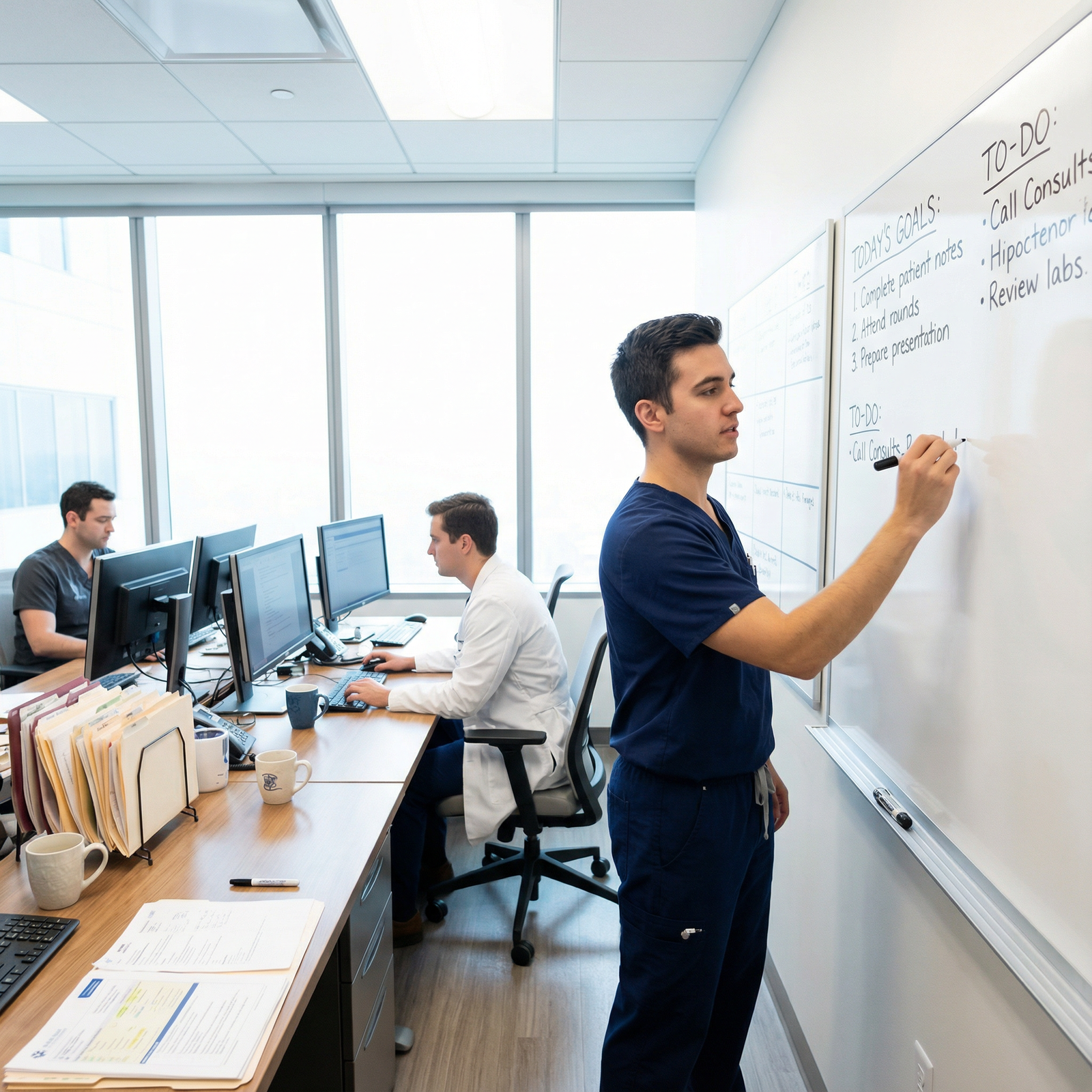
Let me give you a script. Because the structure of your call matters as much as the decision to call.
Lead with the problem and the patient status. Then give your assessment. Then state the exact question or recommendation you need. That's it. Don't ramble. Don't apologize. Don't bury the concern under a pile of irrelevant labs.
"Dr. Lee, I'm calling about Ms. Thompson in 22A, admitted for cholangitis. She just spiked to 39.2 and her pressure dropped to 88 systolic. I've drawn cultures, given a fluid bolus, and broadened the antibiotics. I'm calling because I'm worried about septic progression and I'd like to move her to the unit. Do you agree, or would you prefer we reassess in 30 minutes?"
That call is clean. It's decisive. It shows you've already done the work, checked the chart, checked the patient, checked the labs, made a move, and now you're asking for the next decision.
Here's what not to do. Don't call and start with, "Sorry to bother you." You're not bothering anyone. You're doing your job. Don't call and read me the vitals one by one without context. Don't call and tell me you "think something might be off" without having gone to the bedside. Don't call without having checked the most recent labs, the most recent vitals, and the patient's current status.
And don't hide your uncertainty. If you're unsure, say so, but frame it. "I've done X and Y. I'm considering Z, but I'm not sure if that's the right move here given [specific concern]. What would you do?" That's not weakness. That's judgment in action.
Here's the insider nuance: attendings respect a resident who says, "I'm calling because I think this could become unstable," far more than one who waits until it's already a crisis. The first resident is thinking ahead. The second resident is reacting. One of those looks like a future attending. The other looks like someone who needs more supervision, not less.
Show your judgment. Mention what you've already done. Mention what you considered and ruled out. Mention what you're worried about. Then ask for what you need. That's a competent call.
The Real Risks of Not Calling
The real error overnight isn't interrupting an attending's sleep. It's allowing preventable harm to progress because you were afraid to pick up the phone.
Let's be blunt. The medicolegal consequences of delayed escalation are real. When a case goes to review, the first thing anyone looks at is the timeline. Were there warning signs? Were they documented? Were they communicated? If the record shows that you saw the patient at 2 a.m., noted concerning vitals, and didn't call anyone until 6 a.m. that's a problem. That's a problem for the patient, for you, and for the attending who trusted you to manage their service overnight.
I've seen this play out in quality review meetings. The residents who get praised are the ones who called early, escalated appropriately, and communicated clearly. The residents who get criticized, sometimes harshly, sometimes with career consequences, are the ones who stayed silent when the situation was deteriorating.
Here's the hidden cultural truth: seniors and attendings remember residents who over-escalated appropriately. They remember the resident who called at 2 a.m. with a borderline lactate and a clear plan. That resident gets described as "safe," "reliable," "someone I can trust on call." The resident who didn't call? That resident gets described as "needs closer supervision." Which reputation do you want?
Overnight communication isn't a test of toughness. It's part of training in clinical judgment. You're learning when to act, when to ask, and when to wait, but you're not learning by suffering alone in a call room. You're learning by calibrating with the people who've done this for twenty years.
The call you don't make is the one that haunts you. The call you do make, even if it turns out to be unnecessary, that's just overnight medicine. Attending's won't remember the unnecessary calls. They'll remember the patient who wasn't rescued.
Key Takeaways
Calling the attending overnight is usually a sign of sound judgment, not weakness. The residents who get trusted with more autonomy are the ones who escalate appropriately, not the ones who try to prove they can handle everything alone.
Attendings care far more about timely escalation and clear reasoning than about whether you handled everything solo. The structure of your call, problem, status, action, reason, recommendation, matters more than the fact that you called. A good call makes you look competent. A missed call makes you look dangerous.