You are not supposed to read every note before acting overnight. Trying to do that is dangerous, not diligent.
Let me be blunt: the “good resident reads the entire chart before doing anything” myth is one of the fastest ways to become unsafe, burned out, and behind all night. It sounds responsible. Attendings occasionally imply it. Some chiefs straight-up say it on day one. But when you look at actual data, human factors research, and what competent overnight clinicians really do, the story is very different.
You are expected to know the right information and to get it fast. That is not the same as reading every note.
The Myth vs. The Reality
The myth goes like this:
You’re cross-covering 60–90 patients. Before you write an order, change a med, or call a rapid, you “should” read admission H&Ps, consultant notes, the primary team’s last progress note, and maybe yesterday’s echo. Because “you’re responsible now.”
If you tried that, you’d drown. And some of you already have.
Here’s the reality that matters:
Overnight, your responsibility is triage, safety, and time-critical decision-making. That means high-yield chart review, not exhaustive archaeology.
Human beings simply cannot safely process that much information at 2:37 a.m. while answering pages, dealing with new admits, and covering multiple services. The literature on cognitive load and interruptions in clinical work is very clear: more data does not mean better decisions. Beyond a certain point, it increases error.
The Joint Commission, AHRQ, and multiple human-factors studies all converge on the same basic conclusion:
Information overload + frequent interruptions = more mistakes, not fewer.
So if someone is telling you “read every note before acting,” they’re giving advice incompatible with how actual overnight work functions.
What Overnight Work Really Demands
Overnight call is not daytime rounding with worse lighting. It’s a different job with different priorities.
You are not optimizing, you are stabilizing.
Your reality:
- You’re covering too many patients to do deep dives on everyone. This isn’t a moral failing; it’s how most US residencies are set up.
- Pages are clustered, not spaced. You don’t get “quiet reading time”; you get three pages in the middle of putting in a sepsis order set.
- The patients that will kill you (and themselves) are not the “interesting” ones; they’re the ones where you miss the pattern because you were busy scrolling notes.
Let’s anchor this with how residents actually spend time.
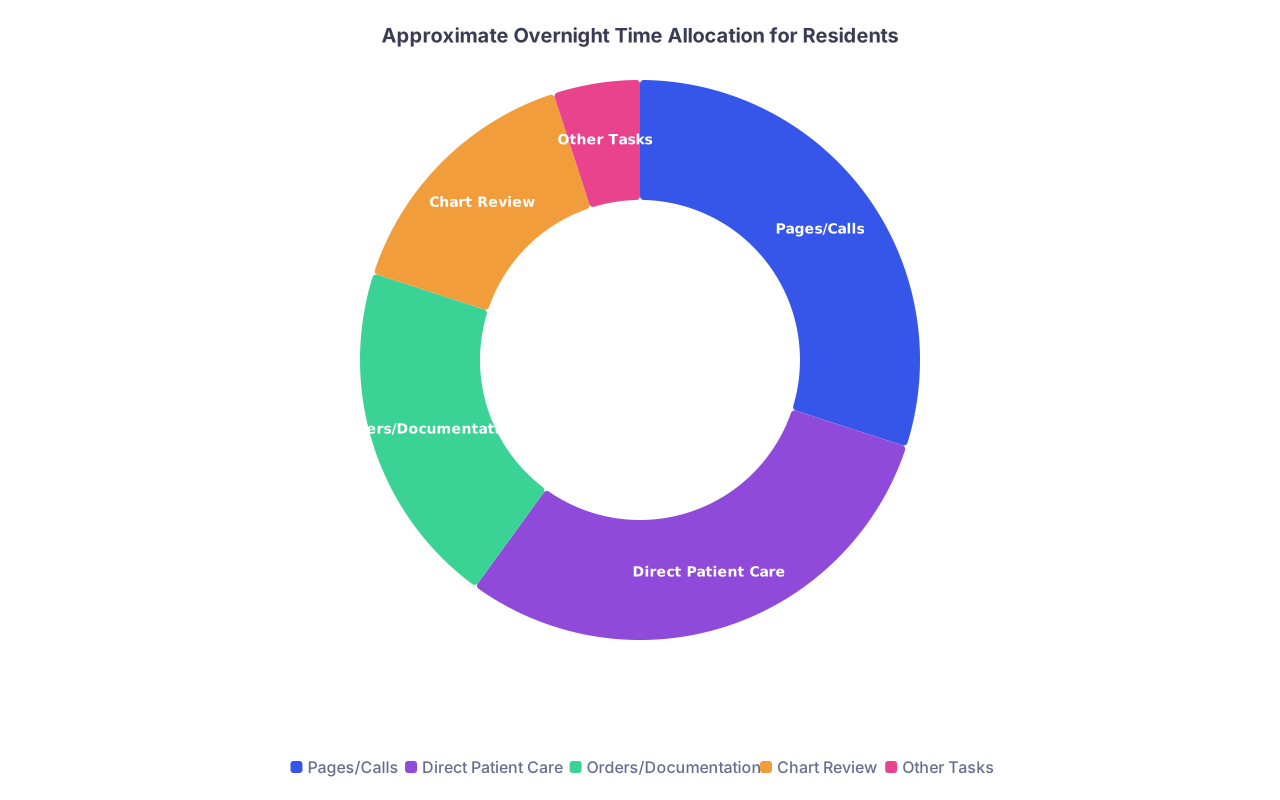
| Category | Value |
|---|---|
| Pages/Calls | 30 |
| Direct Patient Care | 30 |
| Orders/Documentation | 20 |
| Chart Review | 15 |
| Other Tasks | 5 |
On a typical cross-cover night, chart review is a minority of your time. If you try to jack it up to 40–50% by “reading everything,” the time has to come from somewhere: either you delay patient care, or you cut corners elsewhere.
Neither is safe.
What the Data Actually Shows About Safety and Information
There’s a fantasy that more notes = more safety. The research is not on that team.
Studies on decision-making under interruption in hospital settings (medicine, surgery, ICU) consistently show:
- Clinicians already underestimate how much they’re interrupted.
- Every interruption increases the chance you’ll forget a partially-completed task or misremember details.
- Excess documentation and note bloat reduce the ability to rapidly identify important information.
That last one matters. When every patient has:
- 1 long admission H&P
- 3–5 daily progress notes
- 2 consult notes
- nursing note streams
- copy-pasted problem lists that are half-wrong
…reading “everything” is not thorough. It’s naive.
There’s also data from EHR usability research: clinicians often rely on a few key views—recent labs, vitals trends, med list, last summary note—because these are repeatedly shown to be higher-yield for clinical decisions than wading through narrative notes.
In other words, experienced people use shortcuts on purpose.
What You’re Actually Expected to Know Before Acting
No, you are not expected to perform a full forensic reconstruction of the entire hospitalization at 3 a.m. before giving a sleep med or 500 mL of fluids.
You are expected to build a rapid mental model of the patient:
- Why are they in the hospital right now?
- How sick are they?
- What is fragile about them (respiratory, renal, hemodynamic, neuro status)?
- What are the major “do not do” items?
You can get that 80–90% of the time from:
- The primary team’s latest progress note
- The problem list (if it’s maintained decently)
- A quick scan of recent vitals, labs, and meds
- Alerts/allergies and code status
That’s it. That’s the core.
Everything else is “if needed for this problem right now.”
A Practical, Safe Framework: How Much Chart to Read When
Here’s the part nobody teaches in orientation because they’re too busy telling you to “be thorough”: there are different tiers of chart review depending on the situation.
1. Low-risk, routine requests
Examples:
“Can we get melatonin or trazodone for sleep?”
“Patient wants miralax for constipation.”
“BP is 150/85, can we give the PRN labetalol?”
High-yield moves:
- Skim the latest note summary/problem list.
- Check active meds, allergies, and vitals trend.
- Make sure you’re not about to violate a clear instruction (e.g., “no sedatives – hypercapnic respiratory failure,” or “hold all beta blockers”).
You do not need to read the entire H&P and three consultant notes to give 5 mg melatonin. That’s how you end up 10 pages behind at 4 a.m.
2. Moderate risk or change in status
Examples:
New chest pain.
New delirium or agitation.
Significant desaturation.
New fever on a complicated patient.
You step it up:
- Read the latest note carefully for big-picture context and active problems.
- Check vitals trends and recent labs; look for big swings.
- Skim the admission H&P focused on the primary diagnosis and major comorbidities.
- Look at key imaging reports relevant to the complaint (e.g., last CXR on a respiratory patient).
Still not “every note.” You’re doing targeted exploration.
3. High-risk / potentially unstable
Examples:
Hypotension.
Acute neuro change.
Rapid-response-level concern.
“Something is very wrong” from a seasoned nurse.
Here your job is bedside first, chart second.
- See the patient now. ABCs, exam, quick bedside assessment.
- Review vitals, trend, telemetry (if present), fingerstick glucose, etc.
- Then pull the most relevant pieces of the chart: latest note, admission reason, major comorbidities, and key recent results.
If you stand outside the room scrolling consult notes while the nurse is bagging the patient, you’ve missed the plot entirely.
The Hidden Risk: Weaponized Hindsight
Another reason this myth survives: hindsight bias.
An attending or quality review committee sees a complication and then discovers, buried in a note from three days earlier, a line like: “Patient had mild dark stools last week, consider outpatient GI follow up.”
They then say, “If only the night resident had read all the notes, they would have known this…”
No. That’s not how real-time work functions.
Retrospective chart reviews are done with infinite time, no interruptions, and knowledge of the outcome. You on call have none of those. Expecting you to catch every buried sentence in 100+ pages of prior documentation is fantasy medicine.
The safety solution is not “read everything more”; it’s better problem lists, better sign-outs, and better structured data—things you do have some control over on your own patients.
Where You Do Need Depth: Your Own Patients
Here’s the pivot people confuse: being cross-cover vs being primary.
For your own service patients in the daytime, you are expected to have a deep, longitudinal understanding. That absolutely involves reading older notes, understanding diagnostic uncertainty, and knowing what GI, ID, cardiology etc. thought three days ago.
But overnight, when you’re cross-covering:
- You’re a temporary safety net, not the case manager.
- You’re allowed to say, “I’m not fully up to speed on their entire course; I’ve reviewed the latest information and here’s what I see now.”
Trying to fake deep longitudinal knowledge at 3 a.m. by frantically reading back through 7 days of progress notes is how you miss the actual acute issue.
What Good Programs and Good Attendings Actually Expect
The best attendings I’ve worked with don’t ask, “Did you read every note?” They ask a different set of questions when they debrief a tough overnight event:
- Did you see the patient in person when you should have?
- Did you review vital signs, trends, and critical labs?
- Did you check the med list before ordering something risky?
- Did you recognize you were in over your head and call for help early?
- Did you have a coherent understanding of why the patient was in the hospital at that moment?
Those correlate with safety. “Did you read the nephrology note from two days ago in full?” does not.
When I see a resident desperately scrolling ten progress notes before responding to a new fever on a neutropenic patient, I don’t think “thorough.” I think “no one taught you how to triage information.”
A Simple Mental Model: 3 Questions Before You Act
Instead of “Did I read enough notes?”, try this checklist:
- Do I know the admission diagnosis and big-ticket comorbidities?
- Do I know the vital sign and lab trajectory over the last 12–24 hours?
- Do I know any obvious “do not do” boundaries (allergies, code status, critical instructions)?
If any are unclear, that’s where you focus your chart review. Not everywhere.
Then you decide:
- Is this low-risk enough that a quick intervention is reasonable?
- Is this worrisome enough that I need to see the patient now?
- Is this complex or high-stakes enough that I need to call my senior/attending?
Notice what is not on that list: “Have I read every note?”
A Quick Comparison: Unrealistic vs. Realistic Overnight Expectations
| Aspect | Myth Version | Reality Version |
|---|---|---|
| Chart review | Read every note before acting | Targeted, high-yield review |
| Primary goal | Be maximally thorough on each page | Maintain safety across all patients |
| Response to pages | Read first, then maybe see patient | Assess severity, bedside early when needed |
| Measure of success | No one can ever say you 'missed' a line | Patients stayed safe, issues escalated early |
| Cognitive load | Maximize information intake | Optimize signal-to-noise |
How to Protect Yourself Without Drowning
You still want to protect your license and your sanity. You can be efficient without being reckless.
A few high-yield, non-fluffy moves:
- Make and demand good sign-outs. A decent sign-out with “if X happens, do Y” saves you 20 minutes of scrolling per patient.
- Update problem lists and summary sections on your own patients. You’re not just being “nice”; you’re preemptively helping your future self or the night float.
- Document your reasoning for higher-risk decisions. A one- or two-line note: “Paged for X; chart reviewed including latest note, vitals/labs, exam at bedside; decision made to do Y, will reassess in Z hours.” That’s defensible.
And most importantly: normalize asking for backup early instead of trying to compensate with more chart review. Reading ten notes will not fix your uncertainty on a crashing patient. A senior at the bedside might.
Visualizing the Overshoot: How Much Is “Enough” Chart Review?
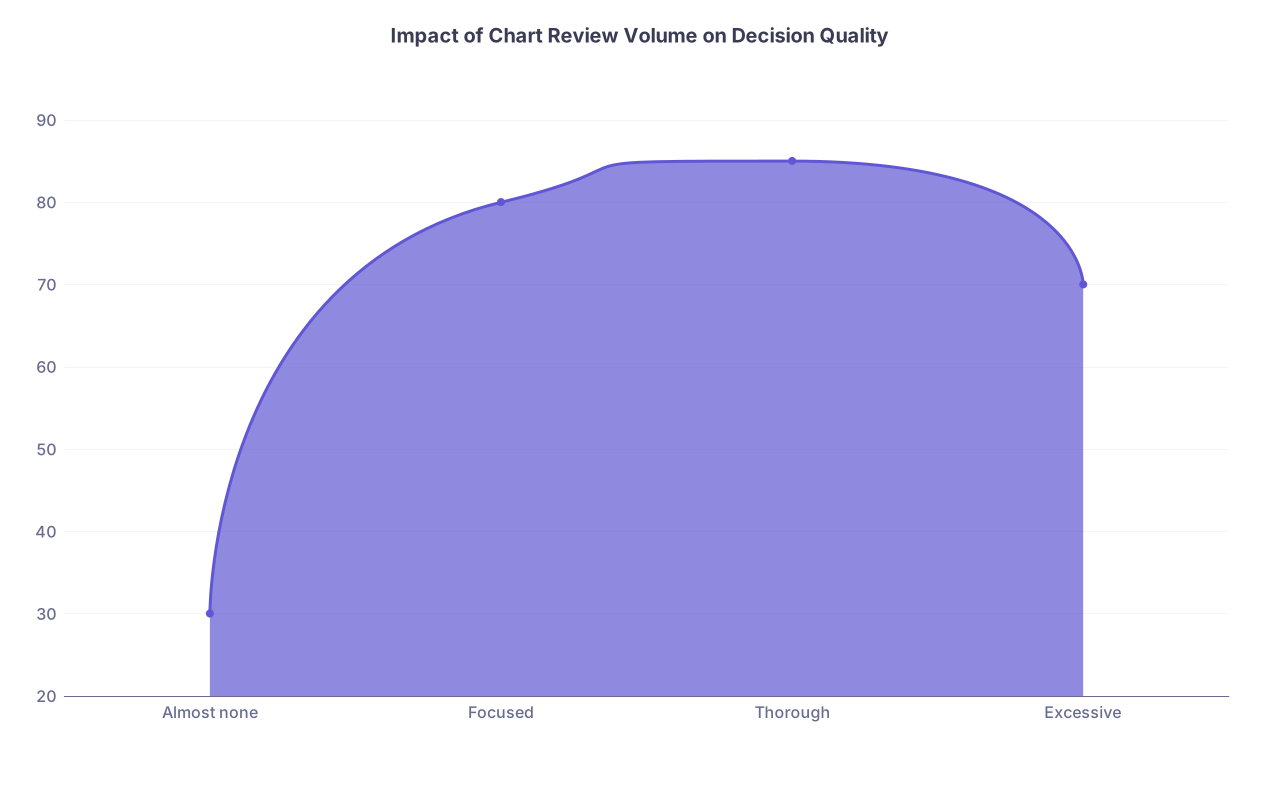
| Category | Value |
|---|---|
| Almost none | 30 |
| Focused | 80 |
| Thorough | 85 |
| Excessive | 70 |
The pattern is consistent across cognitive work: going from “almost none” to “focused” review dramatically improves decisions. Going from “focused” to “thorough” adds a bit. Going to “excessive” while under time pressure reduces performance because of fatigue, time cost, and missed real-time cues.
Overnight, you rarely have the luxury to live in “thorough.” You want to be solidly in “focused.”
A Simple Flow: What To Do When You Get Paged

| Step | Description |
|---|---|
| Step 1 | Receive page |
| Step 2 | Assess urgency from nurse |
| Step 3 | Go see patient now |
| Step 4 | Open chart |
| Step 5 | Read latest note and problem list |
| Step 6 | Check vitals, labs, meds |
| Step 7 | Simple order OK |
| Step 8 | Targeted extra review +/- bedside |
| Step 9 | Bedside and call senior |
| Step 10 | Potentially unstable? |
| Step 11 | Low, mod, high risk? |
Notice there’s no box labeled “Scroll every note written in the last 7 days.”
The Bottom Line
You are not failing if you do not read every note before acting overnight. You’re being realistic.
You are failing if you:
- Delay seeing a clearly unstable patient to read the chart.
- Ignore vitals and trends while reading three consultant notes.
- Pretend to have deep context you don’t, instead of calling for help.
Overnight medicine is about information triage. The myth of “read everything” sounds virtuous, but in practice, it increases fatigue, slows response times, and pushes your attention toward the wrong place—the screen instead of the patient.
Use the chart as a tool, not a trap.
FAQs
1. Will I get in trouble if I did not read a specific note before an adverse event?
You’ll be judged on whether your actions were reasonable with the information and time you had, not on whether you memorized the chart. If you can show that you reviewed the latest summary, vitals, labs, and saw the patient appropriately, that’s usually seen as acceptable standard of care. Retroactive nitpicking of obscure lines in old notes is common in reviews, but it’s rarely the real root cause.
2. Should I ever read back several days of notes overnight?
Occasionally, yes—but only when time allows and the situation truly depends on it. For example, a puzzling recurrent issue that is not emergent where pattern recognition matters. This is the exception, not the rule. If you find yourself routinely reading 5–7 days of notes on cross-cover patients, something about your triage or your sign-outs is broken.
3. How do I push back if a senior tells me to “read everything before acting”?
You do not argue philosophy at 2 a.m. You can say, “On cross-cover with this many patients, I’ve been focusing on latest note, vitals, labs, and meds, and going deeper when the situation is high-risk. If you want me to change that approach, can you walk me through specifically what you’d prioritize?” Force specificity. Most people, when pressed, will back off the “everything” rhetoric.
4. What’s one concrete habit that actually improves my overnight safety?
Make a rule for yourself: any time you consider a move that could seriously harm the patient if you’re wrong—IV fluids in someone with unclear heart function, new sedatives in a fragile respiratory patient, holding key meds like anticoagulants—you must, at minimum, check: latest note for context, vitals trend, last 24 hours of labs, med list, and allergies. That five-part check will save you from far more errors than reading two extra consultant notes ever will.
Key points: Overnight, your job is triage and safety, not literary analysis of the EMR. Focus on high-yield chart review paired with seeing the patient when it matters. And stop letting the “read every note” myth make you worse at the job you’re actually being asked to do.