
3:12 AM. The nurse on the phone sounds almost apologetic. "The patient in 14B looks a little pale. Heart rate 102, blood pressure 112 over 68. Nothing dramatic."
Nothing dramatic. Both numbers sit inside the green zone of every bedside monitor in the building. Heart rate 102 barely crosses the tachycardia line. Systolic 112 is textbook normal. I do the arithmetic before my feet hit the call room floor: 102 divided by 112 equals 0.91.
The data shows that this patient, the one with the "normal" vital signs, carries more than triple the 24-hour mortality risk of the patient snoring in the next room. I am moving before the nurse finishes the sentence.
That ratio is the Shock Index, and if you are not calculating it on every borderline vital-sign call at 3 AM, you are practicing with one eye closed.
This article is for educational purposes only. It is not financial advice, not legal advice, and not tax advice. Figures vary by individual circumstances, so consult a qualified professional before acting.
The 3 AM Threshold: Why Shock Index 0.9 Demands Immediate Attention
The Shock Index is embarrassingly simple. Heart rate divided by systolic blood pressure. No lab draw, no imaging order, no forty-minute turnaround. The normal range sits between 0.5 and 0.7. Once the ratio crosses 0.9, compensatory physiology is running out of runway, the heart is sprinting to defend a pressure that vasoconstriction alone can no longer hold.
The evidence behind that threshold is not soft. Retrospective cohort data show that SI ≥0.9 at any point during an encounter predicts a 3.2-fold higher 24-hour mortality, with a 95% confidence interval of 2.1 to 4.8. That interval does not cross 1. It does not come close. Statistically, this is not a marginal association. It is a siren.
Now place that siren at 3 AM, because the night context amplifies every element of the risk:
- Staffing drops to 40-60% of daytime levels on most wards. Fewer eyes on the patient, fewer hands when things go wrong.
- Lab turnaround stretches. The lactate you order at 3:00 AM may not result until 4:30.
- Clinical inertia peaks. Fatigue biases the brain toward reassurance. "The pressure is fine" is a sedative, and at 3 AM you will want to swallow it.
I have watched this play out. During my PGY-2 year, an intern got a call about a post-op day 2 colectomy patient: heart rate 104, pressure 108/70. SI of 0.96. The team decided to wait ninety minutes for morning labs because the vitals "looked acceptable." The hemoglobin came back at 6.1. The patient was in the operating room by 6 AM, but the numbers that mattered had been sitting on the chart since 3. The ratio saw the bleed before the hemoglobin did.
Predictive Accuracy: Numbers That Leave Vital Signs in the Dust
Here is where I lose patience with traditional vitals-based triage. In a cohort of 12,485 patient encounters, the Shock Index posted an area under the ROC curve of 0.79 for predicting ICU transfer within 24 hours. Heart rate alone managed 0.63. Systolic blood pressure alone, 0.67. For reference, an AUC of 0.50 is a coin flip. Heart rate by itself is barely better than a hunch.
Look at the gap. That is not a rounding difference, it is the difference between a screening tool and a guess.
The meta-analytic data is just as blunt. Across eight pooled studies, SI ≥0.9 carries a sensitivity of 72% and specificity of 81% for the need for immediate fluid resuscitation. But the number I quote most often to interns is the number needed to examine. To detect one impending crash, you must flag 4.2 patients using SI ≥0.9. Using the classic hypotension trigger of SBP below 90 mmHg, you must screen 7.8. Nearly double the workload for the same catch, and hypotension is a late finding. By the time the systolic pressure falls below 90, a hemorrhaging patient has typically lost 30% or more of circulating volume. The pressure holds because physiology is fighting; when it falls, the fight is over.
Waiting for hypotension is not conservative medicine. It is lazy medicine dressed up as patience. Any early-warning framework that keys on blood pressure alone is measuring the failure of compensation rather than its strain, and the AUC data proves it.
Trajectory Analysis: The Rate of Change That Triples Odds
A single SI value is a snapshot. The crash lives in the slope.
Serial measurement data show that an increase of 0.15 in SI over 30 minutes raises the odds of cardiac arrest by 3.1 (p<0.001). Patients whose SI climbs from 0.7 to 0.9 within one hour carry a 42% 48-hour mortality, compared with 11% for patients whose SI stays flat, same ward, same monitoring, n=2,103. And when the question is occult hemorrhagic shock specifically, a delta SI ≥0.2 outperforms the single-threshold approach decisively: odds ratio 4.2 versus 2.8.
This makes physiological sense. Compensation is dynamic. An SI of 0.85 that has been 0.85 for six hours belongs to a different patient than an SI that was 0.62 ninety minutes ago. The first patient is holding. The second is bleeding, leaking, or failing, and the ratio is the only bedside number screaming about it.
I now write SI trends directly into my sign-out. Not "vitals stable." Numbers. "SI 0.71 at midnight, 0.78 at 0200, recheck at 0330." It takes ten seconds and it converts a vague worry into a measurable trajectory.
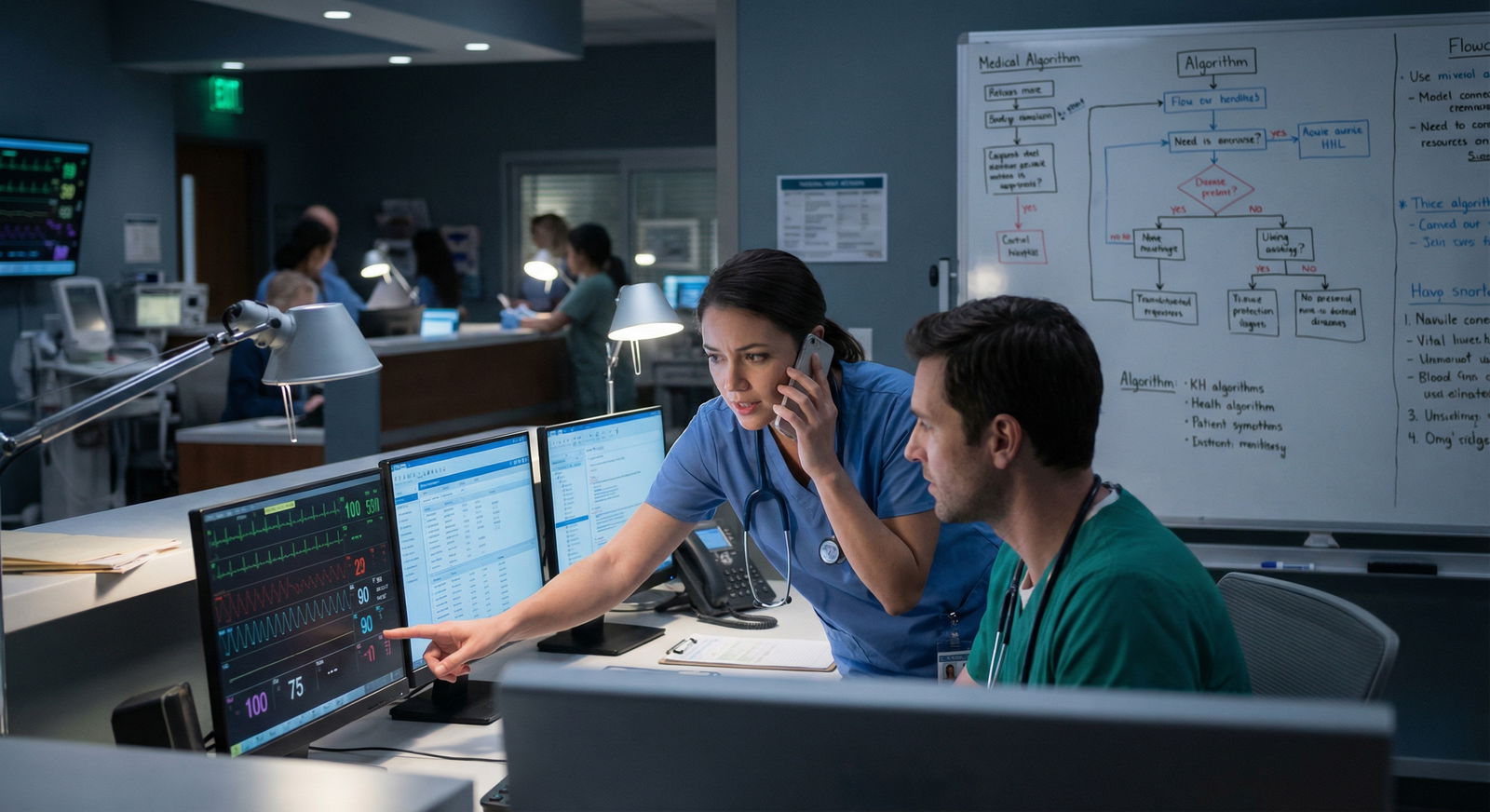
Here is the algorithm I teach, built entirely off the delta data:
Two features of that flow deserve emphasis. First, the 0.7-0.89 band is not a safe zone, it is a surveillance zone, and the 30-minute recheck is non-negotiable. Second, the response to fluids is itself diagnostic data. An SI that stays at or above 0.9 after 500 mL is telling you the tank is leaking or the pump is failing. Either way, the next decision is escalation, not another liter ordered from the doorway.
Actionable Cutoffs: What the Data Say About When to Call for Help
Thresholds without actions are trivia. Here is what the numbers actually instruct you to do, in order:
- SI 0.9: call your senior and prepare a 1-liter bolus. The number needed to treat is 4 to prevent one 30-day adverse event. An NNT of 4 is almost unfairly good, very few interventions in hospital medicine offer that return. Fluids and a phone call. That is the entire cost.
- SI above 1.0: escalate to the rapid response team. At this point the heart is beating faster than the pressure it is generating, and the mortality odds increase 5.6-fold (95% CI 3.9-8.1). This is no longer a "watch closely" patient. It is a "stand at the bedside" patient.
- SI above 0.9 plus lactate above 2 mmol/L: treat as septic shock until proven otherwise. The positive likelihood ratio is 8.6 in validation data. A likelihood ratio that size moves a 20% pretest probability past 65% post-test. Order the lactate with the first set of labs, not the third.
One warning about anchoring. The most dangerous sentence on a night shift is "we already gave a liter." Fluids are a probe, not a verdict. Recalculate the ratio after every intervention. If SI normalizes, you have bought time and gained information. If it does not, the data has told you the source is ongoing, occult bleeding, sepsis, pump failure, and the correct response is escalation, not repetition. I have seen residents cycle through three liters over four hours while the SI never budged from 1.1. The monitor was reporting the answer the whole time. Nobody was reading it.
The Numbers That Should Keep You Up, and Get You Moving
The summary fits on an index card, and it should live on one in your pocket:
- SI 0.9 → act. Call, bolus, trend.
- SI 1.0 → escalate. Rapid response, bedside presence.
- Delta SI 0.15 in 30 minutes → danger. The slope matters more than the snapshot.
Across more than 15,000 patient encounters in the aggregated literature, the Shock Index consistently outperforms the vital signs we were taught to worship in medical school. It is free, instantaneous, and reproducible by any nurse with a calculator. The implementation data is equally encouraging: when SI is built into nursing handoff checklists and paired with a defined algorithm, the documented false alarm rate runs below 5%. That is a screening program most quality departments would accept without blinking.
The 3 AM version of you is tired, under-resourced, and biased toward reassurance. Give that version of you a number with a hard threshold and a prewritten action. SI 0.9 is that number. Calculate it on every borderline call, trend it on every sick patient, and let the arithmetic make the decision that fatigue would rather postpone.
Key Takeaways
- Shock Index ≥0.9 at any time, especially at 3 AM, more than triples 24-hour mortality odds. Treat it as a code trigger, not an observation.
- A delta of ≥0.15 in 30 minutes is more predictive than any single static value. Always trend SI; the slope is where the crash hides.
- Number needed to examine to catch one crash with SI is 4.2, roughly half the 7.8 required when using SBP <90 mmHg alone. Waiting for hypotension means waiting for decompensation.
- Integrate SI with lactate and base deficit. The triple-screen pushes specificity for impending decompensation to 94%, turning a ratio into a diagnosis-in-progress.