
Educational disclaimer: This article is for general educational purposes only and is not legal, financial, tax, immigration, or contract advice. Residency salary, benefits, relocation costs, visa issues, and employment terms vary by program and state, so review your specific offer and speak with your medical school advisors and qualified professionals before making a decision.
What are you supposed to feel when the SOAP email finally comes and it's not the categorical spot you begged the universe for, but a TY or prelim offer instead?
Because let's be honest: it doesn't feel clean. It feels messy. You might feel grateful and devastated in the same breath. One second it's, Thank God, I have something. The next it's, Oh no. Is this just a nicer-looking disaster? I've watched applicants stare at these offers like they're reading a lab value that might change their life. Relief. Shame. Panic. Hope. Then panic again.
That reaction is normal. More than normal. It's the reaction of someone who understands exactly how much is riding on this decision.
The real question isn't whether a TY or prelim year is "good" or "bad." That's too simplistic, and frankly, it's useless. The real question is whether taking this offer protects your momentum and gives you a stronger path forward—or whether it just delays the pain and locks you into a year that won't actually help.
Here's the simple version. A transitional year, or TY, is usually a broad-based intern year with a mix of rotations and often a somewhat more flexible structure. A preliminary year is usually a one-year position in medicine or surgery, often heavier and more service-focused, without a guaranteed PGY-2 spot attached. Neither is the same as a categorical residency seat. That's the part people keep trying to soften. Don't. It's different, and the difference matters.
Whether it's worth taking depends on a handful of brutally practical things: your target specialty, the specific program, the city, your finances, your stress tolerance, your support system, and how much uncertainty you can emotionally survive for another year. This isn't just a career decision. It's a life decision made while your nervous system is on fire.
What a TY or Prelim Year Actually Means for Your Next 12 Months
A TY or prelim year is not fake training. It is real work, real responsibility, real evaluations, real fatigue. You'll admit patients, write notes, take call, answer pages, and drag yourself through intern-level chaos just like everyone else. The difference is that categorical residents usually know where they're going next if they stay in good standing. You may not. That's the stress fracture running through the whole year.
A TY tends to be broader. You'll often rotate through inpatient medicine, ambulatory care, emergency medicine, ICU, electives, sometimes lighter blocks, sometimes not. Some TY programs are beautifully organized and genuinely educational. Others are glorified patchwork years where the wellness brochure looks far better than the actual schedule. I've seen both. One resident had enough elective time to build radiology connections and reapply smartly. Another got buried in service work and spent the year too exhausted to fix anything.
Prelim years, especially medicine or surgery prelims, can be more intense and less forgiving. More call. More service. More chances to prove yourself, yes, but also more chances to get stretched so thin that "reapplication strategy" becomes a joke you tell yourself at 1:30 a.m. while pre-rounding. If you are considering a prelim year, don't romanticize it. Some are excellent launching pads. Some are meat grinders.
And the biggest fear? "Will this count against me next year?" No. Not automatically. Taking a TY or prelim year does not stamp your file with permanent damage. Programs don't reject you just because you spent a year in one of these roles. But here's the harder truth: the year also does not magically rescue you. It only helps if you use it well and if the program gives you enough support to do that.
The upside is real, though. You stay clinically active. You earn a salary. You can collect stronger letters from attendings who've seen you function as an intern rather than just a student. You can repair weak spots in your application, whether that means a better Step 3 outcome, stronger communication about your specialty choice, more mature interview answers, or actual evidence that you can thrive under pressure. You also stay in the training pipeline, which matters more than people admit. Clinical distance is harder to explain than people think.

Before You Say Yes: The Decision Filters That Matter Most
This is where anxious applicants often spiral. They ask, "Should I just take anything?" No. Absolutely not. Desperation is understandable, but blind acceptance is how people end up trapped in a year that drains them and does almost nothing for their long-term plan.
Start with specialty alignment. If you're trying to go into anesthesiology, radiology, dermatology, PM&R, neurology, or another path where a preliminary or transitional year can make structural sense, then a TY or prelim may fit reasonably well. If you're trying to match into a field where this year gives you meaningful clinical continuity and access to mentors, that's a good sign. If the offer drops you into a specialty environment that has almost no relevance to your goal and no mechanism to support reapplication, that's not a lifeline. That's drift.
Then look at the program itself. Not the marketing. The reality. Does this place have a track record of helping unmatched or reapplying residents succeed? Do they write strong letters? Do they make room for interview days? Do they offer mentorship without making you beg for it? Ask blunt questions if you can. "How have prior TYs or prelims matched the following year?" "Who advises reapplicants?" "Is there elective time?" "Can residents interview?" These aren't rude questions. They're survival questions.
A supportive program can turn a disappointing SOAP result into a salvageable year. An unsupportive one can make a bad situation worse. I've seen applicants accept a prelim medicine spot because they felt they had no choice, only to discover by October that nobody cared where they wanted to go next. They were useful to the service. That's not the same thing as being developed.
Red flags matter. A lot. If the program has poor educational support, vague answers about mentorship, reputation problems, unrealistic workload, or a location that creates impossible financial or family stress, don't brush that aside just because you're scared. Fear makes bad programs look less dangerous than they are. They aren't.
And yes, location matters. More than people like to say out loud. If accepting means moving somewhere you can't afford, leaving behind your support system during the hardest year of your life, or creating immigration, childcare, or health-care problems you can't solve, that isn't you being "weak." That's logistics. Logistics end careers every year because people pretend they don't count until it's too late.
Now compare the worst-case scenarios honestly.
Worst-case if you say yes: you spend a year working brutally hard, maybe in a place that isn't a great fit, and you still have to reapply without a guaranteed categorical spot afterward. That stings. Badly. But you may also gain salary, clinical continuity, new letters, stronger experience, and a much more credible reapplication.
Worst-case if you say no: you preserve flexibility, but you step back into uncertainty with no guaranteed training position, no paycheck from residency, and no promise that next cycle goes better. That doesn't mean declining is wrong. It means declining has its own cost, and pretending otherwise is fantasy.
My opinion is direct: if the TY or prelim year is reasonably aligned with your specialty path, comes from a program with actual support, and doesn't wreck your finances or health, take it. Momentum matters. Paid clinical work matters. Being inside the system matters. But if the offer is clearly misaligned, exploitative, or personally unworkable, don't let panic bully you into a bad year.
If You Take It, How to Make the Year Work for You Instead of Against You
If you accept, don't drift into the year hoping it somehow redeems itself. That's a mistake. You need a plan before July, and definitely by the first month.
In the first 30 to 60 days, meet the people who matter. Program director. Associate program director. Chief residents. Faculty in the department most relevant to your intended specialty. Tell them clearly, professionally, and early what your goals are. Not in a dramatic, apologetic way. Just plainly. "I'm grateful to be here, I plan to work hard, and I expect to reapply in X specialty. I'd value guidance on how to make this year count." Good mentors respond to clarity.
Ask for expectations up front. What does excellent performance look like here? How are residents evaluated? Who writes letters? Which rotations put you in front of strong faculty? Where do prior reapplicants usually struggle? These answers save months of guessing.
Document everything early. Cases. presentations. QI work. research participation. positive feedback. difficult rotations completed well. Don't trust your tired intern brain to remember in January what happened in August. It won't. Keep a clean running file. Future-you will need it when personal statements, ERAS entries, and letter requests come around.
Then build your next application like someone who intends to win, not just survive. If your target specialty allows away exposure or networking through electives, pursue it strategically. If research was a weakness, plug into a realistic project fast, not a fantasy project that never finishes. If your letters were generic last cycle, earn better ones by showing reliability, growth, and maturity under real intern pressure. That's what changes narratives.
And yes, narrative matters. A lot. Next cycle, you need a clean explanation for what happened and what changed. Not self-pity. Not vague resilience clichés. A grounded story. "I didn't match into my desired field, I entered a rigorous clinical year, strengthened my skills, confirmed my specialty commitment, earned stronger evaluations, and reapplied with a more mature understanding of the work." That's convincing because it's concrete.
Now the part anxious applicants usually neglect: survival. Protect your sleep as much as the schedule allows. Guard your paperwork. Answer emails. Track deadlines like your future depends on them, because it does. Don't let one rough attending or one ugly block convince you the year is proving you're a fraud. Intern year makes almost everyone feel barely functional at some point. That's not prophecy. That's internship.
Also, set boundaries where you can. You do not need to become the martyr intern who says yes to every extra task if it destroys your ability to reapply effectively. Be reliable. Be helpful. But don't be naive. Nobody is going to care more about your future than you do.
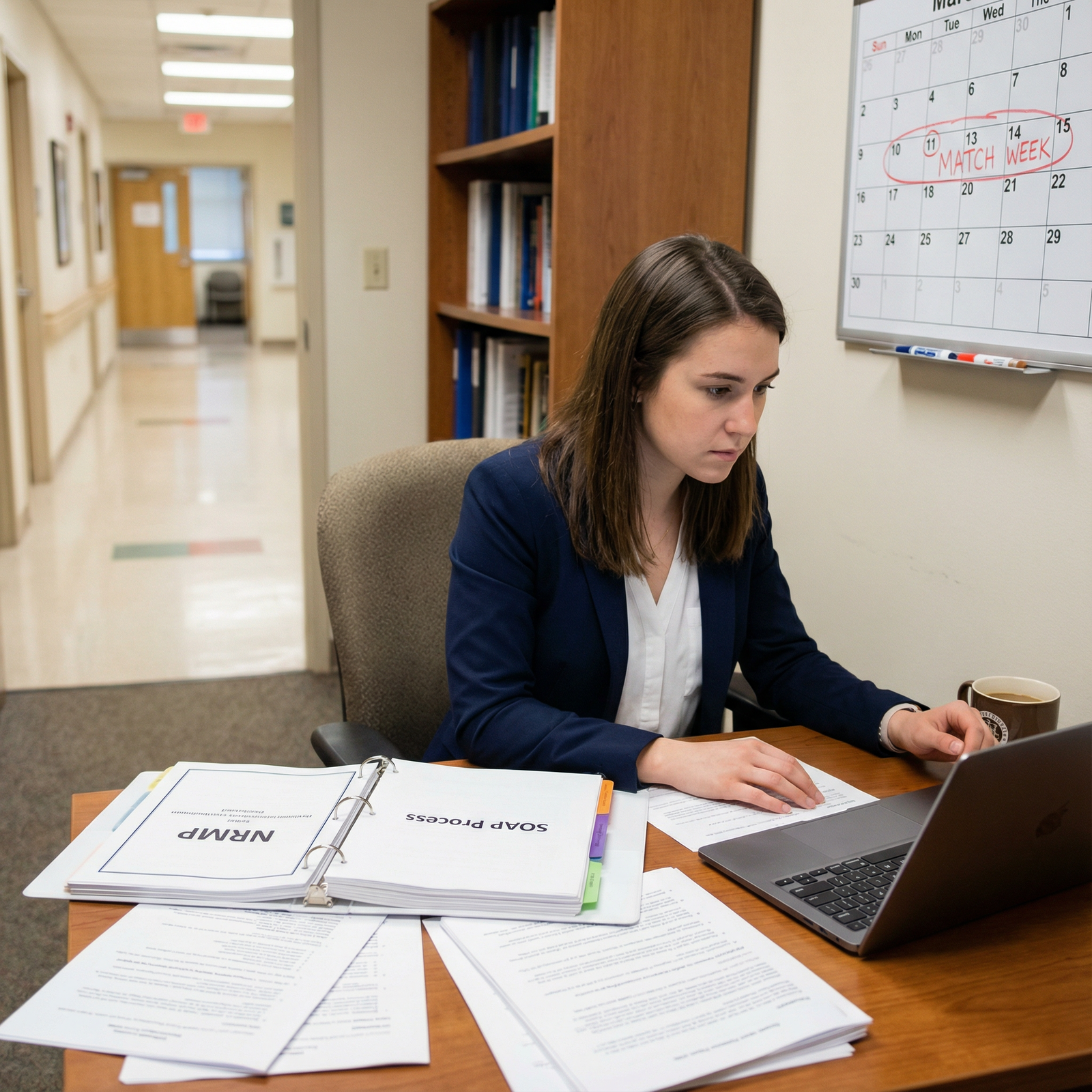
If You Decline It, What Happens Next—and How to Protect Your Future
If you decline, the first thing you need to know is this: you are not automatically ruining your career. That's the panic talking. Declining a bad-fit TY or prelim offer can be completely rational. Sometimes it's the smartest move in the room.
But don't confuse "rational" with "easy." The aftermath can feel awful. You'll likely second-guess yourself at weird hours. You'll imagine alternate futures. You'll wonder if you just said no to the last moving train. That's normal. It doesn't mean you were wrong.
What matters is what you do immediately after. Contact trusted advisors fast. Reassess any remaining SOAP possibilities. If there aren't any viable options, start building a structured backup year right away: research, clinical work if feasible, teaching, an additional degree if it truly strengthens your file, or a focused application repair plan. Not random busywork. Strategic activity.
Declining makes sense when the year clearly conflicts with your long-term specialty path, your finances, your health, your family obligations, or your basic ability to function. A toxic program in an impossible setting is not some noble rite of passage. It's just a bad decision dressed up as grit.
A TY or prelim SOAP offer is not automatically a failure, and it is not automatically a trap. It's a tool. Sometimes a very good one. Sometimes a terrible one. Your job is to decide which it is in your specific situation, not in the abstract fantasy version people post about online.
So if the offer is solid, take it and attack the year with purpose. If it's wrong for you, decline it and move immediately into Plan B with discipline, not paralysis. Either way, don't let shame make the decision for you. Fear is loud. It is rarely wise.
If you're sitting there refreshing your inbox and catastrophizing every possible outcome, stop spiraling alone. Call an advisor. Call your dean. Call the attending who actually tells you the truth. Make the decision fast, but make it with your eyes open.