
You’re in that awful in‑between zone: a thin interview season, your rank list feels more like a wish list, and SOAP is sitting in the back of your mind like a fire alarm that might go off. And now the worry hits:
“If I end up matching through SOAP, is that going to screw up my fellowship options later?”
Let me answer that head‑on, then I’ll unpack the details.
Short answer: No, matching through SOAP does not automatically limit your fellowship options. What limits fellowship options is why you ended up in SOAP and what you do during residency.
Programs care about your performance as a resident far more than the mechanism you matched through.
Let’s break this down so you can see where the real risks are—and what you can do now to protect your future fellowship plans.
The Core Question: Do Fellowship PDs Care If You SOAPed?
Here’s the blunt truth:
Fellowship program directors don’t sit around asking, “Did this applicant match in the main Match or SOAP?”
They do look at:
- Where you trained (program reputation, case volume, faculty)
- How you performed (evaluations, letters, milestones, leadership)
- What you produced (research, QI, teaching, niche interests)
- Any big red flags (remediations, professionalism issues, exam failures)
SOAP vs main Match is not a standard data point on your application. It’s not a checkbox in ERAS. If they find out, it’s usually because:
- Your residency program is clearly low‑tier or off‑cycle in a way that suggests SOAP
- You mention it in a personal statement or conversation
- Your timeline looks odd (e.g., started PGY‑1 in October)
So no, the fact of SOAP itself doesn’t tank you. What might matter are the underlying issues that led you there and the kind of residency you end up in.
What Actually Affects Fellowship Options (Regardless of SOAP)
If you want to understand your real risk, stop thinking “SOAP vs non‑SOAP” and think about these instead:

| Factor | Impact on Fellowship Odds |
|---|---|
| Program reputation | Moderate to high |
| Clinical performance | Very high |
| Letters of recommendation | Very high |
| Research/scholarship | Moderate to high (varies by field) |
| Board exam performance | Moderate |
| Professionalism/behavior | Make or break |
1. Program reputation and resources
Fellowship PDs absolutely pay attention to where you trained. Matching into:
- A strong academic IM program (even community‑academic hybrid) keeps most subspecialty IM fellowships open.
- A solid EM program keeps you viable for toxicology, ultrasound, EMS, critical care, etc.
- A reputable FM program with good inpatient exposure and procedures helps for sports, OB, geriatrics, etc.
What can hurt you:
- Very small, brand‑new, or unstable programs with limited case mix
- Non‑ACGME or questionably accredited programs (some fellowships won’t touch these)
- Programs in chronic probation or with high turnover
SOAP can push you toward lower‑visibility programs. But many SOAP‑filled programs are completely fine—just less “name‑brand.”
2. Your performance as a resident
This is the one fellowship PDs actually care about.
They look at:
- Rotation evaluations and milestone progression
- Whether you’re the resident others trust at 2 a.m.
- Whether attendings voluntarily write you strong letters
A SOAP‑filled spot doesn’t stop you from being the best resident in your class. I’ve seen SOAPed interns become chief residents and then match into very competitive fellowships because they crushed it once they got in the door.
3. Letters of recommendation
Fellowships live and die by letters. Three to four specific, detailed, advocacy‑level letters beat your entire CV in terms of impact.
SOAP may affect:
- Whether your program has nationally recognized faculty in your target field
- How many subspecialists are around to mentor you and write letters
- Whether your PD is well‑connected
That’s the only real way SOAP can “limit” options: less network, less built‑in name recognition. But you can compensate with:
- Visiting electives at fellowship‑heavy centers
- Multi‑institution projects
- National society involvement (abstracts, committees, presentations)
4. Research and scholarly output
For some fellowships (cardiology, GI, heme/onc, advanced imaging, academic EM), research matters a lot. For others (sports med, OB in FM, many community‑oriented fellowships), it’s a “nice‑to‑have, not mandatory.”
SOAP can matter here if your program:
- Has no research infrastructure or mentorship
- Gives you zero protected time
- Doesn’t encourage or track scholarly activity
But even in resource‑poor programs, residents who want to do something usually find a way: case reports, QI projects, small retrospective studies with an affiliated university, or work with national registries.
Real Ways SOAP Can Indirectly Limit Fellowship Options
Let’s be honest. There are some pitfalls.
1. You accept a program that doesn’t match your fellowship goal
This is the big one.
If you want:
- Cardiology, GI, heme/onc → you need an IM residency with decent subspecialty presence
- Critical care → solid IM/EM/Anes program with strong ICU exposure
- Sports Med → FM (or EM) program supportive of procedures, MSK, and sports coverage
- MFM, REI, Gyn Onc → OB/GYN with at least some academic leaning
SOAP panic can push you to click “accept” on literally anything with a salary. That’s how someone who dreams of cards ends up in a small prelim surgery spot with no realistic IM path. That absolutely limits fellowship options.
The mechanism (SOAP) didn’t hurt you. The misalignment did.
2. You end up somewhere unstable or poorly structured
Red flags:
- New program with zero graduates and no clear fellowship placement track record
- Constant leadership turnover
- Chronic ACGME warning/probation
- Scut‑heavy with minimal teaching or feedback
Those settings make it much harder to build the kind of portfolio fellowships want: strong letters, research, leadership roles, solid case mix. Again, not impossible—but you’re working uphill.
3. Your own morale tanks and you stagnate
This is the quiet killer.
You feel burned that you SOAPed. You think you’re “behind” forever. You stop pushing. You do the minimum. You avoid asking for mentorship because you’re embarrassed.
That will absolutely limit your fellowship options, because your application is built during PGY‑1 and PGY‑2. If you emotionally check out for those years, you’re done.
SOAP didn’t do that. Your response to SOAP did.
Strategy: If You Might SOAP but Want Fellowship Later
Let’s talk about what you can do now, during this match cycle and SOAP week, to protect future fellowship options.
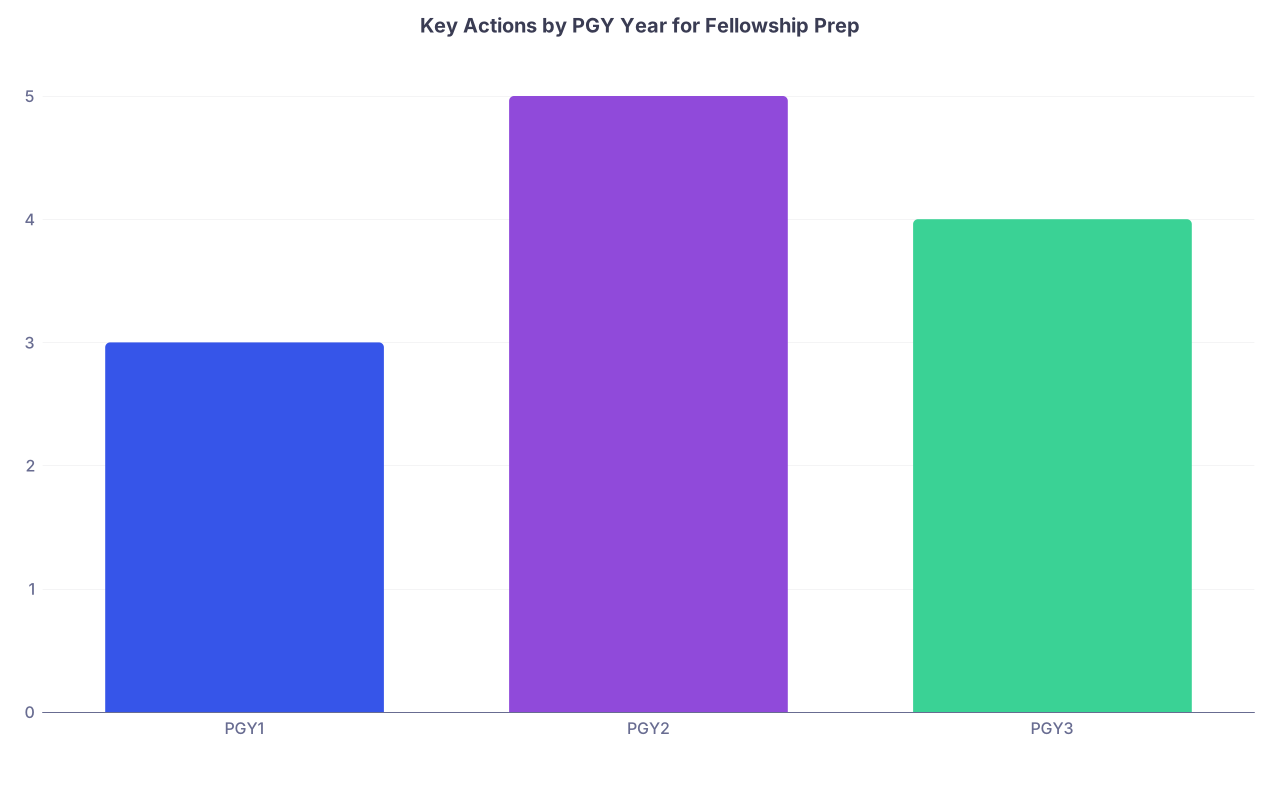
| Category | Value |
|---|---|
| PGY1 | 3 |
| PGY2 | 5 |
| PGY3 | 4 |
(Values here = rough count of “critical” actions to focus on that year.)
1. During main Match and rank list time
Before SOAP even happens:
- Rank programs where you can see a path to your fellowship slightly higher, even if they feel less shiny in other ways. A mid‑tier academic IM program with a solid cards division is better for future cardiology than a “name” prelim surgery year.
- Be realistic about competitiveness. If your Step scores and application aren’t near the usual fellowship‑bound range in a hyper‑competitive specialty, consider parallel plans now, not in PGY‑3.
2. During SOAP week
If you end up in SOAP, do not just click randomly.
Here’s the decision framework:

| Step | Description |
|---|---|
| Step 1 | In SOAP |
| Step 2 | Filter programs by core specialty needed |
| Step 3 | Prioritize strong categorical programs |
| Step 4 | Check for subspecialty presence and stability |
| Step 5 | Deprioritize unless no other options |
| Step 6 | Apply and rank based on fit and support |
| Step 7 | Do you have a clear fellowship goal? |
| Step 8 | Is this program in required specialty? |
Rules of thumb:
- For medicine subspecialties → prioritize categorical IM with at least some subspecialists on faculty
- For procedural EM fellowships → prioritize ACGME‑accredited EM programs with ultrasound, toxicology, EMS access
- For FM fellowships → choose FM programs with OB, sports, or geriatrics exposure depending on your plan
- Be very cautious about prelim‑only paths if you don’t see a realistic route to a full categorical spot later
If you’re truly down to “any job vs no job,” of course you take the job. But within the options you do have, keep your future fellowship in mind.
3. Early residency (PGY‑1 and early PGY‑2)
This is where you actually build your fellowship application. SOAP is now irrelevant.
Focus on:
- Being clearly in the top tier of residents clinically
- Asking your PD and mentors early about fellowship interest
- Grabbing any project that’s even remotely aligned with your target field
- Getting on the radar of subspecialists: show up, be prepared, follow up on feedback
Fellowship PDs read between the lines. If your letters say “they’re one of the strongest residents I’ve worked with in the last 5 years,” nobody cares that ERAS once said “SOAP.”
Specialty‑Specific Reality Checks
I’ll be blunt here, because this is what you actually want to know.

Internal Medicine → Cards, GI, Heme/Onc, etc.
- Matching IM through SOAP into a mid‑tier academic or community‑academic program? Still very viable for most fellowships if you’re a star resident.
- Matching IM through SOAP into a tiny, heavily service‑oriented program with no subspecialty faculty? You’ll have a harder time for the top‑tier fellowships but can still match into solid community fellowships or less competitive subspecialties.
- No IM categorical spot at all (e.g., prelim only or different specialty)? You’ve likely closed the door to most IM subspecialties unless you later secure a categorical IM slot.
EM → Ultrasound, Critical Care, Toxicology, EMS
- SOAPing into an ACGME EM program is fine. Plenty of EM residencies get filled through SOAP every year and still place people into fellowships.
- The bigger issue is whether the program has existing fellowships or strong track records in your area of interest.
FM → Sports, OB, Geriatrics, Palliative, Addiction, etc.
- SOAPing into FM rarely “kills” fellowship plans. These fellowships tend to be less numbers‑driven and more about fit, letters, and interest.
- Program culture matters more than prestige here: Do they support OB? MSK? Do any graduates actually go on to the fellowship you want?
Surgical subspecialties
Whole different beast.
- Many competitive surgical fellowships look heavily at program reputation, case logs, and letters from high‑profile surgeons.
- SOAPed surgery spots often sit in smaller or still‑developing programs. Not impossible, but it’s harder to reach the highest‑tier fellowships from there.
- That said, a few years of strong performance, high case volume, and advocacy letters can still get you into good fellowships.
How To Talk About SOAP Later (If It Comes Up)
Most of the time, it won’t come up. If it does:
Keep it simple, brief, and forward‑looking:
- “I had a weaker interview season than expected, ended up matching through SOAP into my current program, and it honestly turned out to be the right place for me. I’ve had great mentorship in X, which is what got me interested in your fellowship.”
No long apology. No defensive monologue. Own it, pivot to what you did since then.
Quick Reality Summary
- SOAP itself is not a fellowship death sentence.
- Your residency choice, performance, and mentorship are what matter.
- The most dangerous part of SOAP is panic‑accepting something that doesn’t align with your long‑term goals when you actually had better‑aligned options.
- If you land in a less‑ideal program, you’re not done—you just have to be more intentional and proactive.

FAQ: SOAP and Fellowship Options (7 Questions)
Can fellowship programs see that I matched through SOAP?
There’s no automatic “SOAP” label on your fellowship application. Programs see where and when you trained, not which NRMP mechanism you used. They can sometimes infer it from timelines or program patterns, but it’s not a standard data point.Is it better to go unmatched and reapply next year than to SOAP into a weaker program if I want a competitive fellowship?
Usually no. Being out of training, doing nothing clinically and trying again, is a big red flag. In most cases, it’s better to SOAP into the best‑aligned ACGME program you can and then build a strong track record, even if the name isn’t ideal.If I SOAP into a community program, can I still match into academic fellowships?
Yes, it happens every year—especially in IM and EM. You’ll need strong letters, evidence of scholarship, and probably a couple of connections (through electives, conferences, or multi‑center work). It’s harder, but very doable.Does SOAP hurt my chances at ultra‑competitive fellowships (cards, GI, surgical subspecialties)?
Indirectly, maybe. Those fields care a lot about program reputation and research. If SOAP lands you in a place with limited resources in that specialty, you’ll have to work harder to compete. But if you’re at a solid program with active subspecialists and you perform at the top, SOAP itself isn’t the blocker.Will being a chief resident offset a lower‑tier SOAPed program for fellowship?
Being chief helps a lot. It signals leadership, strong evaluations, and PD trust. A chief resident from a lesser‑known program can absolutely match into good fellowships; again, letters and performance matter more than how you matched.If I end up in a prelim spot through SOAP, can I still get to my desired fellowship?
Only if you transition into the correct categorical residency (IM for IM subspecialties, FM for FM fellowships, etc.) in time. A stand‑alone prelim year with no path to a categorical spot will not lead directly to almost any fellowship. You’d need a concrete plan to move into the right residency.What’s one thing I should prioritize when choosing SOAP programs if I know I want fellowship later?
Prioritize alignment with the core specialty and subspecialty ecosystem you’ll need. If you want a subspecialty, matching into the correct core discipline with at least some subspecialist faculty around is more important than location, minor perks, or even “brand name.”
Open a blank note or doc right now and write this at the top:
“My target fellowship: ______. My non‑negotiable residency needs to keep that realistic: ______.”
Fill those in before SOAP week—or before you finalize your rank list. Then use that as your filter for every decision you make from here on.