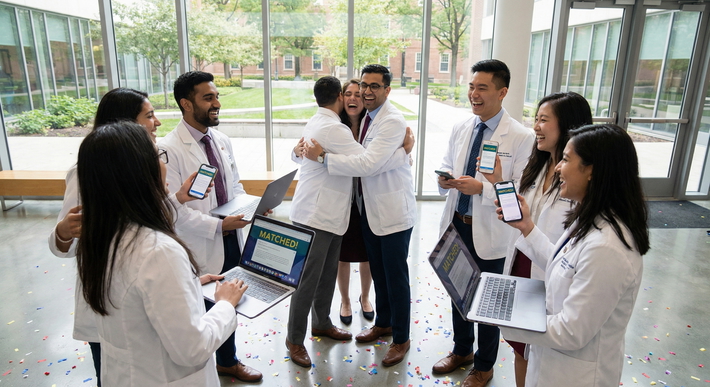
A 260+ on Step 2 is excellent. It is not the same thing as a strong residency application.
That's the hard truth a lot of IMGs learn too late. I've seen applicants with a 265 get fewer interviews than someone with a lower score but two solid US letters and even a brief observership. Why? Because programs aren't just asking, "Are you smart enough?" Your score already answered that. They're asking, "Can we picture you talking to our patients, presenting on rounds, documenting in our system, and fitting into our workflow on day one?"
If you have a top Step 2 score and no US rotations, you are not doomed. Not even close. But you do need to stop acting like the score should carry the whole application. It won't. You have to prove the parts of residency readiness that a multiple-choice exam can't measure.
The Score Trap: Why a 260+ Isn't Enough
A huge Step 2 score gets attention. It does not finish the job.
Here's the problem: among IMGs aiming for competitive or even moderately IMG-friendly programs, high scores are common now. A 260 used to feel rare. It still reflects strong performance, but it no longer makes program directors fall out of their chairs. For many programs, it's a screen-clearer, not a deal-closer.
What programs care about after the score:
- Can you communicate clearly with patients in conversational English?
- Can you present a patient in the style expected in US training?
- Do you understand basic workflow in the US system?
- Can you function in a team with nurses, case managers, social workers, pharmacists, and attendings?
- Have you been observed doing any of that by a US physician?
That last one matters more than applicants want to admit.
Program directors use US clinical experience as a shortcut. Not a perfect shortcut. But a real one. They know USCE doesn't guarantee a great intern. Still, it tells them you've at least been exposed to the pace, etiquette, documentation culture, and patient expectations here. Without it, they worry. And when a program has 4,000 applications, worry equals rejection.
This is where high-scoring IMGs get trapped. They assume the score proves overall readiness. It doesn't. Exams measure knowledge application under test conditions. They do not measure bedside communication, cross-cultural sensitivity, charting habits, professionalism in an American teaching environment, or whether you'll freeze when an attending says, "Call the consult and update the family."
For more on this, see how a strong score fits into your overall strategy.
And yes, match patterns reflect this reality. IMGs without US clinical experience generally see lower interview yield, even when their numbers are strong. The score may get you through an initial filter, but lack of US exposure can quietly stop your file from moving forward.
Bluntly: a 260+ is powerful, but by itself it can look one-dimensional. Programs don't want a great test-taker they have to "decode." They want someone legible. Familiar. Lower risk.
If you're an IMG concerned about how your US clinical experience stacks up against your Step 2 performance, see which counts more for IMGs: US clinical experience or Step 2 CK score for a deeper breakdown.
So your task is simple: make your application easy to trust.
That means translating your international training into language US programs understand, then adding enough US-facing clinical proof that your score becomes part of a fuller story, not the whole story.
Translating Your International Experience into US-Relevant Currency
Your international experience has value. The mistake is presenting it vaguely.
"Worked in a busy tertiary hospital" is weak. Everyone writes that. It tells me nothing. If you want US programs to respect your background, translate it into concrete, comparable terms.
Use four buckets:
- Patient volume
- How many patients did you see per day?
- In what settings, clinic, ED, inpatient wards, ICU?
- Clinical autonomy
- What decisions did you make yourself?
- What did you do before senior review?
- Case complexity
- What kinds of pathology did you manage?
- What acute presentations were routine for you?
- Communication and language
- How many languages do you use clinically?
- Did you counsel families, break bad news, obtain consent?
Good framing sounds like this:
- "Managed 25-35 patients per day in a government tertiary-care internal medicine service."
- "Performed initial assessment and management planning for undifferentiated emergency presentations before attending review."
- "Participated in care for high-acuity patients in a resource-limited setting, strengthening diagnostic reasoning when advanced imaging or subspecialty support was not immediately available."
- "Provided counseling in English and Hindi across diverse literacy levels, including medication adherence and discharge planning."
That's real. That's readable. That works.
Quantify whenever possible:
- Number of deliveries
- Number of intubations observed or assisted
- Number of venipunctures, sutures, lumbar punctures, catheter placements, or first assists
- Number of outpatient visits
- Number of inpatient months
- Number of call shifts
And don't hide resource-limited training like it's an embarrassment. It's often a strength if you frame it correctly. Doctors trained in constrained environments often develop sharp clinical judgment, efficiency, adaptability, and grit. Those are residency assets. Say so.
Your goal is to make a program director think: "This person may not have much USCE, but they are clearly clinically mature."
That shift matters.
Closing the US Clinical Experience Gap: Options You Can Start Today
If you have zero US rotations, fix that. Don't overthink it. Start now.
No, virtual experience is not equal to a full in-person rotation at a US teaching hospital. Anyone telling you otherwise is selling something. But virtual and hybrid options are still useful, especially if they give you direct interaction with US physicians, patient-facing exposure, feedback, and a possible letter.
Here are your main options.
1. Virtual rotations
Best for:
- Applicants abroad who can't travel immediately
- Building a first US physician relationship
- Learning presentation style, documentation logic, and telehealth workflow
Look for programs that include:
- Live case discussions
- Real-time telemedicine or supervised patient interaction
- Direct attending feedback
- A clearly described LoR process
Avoid lecture-only "rotations" dressed up as clinical exposure. Those are weak and programs can smell it.
2. In-person observerships
Best for:
- Graduates who can travel
- Applicants who need credible US letters fast
- Building confidence in US hospital etiquette
Observerships aren't hands-on in most cases, but they still matter. A strong observership letter can say:
- You were punctual
- You communicated well
- You understood clinical reasoning
- You engaged professionally with the team
- You adapted quickly to the US setting
That's useful. Very useful.
A short, serious observership beats no US exposure at all. I've seen 2-4 week experiences produce excellent letters when the applicant was prepared, engaged, and easy to teach.
For a closer look at how a strong US rotation can offset a lower Step score, check out how one strong US rotation can outweigh a marginal Step score.
3. Externships or hands-on IMG programs
Best for:
- Graduates eligible for structured hands-on roles
- Applicants applying to specialties where direct clinical proof matters more
These can be excellent, but quality varies wildly. Some are legitimate and educational. Some are expensive window dressing. Ask blunt questions:
- Will I interact with patients?
- Who writes the letter?
- Is the physician known to residency programs?
- How often will I present or document?
- Is there actual teaching?
If nobody can answer clearly, walk away.
4. Telemedicine volunteering
Best for:
- Applicants who need flexible US-facing experience
- Building communication skills and supervised patient interaction
This is growing fast. Good telemedicine roles can help you learn:
- Triage style
- Patient interviewing in US conversational norms
- Documentation structure
- Follow-up and care coordination language
Again, supervision matters. If no physician observes you, the value drops.
5. US-based research with clinical contact
Best for:
- Applicants already pursuing research in the US
- Building faculty relationships that can become advocacy
Pure bench work won't solve a USCE gap. Clinical research with patient enrollment, chart review, outcomes work, or multidisciplinary meetings is better. It shows you can function in an American academic environment.
Here's the practical ranking I give most IMGs:
- In-person hands-on externship if accessible
- In-person observership with strong teaching and LoR
- High-quality virtual rotation with direct attending interaction
- Telemedicine volunteer role with supervision
- Clinical research with patient-facing components
The best strategy is stacking, not choosing only one. Even a combination like:
- 1 virtual rotation
- 1 observership
- 1 telemedicine role
...can change how your application reads.
Bottom line: stop waiting for the "perfect" USCE opportunity. The perfect one often never comes. A good, credible, supervised experience now is better than an ideal one you never secure.
Crafting a Compelling Narrative in Your Personal Statement and LoRs
If you have no or limited USCE, don't dodge it in your personal statement. Address it cleanly.
Not defensively. Not apologetically. Just directly.
A strong narrative sounds like this:
- You built rigorous clinical foundations in your home country.
- You validated that knowledge with a top Step 2 score.
- You then intentionally pursued US exposure to understand system expectations, communication style, and patient care structure.
- Those experiences confirmed your fit for residency in the US.
That's a strategy. Not a gap.
What you should not do:
- Pretend the lack of USCE doesn't exist
- Over-romanticize your Step score
- Write five paragraphs about childhood inspiration and zero about clinical readiness
- Sound bitter that programs "don't appreciate IMGs"
Programs are not recruiting your frustration. They are recruiting a resident.
Tie your Step 2 score to behavior, not ego. Don't say, "My 265 proves I'm exceptional." That sounds immature. Better:
- "Preparing for Step 2 while training clinically strengthened my discipline, pattern recognition, and ability to perform under pressure."
- "My exam performance reflected not only content mastery but the habits I developed caring for high-volume, medically complex patients."
Now the score is part of your professional identity, not a trophy.
Letters matter even more when USCE is thin. You need at least one or two people who can comment on things beyond intelligence:
- Communication with patients
- Receptiveness to feedback
- Professionalism
- Teamwork
- Reliability
- Presentation skills in English
- Adaptation to US clinical norms
If your US letter just says you were "knowledgeable and interested," that's mediocre. Better than nothing, but still mediocre. The best US LoRs are specific. They mention encounters, presentations, initiative, bedside manner, and trustworthiness.
Before any rotation or observership, ask yourself: what would make this doctor remember me enough to write specifics?
Answer:
- Show up early
- Read before clinic
- Present clearly
- Ask smart, concise questions
- Be normal with staff
- Don't cling awkwardly
- Send a thank-you note
- Ask for the letter while your work is still fresh in their mind
That's how letters get stronger.
Action Plan: From Score to Interview in 6 Months
If you want structure, here it is. Six months. No drama. Just work.
Months 1-2: Build your US-facing foundation
- Apply to virtual rotations with actual attending interaction
- Apply to observerships, externships, and IMG-friendly hospital programs
- Reach out to alumni, senior IMGs, and mentors for leads
- Make a list of IMG-friendly programs in your target specialty
- Update your CV with quantified clinical experience
- Practice one-minute and three-minute self-introductions for networking
Your goal: secure at least one credible US experience and start building relationships.
Months 3-4: Turn exposure into evidence
- Complete your rotation, observership, or telemedicine role
- Ask for LoRs from physicians who know your work firsthand
- Keep a log of cases, presentations, and feedback
- Draft your personal statement with a clear explanation of your path
- Refine your ERAS experience entries using numbers and outcomes
- If possible, add one academic project, poster, or case report
Your goal: convert activity into proof. Anybody can say they observed. You need documentation, advocacy, and story.
Months 5-6: Package aggressively and intelligently
- Finalize personal statement and have it reviewed by someone blunt, not just nice
- Assign LoRs strategically
- Make sure your application shows clinical maturity, not just academic strength
- Use program signaling where it realistically helps
- Apply broadly but not blindly; prioritize programs with IMG history
- Prepare for interviews by practicing patient-centered communication and "Why no USCE earlier?" responses
Your goal: present as low-risk, motivated, clinically grounded, and ready.
Here's the mindset shift: you're not trying to "overcome" a USCE gap with a score. You're trying to build a complete file around a great score.
That's different. And it works.
If you're sitting on a 260+ and feeling stuck, don't waste another season assuming merit will explain itself. It won't. Build the proof, tell the story correctly, and make programs trust what your score already suggests. Start this week. Not next month.