
The assumption that you need multiple home and away rotations in a specialty to “prove interest” is garbage—and it hurts a lot of smart applicants.
If you’re locked into required clerkships, your school barely offers your target field, or away rotations fell through, you’re not doomed. But you do have to be deliberate. Programs hate guessing. Your job is to make it impossible for them to wonder, “Do they actually care about this specialty?”
Here’s how to handle it when your rotations don’t tell the full story.
First, Be Honest About Your Actual Problem
You do not have “no exposure.” You have limited formal rotations. That’s different, and you need to frame it that way.
Common real situations I see:
- Your school doesn’t have that specialty as a home department (classic for things like rad onc, neurosurgery at smaller programs, PM&R at some MD schools, etc.).
- You discovered the specialty late, after core clerkships were already locked.
- You’re an IMG with only 1–2 US rotations total.
- Personal reasons (family, health, finances, visa) blocked away rotations.
- Scheduling chaos: other required rotations, Step 2 timing, admin mistakes.
You can’t fix the past schedule. You can fix how clearly you show interest now.
Your mindset from here:
“I will make my interest unmistakable in three places: what I’ve done, what I say, and who vouches for me.”
Step 1: Build Real Exposure Without Official Rotations
If you cannot add more electives, you manufacture exposure in other ways. Quietly. Consistently. And then you talk about it like an adult, not like a victim of your school’s scheduling.
Shadowing that actually counts
Shadowing is weak if you do it once, on a random Friday, and never mention it again. It’s useful if it’s:
- Longitudinal (repeated over time)
- Intentional (you show up with questions and reflect on cases)
- With people who can speak about you
Concrete playbook:
Identify 1–2 attendings or senior residents in your target field at your institution or nearby.
Email them something like:
“I’m a rising MS4 very interested in [field]. Because of scheduling and curriculum limitations at [School], I’ve only had one formal rotation. I’m trying to build more real-world exposure. Would you be open to me shadowing you in clinic/OR half a day per week for the next 4–6 weeks?”
Show up prepared: read their clinic schedule (if possible), pre-read basics on common diagnoses or procedures, stay off your phone, and debrief at the end: “Could I ask you two questions about what you think makes a strong applicant in [field]?”
If that turns into 20–40 hours of consistent, real shadowing, that’s something you can name specifically in your personal statement and interviews.
Projects that tie you to the specialty
You don’t have to crank out an R01. You do need at least one tangible project with a clear specialty connection.
Target easy-on, fast-off projects:
- Case reports from interesting patients you saw (even on non-specialty rotations, but ultimately relevant to your target field)
- Retrospective chart reviews where someone has already pulled most of the data
- QI or workflow projects in your target department (clinic flow, consult response times, peri-op checklist tweaks)
The move is:
Ask your shadowing attending or a friendly resident:
“Is there a small project related to [field] that I could help with this year—case report, chart review, QI—something where I can actually contribute and see it through?”Set a 6–8 week micro-timeline: outline, draft, submit to something (local conference, national meeting, journal). You don’t control acceptance, but you do control completion.
Use the project to generate:
- Lines on your CV
- Something to discuss in your personal statement (“Through working on X project…”)
- A reason for a letter writer to describe your sustained engagement with the field
Conferences and societies: do the minimum strategically
No, joining a national society alone doesn’t prove anything. But combined with the above, it rounds the picture.
At minimum:
- Join the main specialty society as a student member (e.g., AAPM&R for PM&R, AANS for neurosurg, ACR for radiology).
- Attend at least one regional or national meeting (virtual is fine if you actually engage).
If you can:
- Present a poster (even if it’s a small QI project or case report).
- Go to the student or resident networking session and introduce yourself to at least 3 faculty from programs you’ll apply to.
Put these on your CV with dates. In your personal statement or interviews, reference one concrete session, talk, or experience from the conference. That’s what makes it feel real, not performative.
Step 2: Use Your Limited Rotation(s) Aggressively
If you only have one rotation in your target field, you can’t just “do well.” You need to treat it like your audition and your evidence file.
Decide your brand before the first day
You want 2–3 adjectives attendings at that rotation could honestly use about you in a letter:
“relentlessly prepared,” “excellent with patients,” “hungry to learn,” “self-directed,” “teachable.”
Then you act in a way that makes those inevitable, not optional.
Concrete behaviors that pay off:
- Show up early, stay a bit late. Not performatively, but enough that people think, “They’re clearly invested.”
- Ask 1–2 well-thought questions per day that show you read before showing up.
- Volunteer for the unsexy tasks: discharge summaries, calling families, following up labs, chasing consults. Yes, even on subspecialty service.
- Seek feedback in week 1–2: “I’m hoping to be a strong applicant in [field], and this is my only formal rotation in it. Is there anything I should adjust now to make sure I’m showing that level of commitment?”
That last sentence signals intent and buys you real-time course correction.
Lock in at least one strong specialty letter
Your limited rotation is where you must secure a strong letter from someone credible in that field.
Don’t wait until the last day and mumble, “Uh, could you write a letter?” You do it like this:
Mid-rotation, ask for performance feedback.
If they’re positive, say:
“This is my only core rotation in [field], and I’m applying this cycle. If by the end of the rotation you feel you can write a strong letter for me, I’d be very grateful.”End of rotation, follow up and formally request the letter with:
- Your CV
- Personal statement draft (even if rough)
- Bullet list of 4–6 specific things you did on the rotation that show work ethic, initiative, clinical thinking
You’re not being pushy. You’re making it easier for them to write the exact letter you need: “Even though this was his/her only formal rotation in [field], they clearly…”
Step 3: Rewrite the “Limited Rotations” Story in Your Application
Programs see hundreds of ERAS files. If your exposure looks thin, their brains immediately run three scripts:
- “Are they hedging or not really sure?”
- “Are they trying to backdoor into a competitive specialty?”
- “Will they actually be happy in this field?”
You can’t leave space for these questions. You answer them head-on in three places: personal statement, experiences section, and letters.
Personal statement: don’t whine, explain
You do not make the essay about how unfair your curriculum is. You briefly explain the constraint, then pivot hard to what you did anyway.
Skeleton approach:
- One or two specific experiences that pulled you toward the specialty.
- A short, direct sentence explaining the structural limitation:
- “Because [School] does not offer a home [specialty] department, I completed one formal elective at [Hospital] and built additional exposure through longitudinal shadowing, research, and conference participation.”
- 2–3 concrete things you did to deepen your interest despite that:
- “I spent weekly sessions in Dr. X’s clinic for three months…”
- “I joined a QI project improving Y…”
- “I presented at the regional Z meeting…”
The vibe: resourceful, not resentful. Programs respect that.
ERAS experiences: label the specialty links
If you bury your specialty-related work under generic “Research Assistant” or “Volunteer” with no context, reviewers will miss it.
You fix that by being explicit in your descriptions. Example language:
- “Worked with the PM&R consult team to track…”
- “Shadowed neurosurgery attending in clinic and OR weekly for 10 weeks…”
- “QI project in emergency radiology improving turnaround time for…”
Front-load the specialty:
Instead of
“Research Assistant – Department of Medicine”
try
“Research Assistant – EM-focused sepsis QI (Emergency Medicine)”
They read fast. You need to make it painfully obvious what’s relevant.
Letters that say the quiet part out loud
You can’t write your own letters, but you can prime your letter writers.
Tell them plainly:
“Some programs may worry I’ve had limited formal rotations in [field]. If that matches your honest impression, it would help me a lot if you could comment directly on my commitment to [field] and how I sought out opportunities despite our curriculum’s limitations.”
Good letter writers will literally write a line like:
“Although our institution offers only a single elective in [field], [Name] consistently sought out additional experiences, including shadowing, research, and conference participation, and I have no doubt about their commitment to this specialty.”
That one sentence neutralizes a red flag for dozens of programs.
Step 4: Use Interviews to Hammer Home Commitment (Without Sounding Desperate)
When they ask, “Tell me about your exposure to [field],” they are often really asking: “Are you sure?”
You should have a practiced, tight answer that:
- Acknowledges the limitation without drama.
- Lists the specific ways you compensated.
- Ends with why you’re sure this is the right fit.
Example for someone with one home elective and no aways:
“My medical school has only one formal elective in [field], which I completed at [site] and loved. Knowing that would be my only rotation, I built additional exposure by shadowing Dr. X in clinic weekly for several months, joining a QI project on [topic], and attending the [specialty] regional meeting where I presented a case poster. Between those experiences, and talking honestly with mentors about the lifestyle and patient population, I’m very confident this is the right field for me.”
Notice the absence of apology. Just facts and intention.
Handle the “Why no away rotations?” question directly
If you had zero away rotations in a field where aways are common (ortho, urology, neurosurg, some IM subspecialties), have a clean, non-whiny answer.
Valid answers, phrased like an adult:
Curriculum constraints:
“My school locks core rotations through December of MS4, so there wasn’t a way to fit an away without delaying graduation. Because of that, I tried to build as much exposure locally as I could—shadowing, research, and going to [conference].”Financial or personal constraints:
“For financial/family reasons, I needed to stay in [city] during that period. I talked with my advisor and we decided the best approach was to maximize experiences at my home institution instead—so I focused on [X, Y, Z].”Late specialty switch:
“I originally thought I’d pursue [other field] and realized during third year that [target field] aligns much better with how I like to work. By the time I switched, away rotation slots were mostly filled. I committed to [field] anyway and built exposure as best I could through [specific actions].”
You don’t over-explain. Two sentences, then re-anchor on what you did.
Align your “why this specialty” with what the field actually values
If you have limited time in the field, your understanding has to sound more mature, not less.
Example:
Rad Onc → don’t say “I like physics and long-term relationships with patients” and stop there. Back it up with something you saw or did.
PM&R → do not reduce it to “I like sports and function.” Talk concretely about team dynamics, longitudinal goals, or working with complex disabilities.
You want one or two specific stories (from your shadowing, project, or conference) that show you get the day-to-day reality, not just the brochure version.
Step 5: Adjust Your Program Strategy to Match Your Profile
If you have limited rotations in the field and no home department, you are not a slam-dunk at the most competitive, research-heavy programs. You can still match well if you apply smart.
Here’s how I’d think about it.
| Program Type | Priority Level | Rationale |
|---|---|---|
| Home region mid-tier | Highest | More forgiving, value personal ties |
| Community programs | High | Less obsessed with perfect exposure |
| Newer/expanding programs | High | Need bodies, often more flexible |
| Top-tier academic | Selective | Apply, but don’t overconcentrate |
| Very competitive metros | Selective | Add some, but not your core list |
You balance your list heavily toward places that:
- Know your school (or region)
- Are community- or hybrid-focused
- Have a track record of taking people without heavy specialty research
You can still throw darts at big names, but you don’t build your whole year around them.
Step 6: If You’re Still Early Enough, Build a Mini-Timeline
If you’re MS2–early MS3 reading this, you actually have room to act, not just spin.
Here’s what a compact, realistic plan might look like:
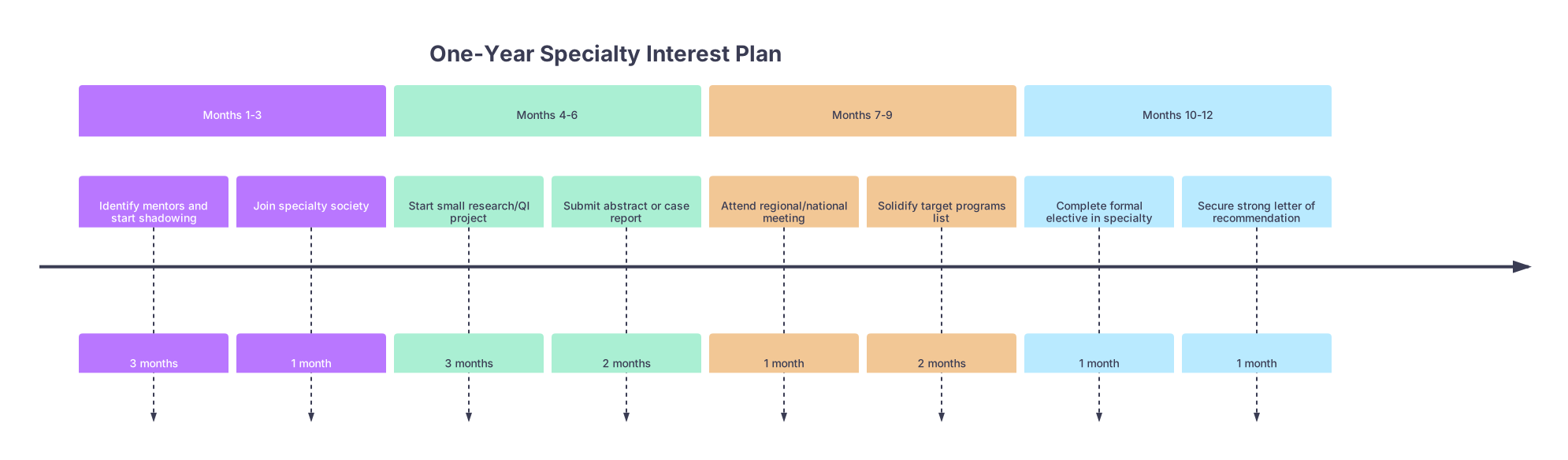
| Period | Event |
|---|---|
| Months 1-3 - Identify mentors and start shadowing | 3 months |
| Months 1-3 - Join specialty society | 1 month |
| Months 4-6 - Start small research/QI project | 3 months |
| Months 4-6 - Submit abstract or case report | 2 months |
| Months 7-9 - Attend regional/national meeting | 1 month |
| Months 7-9 - Solidify target programs list | 2 months |
| Months 10-12 - Complete formal elective in specialty | 1 month |
| Months 10-12 - Secure strong letter of recommendation | 1 month |
You’re basically doing four things over a year:
- Regular shadowing (even half-day per week)
- One manageable project
- One formal elective
- One meaningful professional touchpoint (conference, meeting, or student group)
If you stack those, you will not look like someone who just clicked a random specialty dropdown on ERAS.
Quick Specialty-Specific Realities
I’ll be blunt about a few fields where “limited rotations” hits differently.
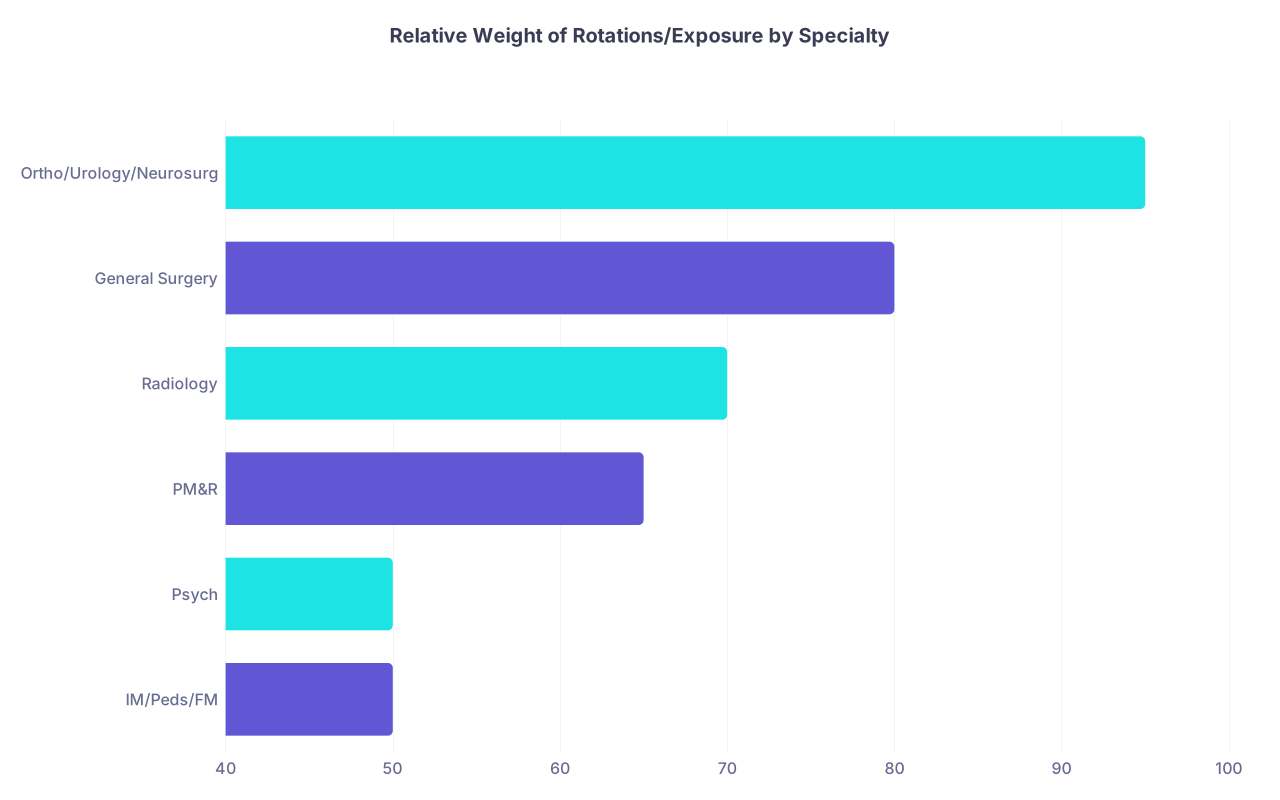
| Category | Value |
|---|---|
| IM/Peds/FM | 50 |
| Psych | 50 |
| PM&R | 65 |
| Radiology | 70 |
| General Surgery | 80 |
| Ortho/Urology/Neurosurg | 95 |
- IM/Peds/FM/Psych: One good sub-I in the field + strong core clerkship comments + coherent story is usually enough. Limited electives aren’t fatal.
- Radiology/Anesthesia/Path: They expect at least some direct exposure because students often choose them late. A focused elective + clear reasoning works.
- PM&R/EM: Programs are used to people coming from schools with weak home presence. They’ll look harder at your advocacy—shadowing, conferences, projects.
- Ortho/Uro/Neurosurg: Aways are a big deal. Limited rotations is a real handicap. In these, you absolutely must lean hard on: early relationships, at least one killer home rotation if available, and possibly a research year if you’re very late to the game and gunning high.
You don’t need to be perfect. You do need to be realistic.
If You’re Truly Stuck: The Backup Conversation
Sometimes the truth is rough:
- You found the specialty at the end of MS4.
- You have zero formal exposure.
- No home department. No time for aways. Weak Step 2.
In that scenario, your best move may be: apply broadly to a related but more accessible field this cycle, then consider a targeted re-application or fellowship route later if you still want that original specialty.
Example: late-to-rads → match IM, then aim for cards or pulm/crit if you like complex diagnostics and procedures.
Late-to-ortho → match FM or IM and look into sports med or pain later.
Not romantic, but it’s honest. And a stable, interesting career in a related field is better than scrambling unmatched on the basis of “vibes” and one half day of shadowing.
One More Thing: Consistency Across Your Application
Programs pay attention to contradictions. If you claim, “I’m deeply committed to [field],” but:
- Your research is all in unrelated areas with no plausible story,
- Your hobbies/interests scream another specialty (e.g., years in neurosurg research then applying radiology with no bridge story),
- Your personal statement, experiences, and letters don’t line up,
they’ll doubt your sincerity.
Do a quick internal audit:
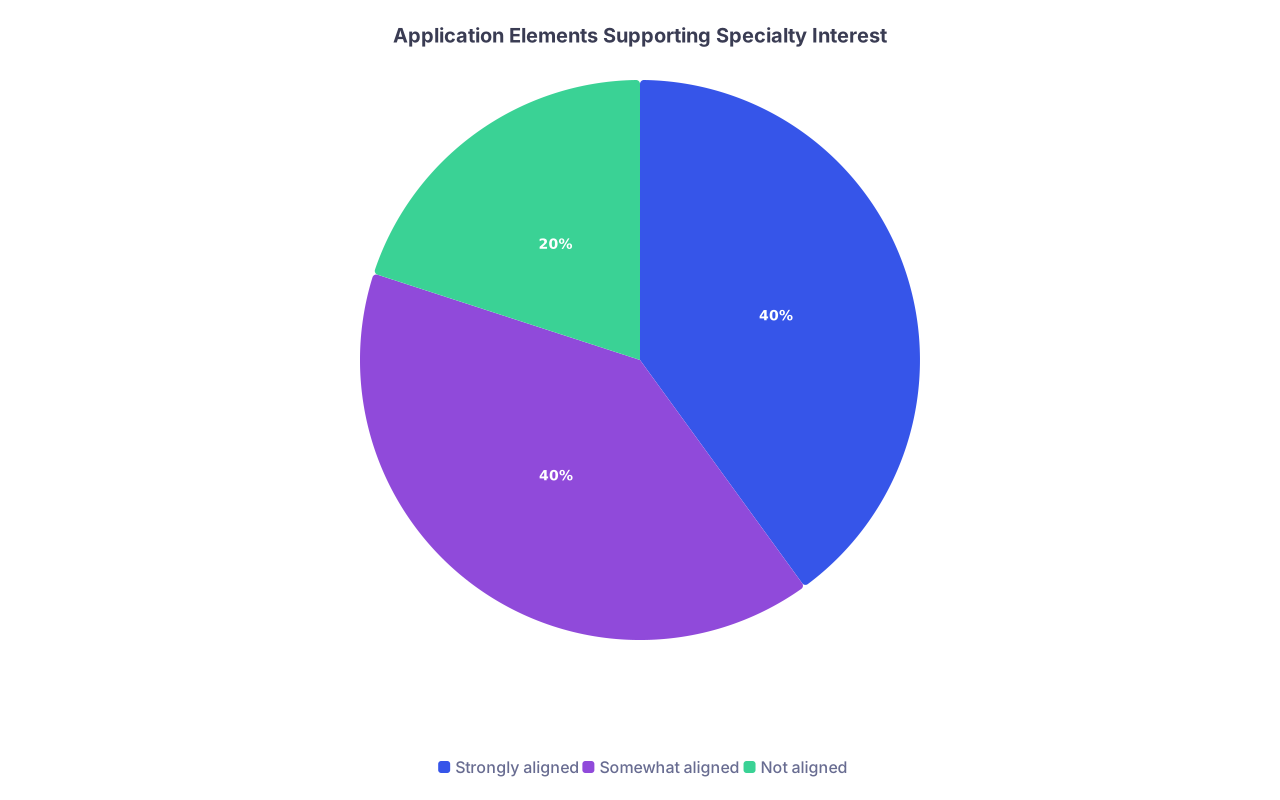
| Category | Value |
|---|---|
| Strongly aligned | 40 |
| Somewhat aligned | 40 |
| Not aligned | 20 |
You want most of your major visible elements (PS, experiences, letters, interview answers) in the “strongly aligned” bucket. A few “neutral” pieces are fine. Too many conflicting signals kills you more than lacking one extra elective.
Final Check: What You Should Have in Place
By the time ERAS is submitted, your “limited rotations” story should look like this:
- One formal elective or sub-I where you crushed it and got a specialty letter.
- Ongoing shadowing or clinical exposure you can describe concretely.
- At least one project, case, or QI effort tied to the field.
- Involvement with a specialty society or conference, even if minimal.
- Personal statement and letters that explicitly acknowledge and reframe the structural limitations.
If you can honestly check those boxes, your lack of multiple rotations won’t sink you. Programs might still prefer applicants with deeper formal exposure—but you’ve moved yourself out of the “red flag” category and into “solid, resourceful candidate who made the most of a constrained environment.”
Strip It Down: What Actually Matters
- You cannot change how many rotations you had. You can control how convincingly you show you chased the field anyway—through shadowing, projects, and relationships.
- You must rewrite the story from “limited exposure” to “structural limits + deliberate, consistent actions”—in your personal statement, ERAS descriptions, and letters.
- In interviews, stop apologizing. Explain the constraint in one clean sentence, then spend the rest of your time showing you understand the specialty and would be a good resident in it.