
It’s August. ERAS opens in a few weeks.
For the last three years you were “definitely ortho.” Your letters are from surgeons, your research is in fracture fixation, your personal statement draft starts with “From a young age, I knew I wanted to be an orthopaedic surgeon…”
And now you want anesthesia. Or psychiatry. Or radiology. Or honestly, just not ortho.
You’re staring at your CV thinking:
“I look like a strong applicant… for the wrong specialty.”
You do not have time to start over from zero. You do have time to rebuild strategically. Here’s how you handle this situation without blowing your match year.
Step 1: Get Clear On What You’re Actually Doing (And Why)
First thing: you cannot afford to look confused or flaky. Programs hate “undifferentiated” more than they hate low Step scores.
You need a crisp story:
“I’m applying to X. This is why. Here is the evidence.”
If your brain is still ping-ponging between two fields (“maybe IM, maybe EM?”), sort that out before you start rewiring your application.
Ask yourself three blunt questions:
- Which field can I actually see myself in day to day?
- Which one am I willing to read about for the next month for fun?
- Which community of residents/attendings felt like “my people” on rotation?
Pick. One.
If you’re genuinely dual-applying (like IM + Neuro, or Anesthesia + IM prelim), that’s a different strategy and you have to compartmentalize it. But the main target needs to be clear in your own head.
Now, you need a sentence that explains the switch without sounding impulsive. Example:
Surgery → Anesthesia:
“On my surgery rotations, I realized the part of the OR I was drawn to most was perioperative physiology — airway, hemodynamics, analgesia — and I consistently found myself staying behind to discuss cases with anesthesia attendings.”EM → Psychiatry:
“My EM months showed me that the patients I naturally gravitated toward were those with complex psychiatric needs; I found myself wanting the longitudinal work beyond stabilizing them in crisis.”
Your reasons must sound:
- Specific
- Observed over time (not “last week I decided…”)
- Grounded in your clinical experiences
If your reason is actually lifestyle or burnout from your original field, you keep that as subtext. You can acknowledge values (teamwork, continuity, procedural interest), but you do not say “I wanted better hours.”
Step 2: Audit Your Existing Application Like a Program Would
You already have a portfolio, it’s just misaligned. You’re not starting from scratch; you’re repurposing.
Open a document and make four columns:
- Item (clerkship, research, job, leadership)
- Appears to support: Old specialty / New specialty / Neutral
- How I can spin this toward new specialty
- What’s missing for new specialty
Now go through:
- Clerkships and sub‑Is
- Research projects
- Leadership roles
- Volunteer work
- Teaching
- Honors/awards
Most students underestimate how much is actually neutral or flexible.
Example: You thought your ortho trauma research is “wasted” on EM or Anesthesia. It is not. It screams: acute care, high-stakes decision-making, OR exposure, interprofessional collaboration. That’s usable.
Your goal from this audit:
- Identify at least 3–5 experiences you can credibly frame as pointing toward your new field
- Identify the glaring gaps (no letter in new specialty, no sub‑I, zero mention of it in your personal statement)
Those gaps are what we target next.
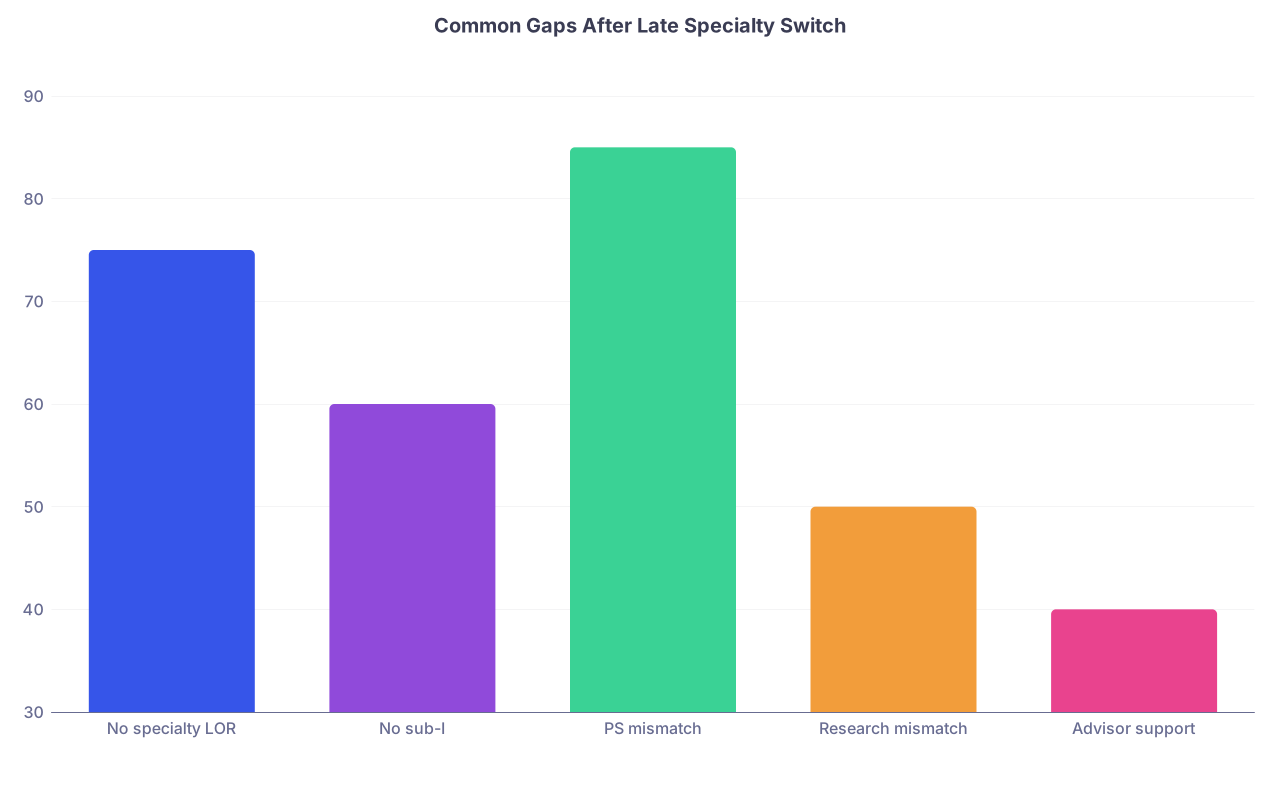
| Category | Value |
|---|---|
| No specialty LOR | 75 |
| No sub-I | 60 |
| PS mismatch | 85 |
| Research mismatch | 50 |
| Advisor support | 40 |
(Percentages roughly reflect how often I see these when students come for last-minute help.)
Step 3: Fix the Non‑Negotiables First
There are three things you absolutely must realign, even with a late switch:
- Letters of Recommendation (at least one in new specialty)
- Personal Statement
- Program list strategy
Everything else is “nice to fix,” but these three are mandatory.
3a. Letters of Recommendation: Getting At Least One Solid Specialty Letter
If you’re switching late, you might not have done a sub‑I or away in the new field. That’s the classic panic point.
Here’s the move:
Identify the best possible contact in the new specialty
- The attending you worked most with on a short elective
- Clerkship director
- Research mentor in that field
- Even a preclinical course director who’s in that specialty (last resort, but sometimes needed)
Email them a direct but respectful ask
Subject: LOR for [Specialty] Residency Applications – [Your Name]
Body can be something like:
Dear Dr. X,
I hope you are well. I’m a fourth-year student at [School] and worked with you on [rotation/project] in [month/year].
I’ve decided to apply to [specialty] and am hoping to request a strong letter of recommendation from someone in the field who has seen my clinical work. I especially appreciated [specific case / feedback they gave you], and felt you had a good sense of how I functioned on the team.
I realize this is relatively close to application season, but I’d be happy to provide an updated CV, personal statement draft, and a brief summary of the work we did together to make this as easy as possible.
Please let me know if you’d feel comfortable supporting my application in this way.
Best,
[Name], MS4Notice the phrase “strong letter.” If they agree, good. If they dodge that wording, you might get a lukewarm letter and should try another person too.
If you’re very late and have no real exposure
Talk to your dean’s office and the clerkship director. Ask if there’s any way to do:- A 2‑week “mini‑elective” early in the year
- An observership that at least lets someone see you show up early, stay late, and read
Then be upfront: “I made this decision late. I’m trying to give you enough of a look at me to write something honest and supportive.”
You still keep letters from your prior field if they’re strong and talk about your work ethic, team skills, etc. A great surgery letter can still help an anesthesia application. But you need at least one person in the destination field.
Step 4: Rewrite Your Personal Statement Without Trashing Your Old Path
Your old draft probably reads like a love letter to the wrong specialty. You cannot just swap the word “surgery” for “anesthesia” and hope nobody notices.
Here’s how you rebuild it quickly and cleanly.
Structure that works especially well after a late switch
- Clinical Anchor – A concrete story from your new specialty
- Pattern Over Time – How your experiences kept steering you toward the same kind of work
- What You Value in Clinical Work – Tie your traits to the specialty
- Why This Specialty Now – Acknowledge the pivot without dramatics
- Looking Forward – What kind of resident/physician you want to be
Notice what’s missing: a long premed-to-now memoir. You don’t have space for that.
Example pivot paragraph (the most delicate part):
Earlier in medical school, I explored [old specialty] extensively through rotations and research, assuming that would be my path. Those experiences were valuable, but what actually stood out during that time were the moments I spent focused on [new specialty’s core elements – e.g., managing hemodynamics, complex psychiatric presentations, longitudinal relationships]. As I gained broader clinical exposure, the pattern became obvious: the work that consistently engaged me deepest was the work at the heart of [new specialty].
That paragraph does a few things:
- It acknowledges you did invest in another field (programs can see your CV; you’re not fooling anyone)
- It frames the old specialty as “exploration,” not a mistake
- It says the new specialty is the center of gravity that emerged, not a random pivot
What you do not do:
- Trash the old field (“I realized surgery was too brutal,” “I could never be happy in EM”)
- Blame burnout alone
- Make it sound like a last-minute panic choice
You’re telling them: “I tried X seriously. The data from that experiment still pointed me to Y.”
Step 5: Reframe Your Existing Experiences Toward the New Field
You don’t have time to collect a whole new portfolio. So you re-interpret what you’ve done through a different lens.
Take three example “misaligned” profiles and see how they can be re-aimed.

Example 1: Ortho-heavy student switching to Anesthesia
- Ortho fracture call → exposure to trauma, airway challenges, perioperative care
- OR time → comfort in procedural environments, team-based acute care
- Ortho research → outcomes, perioperative complications, acute pain management tie-ins
You rewrite bullets like:
“Assisted in >40 operative fracture cases” →
“Participated in >40 operative trauma cases, observing and discussing perioperative management and hemodynamic considerations with anesthesia teams.”
You are not lying. You’re choosing what to emphasize.
Example 2: EM-focused student switching to Psychiatry
- EM rotations → acute stabilization of psychiatric crises, managing agitation, de‑escalation
- EM research → ED utilization among patients with serious mental illness, substance use, etc.
- Volunteer work → crisis hotline, shelter work, anything with vulnerable populations
Bullets become:
“Managed 10+ patients per shift in high-volume ED” →
“Regularly evaluated and de‑escalated patients presenting with acute psychosis, suicidality, or severe anxiety in a high-volume ED, which sparked my interest in long-term psychiatric care.”
Example 3: Surgery → Internal Medicine
- Post-op management → fluids, electrolytes, infections, medical optimization
- ICU exposure → ventilators, vasopressors, complex medical decision-making
- Research → surgical outcomes = comorbidities, perioperative medicine
You lean into complex medical reasoning, not technical parts.
Do this systematically with your whole CV. If a bullet is surgically flavored but actually shows something relevant — communication, complexity, longitudinal follow-up — tweak it.
Step 6: Fix Your Program List Strategy For a Late Switch
This is where a lot of late-switchers quietly self-destruct. They build their list like they were still applying in the original specialty. That’s wrong.
You need to assume:
- You may look “late to the party” to some programs
- Your specialty-specific signal (research, sub‑Is, letters) may be weaker than your peers
- Your best shot is often at programs that know you or are less hyper-selective on “perfect fit” narratives
So you bias your list toward:
- Your home program in the new specialty (if it exists)
- Hospitals where you rotated in any capacity and behaved like a competent human
- A larger number of mid-tier and community programs than your old field might have required
Here’s a rough feel (NOT gospel, but reality-based) of how many programs late switchers often need to hit, assuming they’re otherwise reasonable applicants:
| Target Specialty | Typical Range if Switching Late |
|---|---|
| Internal Medicine | 25–40 programs |
| Psychiatry | 35–50 programs |
| Anesthesiology | 35–60 programs |
| Emergency Med | 35–50 programs |
| General Surgery | 40–60 programs |
If you’re switching into something very competitive (Derm, Ortho, ENT, Plastics) late and you do not already have research + letters there, you need a frank talk with an advisor about whether to:
- Delay graduation / take a research year
- Apply to a backup field this cycle
- Or accept substantial risk of not matching
People do match into competitive fields late, but it usually involves a strong pre-existing relationship or exceptional metrics. Hope is not a plan.
Step 7: Clean Up the “Tells” That You Switched at the Last Second
Program directors are very good at sniffing out chaos. You can switch late without looking reckless if you remove the obvious red flags.
Walk through your application looking for mismatches:
- CV section “Career Goals” still says “I plan to pursue Orthopaedic Surgery”
- ERAS experiences mention “pursuing a career in EM” in the narrative
- Personal statement for your preliminary year sounds more sincere than the one for your advanced specialty (this happens a lot in anesthesia/derm/rads applicants)
Fix them.
Also: dual applying. If you’re dual applying out of fear (e.g., Anesthesia + IM), you must keep the narratives separate.
That means:
- Separate personal statements
- LORs that can be used across both fields focus on general strengths (work ethic, teachability, teamwork), not “dedicated to becoming a surgeon”
- Careful with regional overlaps. It looks odd if you apply Anesthesia + IM at the same small program without a clear reason (couples match, prelim/advanced structure, etc.)
If a PD ever asks you directly in an interview, “Are you also applying to X?” the honest but composed answer sounds like:
“I did explore [other field], and I submitted some applications there early. However, as I solidified my long-term goals, it became clear that [this specialty] is where I see myself. That’s reflected in how I’ve prioritized interview offers and the programs on my list.”
You’re not the first late switch they’ve seen. But they’re checking whether you’re actually committed now.
Step 8: Use Interviews to Lock In Your New Story
If you’ve done the earlier steps decently, you’ll get interviews. Your job there is to stabilize the impression.
Common question you will almost certainly get:
“So tell me how you became interested in [new specialty].”
Your answer should hit:
- Initial broad interests (brief)
- Key clinical experiences that shifted you toward the new field
- What you still appreciate about the old path but why this one fits better
- Evidence that this isn’t a temporary infatuation
A quick structure:
“Coming into clinical years, I was very focused on [old specialty] and I pursued that seriously — rotations, research, mentorship. What surprised me was that during those experiences, the parts of the work I was most drawn to were actually [specific aspects aligned with new specialty].
As I did [elective/rotation] in [new specialty], it clicked that those were not side interests — they were the core of the kind of doctor I wanted to be. Since then, I’ve [met with mentors, done X elective, sought a letter, started reading Y], and each step has made me more confident that [new specialty] is where I belong.”
Short, clear, no drama.
If they poke at the timing — “That sounds like a recent realization” — you can lean on pattern recognition:
“The decision point was recent, but the underlying pattern has been there for a while; it just took me some time to recognize that what I enjoyed most on rotations aligned more with [new specialty] than [old specialty]. Once I recognized that, I felt it was better to make the change and commit fully rather than stay on a path that wasn’t the best fit.”
You’re selling maturity and self-awareness, not panic.
Step 9: Decide Honestly If You Should Delay a Year
Nobody likes this part, but I’m not going to pretend it’s never the right answer.
If all of the following are true:
- You switched very late (after September)
- You have zero specialty letters in the new field
- You have no rotations or electives in the new field
- You’re targeting a moderately or highly competitive specialty
- Your Step/clinical performance is average or below for that field
…then going all-in this cycle may be a straight-up bad bet.
A deliberately planned extra year with:
- 1–2 strong rotations in the new specialty
- At least one meaningful research or QI project
- Mentorship from a well-known faculty member who will actually advocate for you
- A personal statement and application built intentionally for the field
…will usually give you a better chance at a sane match than a rushed “maybe someone will take me” application.
Students are often scared this means “I’ll never match.” Reality: I’ve seen plenty of people take that year, come back with a rebuilt application, and match into solid programs — sometimes in the same city they wanted originally.
If you’re on the fence, have two conversations:
- With a specialty advisor in your new field
- With your dean / student affairs
Ask them one specific question:
“If I were your own kid, would you tell me to apply now, or take a year and come back stronger?”
Their face and tone will usually tell you the truth faster than their words.

| Step | Description |
|---|---|
| Step 1 | Realize need to switch |
| Step 2 | Commit to one specialty |
| Step 3 | Audit existing CV |
| Step 4 | Secure at least one specialty LOR |
| Step 5 | Rewrite personal statement |
| Step 6 | Reframe experiences toward new field |
| Step 7 | Build realistic program list |
| Step 8 | Prepare interview narrative |
| Step 9 | Apply this cycle fully committed |
| Step 10 | Plan extra year to strengthen app |
| Step 11 | Chance of match reasonable? |
Quick Reality Check and Wrap-Up
You switched late. Fine. Programs have seen worse. What matters now is whether your application looks:
- Coherent
- Committed
- Thoughtful
Not perfect.
Three points to hold onto:
- You’re not starting from zero. Most of what you’ve done can be reframed; get at least one letter and a personal statement that clearly point in the right direction.
- Avoid looking scattered. Clean the “tells,” keep your story consistent, and apply where your odds make sense — not just where your heart wanted to go three years ago.
- If the numbers and timing are truly stacked against you, consider the hard but smart move: take the extra year, build a real application for the specialty you actually want, and stop improvising your career on a deadline.
You can recover from a late specialty switch. But only if you stop pretending nothing changed and rebuild on purpose.