
It’s mid-October. Your ERAS is submitted, interviews are trickling in, and you finally get a chance to see your MSPE (Dean’s Letter). You read it once. Then again. Your stomach drops.
No disaster. No professionalism violation. But also… no real praise. Generic phrases. Vague comments. That one rotation where things were rocky feels “accentuated.” And now you’re thinking: “Did my school just quietly torpedo my application?”
You’re not crazy to worry. A lukewarm MSPE does hurt—especially in competitive specialties or at name-brand programs. But it’s not the end of your match. Not even close.
Here’s how to think about this and what to do, step by step, if you’re sitting there with an MSPE that’s more “meh” than “wow.”
First: Diagnose Exactly How Bad It Is
Before you react, you need an honest read of where you stand. “Lukewarm” can mean very different things.
1. Compare your MSPE to samples from your school
If you can, get:
- A couple of classmates’ MSPEs (people you know are strong, and some average)
- Any sample MSPEs your school distributes
- Past grads’ letters they’re willing to share (even 1–2 is useful)
You’re looking for:
- Tone: Does your letter sound clearly less enthusiastic than others, or is this just your school’s bland template?
- Superlatives: Do others get “outstanding,” “top student,” “highly recommended,” while you get “performed adequately,” “met expectations”?
- Narrative rotation write-ups: Are the “weak” phrases clustered in one clerkship, or is it lukewarm across the board?
If your school uses a known “grade deflation” or “praise deflation” style (many do), then bland language might not be a unique hit on you. Program directors who recruit heavily from your school often know this.
2. Identify the specific problems
There are a few flavors of lukewarm:
Generic / non-specific praise
“Hardworking,” “reliable,” “pleasant to work with,” but almost nothing about clinical reasoning, leadership, or initiative.Faint praise with coded negatives
Phrases like:- “Met expectations for level of training”
- “Improved over the course of the clerkship”
- “Accepts feedback”
- “Will be a solid resident with appropriate supervision”
These are subtle signals you weren’t a star.
Highlighting a bad rotation or pattern
One or two clerkships with:- “Had difficulty with time management”
- “Needed close supervision”
- “Required frequent prompting”
Or they explicitly call out “below expectations” or “satisfactory” while others are “excellent.”
Class ranking language that hurts
Things like “upper third,” “middle third,” or any bar graph that shows you dead-center while you were hoping for top.
Write down what category you’re in. Be honest. You cannot fix what you won’t name.
Understand How PDs Actually Use the MSPE
You need to know how this document functions in the wild, not just what your dean told you in a town hall.
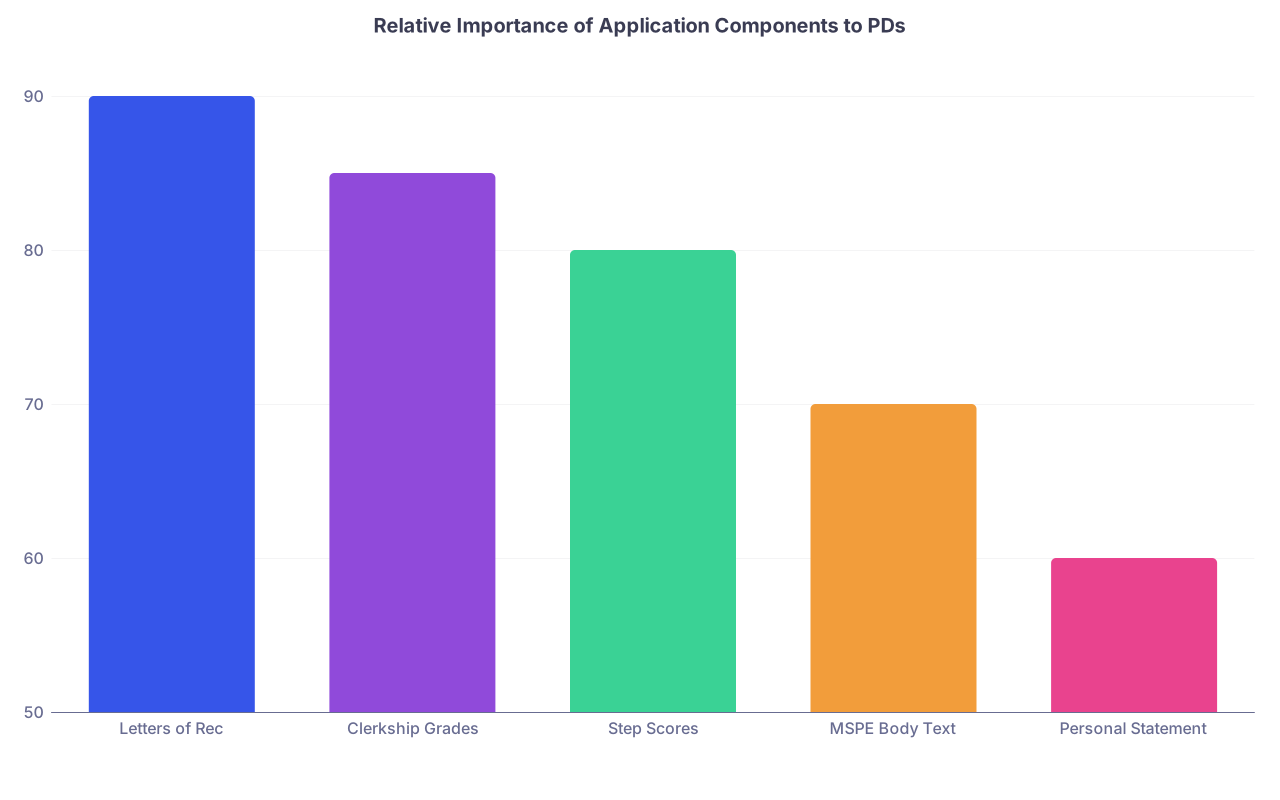
| Category | Value |
|---|---|
| Letters of Rec | 90 |
| Clerkship Grades | 85 |
| Step Scores | 80 |
| MSPE Body Text | 70 |
| Personal Statement | 60 |
This isn’t exact for every specialty, but it captures the general reality:
- The MSPE is context and pattern recognition, not a solo decision-maker.
- PDs skim:
- Class ranking / graphical performance
- Summary paragraph
- Any red flags (professionalism, failures, remediation)
- Rotation narratives in their own specialty
What that means practically:
- If your MSPE is bland but your letters of recommendation are glowing and specific, the letters usually win.
- A single bad clerkship write-up (especially early in third year) can be neutralized by stronger later letters and better performance on sub-I’s.
- PDs care about trajectory. “Improved significantly in her ability to…” later in MS4 carries weight.
Your goal is to overpower a lukewarm institutional document with personal, specific, credible endorsements and evidence of growth.
Immediate Damage Control: What You Can Still Do This Cycle
Assume it’s mid-season. You’re already in the match. Here’s what’s still on the table.
1. Strengthen what PDs trust more than MSPEs: your letters
If you don’t have at least 2 truly strong letters in your chosen specialty, you’re exposed. A strong letter doesn’t say “hardworking and nice.” It says things like:
- “Top 10% of students I’ve worked with in 15 years”
- “Handled intern-level responsibilities on our busy cardiology service”
- “Residents sought her out for help with complex patients”
If your letters are just “fine” and your MSPE is lukewarm, you’ve got a problem. Immediate moves:
- Ask for an additional late-season letter from someone who actually saw you work:
- Your sub-I attending
- Research PI who knows your work ethic and reliability
- A core clerkship director who liked you
- Send a focused email:
“Dr. X, I’m applying to internal medicine this year and would be very grateful if you’d be comfortable writing a strong letter of recommendation speaking to my clinical performance on your service, particularly [specific example].”
If they hesitate or look uneasy, that’s your answer. Do not push. Find someone else.
2. Use your personal statement as a quiet counterbalance
You don’t write “my Dean’s Letter undersells me.” That looks defensive and weird. You do:
- Highlight:
- A difficult rotation where you grew a lot
- A tough piece of feedback you addressed
- Your progression from early 3rd year to now
- Sink in specific examples that contradict “lukewarm” impressions:
- Running a family meeting
- Taking ownership of a complex patient panel
- Leading a QI project that actually changed something on the ward
The subtext: you’re not the vague, generic person your MSPE suggests. You’re concrete, reflective, and engaged.
3. Nail every interview interaction
Once you’re in the room (or on Zoom), you get a short window to overwrite the narrative.
If you suspect the MSPE is dragging you down, assume interviewers have seen it. Don’t bring it up unprompted, but be prepared for versions of:
- “Tell me about a time you struggled on a team.”
- “What’s an area of feedback you’ve worked on in medical school?”
- “How would your residents describe you on the wards?”
If your MSPE hinted at “needed frequent feedback” or “time management issues,” you answer with:
- A clear, non-defensive example (e.g., early in OB you struggled balancing notes and patient care).
- Exactly what feedback you received.
- Specific changes you made.
- How this shows up now (and ideally, backed by later clerkship comments or a letter).
You’re telling a before-and-after story that makes the “lukewarm” language look like outdated data.
Strategic Moves If You’re Early Enough in MS4
If MSPEs haven’t gone out yet or you’re early 4th year and just know your third-year performance was spotty, you have more levers.
1. Get “redeeming” rotations on the record
You want recent, high-responsibility rotations that show:
- Reliability with intern-level tasks
- Strong clinical reasoning
- Initiative and team contribution
That usually means:
- A sub-I in your target specialty
- Another demanding rotation (ICU, ED, wards) where you can shine
- Away rotations (if not already done) at programs that might “adopt” you
Then you do two things:
Verbally tell those attendings you need help counterbalancing your performance earlier in med school. Yes, actually say it. For example:
“I had a slower start to third year and I’m worried that my MSPE will be a bit lukewarm. I’m working hard to show where I am now. If you feel you can, I’d be grateful for a letter that speaks to my current level and growth.”Ask clerkship leadership (sub-I director, site director) if they can ensure strong, specific comments land in your MSPE addendum or in your narrative. Some are willing to “update the story” if you clearly show improvement.
2. Talk to your Dean’s Office if the letter is factually off
You’re not going to get them to rewrite the tone. But you can:
- Correct factual errors (dates, grades, honors).
- Request the inclusion of major achievements that somehow got omitted (major awards, publications, leadership roles).
- Ask if they’ll include a brief comment on trajectory:
“In the latter half of third year and during MS4, [Name] demonstrated significant growth in efficiency and independence.”
Some schools will not budge. Some will, particularly if you present it professionally and not as a personal attack.
Long-Term Framing: If You’re Reapplying or Still in M3
If you’re a reapplicant or a current M3 reading this early (smart), then your job is part rehab, part prevention.
1. Reapplicant advantage: you get to bring data
A lukewarm MSPE on a prior cycle can be softened by:
- A strong gap year (or two) with:
- Hardcore clinical work (hospitalist scribe, RN, MA, triage, etc.)
- Publications, first-author if possible
- Consistent mentorship from someone established who will write a killer letter
- A clear upward trend:
- Step 2 CK improvement vs Step 1 / Step 2 vs old performance
- Additional rotations where you knocked it out of the park (often as a prelim or TY intern)
You’re basically arguing: “Whatever that letter reflects, it’s old data. Here is the newer, stronger version of me—with receipts.”
2. Current M3: stop the bleeding now
If your early clerkships were shaky:
- Meet with a trusted clerkship director or advisor and say the quiet part out loud:
“I’m worried that if I keep being ‘average’ or ‘below expectations,’ my MSPE will limit me. I need specific guidance to turn this around.” - Ask for targeted feedback weekly, not just at the end of rotations.
- Fix the predictable killers:
- Chronically late notes
- Poor follow-through with tasks
- Looking disinterested or disengaged
- Not knowing your patients cold on rounds
These are what generate “lukewarm” language.
The fastest rehab is: everyone on the next rotation saying, “Oh yeah, they’re solid. Very different from what I heard from [previous service].”
How to Quietly Re-Shape Your Narrative Across the Application
You can’t change the MSPE text. But you can choose what story dominates everywhere else.
Here’s the balance you’re aiming for:
| Component | Primary Function |
|---|---|
| MSPE | Institutional summary, trends |
| Letters of Rec | Detailed, personal endorsement |
| Personal Statement | Narrative, reflection |
| ERAS Activities | Concrete evidence, specifics |
| Interview | Real-time confirmation |
1. ERAS experiences: get specific, not fluffy
If your MSPE is vague, your activities need to be concrete and outcome-focused.
Weak:
“Volunteered at student-run clinic. Helped provide care to underserved populations.”
Stronger:
“Led Saturday shift at student-run clinic. Organized triage workflow for 3-provider team, reduced average patient wait time from ~90 to 45 minutes over 3 months.”
You want PDs to see a pattern of:
- Taking initiative
- Actually finishing things you start
- Being trusted by teams to handle real responsibility
2. Letters: curate, don’t just collect
If one of your letters might echo the lukewarm vibe, do not submit it just because it exists.
Prioritize letters that:
- Directly compare you favorably to peers
- Mention specific patient care examples
- Emphasize reliability and team value
Ask letter writers, if appropriate, to explicitly mention your growth over time. That reframes early mediocrity as a solved problem, not a permanent trait.
3. If directly asked about the MSPE… answer cleanly
Occasionally, someone will essentially say:
“I noticed your MSPE comments on [X]. Can you talk about that?”
Your response should:
- Own it:
“Yes, that was accurate at the time. Early in third year I struggled with [specific thing].” - Show learning:
“I realized [what was missing / what I didn’t see].” - Show work:
“Since then I deliberately did [specific actions], and my later evaluations on [rotation/sub-I] reflect that.”
No blaming, no long rant about unfairness, no trashing attendings or the Dean’s office. Program directors smell that a mile away and it kills your chances faster than a bland MSPE.
When a Lukewarm MSPE Actually Matters Less
You might be overestimating the damage if:
- You’re applying to less competitive specialties or community-focused programs.
- Your Step 2 CK is strong and you’ve got:
- Consistent honors in core clerkships (minus one outlier)
- Strong recent letters
- Your MSPE is generic but not negative. No subtle digs, no professionalism concerns, just boring.
There’s a huge difference between:
- An MSPE that quietly says, “Solid, unremarkable student.”
- An MSPE that whispers: “We had some concerns about this person.”
The first you can definitely overcome. The second is harder, but still not impossible with time, growth, and strong real-world performance.
Visualizing Your Action Timeline
If you’re trying to figure out “what to do when,” this might help.
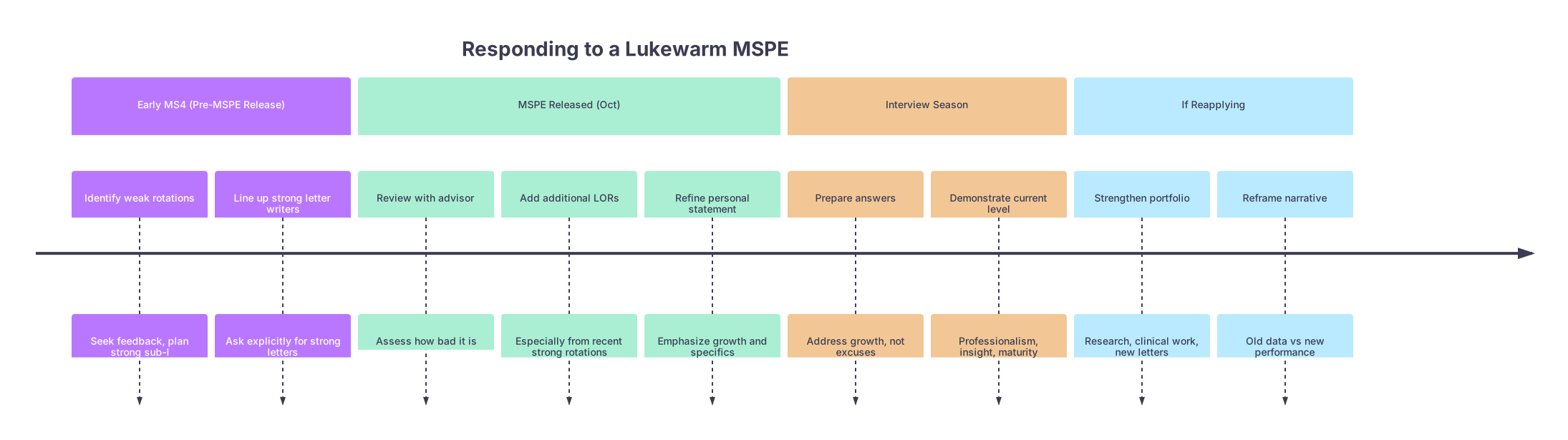
| Period | Event |
|---|---|
| Early MS4 (Pre-MSPE Release) - Identify weak rotations | Seek feedback, plan strong sub-I |
| Early MS4 (Pre-MSPE Release) - Line up strong letter writers | Ask explicitly for strong letters |
| MSPE Released (Oct) - Review with advisor | Assess how bad it is |
| MSPE Released (Oct) - Add additional LORs | Especially from recent strong rotations |
| MSPE Released (Oct) - Refine personal statement | Emphasize growth and specifics |
| Interview Season - Prepare answers | Address growth, not excuses |
| Interview Season - Demonstrate current level | Professionalism, insight, maturity |
| If Reapplying - Strengthen portfolio | Research, clinical work, new letters |
| If Reapplying - Reframe narrative | Old data vs new performance |
FAQ (Exactly 4 Questions)
1. Should I ever mention my lukewarm MSPE directly in my personal statement?
No. Do not call it out explicitly. It anchors the reader to the negative. Instead, use the personal statement to highlight concrete examples of your growth, responsibility, and strengths—especially in the same domains your MSPE undersells. Let your current performance and reflection imply that earlier, weaker impressions are outdated, without putting “lukewarm MSPE” in neon lights.
2. Is it worth asking my Dean to change the tone of my MSPE?
Tone, almost never. Factual corrections, absolutely. You can and should request fixes for incorrect grades, missing honors, wrong dates, or omitted major achievements. You can ask if they’ll include a brief note about improvement over time if you’ve clearly turned things around—but many schools won’t adjust subjective language once finalized. Go in with realistic expectations and focus your energy where you have more control: letters, interviews, and current performance.
3. How much does a single bad clerkship narrative hurt me?
A single bad or lukewarm clerkship, especially early in third year, is survivable if the rest of your record shows a clear upward trend. Program directors know students have off months, bad fits with teams, or early adjustment issues. What worries them is a pattern: multiple clerkships saying the same negative things (poor reliability, attitude issues, persistent difficulty with basics). Your job is to make that one rotation look like the exception, not the rule, by stacking strong later evaluations and letters on top of it.
4. If I think my MSPE really damaged this cycle, should I withdraw and reapply next year?
Usually, no. Withdrawing mid-cycle is drastic and rarely necessary. Most of the damage from a lukewarm MSPE is already baked in once applications are out. You’re better off playing out the cycle, seeing where you land, and then reassessing. If you go unmatched or end up in a prelim year you didn’t want, then you use the next year to build a much stronger portfolio: stellar letters from real-world clinical work, improved scores if possible, and clear evidence that you’ve outgrown whatever that MSPE reflects. Quitting mid-cycle just gives you no data and no plan.
Key takeaways:
- A lukewarm MSPE is a problem, but not a death sentence—letters, recent performance, and your trajectory carry more weight.
- Own any real weaknesses, fix what you can now (strong letters, sharp interviews, specific ERAS entries), and stop wasting energy trying to rewrite an institutional document you don’t control.
- Your job is simple: make the MSPE look like old, incomplete data—and back that up with concrete, current evidence that you’re the resident they actually want.