
The bias against newer and unranked schools is real. You cannot ignore it. You have to outwork it and out-signal it.
If you’re coming from a new MD/DO school, an offshore school, or a U.S. school that doesn’t show up on any shiny ranking lists, you’re playing residency applications on “hard mode.” Not impossible mode. Hard mode.
Here’s the mindset shift: you’re not just applying as “a good applicant.” You’re applying as “a good applicant from a place they’re not sure about yet.” That second clause changes how you have to play the game.
This is the article for you if you’ve heard versions of:
- “Our program has never taken anyone from your school.”
- “We’re still learning about that place.”
- Or the classic: “What’s the clinical training like there?”
Let’s walk through how to answer those doubts without sounding defensive, desperate, or delusional.
1. Understand What Program Directors Worry About
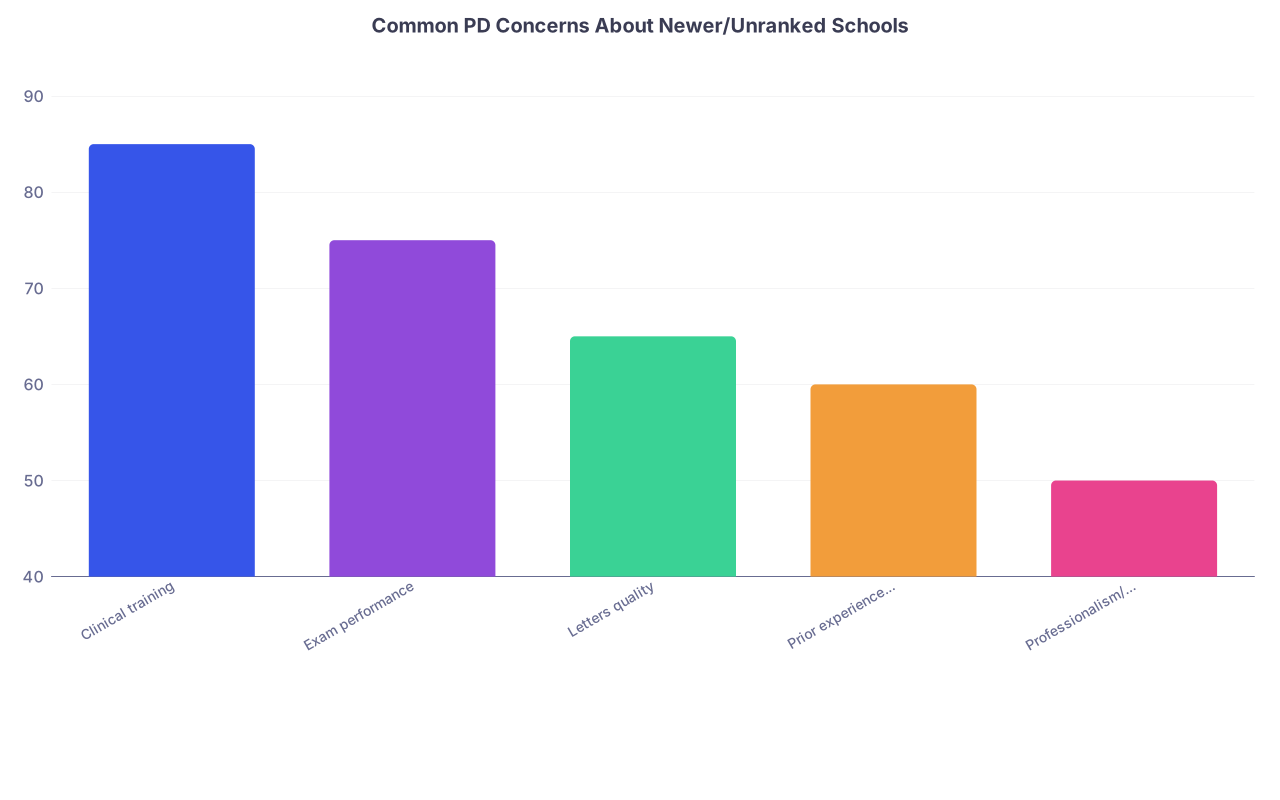
| Category | Value |
|---|---|
| Clinical training | 85 |
| Exam performance | 75 |
| Letters quality | 65 |
| Prior experience with school | 60 |
| Professionalism/support | 50 |
You cannot fix a problem you do not name. So let’s name the actual anxieties program directors have about applicants from newer or unknown schools.
They worry that:
- They can’t predict your exam performance.
- Your clinical training might be uneven or underdeveloped.
- Your letters might be inflated because your faculty are “trying to help the school.”
- They’ve never seen a resident from your school succeed in their program (because no one has matched there yet).
- You may not be used to high-volume or high-acuity environments.
Notice what’s not on that list: “Your school isn’t top 20.” Most PDs outside the ultra-elite programs do not care about U.S. News rankings the way premed Reddit thinks they do. They care about signals. Evidence. Track record.
So your job is to say—without ever saying it directly—“I am a low-risk, high-yield choice, even if my school is an unknown quantity.”
That means you must overperform on the things they do trust:
- Objective metrics (Step/Level, class rank where available)
- Performance on away rotations
- Strength and specificity of letters
- Concrete, relevant experiences (research, QI, leadership)
- How other trusted institutions have ‘vouched’ for you
Let’s walk through how to build that.
2. Turn Your Clinical Rotations Into Proof, Not Just Boxes Checked
If your school is new or unranked, your “core rotations at home hospital” don’t automatically impress anyone. But you can turn clinicals into a massive positive if you’re deliberate.
Strategically choose where you rotate
If you still have flexibility:
- Prioritize teaching hospitals with established residencies in your target specialty.
- Prefer sites where residents from known schools rotate—guilt by association, but in your favor.
- Do at least one away (audition) rotation at a program you’d actually rank highly.
Your hidden advantage: newer schools often rely on distributed clinical sites. That means you can sometimes pick 2–4 different systems. Use that. It lets you collect letters and reputation from multiple places.
If your sites are pre-assigned and not impressive on paper, you compensate by:
- Doing aways at stronger, name-recognizable places in 4th year.
- Doubling down on performance metrics: honors, narrative comments, concrete patient impact stories.
How to actually signal strength on rotations
On every rotation that might produce a letter, you should be doing three things very obviously:
Know the bread-and-butter cold
You want attendings saying, “This student functions at an intern level.” That does not come from dazzling them with zebras. It comes from:- Calling back labs and imaging without prompts.
- Writing clear, concise notes that don’t need rewriting.
- Following through: if you say you’ll check something, you actually do.
Be visibly dependable
You want your name associated with “safe pair of hands.” That’s:- Early in, never late.
- Proactive: “I already looked that up; here’s the summary.”
- Calm when things go sideways.
Make it easy for them to write a specific letter
Near the end of the rotation, say something like:“Dr. Smith, I’m applying to internal medicine this cycle. I’ve really appreciated the feedback you’ve given me. Do you feel you’ve seen enough of my work to write a strong, supportive letter for residency?”
If they hesitate, do not push. Get a different letter. A lukewarm letter from a big-name place is worse than no letter.
3. Use Letters of Recommendation as Your Primary School Translator
Your school’s name won’t carry you. Your letter writers’ names might.
If your badge says “Unknown Med” but your letters say “Academic Chair of Surgery at Major Teaching Hospital,” PDs will read those letters very carefully.
Here’s how to maximize that:
Who should be writing your letters
For most core specialties, your ideal letter mix looks like:
| Specialty Example | Key Letter Types | Priority Level |
|---|---|---|
| Internal Medicine | Home IM faculty, away IM faculty, research mentor | High |
| General Surgery | Sub-I/away surgery faculty, home surgery faculty | Very High |
| Psychiatry | Clinical psych faculty, away psych faculty | High |
| EM | SLOE from EM rotation, second SLOE if possible | Critical |
When you’re from a newer or unranked school, you want at least one letter from:
- A place that has a residency program in your target specialty
- Or a person whose title screams “trust me”: program director, associate PD, department chair, vice chair for education
Your own school’s faculty can write great letters, especially if they’re known in the field. But you want at least one letter that says, “This student succeeded in our environment, not just at their new place.”
What those letters must actually say
Watch for generic fluff. You want:
- Comparison statements: “Among the top 5% of students I’ve worked with in the last 5 years.”
- Concrete behaviors: “I trusted them to run the list on call nights.”
- Endorsement language: “I would be thrilled to have them as a resident in our program.”
If your school is new, the subtext you want in at least one letter is:
“This student is just as strong as the students we get from [well-known schools].”
You cannot write that line for them, but you can give them ammunition. Hand them:
- A short CV
- A 1-page “highlights” document with 3–5 specific clinical moments
- Your personal statement draft
Make it as easy as possible for them to remember concrete things you did.
4. Crush the Objective Signals: Exams, Research, and Class Performance
You don’t get to be “average” on the hard numbers. Not if your school is unknown.
Exam performance: your first firewall
USMLE/COMLEX gives PDs a way to ignore their bias… if you let them.
If your school is newer/unranked, “solid” is not good enough in competitive fields. You’re aiming for:
- Above the specialty’s median Step 2/Level 2 score
- Strong shelf scores if your school reports them
- Passing everything on the first attempt, no drama
If you’ve already taken Step 1/Level 1 and it’s Pass/Fail, then Step/Level 2 becomes your primary number. Treat it as such. Study like your specialty choice depends on it—because for you, it might.
If you already have a mediocre Step 2/Level 2 score, your strategy shifts:
- Avoid the most score-obsessed programs.
- Prioritize places that have taken DO/IMGs or historically value holistic review.
- Lean even harder on aways and standout letters.
Research and scholarly work: optional for some, required for others
If you’re going for derm, ortho, plastics, neurosurgery, ENT, or anything similarly brutal, your new/unranked school status means you really should have something scholarly.
You don’t need 10 first-author publications. You do need evidence that you can think and produce. That might be:
- One or two case reports or case series (yes, these still help if done well)
- A QI project with measurable outcomes (length of stay, readmission rates, etc.)
- A poster at a regional or national conference
- Doing stats/data work for a faculty member at a better-known institution
You’re trying to send one message:
“My intellectual and academic ceiling is not limited by my school’s name.”
And if your school is weak on infrastructure, you may have to cold-email or leverage away rotations to find these projects. It’s annoying. Do it anyway.
5. Rewrite Your Personal Statement and ERAS to Preempt the Bias
Do not whine about your school. Do not apologize for it. Do not overexplain it.
You want to do two things in your written materials:
- Make your trajectory look deliberate, not accidental.
- Quietly demonstrate that your training is rigorous and broad.
How to mention your school (if at all)
You generally don’t need a paragraph about, “As a student from a newer medical school…”
However, if there’s a real story (e.g., you were in the charter class, you helped build systems, you had to rotate at three different hospitals across a state), you can use that as a leadership and adaptability narrative.
The frame is key:
- Bad: “Because my school was new, I didn’t have as many resources.”
- Good: “Being part of a new program meant I was routinely asked to build systems from scratch—creating sign-out templates, standardizing M&M presentations, and mentoring younger classes through brand-new rotations.”
You’re not making excuses. You’re signaling resilience and initiative.
Make your experiences do the heavy lifting
When you list experiences, especially clinical, be specific in ways that reassure PDs about your training:
Instead of:
“Completed internal medicine core at Community Hospital X.”
Write:
“Internal Medicine Core, Community Hospital X – Safety-net hospital with high-acuity, diverse patient population. Managed full panel of patients on teaching service, including decompensated cirrhosis, DKA, septic shock; led daily presentations on ICU transfers and discharge planning.”
You’re translating “unknown site” into “real, intense clinical work.”
6. Use Away Rotations as Your Strongest Signal (If Your Specialty Allows It)

| Step | Description |
|---|---|
| Step 1 | Strong Away Rotation |
| Step 2 | High-Energy Performance |
| Step 3 | Outstanding Letter |
| Step 4 | Program Talks About You at Ranking |
| Step 5 | Word-of-Mouth to Other Programs |
| Step 6 | Proves Your Training Level |
If your specialty uses audition rotations (surgery, EM, ortho, OB/GYN, etc.), this is where you can erase 80% of the doubts about your school in one month.
On an away rotation, you’re not “a student from NewMed.” You’re “that student who crushed it on nights and somehow stayed cheerful at 4 a.m.”
Here’s how to treat an away rotation when your school is unknown:
Pick your sites carefully
Aim for:- Programs that actually match students like you (DOs, IMGs, new schools, etc.)
- Places in the geographic region you want.
- Institutions that other PDs know and respect, even if they’re not Ivy-level.
Show up overprepared
Know the common cases for that specialty. Ask current residents, read the program’s own guidelines if they exist. You don’t need to be brilliant; you need to be reliable and unflappable.Ask for feedback early
Middle of week 2:“Dr. Lee, I really want to make sure I’m meeting expectations. Are there 1–2 things you’d like me to change or focus on for the rest of the rotation?”
Listen. Adjust visibly. People remember that.
- Ask explicitly if they support you
Near the end:“I’ve really enjoyed working with your team and I’m strongly interested in your program. Based on my performance, do you think I’d be a competitive applicant here?”
Their answer tells you how heavily to weight that program on your list and how much to lean on that rotation in your ERAS.
7. Communicate With Programs Without Sounding Defensive
You need to learn how to talk about your school in interviews and emails without sounding like you’re trying to sell a used car.
Interview answer you will get
Some version of: “Tell me about your medical school.”
Bad answer:
“Yeah, it’s newer, so we don’t have the same resources as some older schools, but we’re working on it…” (You just confirmed their bias.)
Better answer:
“My school is relatively new, which has actually meant more direct access to faculty and a lot of flexibility in structuring my training. For example, I was able to rotate at [Hospital A], [Hospital B], and [Hospital C], all of which have strong [specialty] services. Across those sites, I’ve seen high-volume bread-and-butter and a lot of complex pathology, which has made me very comfortable managing sick patients on the wards.”
Short. Confident. Concrete.
When to address it directly in emails
If you’re doing a targeted email (signals, interest emails, post-interview notes), you can briefly reference your school if there’s a strength angle:
- Charter class? Mention building traditions, curriculum feedback, starting organizations.
- Multiple hospitals? Mention adaptability to different systems/EMRs.
- Early responsibility? Mention running codes, cross-covering, etc. (if true).
What you never write: “I hope you won’t hold my school’s newness against me.”
They might be thinking it. You do not say it.
8. Build an Application Story That Makes Sense
Last piece. Programs like patterns they recognize.
Your story should read something like this:
- Came from [New/Unranked School]
- Sought out strong clinical sites and away rotations at [Known Hospitals]
- Excelled there → letters from people PDs trust
- Scored well on exams
- Did relevant projects/experiences in target specialty
- Articulate, grounded reason for choosing specialty and their program
What you are not is: “Random student from unknown school with average numbers and no context.”
If your file makes a PD say, “Honestly, if I covered their med school name, they look like every other strong applicant we like,” you’ve won.
FAQ (Exactly 3)
1. Should I explain “why my school is unranked/new” in my personal statement?
No. Rankings are a premed obsession, not a program director priority. You do not need to educate PDs on why your school doesn’t show up on U.S. News. The only time you explicitly discuss the “newness” is when you can credibly turn it into a strength: you helped build curriculum, created new rotation sites, started organizations, or handled the uncertainty of a new program while still overperforming. Anything that sounds like excuse-making, you cut.
2. If my school isn’t well known, is it better to prioritize away rotations at “big-name” places or at mid-tier programs more likely to rank me?
If you’re from a newer or unranked school, you should lean toward programs that both:
- Actually take students like you (check prior match lists, current residents), and
- Have at least regional name recognition.
A famous name where you’re functionally invisible is useless. A solid, respected regional program where you’re the star student—and they write you a glowing letter—is pure gold. If you can pull off one “reach-name” away and one realistic, high-yield away, that’s ideal.
3. I already have an average Step 2 score and my school is unknown. Is it even worth applying to a competitive specialty?
It depends how “competitive” and how “average.” If you’re talking derm/ortho/plastics with a clearly below-median Step 2 for the field and no serious research, you’re probably lighting money on fire. If you’re talking something like anesthesiology, radiology, or EM at non-elite programs, and the rest of your app is strong—great aways, outstanding letters, clear specialty commitment—you still have a shot. The honest move is to sit down with mentors outside your own school if possible (away rotation attendings, research mentors) and ask for unfiltered feedback. Then build a parallel plan (prelim year, backup specialty) that you’d actually be willing to live with.
Key points to keep in your head:
- You’re not trying to make your school look prestigious; you’re trying to make yourself look low-risk and high-yield through objective signals and trusted voices.
- Away rotations, strong letters from known institutions, and above-average exam performance are your main tools to override “unknown school” bias.
- Never apologize for your school. Translate its realities into proof of resilience, initiative, and real clinical competence.