
The professionalism incident itself is not what sinks most applicants. The cover-up, denial, and sloppy explanation are what do the real damage.
If you’ve had a professionalism issue in medical school and you’re now staring down ERAS, here’s the reality: you are not automatically doomed. But you also do not get to “hope they don’t notice.” They will notice. Your job is to control what that notice means.
Let me walk through how you handle this like an adult, not like a panicked student hoping it disappears.
Step 1: Get Absolutely Clear on What’s in Your Record
Before you strategize, you need to know exactly what programs will see. Vague memories and hallway gossip are useless.
Do this now, not two weeks before ERAS locks.
Request your full record from your school.
Ask in writing (email is fine) for:- Your MSPE (Dean’s Letter) draft if available
- Any professionalism reports, remediation letters, or committee decisions
- Any notation policies (what goes in the MSPE, what stays internal)
Sit down and read every word.
No multitasking. Phone away. Highlighter out. Ask:- How is the incident described?
- What language is used: “professionalism concern,” “formal remediation,” “disciplinary action,” “non-cognitive concern”?
- Is there a pattern implied or clearly documented, or a single event?
Clarify gray areas with the right person.
Usually:- Student affairs dean
- Academic affairs dean
- Sometimes an ombudsperson
Script it if you need to:
“I’m applying to residency this cycle. I want to be completely honest and aligned with how the MSPE describes my professionalism incident. Can you walk me through exactly what’s in my file and what will be sent to programs?”
Ask one very specific question:
“If a PD calls you about me, what would you say about this incident?”
Their answer is your baseline. You are not trying to out-spin them. You are trying to match and slightly outperform them in maturity and insight.
| Incident Type | Typical Risk to Application |
|---|---|
| Single tardiness/write-up | Low |
| Unprofessional email/arguing | Low–Moderate |
| Missed exam/rotation duty | Moderate |
| Lapse in patient confidentiality | Moderate–High |
| Dishonesty/cheating issue | High |
| Boundary/substance issue | High |
If you do not know exactly which box you’re in, you’re flying blind.
Step 2: Classify Your Situation Honestly
You’re in one of three broad categories. The strategy depends on which.
Category A: Minor, Isolated Professionalism Concern
Examples:
- A single written warning for being late repeatedly on one rotation
- Unprofessional email to staff, apologized, documented resolution
- Mild communication concern noted in one clerkship evaluation
Programs see these every year. Annoying but survivable.
If the MSPE mentions it briefly, and it’s clearly resolved, you don’t need a long confessional. You need a consistent, calm, aligned narrative.
Category B: Documented Remediation or Committee Involvement
Examples:
- Required professionalism remediation course
- Formal meeting with professionalism/academic committee
- Notation like “required to repeat rotation due to professionalism concerns”
This category matters. It raises questions:
- Are you coachable?
- Is this fixed, or ongoing?
- Do others still have concerns?
You’ll need to address it directly in at least one written component, and you should actively recruit advocates who can vouch for your subsequent behavior.
Category C: Serious Conduct or Integrity Issues
Examples:
- Cheating or falsifying documentation
- Significant HIPAA violation
- Boundary violation with patients or staff
- Suspension or leave related to conduct
This is the tough group. Not impossible, but you’re swimming upstream.
Here, you must:
- Be absolutely consistent and transparent
- Show extended, verifiable change over time
- Adjust expectations on specialty/competitiveness and number of applications
If you’re in Category C and you’re thinking “maybe I just won’t mention it,” you’re planning professional suicide. Someone will mention it for you.
Step 3: Decide Where and How to Address It in Your Application
You have a few levers:
- Personal statement
- Program-specific secondary questions (if they ask about professionalism/discipline)
- ERAS “adverse actions” / interruptions section
- LoRs + MSPE
- Interview conversations
The key rule:
One clear, honest, concise primary explanation. Then alignment everywhere else.
Personal Statement: When to Use It, When Not To
Use the personal statement if:
- The incident fundamentally shaped your growth and who you are as a physician.
- It’s a major issue (Category B or C) and you need to frame it before the MSPE blindsides them.
Do NOT turn your personal statement into:
- A legal brief
- A self-pity essay
- A blow-by-blow timeline
If you use it, the structure should look something like this:
- Brief, factual acknowledgement.
- Short description of what you got wrong (own your part).
- Specific actions you took to repair and grow.
- Concrete evidence of sustained change.
- How this now makes you a safer, more reliable resident.
If your issue is minor (Category A), you probably do not need to put it in the personal statement at all. Let the MSPE’s small line and maybe a brief ERAS explanation stand.
Step 4: Craft the Actual Explanation (Words Matter)
You need one core paragraph that you can adapt across contexts.
Bad approaches I see over and over:
- Blaming “miscommunication” without owning any behavior
- Over-explaining with irrelevant detail
- Vagueness: “There were some concerns about my professionalism” (what concerns?)
- Overly emotional or defensive tone
You want: direct, concise, accountable.
Here’s a skeleton you can adapt:
- What happened (high level, not gossip-level detail)
- What you did wrong (clearly)
- What you did to fix it
- What’s changed since
Example – moderate incident (chronic lateness / reliability issue):
“During my third-year internal medicine rotation, I received formal feedback and a professionalism citation regarding repeated lateness and delayed completion of documentation. At the time, I was overcommitted and did not communicate clearly with my team, which understandably led to frustration and questions about my reliability. I met with the clerkship director and completed a structured professionalism remediation plan focusing on time management, communication, and ownership of tasks. Since then, I’ve been consistently early to pre-rounds, have had no further professionalism concerns, and my subsequent evaluations specifically note improved reliability and follow-through.”
Notice:
- No excuses
- No blaming the rotation, the chief, the system
- Concrete behavior before and after
For a more serious incident (e.g., academic dishonesty), the tone has to be even more sober:
“Early in my second year, I made a serious error in judgment and was found to have violated the school’s academic integrity policy by altering a small portion of a group assignment before submission without my teammates’ knowledge. I accepted full responsibility and was placed on professionalism remediation, which included a course in ethics, regular meetings with the professionalism dean, and a formal reflection process. There have been no further incidents. Over the past two years, I’ve taken extra care to be transparent in my work and to ask for guidance when I’m uncertain, and my clinical evaluations describe me as dependable and trustworthy. I understand that integrity is non-negotiable in medicine, and this experience fundamentally changed how I approach my responsibilities to patients and colleagues.”
You’re not minimizing. You’re showing that the person who did this is not the same person applying now.
Step 5: Align Your School, Your Writers, and You
A common way applicants get burned: the dean, the letter writers, and the applicant all describe the incident differently.
Program directors hate that. It screams “not honest” or “still in denial.”
You want alignment.
1. Meeting with Student Affairs / Dean
You already asked what they’d say. Now you say:
“I would like to make sure my explanation in ERAS and in interviews matches the MSPE and the school’s perspective. Can I share with you a draft paragraph of how I plan to describe the incident and get your feedback?”
Let them edit it. Accept some wording you don’t love if it keeps you anchored to their official narrative.
2. Talk to Your Letter Writers
Pick letter writers who:
- Know you after the incident.
- Have actually seen you on the wards/clinics.
- Can credibly say, “I trust this person with patients at 2 a.m.”
Have a real conversation:
“I want to be upfront. I had a professionalism issue [briefly state]. It’s in my MSPE. Since then, I have worked hard to address it. You’ve seen me after that point. If you’re comfortable, it would help a lot if you could speak to my professionalism and how I function on the team now.”
You are not asking them to argue with the MSPE. You’re asking them to provide current evidence.
Step 6: Adjust Strategy by Specialty and Competitiveness
You do not apply to dermatology with a major professionalism black mark and then get shocked when interviews are scarce. This is not about fairness; it’s about probabilities.
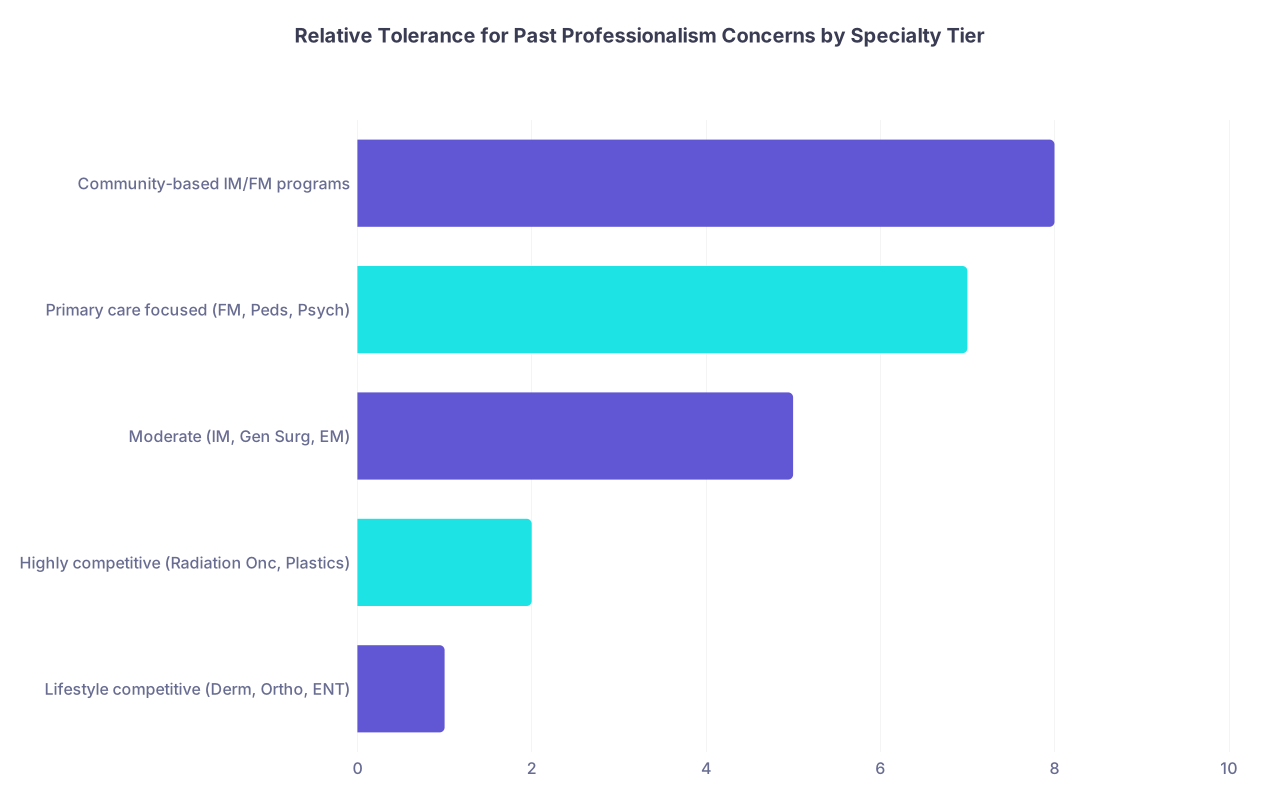
| Category | Value |
|---|---|
| Lifestyle competitive (Derm, Ortho, ENT) | 1 |
| Highly competitive (Radiation Onc, Plastics) | 2 |
| Moderate (IM, Gen Surg, EM) | 5 |
| Primary care focused (FM, Peds, Psych) | 7 |
| Community-based IM/FM programs | 8 |
(10 = most tolerant, 1 = least. This is directional, not an exact science.)
If you have a notable professionalism incident:
- Hyper-competitive, small specialties are higher risk.
- Community programs and primary care–oriented fields are sometimes more open to applicants with a “story,” especially if you show maturity and a strong work record since.
You may need to:
- Apply more broadly geographically
- Increase total number of applications
- De-prioritize brand-name academic programs in favor of solid, mid-tier or community-based ones
- Have a backup specialty if you’re in Category C and aiming high
Step 7: Interview Day – When and How to Talk About It
Two big mistakes here:
- Volunteering a five-minute confession in response to “Tell me about yourself.”
- Offering a vague dodge when they ask directly.
Use this rule:
- If they do not ask, and the incident is already appropriately disclosed in ERAS/MSPE, you don’t need to re-open it every time.
- If they ask explicitly, you answer clearly, briefly, and with the same structure as your written explanation.
Common question formats:
- “I see there was a professionalism concern mentioned in your MSPE. Can you tell me more about that?”
- “Has there ever been a time that your professionalism was questioned?”
- “Is there anything in your record you’re concerned about us seeing?”
Your answer should be 60–90 seconds, not 6 minutes.
Basic spoken template:
“Yes. In my third year, I had a professionalism citation related to [short description, no dramatics]. At that time, I [own your part succinctly]. I went through [remediation/meetings/etc.], which gave me a chance to [what you learned/changed]. Since then, I’ve [specific behavior changes + evidence: ‘had no further concerns raised; in fact, my last two rotations commented positively on my reliability and teamwork’]. I’m glad it was addressed when it was, because it forced me to grow before residency, not during it.”
Then stop talking. Look them in the eye. Let them ask follow-ups if they want.
Do not:
- Blame a specific attending by name.
- Get emotional and teary every time you tell the story.
- Argue that the evaluation was “unfair” for three minutes.
Whether it was fair or not, it exists. You’re being evaluated on how you carry it.
Step 8: Show, Don’t Just Tell – Build a Track Record After the Incident
Words alone don’t fix this. Behavior and documentation do.
You’re trying to build a clear before/after story:
Before: incident, concern, remediation
After: consistent, boring reliability and professionalism
You can do this by:
Crushing your sub-internships / acting internships.
Ask for specific, written feedback on professionalism, teamwork, and communication.Choosing electives where people actually see you work.
Not just research or reading electives. In-person, team-based environments.Getting at least one letter that explicitly says some version of:
“On our busy inpatient service, [Name] was consistently early, responsive to feedback, and a dependable member of the team. I would have no hesitation having them as a resident on our service.”
You want evidence that directly contradicts the fear PDs will have:
“Is this going to be the resident who causes drama, doesn’t show up, or lies to us?”
Step 9: If Your Incident Is Very Serious – Consider Timing and Extra Steps
If you’re in the “suspension/cheating/major boundary” territory, you should at least entertain the question:
“Should I apply this year, or wait a year and build more distance and proof?”
Sometimes waiting is smart. Not always, but more than students want to admit.
You can use extra time to:
- Rack up strong clinical experiences (e.g., as a research fellow with patient contact, a clinical instructor role, etc.)
- Do meaningful work that shows stability and maturity (full-time job, sustained community work, clinical research with strong letters)
- Put more calendar distance between the incident and your application
Also smart: getting an outside mentor’s eyes on your situation.
Not your classmate. Not Reddit.
Someone who has:
- Sat on residency selection committees
- Read hundreds of MSPEs
- Actually taken or rejected applicants with professionalism flags
Sit down (or Zoom) and say, “Here is exactly what happened and what’s in my MSPE. If you were a PD, what would you need to see to feel comfortable ranking me?” Then build toward that.
Step 10: Mental Framing – How You Carry This Matters
You can come into this process with one of two mindsets:
- “I was wronged, and now everything is ruined.”
- “I made a mistake, I learned from it, and now my job is to make it very easy for reasonable people to give me a shot.”
Programs are not looking for perfection. They are looking for:
- Honesty
- Self-awareness
- Trajectory
If your arc is clearly upward, and your explanation is clean, you’ll be surprised how many PDs say, “We’ve all seen students mature. This one seems to have done the work.”
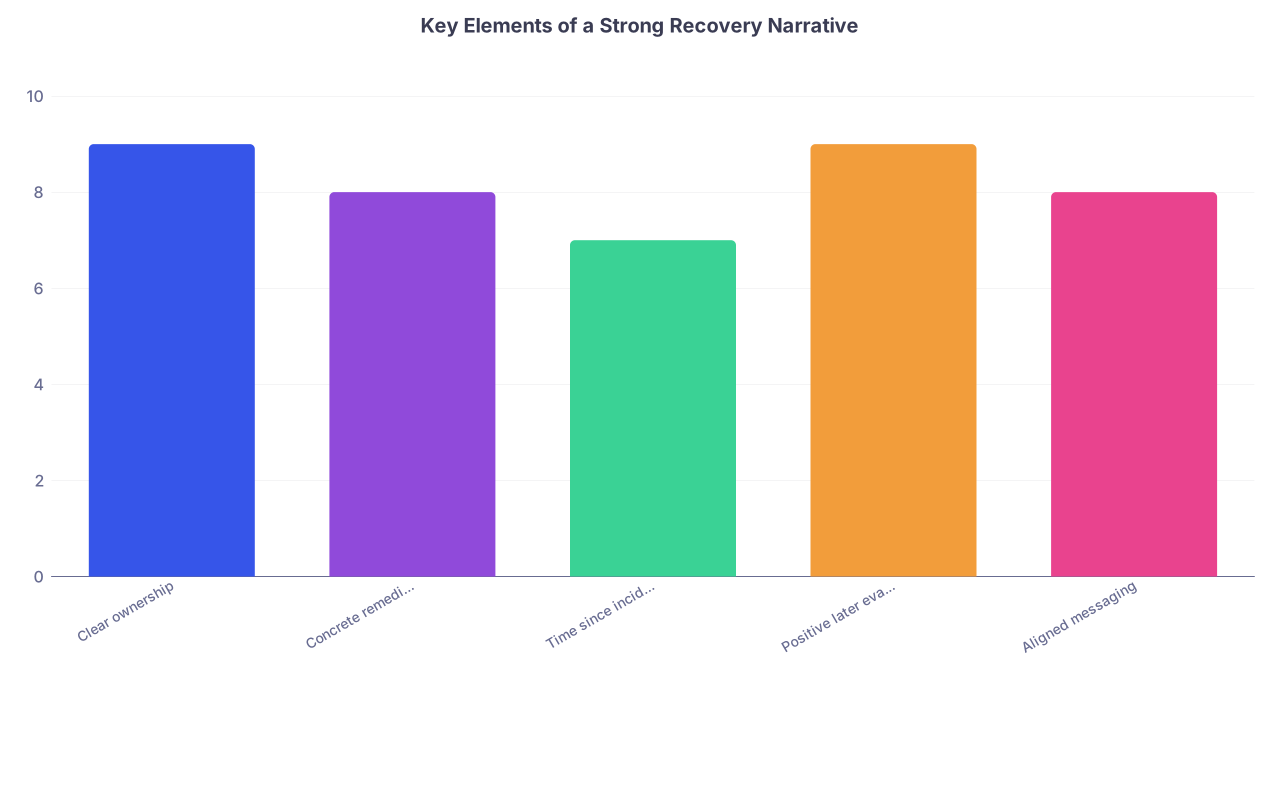
| Category | Value |
|---|---|
| Clear ownership | 9 |
| Concrete remediation steps | 8 |
| Time since incident | 7 |
| Positive later evaluations | 9 |
| Aligned messaging | 8 |

| Step | Description |
|---|---|
| Step 1 | Confirm what is in your record |
| Step 2 | Classify severity |
| Step 3 | Draft aligned explanation |
| Step 4 | Meet with Dean/Student Affairs |
| Step 5 | Brief key letter writers |
| Step 6 | Target programs realistically |
| Step 7 | Prepare interview answers |
| Step 8 | Demonstrate consistent professionalism |
The Bottom Line
Three things matter most if you’ve had a professionalism incident:
- Clarity and alignment – You, your MSPE, and your letter writers all tell the same, honest story. No spin, no contradictions.
- Documented growth – You show concrete changes in your behavior, backed by later evaluations and letters, not just your own narrative.
- Strategic realism – You choose specialties and programs that will actually consider you, and you apply broadly enough to give yourself a real shot.
Handle those three, and a professionalism incident becomes a challenge to manage, not a life sentence.