
You opened your NRMP email. “We are sorry to inform you…” Now it’s a week later, the scramble is over, SOAP didn’t work, the dust has settled—and you’re sitting there with one brutal question:
“Do I try again—and if I do, how do I fix everything?”
This is that article. Not theory. Not “growth mindset” fluff. This is: you did not match, you’re reapplying, and you’re willing to tear your application down to the studs and rebuild it.
Let’s walk through what that actually looks like, piece by piece.
Step 1: Diagnose What Went Wrong (Brutally, Not Vaguely)
Before you “improve” anything, you need a clear autopsy of your cycle. Most reapplicants skip this and just “do more research” or “add a year of something.” That’s how you burn another year and still do not match.
You need a concrete diagnosis across four domains:
- Academic metrics
- Specialty choice and list strategy
- Application quality (ERAS, letters, PS)
- Interview performance / professionalism
Start with data, not feelings.
| Domain | Green (OK) | Yellow (Questionable) | Red (Major Problem) |
|---|---|---|---|
| Scores | Step 2 ≥ specialty median | Step 2 a bit below median | Low Step 2, multiple fails or no score |
| Interviews | 10+ interviews (IM) / 6+ (most others) | 4–9 interviews | 0–3 interviews |
| SOAP Outcome | Got offers | Waitlisted but no offer | No traction at all |
| Application Docs | Faculty-reviewed & praised | Mixed feedback | No one really read or edited them |
If you had:
- 15+ interviews and no rank → likely interview / professionalism / red-flag issue.
- 0–3 interviews → likely stats, school reputation, specialty choice, or app quality problem.
- A handful of interviews but no rank → a mix: borderline metrics plus poor interviews or weak letters.
Here’s what you do in this diagnostic phase:
Get outside opinions—blunt ones.
Send your full ERAS (PDF) to:- A trusted PD or APD who actually knows you.
- A recent grad who matched in your target specialty.
- A dean / advisor who has seen many match outcomes.
Tell them: “I didn’t match and I want blunt feedback on what would worry a PD.”
Ask the specific question most people avoid:
“If you were a PD, and you saw my file in a 300-application pile, would you rank me? Why or why not?”Look at your numbers against reality.
Use NRMP Charting Outcomes and program websites. Stop guessing what’s “competitive.” Programs quietly have minimums, especially for Step 2.Identify true red flags.
Examples:- Step 1 or 2 fail
- Clerkship failures or professionalism write‑ups
- Big unexplained gap in training
- Huge specialty switch without a story
Your restructuring plan will anchor to those findings. Not your feelings about where you “should” have matched.
Step 2: Decide If You’re Changing Specialty, Geography, or Strategy
Reapplicants often face one of three realities:
- Your specialty was too competitive for your profile.
- Your specialty was fine, but your list and materials were weak.
- You were anywhere from fine to strong, but there’s a serious red flag.
Be honest which bucket you’re in.
A. If you were chasing a very competitive specialty
Think: Derm, Ortho, ENT, Plastics, Urology, Optho, certain IM subspecialty pathways.
If your file looked like:
- Average/low Step 2
- Modest research for that field
- No home program support
- Few/no interviews
You have three options:
Stay in the same specialty, but completely overbuild.
Usually means: 1–2 years as a dedicated research fellow in that field, new letters from big names, another Step (if applicable) raised, or a major change in productivity (first-author papers, posters, local reputation).Pivot to a less competitive but still related specialty.
Example: Ortho → PM&R; ENT → IM or FM; Derm → IM or FM with eventual derm interests. This is a sane path for many people.Go for a categorical “doorway” specialty and plan long-term.
Like IM with goal of cards/GI later. Or FM with strong procedural focus.
If you’re on your second failed cycle in the same hyper-competitive field with no major change to your stats, I’ll be blunt: it’s time to change fields or accept a high risk of permanent non-match.
B. If your specialty was realistic but your strategy was bad
This is common with IM, FM, Peds, Psych, Neuro, Path.
Common mistakes I see:
- Applying to 40–60 programs in a non-competitive specialty when you’re not top-tier.
- Overweighting “dream cities” and underapplying to community programs.
- Weakly tailored personal statement and generic letters.
In a rebuild year, you may not need a new degree or a research miracle. You might need:
- 80–120 smartly chosen programs (if IM/FM and you’re not stellar).
- Stronger, specific letters from people who will pick up the phone for you.
- One year of relevant, recent US clinical work with direct PD-visible performance.
C. If you have a true red flag
If you failed a Step, repeated a year, or had a professionalism mark, you’re not done. But you do have to change the plan.
Your job in the restructuring year:
- Prove reliability, professionalism, and consistency over time.
- Put yourself in roles where attendings and supervisors will happily attest to that.
- Make your red flag old news—something you addressed, compensated for, and grew beyond.
Step 3: Pick the Right “Gap Year” Structure (Not All Gaps Are Equal)
“I’ll just do research” is lazy thinking. So is “I’ll just moonlight as a scribe and reapply.” You need a structured year with clear deliverables.
Use this simple decision flow:

| Step | Description |
|---|---|
| Step 1 | Did not match |
| Step 2 | Dedicated study + retake Step/COMLEX |
| Step 3 | US clinical / prelim / TY |
| Step 4 | Research year in target field |
| Step 5 | Clinical job with heavy evals |
| Step 6 | Rebuild profile and reapply |
| Step 7 | Main issue? |
Let’s break the possible paths.
Option 1: Research year
Good for:
- Competitive fields
- Visas where you need academic backing
- People with OK clinical but thin scholarly output
But it only helps if:
- It’s in your target specialty or clearly adjacent.
- You have a mentor who knows how to push projects to completion and will write you an A+ letter.
- You commit to tangible outcomes: X abstracts, Y publications, real presentations.
A “research year” where you move spreadsheets around and get one middle-author paper no one cares about is not enough to rescue a weak app.
Option 2: US clinical year (non-residency but hands-on)
This includes:
- Chief year at home institution (if applicable)
- US-based fellowships that allow direct patient care (e.g., non-ACGME fellowships)
- Long-term observership/externship with real responsibility (hard to find, but exists)
Good for:
- IMGs lacking solid US LORs.
- Anyone with older graduation dates needing “fresh” clinical experience.
- People whose prior cycle had weak or generic letters.
Make sure:
- You’re working with attendings who write specific letters.
- Your role is active: notes, presentations, follow-ups, teaching juniors if possible.
Option 3: Preliminary/TY year or switching into a different categorical
If you matched into a prelim or TY but not categorical, or if you can pick one up this year off-cycle:
- Use it as a 12-month audition.
- Be the resident everyone remembers for the right reasons: no drama, dependable, prepared, pleasant to work with at 3 a.m.
- Get strong letters from program leadership.
Sometimes that prelim/TY PD will call IM or FM programs and basically place you. That’s the leverage you’re looking for.
Option 4: Nontraditional but strategic clinical work
Scribing, urgent-care MA jobs, telehealth assistant roles, etc.
They’re not equal. If you must work, choose roles that:
- Are supervised by physicians who can write letters.
- Involve medical decision-making exposure—not just data entry.
- Allow long-term relationship building (12+ months).
If you’re just trying to pay rent and cannot get anything else, fine. But do not fool yourself: a scribe job isn’t equivalent to a strong US clinical year in PD eyes. It’s supplemental, not central.
Step 4: Repair Your Metrics and Timeline—Like a Project, Not a Vibe
If your Step/COMLEX performance tanked your app, your “restructuring” plan lives or dies on your next exam outcome.
You need a real plan and a timeline. Not “I’ll study harder.”
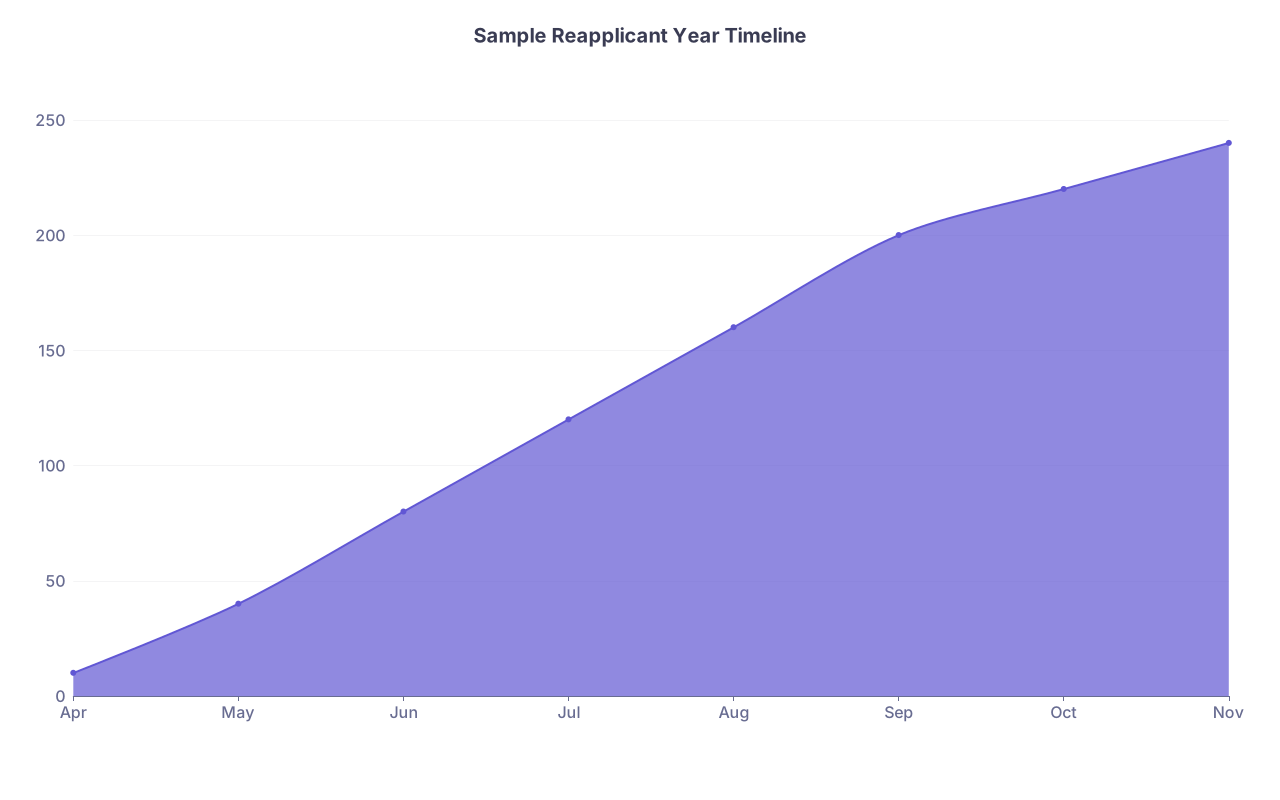
| Category | Value |
|---|---|
| Apr | 10 |
| May | 40 |
| Jun | 80 |
| Jul | 120 |
| Aug | 160 |
| Sep | 200 |
| Oct | 220 |
| Nov | 240 |
Think like this:
- April–May: Dedicated diagnostic period + choose path (research / clinical / both).
- May–August: If retaking Step: intensive prep with weekly NBME/COMSAE, tutoring if needed, strict schedule.
- June–September: Begin research/clinical role, build relationships early, ask what projects you can own.
- September–October: ERAS submission with updated narrative and some visible progress (presentations submitted, QI project launched, etc.).
- Rest of year: Keep stacking achievements and behaviors that PDs value; send updates to programs if meaningful.
If you’re retaking an exam:
- Use a tutor or coach if you’ve failed before. This is not the time for pride.
- Treat it like a job—hours tracked, question blocks logged, weak topics aggressively remediated.
- Do not sit for the retake until your practice scores are consistently in a safe zone. Failing twice is a near-fatal wound for many specialties.
Step 5: Rewrite Your Narrative From Scratch (Not Just Touch Up)
You’re not “reapplying with minor edits.” You’re a different applicant now—or you should be. Your ERAS and personal statement need to reflect that.
A. New personal statement, new spine
Your old statement probably said some version of:
- “I’ve always loved X field.”
- A patient story.
- Buzzwords about teamwork and empathy.
You cannot just reuse that with the word “reapplying” inserted.
You need to:
Acknowledge the reality without making it a pity party.
One line, max:
“After not matching last cycle, I spent the past year in a [research/clinical] role that deepened my commitment to [specialty] and allowed me to strengthen [skills].”Show what you did about it.
Examples:- You took a research year and learned how to manage projects and present at meetings.
- You worked clinically and proved reliability, communication, and independence.
- You improved your exam performance with a disciplined approach.
Make it forward-looking, not apologetic.
No one wants to rank the applicant whose main energy is regret.
B. Work/Activities section: make every entry pull weight
Stop with the vague “I was involved in…” nonsense. PDs skim. You need dent-making bullet points.
Instead of: “Assisted with various research projects in cardiology.”
Write: “Led data collection and analysis for a 200-patient heart failure quality improvement project; abstract accepted to [Conference].”
If you don’t have those outcomes yet, set them up now so they’re pending by the time applications open.
C. New letters—non-negotiable
Old cycle letters are radioactive if you didn’t match. Either they weren’t strong enough, or they’re now outdated.
You want:
- At least 2–3 new letters from the restructuring year.
- Ideally 1 from a PD or APD, and 1–2 from core faculty who can compare you favorably to current residents.
Ask them directly:
“Do you feel you can write me a very strong letter for [specialty] residency?”
If they hedge, thank them and ask someone else.
Step 6: Fix Your Interview Presence and Red-Flag Management
If you had decent interview numbers but no rank, your problem is probably here. I’ve seen this more times than I’d like.
Common issues:
- Long, meandering answers that never actually answer the question.
- Defensive energy around exam failures or gaps.
- Sounding bitter about prior experiences or “unfairness.”
- Coming across as disorganized or scattered about your path.
You fix this the same way you fix Step scores: reps with feedback.
Do 5–10 mock interviews with different people.
- One with someone who doesn’t know you well (for first impression feedback).
- One with a PD/APD if you can get it.
- A few with peers/friends who are blunt.
Have crisp answers to predictable landmines:
- “Why did you not match last cycle?”
- “Tell me about your exam performance.”
- “Why should we believe this cycle will be different?”
Your answer needs to hit three beats:
- Ownership (no blame-shifting).
- Specific actions you took to improve.
- Why you’re now better prepared and more valuable to a program.
Check for subtle attitude problems. Programs smell bitterness. Even if it’s justified. If you talk too much about what “should’ve” happened, or how your school “didn’t support” you, you’re done.
You’re selling yourself as the person they want at 2 a.m. on a bad call night. Calm, non-dramatic, gets it done.
Step 7: Apply Wider, Smarter, and Less Proud
Last piece of the rebuild: your application strategy.
Your past cycle showed you what doesn’t work. Use that.
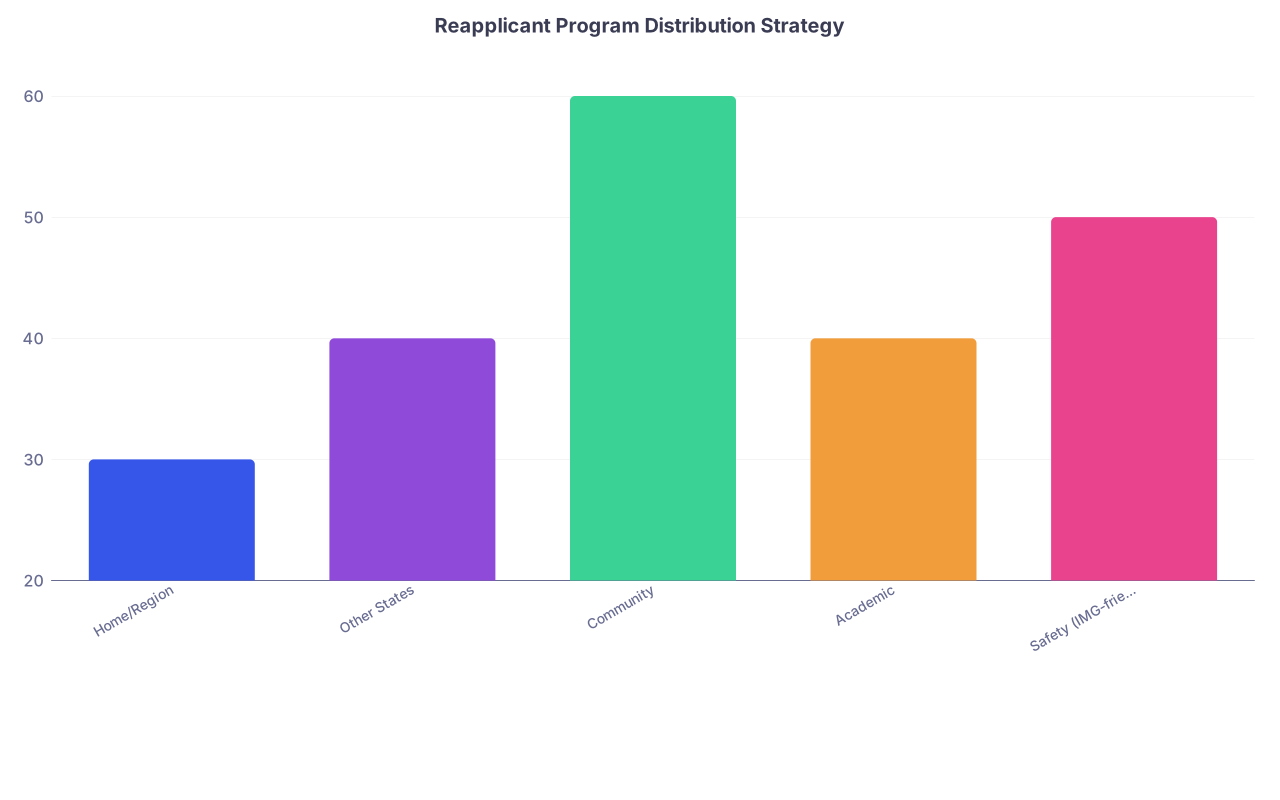
| Category | Value |
|---|---|
| Home/Region | 30 |
| Other States | 40 |
| Community | 60 |
| Academic | 40 |
| Safety (IMG-friendly) | 50 |
Concrete guidelines:
Increase volume—within reason.
If you applied to 40 IM programs and got 2 interviews, you probably need 100+ unless your profile drastically improved.Favor community and mid-tier academic programs.
Especially ones known to take IMGs or reapplicants. Look at current resident lists.Drop vanity programs unless you truly transformed your profile.
Another year of “reach” applications just to soothe your ego is how people end up in a second unmatched cycle.Email programs strategically—but not desperately.
If you have a real connection (did a rotation there, research collaboration, met the PD), send a short, specific email with updated CV and one-paragraph note. Not a life story.Use your mentors to advocate.
A PD or big-name attending sending 3–5 personal emails to programs where they have pull is often more useful than you sending 200 cold messages.
Step 8: Take Care of the Human Being in This Story
You can be strategic and still be wrecked. Not matching feels like public failure, even though it’s not.
Two quick points:
- You need at least one person in your life who knows the whole story and can call you out when you start spiraling or making bad decisions out of shame.
- You also need boundaries. Your whole identity can’t be “reapplicant who didn’t match.” Build in something weekly that reminds you you’re a human being, not a failed test score.
I’ve watched people come back from brutal setbacks and match into solid programs. The pattern is the same: they get honest about what went wrong, then they attack that problem like it’s their job.
Because, for this year, it kind of is.
Key Takeaways
- Do a ruthless, specific diagnosis of why you did not match—scores, specialty choice, application quality, interviews, and any red flags. No vague “I guess I was unlucky.”
- Build a structured reapplicant year that directly targets those weaknesses: research, US clinical, exam repair, and new letters from people who will go to bat for you.
- Rebuild the story: new specialty if needed, new personal statement, new letters, better interview skills, and a wider, smarter application list that prioritizes actual odds over ego.