
The idea that “a low Step score hurts IMGs way more than US grads” is only half true—and the half people quote is outdated.
A low Step score absolutely matters for both groups. The difference is where it matters, how much cushion you have, and what levers you can still pull. Most students get this wrong, then make bad strategic decisions because they’re operating off myths from 2014 SDN posts.
Let’s strip this down to what the data actually shows and what you can still control.
What the Match Data Really Says (Not What People Repeat)
Let’s start with cold numbers, not forum folklore.
The NRMP’s “Charting Outcomes in the Match” has been quietly telling the same story for years:
- US MD seniors with below-average Step 1/2 scores still match at reasonably high rates in less competitive specialties—if the rest of the app is solid.
- IMGs with the same scores match at dramatically lower rates—especially in desirable metro areas, academic programs, and competitive fields.
But here’s the actual catch: people collapse all specialties into one vague “match rate.” That’s useless. You don’t apply to “the Match,” you apply to internal medicine in the Northeast, or FM in the Midwest, or community psych with a visa opportunity.
For example (numbers rounded, but pattern held for years before/after Step 1 went pass/fail):
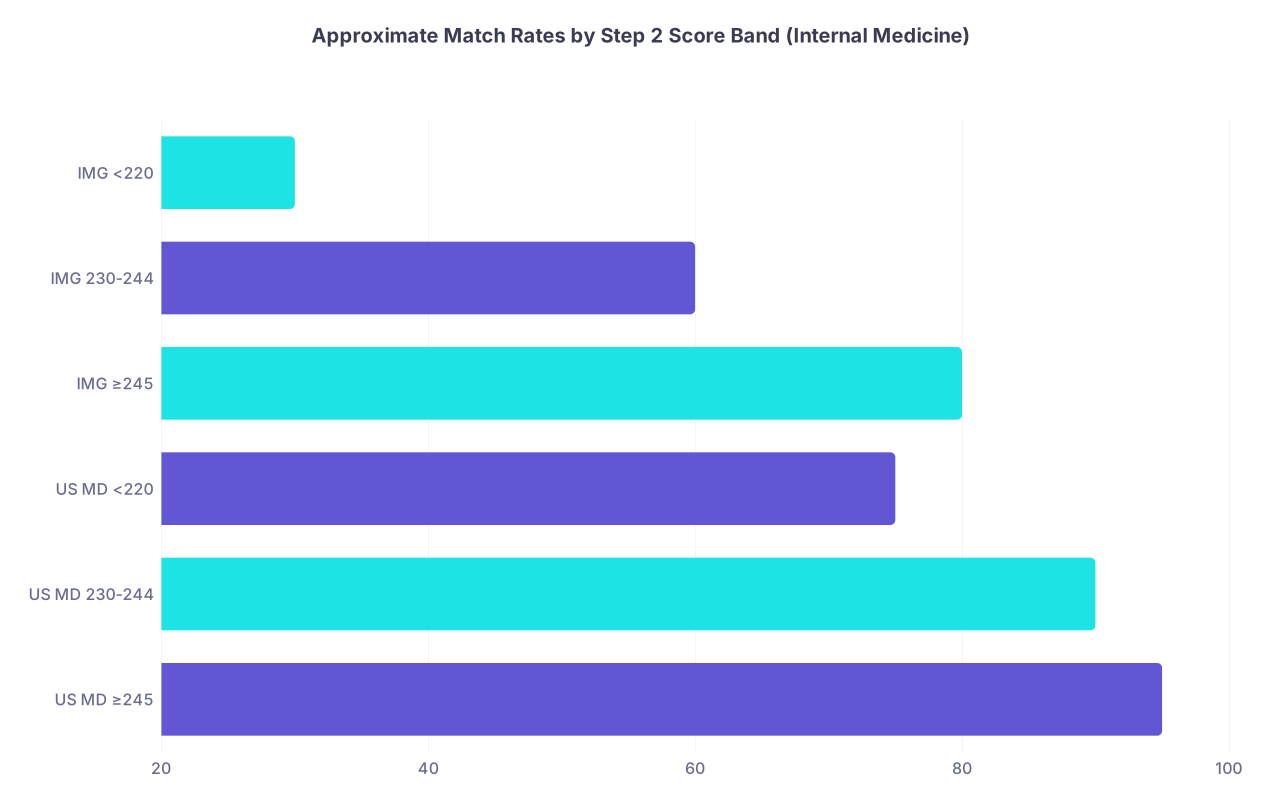
| Category | Value |
|---|---|
| US MD ≥245 | 95 |
| US MD 230-244 | 90 |
| US MD <220 | 75 |
| IMG ≥245 | 80 |
| IMG 230-244 | 60 |
| IMG <220 | 30 |
The message isn’t “US grads are immune” or “IMGs are doomed.” It’s simpler and harsher:
- At the same score, US MDs get more forgiveness.
- That forgiveness is not infinite. A 205 Step 2 as a US MD is still a problem. A 205 as an IMG is nearly catastrophic in most mainstream pathways.
So does a low Step score matter less for US grads than IMGs?
Yes—but not in the magical way people think. It’s a relative advantage, not a force field.
The Real Advantage US Grads Have (Hint: It’s Not Just the Diploma)
The biggest mistake I see IMGs make: they think US grads “get away with” low scores simply because they went to a US school. That’s not how PDs talk about it behind closed doors.
The US grad advantage is layered and structural:
Brand trust and known curriculum
Program directors know what a 215 from State University SOM usually looks like in real life. They’ve trained those grads for years. They know the dean, the rotation sites, the grading rigor. That familiarity makes them more willing to take a chance on an unimpressive score.Built-in US clinical experience
US MD/DO grads automatically have US LORs, observed performance, and standardized narratives (“top 20% of the class,” “outstanding on wards”). A lower Step score is counterbalanced by months of “I saw this person on the floor and they are normal/competent.”Home program bias
This is the dirty little open secret. Many mid-tier US students with unimpressive scores land comfortably in their home program or affiliated sites. That option barely exists for most IMGs. A program will often overlook a low score for “our student” they’ve already worked with.Advising and signaling
I have watched US med schools quietly steer lower-score students toward safer specialties early, adjust their application strategy, and plug them into friendly programs. IMGs usually get generic advice and find out far too late that they aimed too high or too narrow.
So yes, US grads can “survive” lower numbers more often—not because PDs magically stop caring about scores, but because there’s other concrete information to offset them.
If you’re an IMG, that’s the actual problem you’re fighting: lack of other objective data and trust, not just the digits on your score report.
Where a Low Step Score Hurts US Grads Just as Much
Here’s where the myth falls apart. There are clear situations where a low Step score is almost equally toxic for US grads and IMGs.
Competitive specialties
You want derm, ortho, ENT, plastics, integrated vascular, neurosurg, rad onc? A “low” Step (for that field) is a near-fatal blow regardless of passport.
Those programs have more 250+ apps than interview spots. They don’t need to make exceptions. When I’ve heard PDs in those fields talk, it’s brutally simple: “Why fight uphill against our GME committee for a 220 when my inbox is full of 260s?”
In these specialties, a low Step for a US grad and an IMG both often means: re-route your career plan or do a research year and pray.
Hyper-competitive locations and brand-name hospitals
Big-name academic hospitals in coastal cities don’t exist to rescue your trajectory. They have absurdly deep applicant pools. That UCSF IM program isn’t going to say, “Well, this US MD with a 215 seems nice.” They don’t have to.
In those ecosystems, a low score can shut doors for everyone, US or IMG. The difference is that the US MD might still get love from strong community programs. The IMG, much less so.
Red flags + low score = double hit
If you’re a US grad with a low Step score and any of the following:
- failed a clerkship
- took an extra year for non-obvious reasons
- has weak or generic letters
- changed specialties late with no track record
You’re suddenly not that far from IMG-level skepticism. PDs are pattern-recognition machines; they’re asking “Is this person going to struggle with our exams and patient load?” The more smoke they see, the less they care which med school logo is on your diploma.
The Hard Truth for IMGs with Low Step Scores
This is where people usually sugarcoat. I won’t.
If you’re an IMG with a significantly low Step 2 score (for primary care fields, let’s say <220, and especially <210):
- Your chances at university-affiliated categorical positions in competitive regions are extremely low.
- Your chance at visa-sponsoring categorical positions drops further.
- Your realistic path often moves toward:
- community internal medicine in less popular geographic areas
- family medicine in underserved regions
- prelim/TY years as a foot in the door (risky, but sometimes strategic)
That doesn’t mean zero hope. It means you cannot play the same game as a US MD with the same number.
You need to overcompensate in very specific ways:
- US clinical experience that’s real, recent, and strong—ideally 2–3 months of hands-on electives/observerships with letters that say more than “pleasant and punctual.”
- Hyper-targeted applications to programs historically taking IMGs with similar numbers. That means data, not vibes. Look at program rosters. Look at where your seniors matched. Ask explicitly.
- Early, aggressive networking—emailing coordinators and PDs with concise, well-written messages, using any existing connections ruthlessly.
What does not fix a truly low score for IMGs: yet another unpaid observership at a random private clinic with no residents and no reputation.
The Subtle but Real Advantage for US DOs vs IMGs
US DO grads sit in an awkward middle: not quite US MD, not IMG, but the match data is crystal clear—they do much better than IMGs at similar score levels in primary care and many IM programs.
Why? Same theme:
- Known schools and accreditation standards
- Built-in US rotations and letters
- Frequently a home program safety net
So yes, a low Step/COMLEX might “matter less” for a DO than for an IMG. But again, it’s not a free pass. I’ve seen DOs with poor scores and no strong home support go unmatched, while meticulously prepared IMGs with mid-220s match nicely into community IM.
Score is one variable. Status (US MD, DO, IMG) is another. Program fit, geography, visas, research, and—honestly—luck all layer on top.
The “Pass/Fail Step 1” Myth: It Didn’t Save Anyone
A lot of US students quietly believed that Step 1 going pass/fail would reduce the pressure and give them cover if their test performance was mediocre.
Reality: the pressure just moved downstream.
Step 2 CK is now the only standardized, comparable measure in most applications. PDs are not guessing who can pass their in-service exams—they’re staring at that Step 2 number harder than before.
For IMGs, Step 2 became even more make-or-break. If Step 1 is pass/fail and you have no research at a US institution, no US LORs worth reading, and a mediocre Step 2? There’s just nothing for programs to hang their hat on. No reason to take the risk.
So no, the new system didn’t suddenly level the playing field so IMGs and US grads with low scores are judged identically. It intensified the need for one standout number or standout alternative evidence—which US grads are more likely to have.
How to Think About “Low Score” Strategy Without Lying to Yourself
Let me be blunt: too many people with low scores—US and IMG—waste a cycle because they won’t face reality early.
Here’s the right mental model.
First, anchor your expectations honestly:
| Step 2 Range | US MD/DO Interpretation | IMG Interpretation |
|---|---|---|
| ≥250 | Strong to exceptional | Very strong, opens doors |
| 235–249 | Solid/competitive | Good, viable in primary care and some IM |
| 220–234 | Below average but usable | Marginal, needs clear compensating strengths |
| 210–219 | Weak, needs backup plan | Very weak, severely limits options |
| <210 | High risk, must refocus | Nearly disqualifying for most pathways |
This isn’t a law of nature. But it’s how people in selection meetings talk when they filter lists.
Then, use that framework differently depending on who you are:
US MD with 220–230:
You can still match solidly into FM, peds, psych, many IM programs—if you apply broadly, use your home program, and have good narratives/letters. Trying for derm is fantasy.US DO with 220–230:
Primary care and many community IM programs are still realistic. You’ll need broader geography, more applications, and strategic use of DO-friendly programs.IMG with 220–230:
You’re in salvageable but serious territory. You need optimized geography (Midwest, South, non-coastal), real US experience, and absolutely no sloppy errors on your app. You can’t “spray and pray” at all the university programs in New York and hope.
If your score is below those ranges, the question stops being “does it matter less for US grads than IMGs?” and becomes “what’s the most realistic path from here: research year, extra clinical experience, score improvement (if possible), or alternate career plan?”
The Quiet Truth PDs Won’t Tell You on Webinars
I’ve sat in enough selection meetings to know how the conversation really goes. It’s not “we love US grads and hate IMGs.” It’s “given our constraints, how much risk are we willing to accept?”
Low score + IMG + unknown school + visa + little US clinical = high perceived risk.
Low score + US MD + known school + great LOR from their home PD = tolerable risk.
Does a low Step score matter less for US grads? Yes, because they usually come with more reassuring context. Not because PDs are grading on a different numeric scale.
That distinction is everything.
Key Takeaways
- A low Step score absolutely hurts both US grads and IMGs—but US grads usually have built-in buffers: known schools, home programs, US rotations, and trusted letters.
- For IMGs, the same “low” number is much more dangerous because there’s less alternative evidence to offset risk; salvaging it requires ruthless realism and targeted strategy.
- The smart move isn’t pretending scores don’t matter—it’s understanding the relative hit your score causes in your specific situation, then adjusting specialty choice, geography, networking, and application tactics accordingly.