
The couples match will expose every weak point in your relationship and in your applications. That’s the reality.
You’re not just trying to match. You’re trying to match twice, in the same geographic orbit, with programs that might not care that you love each other. They care about rank lists, board scores, and service coverage. Your job is to make it easy for them to say yes to both of you.
I’m going to walk you through what actually works when two strong applicants try to coordinate a couples match without tanking either application or their sanity.
Step 1: Get Brutally Clear on How Strong Each of You Really Is
You can’t coordinate two strong applications if you’re lying to yourselves about how strong they are.
Sit down together and do a cold, unemotional read of both profiles. Not “are we good applicants?” but “how do we stack up in this specialty?”
| Factor | Applicant A | Applicant B |
|---|---|---|
| Step 2 CK | 252 | 241 |
| Specialty | IM | EM |
| Publications | 3 | 1 |
| AOA / Honors | AOA | None |
| Geography ties | Strong | Moderate |
Now, walk through this checklist separately for each of you:
- Step 1 (if you have a score) and Step 2 CK
- Clerkship grades: number of Honors, especially in core rotations for your specialty
- Class rank or AOA/GHHS
- Research: number of abstracts/posters/pubs, and whether they’re in your specialty
- Home program or strong letter writers in your chosen field
- Red flags: leaves of absence, failed exams, professionalism issues
Then force yourselves into one of three buckets by specialty, not overall:
- Solidly above average for that specialty
- Around average for that specialty
- Below average / will need strategy and volume
Do this separately for each person. Not “we.” You and your partner are not one application.
You’ll use this in every decision that follows: which specialties are realistic, how many programs you each need, where you apply, and who needs to flex more on prestige vs location.
Step 2: Understand the One Harsh Truth of the Couples Match
Programs rank individuals. NRMP’s couples algorithm just links your rank lists.
They are not promising to “take the couple or neither.” They’re promising nothing. The algorithm only guarantees this: you will match to the highest pair of ranks on your joint list where both of you get a valid spot.
That means:
- A stellar application can be dragged geographically (and prestige-wise) down by the weaker partner’s realities.
- A slightly weaker application can get surprisingly good results if paired with a very strong partner in a less competitive specialty in a city with lots of programs.
- If both of you are strong but in different levels of competitiveness (e.g., Ortho + FM), the ortho applicant’s world will define the geography, and the FM applicant’s world will define the safety net.
If you don’t internalize this, you’ll create fantasy rank lists and then be stunned on Match Day.
Step 3: Choose Specialties and Geography Like Adults, Not Romantics
The worst couples match plans start with: “We want to be in [single competitive coastal city] or we’ll just scramble later.”
You need a tiered, realistic geography plan that reflects your actual leverage.
A. Map your specialty + geography density
Use a simple rule: you want clusters of programs, not isolated single institutions.
For each of you:
- List: home region, places with family/support, and “we’d be okay there.”
- Then overlay: where does your specialty have 4+ programs within a 1-hour radius?
Big clusters: Boston, NYC, Philly, Chicago, Houston, Dallas, LA, SF Bay, Baltimore/DC, Miami, etc.
Medium clusters: Twin Cities, St. Louis, Denver, Seattle, Pittsburgh, etc.
Now cross-reference: where do both your specialties have decent program density in the same metro or region?
Those are your primary couples target zones.
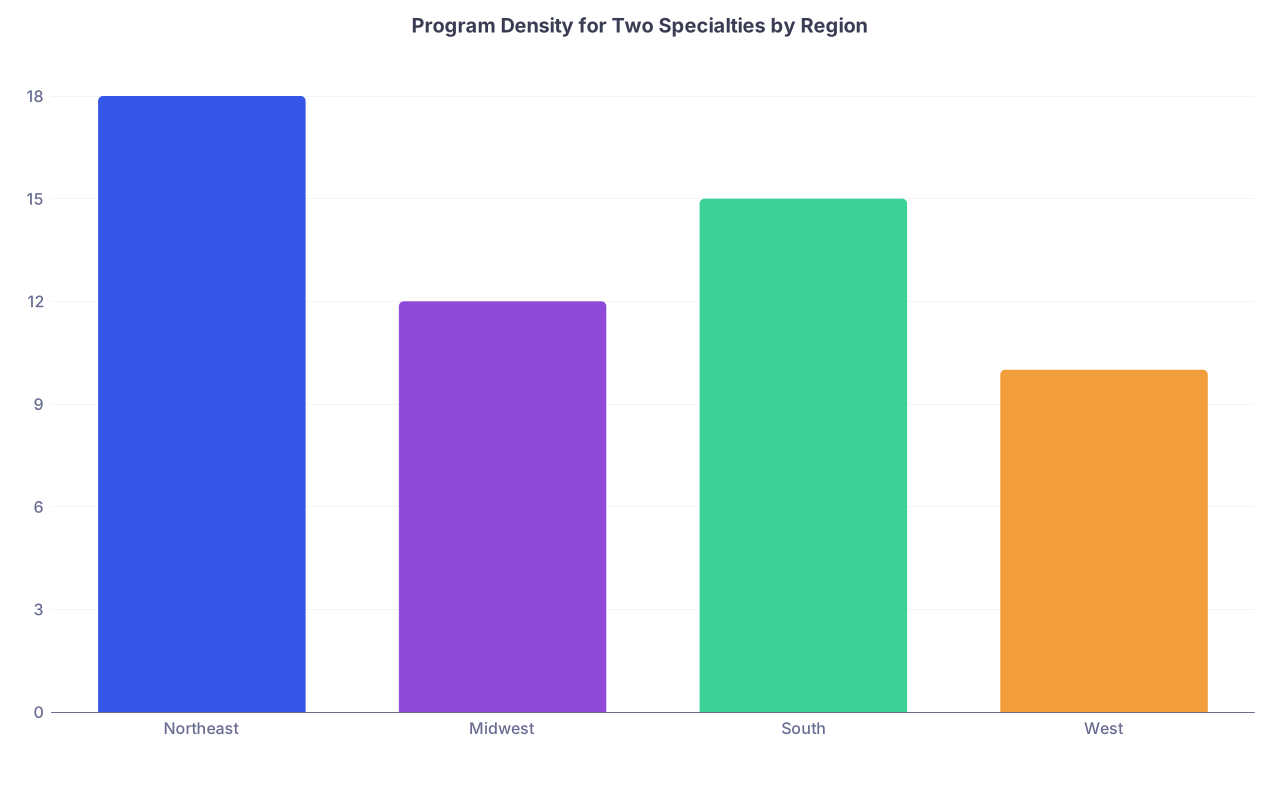
| Category | Value |
|---|---|
| Northeast | 18 |
| Midwest | 12 |
| South | 15 |
| West | 10 |
B. Decide your compromise axis: prestige vs place vs specialty
You don’t get all three. Decide what you’re actually willing to flex:
- Will one of you go down a prestige tier to stay together in a preferred region?
- Will one of you widen to a backup specialty (e.g., categorical IM vs prelim surgery)?
- Are you willing to live 60–90 minutes apart if it means both match solidly?
Write this out explicitly:
- Priority #1: Both match in any reasonable location
- Priority #2: Both match in [broad regions, not single cities]
- Priority #3: Try for dream city if the numbers look safe
This becomes your anchor when anxiety hits and you start dreaming about both matching at the same Top 10 in Manhattan with average scores. Probably not happening.
Step 4: Build Two Strong, Independent Applications First
Do not build a “couples application.” That doesn’t exist.
You build two strong solo applications. Then you coordinate.
For each of you, your ERAS needs to make sense without the relationship:
- Clear specialty commitment in experiences, personal statement, and letters
- No apologizing for the couples match (“I know this is harder…” – cut that line)
- Evidence you’d be a great resident even if single and dropped anywhere in the country
Where do you coordinate?
Personal statements
You do not write a “joint” couples statement. You write your own, strong specialty-focused statement. Then, in one short, direct sentence toward the end:
- “I will be entering the NRMP Match as a couple with my partner, [First Name], who is applying in [Specialty]. We are excited to train in the same region and build a shared life in [broad regions you like].”
That’s it. No romance novel. No trauma-bond story.
Letters
You do not need “couples letters.” You need the right letters for your specialty. The only exception: if you did a joint project and a faculty member knows both of you well, they can briefly mention that you’re couples matching and both strong. But that’s extra, not required.
Experiences
If you’ve done a lot together (same free clinic, same research), that’s fine. Just make sure each of you also has solo things that prove you’re independently strong. Programs worry about couples who look like they move as a single unit and can’t stand on their own.
Step 5: Program Selection: Volume and Strategy for Two Strong Applicants
Here’s where most strong couples screw up: they under-apply because “we’re both competitive.”
Couples match multiplies your risk. You’re strong individually, but the system needs two yeses in the same place.
General rule of thumb (adjust per specialty):
- If solo you’d apply to 30–40 IM programs, as a couple you might need 50–70 each, targeted by geography clusters, not random.
For more competitive fields (Derm, Ortho, ENT, Plastics, Integrated Vascular, etc.) paired with less competitive ones:
- Competitive partner applies as broadly as they would solo (often 60–80+), prioritizing cities with multiple options for the other partner.
- Less competitive partner over-applies but in those cities/regions, even to mid/lower-tier programs they might otherwise skip.
| Specialty Pair | Solo Typical | Couples Target Each |
|---|---|---|
| IM + Peds | 30–40 | 50–70 |
| EM + IM | 40–50 | 60–80 |
| Ortho + FM | 60–80 (Ortho) / 25–30 (FM) | 80–100 (Ortho) / 60–80 (FM) |
| Psych + Neurology | 30–40 | 50–70 |
Do not “save money” at this stage. The cost of reapplying next year is far higher.
Step 6: Emailing Programs About Couples Match – What Actually Works
You’ve probably heard 15 different opinions about emailing programs. Let me simplify it.
You email programs when:
- You both have an interview at the same institution, and you want them to know you’re a couple.
- One of you has an interview and the other doesn’t, at a place that would be an ideal match for both.
You send short, clear emails. Not essays.
When you both have interviews
Each of you sends a brief, individual email to the PC or coordinator:
Subject: Couples Match – [Your Name], [Specialty] Applicant
Dear [Coordinator/Dr. X],
I’m very much looking forward to interviewing with [Program Name] on [date]. I wanted to share that I am participating in the NRMP Couples Match with my partner, [Partner Name], who is interviewing with your [other specialty] program on [date].
We are both very interested in training at [Institution/City] and would be thrilled to match in the same area.
Best regards,
[Name], AAMC ID [#######]
That’s it. You’re connecting the dots, not begging.
When only one of you has an interview
This is trickier. Don’t spam. Use this for top-priority programs in key cities.
Example (from the person without the interview):
Subject: Couples Match – [Your Name], [Specialty] Applicant
Dear [Coordinator/Dr. X],
I am an applicant to your [Specialty] residency program and am participating in the Couples Match with my partner, [Partner Name], who is scheduled to interview with your [other specialty] program on [date].
We are both very interested in training at [Institution/City], and I would be grateful if my application could be reviewed with this in mind.
Thank you for your time and consideration.
Best,
[Name], AAMC ID [#######]
Don’t write this to 50 places. Pick your top 5–10 realistic targets where both could truly see themselves.
Step 7: Coordinating Interview Season Without Melting Down
Here’s what makes or breaks couples: how you handle interviews.
A. Create a living, shared tracker
Not a cute color-coded masterpiece you never update. A ruthless, functional table:
Columns for each:
- Program name
- City/Region
- Specialty
- Interview invite? (Y/N/date)
- Interview date
- Your gut rating (1–10)
- Partner’s opportunities nearby (none / weak / moderate / strong)
- Notes (PD vibe, resident culture, call, etc.)
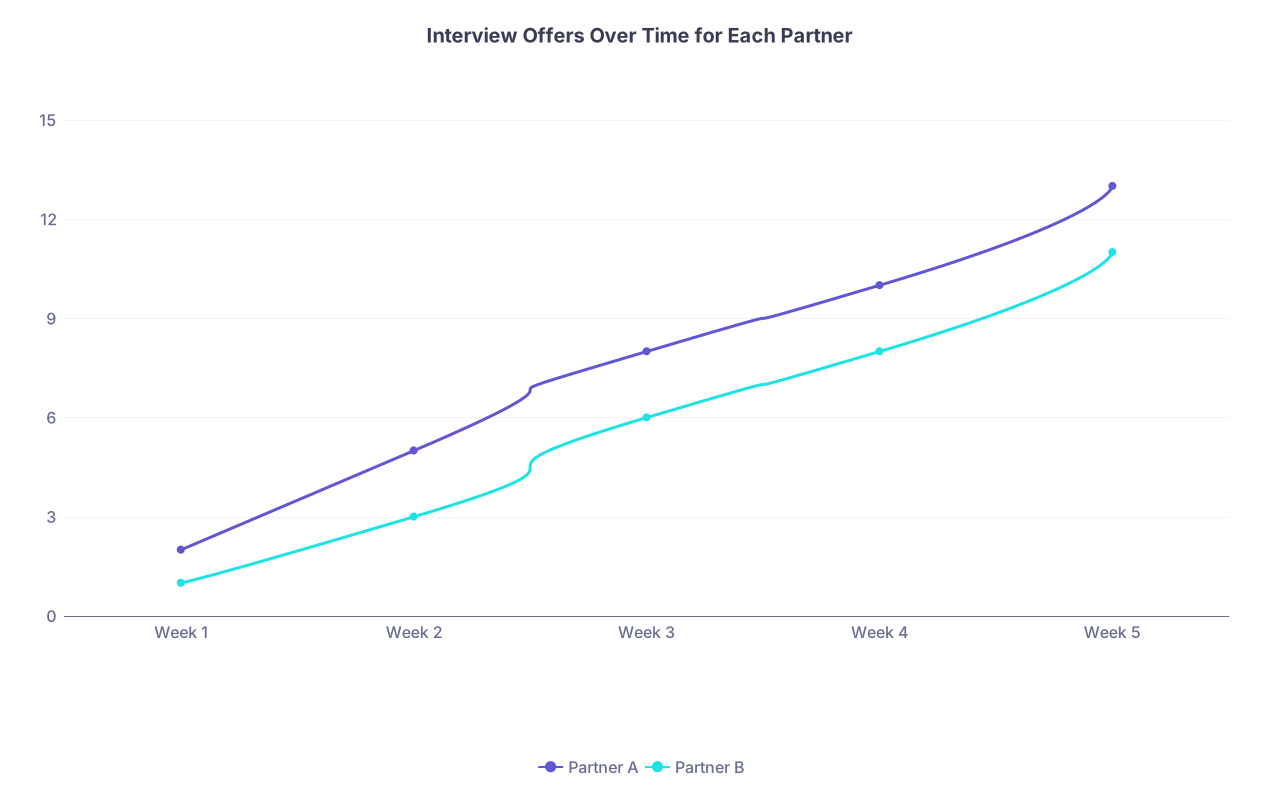
| Category | Partner A | Partner B |
|---|---|---|
| Week 1 | 2 | 1 |
| Week 2 | 5 | 3 |
| Week 3 | 8 | 6 |
| Week 4 | 10 | 8 |
| Week 5 | 13 | 11 |
You should both be able to glance at this and know:
- Where do we both have interviews in the same city?
- Where does one of us have interviews and the other has decent program density?
- Where is one person basically alone (and therefore lower yield for couples goals)?
B. Decide your travel and time-off priorities together
Reality: you might not be able to go to every single interview if schedules clash or money is limited. Prioritize:
- Cities/regions where you both have interviews
- Cities where one has interviews and the other has many potential programs
- Standalone “dream” single-institution cities very carefully. They’re risky.
Do not cancel a solid, realistic city where you both have interviews so you can each go to different “reach” places far apart. That’s couples-match suicide.
Step 8: Building a Joint Rank List Without Destroying Each Other
The joint rank list is where relationships either level up in communication or implode.
Here’s the thing: the system will honor whatever you put down. If you put “top 10 only, same hospital or bust,” it will try. And then you’ll go unmatched.
So you build from the bottom up, not top down.
A. Start with your safety floor
List combinations where one or both of you are at “safety or realistic mid-tier” programs in the same metro area or drivable distance.
You should be able to say: “If we land here, we will be okay. Not thrilled maybe, but okay.”
These go at the bottom of your list. Your safety net.
B. Then layer your realistic favorites
Above that, layer:
- Same hospital, both strong realistic fits
- Same city, different hospitals, both programs realistic
- Same region (1–1.5 hour commute), both programs realistic/solid
C. Then sprinkle the reaches at the top
Your “if the stars align” combos:
- Both at name-brand programs in the same city
- One at a prestige program, one at a solid smaller program nearby
The key: don’t let reach combinations crowd out your realistic ones. If the top 50 of your combinations are fantasy and your real “I’d be fine here” combos start at rank 51, you’re in trouble.

| Step | Description |
|---|---|
| Step 1 | List all interview sites by city |
| Step 2 | Identify overlapping cities/regions |
| Step 3 | Create safety combinations in same area |
| Step 4 | Add realistic same-hospital and same-city combos |
| Step 5 | Add reach combos at top |
| Step 6 | Review bottom of list: is safety acceptable? |
D. Watch your ego and fear
I’ve seen this too often:
- One partner is terrified of being “pulled down” so they insist on ranking only high-tier programs where the other has almost no options.
- The other partner is so scared of not matching that they want to rank any program that even emails them.
You need to say out loud: “Our actual priority is matching together in acceptable programs, not maximizing clout on Instagram.”
If that isn’t true for both of you, that’s not a couples match problem. That’s a relationship problem.
Step 9: How Two Strong Applicants Talk About Being a Couple on Interview Day
Programs are used to couples. You don’t need to be weird about it.
When it comes up (or when you choose to mention it):
- Be factual, not dramatic.
- Emphasize flexibility and independence.
Example script:
“In the interest of transparency, I’m participating in the couples match with my partner, who’s applying in [Specialty]. We’re very excited about the idea of training in the same region, but we’re both ranking programs based on fit and training quality first. We’re being thoughtful about applying primarily to cities with multiple programs so that we have realistic options.”
You’re sending three signals:
- We’re adults who planned this rationally.
- We’re not demanding special treatment.
- If you like me as an individual, you won’t regret it because we’re not fragile.
Bad signal: “We absolutely have to be in the same hospital; we can’t do long distance.” That reads as: high risk for drama and complaints.
Step 10: Protecting Your Relationship During the Process
Last piece, but not soft. If you two implode in December, your applications will suffer.
Some practical rules I’ve seen help:
- One couples-match conversation-free day each week. No rank lists, no “what if we don’t match together.”
- A set time once a week to update the spreadsheet and revisit priorities. Outside that, you don’t renegotiate every anxious thought.
- A rule that each of you gets veto power over one location combo you absolutely cannot live with, but you have to justify it on real grounds (serious family/health reasons, not “I don’t like the vibe of the Midwest”).
You are allowed to want different things. But you don’t get to hide those preferences until February.




One Concrete Thing You Should Do Today
Open a blank document and, separately, each write a brutally honest one-page snapshot of your own application: scores, strengths, weaknesses, and realistic specialty competitiveness.
Then sit down together and compare them. From that side-by-side, pick three metro areas where you both have real program density and agree: “These are our core target zones.”
That single exercise will clean up your thinking more than 10 hours of vague worry.