
You’re on Zoom with a program director. Things are going fine. Then they glance at your ERAS, look back at you, and say it: “I see you took a leave of absence in medical school. Can you tell me about that?”
If your stomach clenched just reading that, this is for you. You took time off in med school—maybe by choice, maybe because life blew up—and now you’re trying to figure out how to present it without looking like a walking red flag.
Let’s walk through exactly how to do that.
Step 1: Understand How PDs Actually See Time Off
Before you script anything, you need to know what you’re up against.
Most program directors do not automatically reject someone for a leave of absence or gap. What they care about is:
- Are you reliable?
- Are you safe?
- Are you going to finish residency without falling apart, disappearing, or failing exams?
Time off is neutral data. It becomes a red flag (or not) based on:
- How you explain it
- What you did with the time
- What your performance looks like before and after
Here’s the unvarnished version of what PDs worry about when they see a gap:
- Uncontrolled mental health or substance issues
- Academic inability that never really resolved
- Major professionalism problems (dishonesty, boundary violations, chronic lateness, conflict with staff)
- Someone who blames everyone else and takes zero responsibility
If your story doesn’t point toward any of those—and you can show a clear “before gap vs after gap” improvement—you’re in safer territory than you probably think.
Step 2: Categorize Your Time Off (So You Can Frame It Correctly)
You can’t present your leave well if you don’t first understand what type it is. Different situations require different framing.

Here’s a simple categorization that actually mirrors how programs think:
| Type of Time Off | PD Risk Level | Main Concern |
|---|---|---|
| Medical / Mental Health | Medium | Stability & follow-up |
| Academic Remediation | Medium-High | Long-term academic ability |
| Family / Caregiving | Low-Medium | Future recurrence, support |
| Research / Degree Program | Low | Commitment, productivity |
| Personal / “Reassessment” | Medium-High | Maturity, direction |
Be brutally honest with yourself which bucket(s) you fall into. If you tell yourself a fantasy version (“It was just to recharge”) and your transcript says “Academic LOA,” your story will crumble under mild questioning.
Step 3: Get Your Documentation Straight Before You Start Writing
Before you touch your personal statement or ERAS explanation, pull everything:
- Official transcript and MSPE (Dean’s Letter)
- Any leaves of absence letters or documentation
- Step/COMLEX score dates
- Course/clerkship evaluations before and after the gap
You need to know:
- How is your leave labeled? “Medical,” “Personal,” “Academic,” “Administrative”?
- Does the MSPE already explain it? If so, how? (Some schools write a full paragraph. Some insert one vague sentence.)
- Do your scores or grades clearly improve after the gap, stay flat, or get worse?
Why this matters: your explanation has to line up with the school’s version and the data. If your MSPE says “medical leave” and you talk only about “family responsibilities,” someone will notice.
Step 4: Decide Where You’re Going to Explain It (And Where You’re Not)
Your time off should not be a mystery, but it also should not dominate your application.
Here are your main venues and how to use them:
- ERAS “Education Interrupted” / “Leave of Absence” section
- Personal statement (only if it’s central to your story)
- Secondary / supplemental questions from programs
- Interviews
ERAS Description: Short, Factual, Neutral
This is not a confession booth. It’s a chart note.
Bad:
“During this time I struggled significantly with my mental health, felt overwhelmed, and had difficulty coping with multiple stressors that led to academic decline…”
Better:
“Took a medical leave of absence from [Month Year] to [Month Year] to address a health condition. Returned to full-time coursework and clinical duties without restrictions and have performed at or above expectations since.”
Or for academic:
“Took an academic leave from [Month Year] to [Month Year] to remediate pre-clinical coursework and strengthen foundational knowledge. Successfully completed all requirements and subsequently passed Step 1 on first attempt and all core clerkships.”
One to two sentences. Factual. No drama.
Personal Statement: Use Only If It’s Actually Pivotal
Ask yourself:
If I removed all mention of my leave from my personal statement, would my narrative fall apart?
If the answer is no, don’t center it there.
Good reasons to include it:
- Your leave completely reshaped your career goals or specialty choice
- You did substantial, relevant work with that time (research, caregiving, public health work)
- You had a major health crisis that now informs how you see patients and practice
If you include it, it gets one compact paragraph, not the whole essay. And that paragraph should move toward growth and future, not a detailed recounting of misery.
Example structure:
- Briefly: what happened (1–2 lines, non-graphic)
- What you did about it (treatment, remediation, taking responsibility)
- What changed afterward (specific improvements)
- How it affects the physician you are becoming (insight, resilience, perspective)
Step 5: Build a Clear, Clean Narrative (The 3-Part Formula)
Here’s the backbone of a non–red flag explanation, regardless of the reason:
- Concise context
- Concrete actions
- Demonstrated stability and improvement
Let’s run through each type of leave with concrete scripts you can adapt.
A. Medical / Mental Health Leave
You don’t owe anyone your diagnosis. Period. You do owe clarity about stability.
Core message: “I had a health issue, I acted responsibly, it’s managed, and my performance since proves it.”
Example (interview answer):
“During my second year I took a medical leave for several months to address a health issue that required focused treatment and recovery. I worked closely with my physicians and the school, returned with clearance, and have remained stable since. Since my return I’ve completed all clinical rotations on time, with strong evaluations and no further leaves. The experience forced me to build better systems for managing stress and asking for help early, which has actually made me more reliable, not less.”
What PDs listen for:
- You sought treatment
- You complied with care
- You’re stable over a realistic time frame (ideally 1–2+ years)
- No ongoing crises or recurrent leaves
B. Academic Remediation / Step Failure + Leave
This one is touchier. You must own it. Dodging responsibility makes you look worse than the failure itself.
Core message: “I underperformed, I changed concrete behaviors, and the proof is in my later scores and clerkships.”
Example (ERAS description):
“Academic leave from [Month Year] to [Month Year] to remediate foundational coursework and restructure my study approach. Worked with learning specialists, adopted spaced-repetition tools, and increased practice question volume. Returned to complete all remaining coursework and clinical rotations successfully.”
Example (interview):
“In M2 I struggled to adapt to the volume and pace of the curriculum and failed [course/Step]. I took an academic leave to remediate content and overhaul my study methods. I met weekly with a learning specialist, switched to active question-based learning, and created a more realistic schedule. After returning, I passed Step 1 on my next attempt and have had solid performance in clinical rotations, including Honors in [X, Y]. The failure was a wake-up call, but I learned to confront problems early and change my systems, not just work longer hours.”
If your performance after the leave is not clearly better, you need to emphasize:
- Specific remediations
- Support systems in place
- How you will continue to monitor and adapt in residency
C. Family / Caregiving Leave
Programs don’t hate this. Their real question: Will this happen again in a way that disrupts residency?
Core message: “This was a time-limited crisis, I stepped up, it resolved or is now stable.”
Example:
“My father had a sudden, life-threatening illness midway through M3. I took a family leave for [X months] to help coordinate his care and support my younger siblings while my mother worked full-time. During that period, we arranged long-term support and rehabilitative care. Once he was stable, I returned to full-time clinical duties and completed all rotations on schedule. This experience clarified how much I value [your specialty], especially continuity and supporting families through serious illness.”
If the situation is ongoing (e.g., disabled child, chronically ill parent), you must show:
- A sustainable support structure exists now
- You’ve already been functioning in full-time clinical roles with those responsibilities
- You’re realistic about residency hours and demands
D. Research / Additional Degree Time
This is generally the least problematic, but it can still raise “Are you actually committed to clinical work?” in some PDs’ minds.
Core message: “I intentionally stepped out to gain skills, I was productive, and now I’m fully back in the clinical lane.”
Example:
“I took a dedicated research year between M3 and M4 in the [X lab] at [Institution]. During that time I worked on [brief topic], resulting in [1 first-author, 2 co-author publications / posters]. The year helped me develop better critical appraisal skills and solidified my interest in academic [specialty]. Once the year ended, I returned to complete my core and sub-internship rotations without delay.”
If you took time and didn’t produce much, don’t inflate. Focus on skills, not imaginary output.
E. “Personal” / Burnout / Directionless Leave
This is the hardest one to frame, because “I was lost and took time off” can sound like “I might do that again when residency gets hard.”
You can still present this without blowing up your chances, but you have to show maturity and clear change.
Core message: “I was overwhelmed / misaligned, I sought help and restructured my life, and my behavior since shows consistency.”
Example:
“Early in my training I struggled with burnout and poor coping strategies. I took a personal leave with the school’s support to work with a therapist, address some longstanding issues, and reassess how I was approaching medicine. During that time I also worked in a structured role as a [scribe, MA, research assistant] to stay connected to clinical care. When I returned, I’d built more sustainable habits and have since completed all rotations and Step 2 without issues. I now have a better understanding of my limits and ask for support early instead of waiting until I’m drowning.”
If nothing structurally changed during your leave, you need to do that work now—before interviews—so the story isn’t hollow.
Step 6: Make Sure Your Story Matches the Data
Words are cheap. Programs compare what you say to what your record shows.
You need alignment between:
- Your stated reason for the leave
- The timing of Step exams
- Clerkship and sub-I evaluations
- Any repeated courses or delays
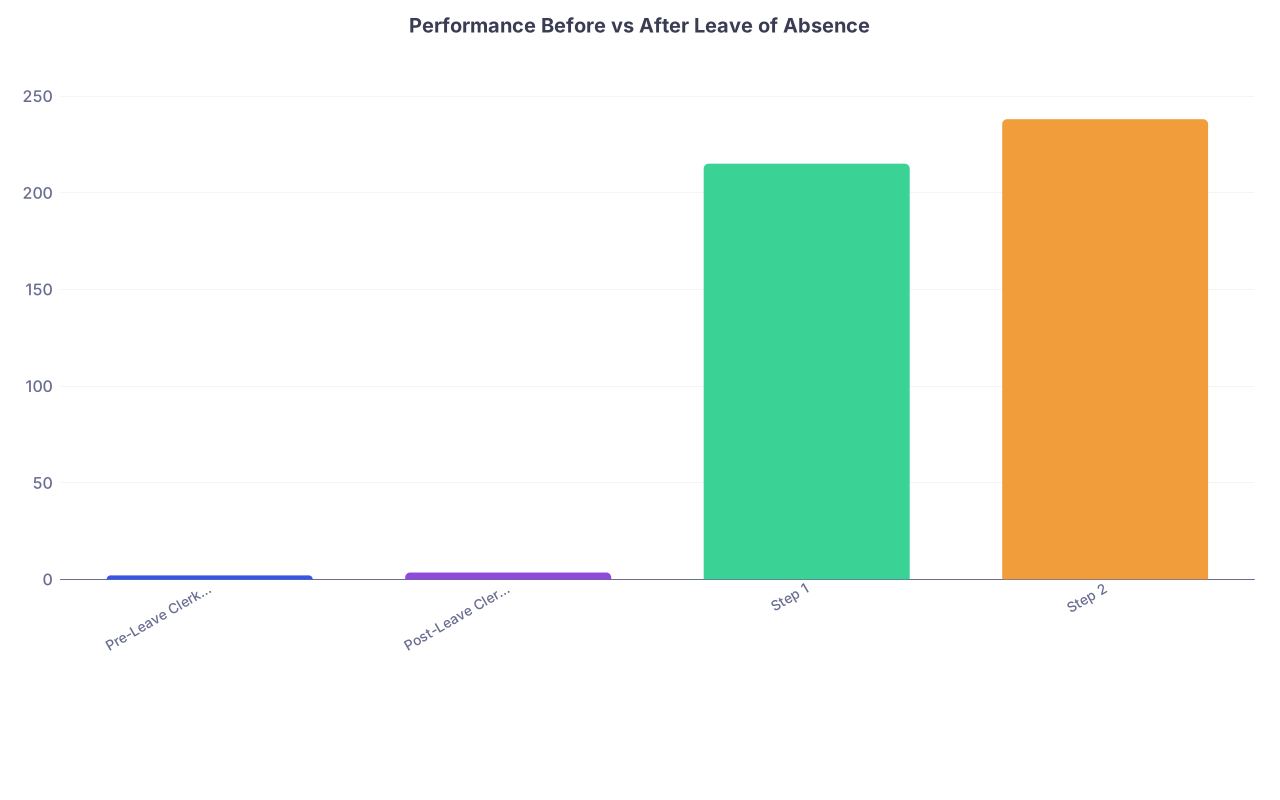
| Category | Value |
|---|---|
| Pre-Leave Clerkships | 2 |
| Post-Leave Clerkships | 3.5 |
| Step 1 | 215 |
| Step 2 | 238 |
If you say, “I really turned things around,” but:
- Pre-leave: mostly Pass
- Post-leave: mostly Pass, no leadership, Step 2 barely higher than Step 1
That’s not “transformed.” It’s “stabilized.” So use language that matches reality.
Example if actual improvement is modest:
“After returning from leave I didn’t suddenly become a top-of-the-class student, but my performance became more consistent and reliable. I passed all remaining coursework and exams on the first attempt and received strong comments on teamwork and communication in my clinical rotations. The biggest change has been in how I manage my work and stress over time, not in a single grade.”
That kind of grounded honesty reads better than selling a miracle that doesn’t exist.
Step 7: Prepare for the Awkward Interview Question—Word for Word
Do not wing this. That’s how people ramble themselves into red flags they didn’t need.
You need a 30–60 second base script you can deliver calmly. Then you can expand if they ask follow-ups.
Structure:
- 1–2 sentences: factual what/when
- 2–3 sentences: what you did / how you addressed it
- 1–2 sentences: what your performance since then shows
Example general template:
“During [year/phase of med school], I took a [medical/academic/personal] leave of absence from [Month Year] to [Month Year]. During that time, I [sought treatment / remediated coursework / cared for a family member / completed research] and worked with my school to create a plan for returning. Since coming back, I’ve [completed X, Y, Z] without additional leaves, and my [Step 2/clerkship evaluations/sub-I performance] reflect that stability. The experience pushed me to [key lesson], which I think ultimately makes me better prepared for residency.”
Practice this out loud until you can say it without sounding defensive or ashamed. Then test it on someone who will be blunt with you (not your nicest friend).
Step 8: Plug the Remaining Holes in Your Application
If you have a leave, you don’t have the luxury of a sloppy rest-of-application. You need compensating strengths.
Highest-yield places to shore things up:
- Letters of recommendation: At least one that explicitly comments on reliability, work ethic, and consistency. Gold standard: “I would have no hesitation having this applicant care for my own family.”
- Sub-I / acting internship: Strong performance there is a huge stabilizer. If you have a leave, your sub-I evals matter more.
- Step 2: For people with academic concerns or a leave related to early struggles, a solid Step 2 (for your specialty) is a big signal that your knowledge base is OK.
Also, do not make your entire application one long therapy session. Time off is part of your story. It’s not your identity as an applicant.
Show:
- Leadership roles
- Teaching or mentoring
- Longitudinal commitments (free clinic, QI projects)
Those say “I can show up, week after week, for something bigger than myself.” PDs like that.
Step 9: Avoid the True Red-Flag Moves
Most people with leaves don’t tank themselves because of the leave itself. They tank themselves with how they handle it.
These are the real killers:
- Lying or wildly minimizing the reason when the MSPE says something else
- Blaming the school, the system, “toxic attendings,” everyone but yourself
- Getting emotional and overly detailed in interviews (e.g., recounting trauma in graphic detail)
- Volunteering extra unrelated negative stories (“Well, and then later I almost failed…” when they didn’t ask)
- Sounding like it all just happened to you, and you made no active choices
You want to project: responsible, self-aware, and forward-looking.
Step 10: If Your Situation Is Really Complex, Get a Human Review
There are some scenarios that are genuinely messy:
- Multiple non-contiguous leaves
- Combination of academic failure + mental health + professionalism notes
- Ongoing major family obligations + marginal scores
In those cases, you’re not just “framing a gap.” You’re managing risk. You should have:
- A brutally honest talk with your Dean’s office
- At least one candid attending mentor in your specialty look over your explanation
- Realistic expectations about tier of programs and possible need for a backup specialty or SOAP plan
I’ve seen applicants with multiple bumps still match—because they got out of denial, owned their story, and applied strategically instead of aspirationally.
Quick Recap: The Three Things You Must Get Right
- Be concise and honest about why you took time off—no drama, no evasiveness, no oversharing.
- Show, with actual performance data and specific actions, that whatever caused the leave has been addressed and you’ve been stable since.
- Practice a clear, calm 30–60 second explanation for interviews that you can deliver without flinching.
You took time off. That’s done. Your job now isn’t to erase it; it’s to prove you’re the kind of person who handles difficulty, learns from it, and still shows up. Programs do not expect perfection. They do expect that.