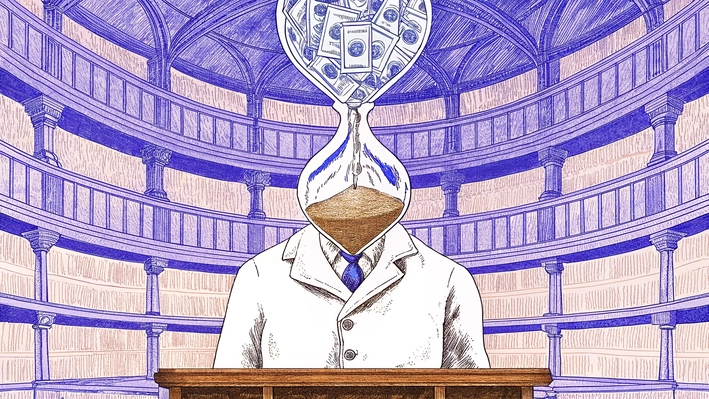
You're three questions deep into a Block 4 cardiovascular vignette. Your heart is already running at about 110 bpm because, you know, USMLE. And then you hear it: the soft squeak of sneakers on industrial carpet. A proctor is moving. Not toward you. Just... moving. Somewhere in the room.
And your brain detonates.
Understanding how your internal state impacts results is key, especially when considering how test day behavior shapes faculty impressions of residents.
Suddenly you're not thinking about the pathogenesis of restrictive cardiomyopathy. You're calculating trajectory. Are they walking your direction? Did you angle your scratch paper correctly? Is your water bottle visible? Does your posture look guilty? Did that weird breathing pattern you did a minute ago register on some invisible infraction log?
Here's the brutal truth: you are misreading the room, and it's costing you points. This is one of the most common, most fixable, and most embarrassing mistakes high-stakes test takers make. You walk in prepared to fight a cognitive battle against a question bank, and instead you spend half your cognitive bandwidth fighting a phantom opponent who is just trying to get through their Tuesday shift.
If you find yourself frequently distracted by external stimuli during exams, learn more about what academic advisors never tell you about exam stress flags.
Stop it. Or more accurately, learn how to stop it. Because this isn't a willpower problem. It's a wiring problem. And wiring can be rewired.
The Danger of the "Surveillance Bias": Why Your Brain Is Lying to You
Let me name the thing so we can kill it: the Surveillance Bias. This is the cognitive error of interpreting routine environmental motion as targeted scrutiny of you specifically.
Your brain does this for evolutionary reasons. Thousands of years ago, the rustle in the tall grass was almost always a threat, and the cost of being wrong (death) was way higher than the cost of being overly alert (lost foraging time). That math made sense on the savanna. It makes zero sense in a Prometric cubicle. But the wiring persists. When your nervous system is flooded with cortisol and adrenaline, your amygdala flags any moving human-shaped object as a potential predator, judge, or authority figure whose gaze could end you.
And here's the trap: proctors are literally designed to be neutral. They walk on a set schedule. They wear the same uniform as the other 40 proctors in the building. They are trained to be invisible. Their training manual probably has a section titled something like "Maintain Non-Engaging Demeanor" or "Avoid Eye Contact with Examinees." They are not watching you. They are managing a room.
But your brain doesn't believe that. Your brain has decided that this person is the hall monitor from 7th grade combined with a TSA agent combined with a strict attending from your surgery rotation. So every time they move, your prefrontal cortex, the part doing the actual test-taking, gets yanked offline to run threat assessment. You're running surveillance software on a thermostat.
The cost is real. Studies on attentional resource theory (and just, you know, the lived experience of every student who's tanked a section because they were too busy being paranoid to think about hyponatremia) show that divided attention degrades performance on complex reasoning tasks. Reading a vignette while half your brain is tracking footsteps is like trying to do anki reviews while someone repeatedly yells your name. The information goes in, but it doesn't stick, and the inferences you draw are junk.
The worst part? The "vibe" you're picking up from the proctor is almost entirely your own projection. That stern look on their face? Resting neutral face. That slow walk toward your row? They're heading to the break room. That pause near your cubicle? They dropped a pen. There is no message. There is no signal. There is just a person doing a job, and your nervous system inventing a narrative where none exists.
Common Behavioral Pitfalls: Red Flags You Are Spiraling
Now let's get specific about what the spiral actually looks like, because you will not always catch yourself in the act. Here are the mistakes I see over and over, in myself and in every panicked test-taker I've ever proctored, tutored, or watched pace a tutorial center.
Mistake #1: The Defensive Posture. You feel footsteps approaching. Your shoulders climb toward your ears. Your typing slows. You angle your monitor slightly, as if a Prometric cubicle wall isn't already blocking 95% of the room. You might even stop clicking entirely until the proctor passes. The result: a 10-second freeze, a broken train of thought, and a vignette you now have to re-read from the top.
Mistake #2: The Compliance Loop. This one's insidious. You catch yourself wondering, "Wait, am I allowed to have my water bottle there?" So you pause the test (oh yes, the timer keeps running) and look up the Prometric rules on the laminated cheat sheet. Then you read another rule. Then you wonder if your posture is "approved." Then you adjust your chair. Then you re-read the rule. You have now entered a loop where the proctor's mere presence has you checking the rulebook instead of doing the test. I've watched students burn 4-5 minutes on a single section this way. That's 4-5 minutes of clinical reasoning, gone. For what? For a rule you already knew.
Mistake #3: The Breath-Hold Tell. This is the canary in the coal mine. If you notice you've been holding your breath every time a proctor enters your peripheral vision, you have already lost your flow state. Your diaphragm is locked, your oxygen saturation is dipping, your sympathetic nervous system is in overdrive, and your ability to integrate information across a 12-line vignette just collapsed. You are now a stress-response machine, not a future physician.
Mistake #4: The Time-Sink Audit. Add it up. Two seconds to glance at the proctor. Three seconds to assess. Four seconds to refocus. That happens six, eight, ten times per block. You just hemorrhaged 60-80 seconds of focused cognition. On a 60-question, 60-minute section, that's a 2% time deficit you didn't plan for. Multiply that across multiple blocks, and you're now rushing through your last 10 questions, the ones most likely to differentiate your score.
These aren't character flaws. They are predictable responses to a hostile-feeling environment when your baseline anxiety is already maxed. The mistake isn't feeling the urge to monitor the proctor. The mistake is letting the urge win. Treat these behaviors like symptoms. When you spot one, you intervene. Immediately. Aggressively. With a protocol.
Protective Protocols: How to Neutralize the Proctor Variable
Okay. So your brain is going to do this dumb thing. What do you do about it? You build a fortress around your attention and treat the proctor as furniture.
Protocol 1: The Five-Second Reset. This is your emergency brake. The moment you catch yourself tracking a proctor, looking up from the screen, or wondering if your behavior is "approved," you do the following in order: (1) Exhale fully through your mouth, force it out like you're blowing out candles. (2) Plant both feet flat on the floor and press down, hard, feeling the contact. (3) Physically move the mouse back over the question stem and click somewhere in the text. (4) Read the last sentence you successfully processed out loud, in a whisper, to yourself. (5) Resume. Total time: under five seconds. This is not meditation. This is a tactical reset of your visual and attentional focus. Do it ten times a block if you need to. Nobody's counting.
Protocol 2: Sensory Masking and Background-Noise Reframing. Reframe the proctor, out loud, in your head, before the test, as part of the room. The same category as the humming fluorescent lights, the buzzing HVAC vent, the squeaky chair. They are environmental. They are static. They are not a signal. During practice tests at home, simulate this by having someone walk past your study space every 10-15 minutes without interacting. Train your nervous system to classify "human moving nearby" as a non-event. The first time you do this, it will feel weird. By the twentieth time, it's background.
Protocol 3: Internal Anchors. Build micro-rituals that force your eyes and hands back to the screen. The most effective one I know: after every single question, before you click "Next," your hand moves to the scratch paper and you write one or two keywords about the answer you just chose. Strokes on paper. Visual contact with your own handwriting. This anchors you in the work and makes it physically harder to slip into proctor-monitoring mode. Other anchors: tap the highlighter tool twice before reading the next stem; rest your non-dominant hand on the desk edge; say the question number under your breath. The point is to create a physical sequence that pulls you back into the test every 90 seconds.
Protocol 4: Pre-Test Briefing. Here's something almost nobody does. At check-in, while the proctor is scanning your ID and taking your photo, you say one thing: "I'm going to be deep in the test, so I probably won't make eye contact." That's it. You've humanized the proctor. You've given them a script. And, more importantly, you've pre-committed to the social contract: I am here to take the test, you are here to run the room, and we are not going to interact. This kills about 60% of the "stranger danger" tension that builds up over four hours of silence. Some proctors will nod. Some will say "happens all the time." Either way, the dynamic shifts from adversarial to procedural before you even sit down.
Protocol 5: Permission Slips. Write yourself a permission slip on your scratch paper during the tutorial: "It is fine to take up space. It is fine to look focused. It is fine to breathe loudly. Nobody is logging my behavior." This sounds ridiculous. It works. Test anxiety is often the fear of being seen doing the wrong thing. Explicitly granting yourself permission collapses that fear in about 30 seconds.

Summary: Don't Let Your Nervous System Sabotage Your Exam
Your goal in that room is the score. Not the comfort. Not the social dynamic. Not proving to the proctor that you're a serious candidate. The score. Everything else is noise, and noise is the enemy of clinical reasoning.
Let's burn this into your brain before you walk into the testing center:
- The proctor is not your opponent. They are furniture with a pulse. Treat them with the same attention you give the ceiling tiles.
- Their "severity" is your projection. I promise you. The stern look is just their face. The slow walk is just their knees.
- Your cognitive bandwidth is a finite, precious resource, and every second you spend monitoring the monitor is a second you stole from your future patients' diagnoses. Spend it on the vignette. Not the room.
- Walk in as an observer of the environment, not a subject of it. You are running an experiment on a question bank. The room is the lab. The proctor is the janitor.
If you do nothing else with this advice, do this: the next time you sit down for a practice block, set a timer for every 8 minutes and ask yourself, "Where were my eyes?" If the answer is "on the room" more than once, you have a leak. Plug it. The proctor isn't going to steal your score. Your hypervigilance will. Don't let a squeaky sneaker cost you a question on cushing's syndrome. You didn't grind through First Aid to lose points to a pair of New Balances.
Take a breath. Plant your feet. Read the stem. That's the whole game.