
It’s 10:47 p.m. Your kid finally stopped coughing long enough to fall asleep. There’s a half-eaten dinosaur nugget on the table, a sink full of bottles, and your exam is in 36 hours. Your friends without kids are texting about “one more Anki pass.” You’re just trying not to cry into your cold coffee.
This is where you actually live: in between UWorld blocks and daycare pick-up. Between path lectures and bedtime meltdowns. And exam stress hits different when you’re also responsible for a human being who does not care that your shelf is on Friday.
Let’s be blunt: the system isn’t built for you. It’s built for a hypothetical 24-year-old with no kids, no caregiving responsibilities, and no one waking them up at 3 a.m. because of a bad dream. So if you try to study the way they do, you’ll burn out hard.
Here’s how to manage exam stress when you’re a medical student and also caring for children—based on what actually works in the real world, not what some perfect planner on Instagram says.
Step 1: Accept that your exam strategy is not going to look “normal”
You cannot out-willpower your way into having no children for the next four weeks. The stress multiplies when you fight that reality instead of building around it.
So you start by resetting expectations—fast.
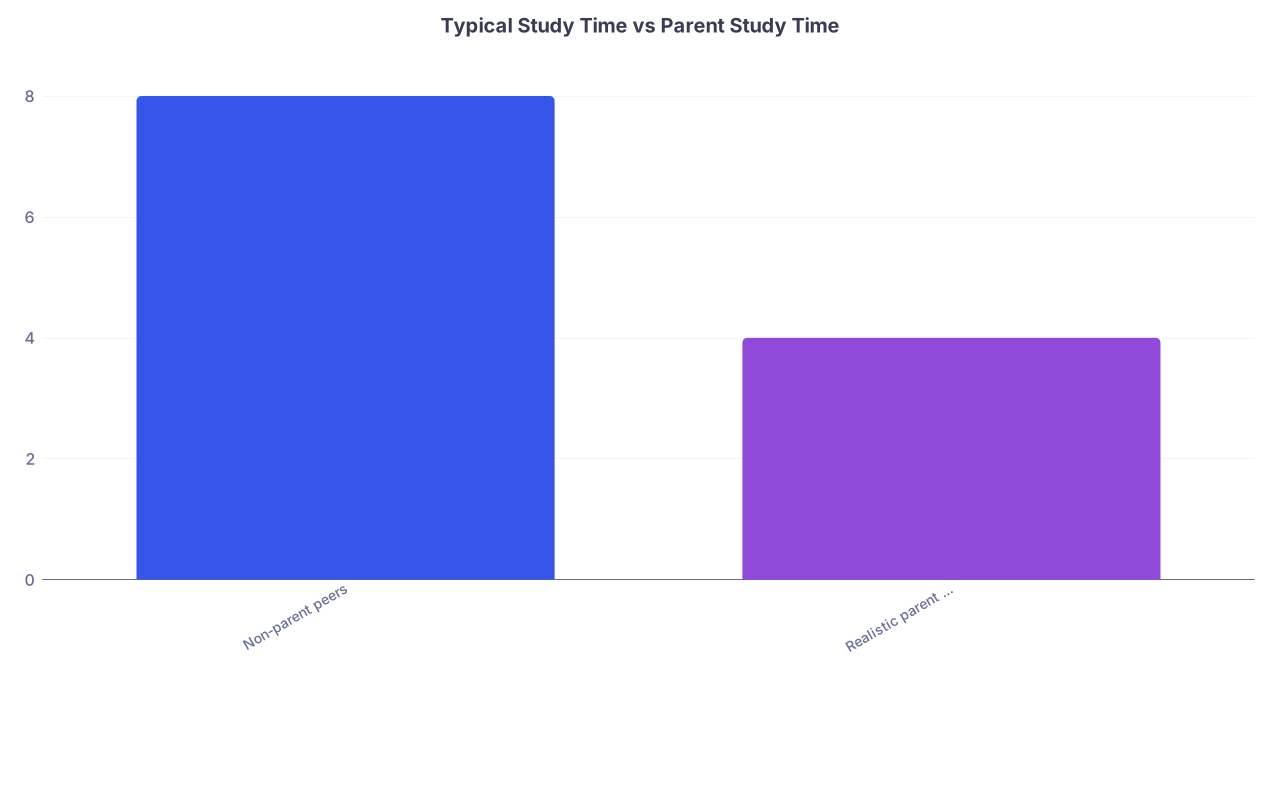
| Category | Value |
|---|---|
| Non-parent peers | 8 |
| Realistic parent schedule | 4 |
Most of your classmates can routinely grind 8–10 hours a day in the week before an exam. You probably can’t. On many days, 3–5 efficient hours is a win. The stress comes when you measure yourself against the wrong yardstick.
You shift from:
- “How many hours did I study?”
to - “How much targeted, high-yield studying did I cram into the pockets I actually had?”
That mindset shift matters, because:
- It reduces that panicky “I’m always behind” soundtrack.
- It gives you permission to protect family time without feeling like you’re self-sabotaging.
- It forces you to choose ruthlessly what actually moves your score.
You’re no longer trying to be max-prepared. You’re aiming for “prepared enough to pass/score well, without blowing up my kid or my sanity.” That’s a legitimate target.
Step 2: Build a “bare-minimum survival plan” first, then add on
When you’re caring for kids, your exam prep needs two levels: survival and ideal.
Survival = what you do if everything goes sideways (sick kid, no childcare, you get sick, partner on call).
Ideal = what you do on the rare golden days when the universe doesn’t mess with you.
Build the survival plan first.
Your survival plan should answer: “If this week explodes, what minimum must happen so I don’t fail?”
For a pre-clinical block exam, that might be:
- 40–60 highest-yield Anki cards/day
- 20–40 mixed practice questions/day
- 30–60 minutes skimming class objectives / summary sheets
For a shelf:
- 20–40 UWorld questions/day (or every other day if you’re already deep)
- 15–30 minutes reviewing incorrects
- One quick pass over a high-yield outline (like an IM cheat sheet) every 2–3 days
Then ideal days just stack on top. Maybe you add:
- Another 20–40 questions
- A longer block of review
- 1–2 hours of deeper reading
But your stress drops when you know: “Even with chaos, if I protect this base level, I’m okay.”
Write it down somewhere visible. Not in your head—on paper or in your phone.
Step 3: Use “micro-blocks” instead of chasing long study marathons
You probably don’t have 4-hour uninterrupted study blocks. You have this:
- 17 minutes while your toddler is glued to Bluey
- 25 minutes during nap (if the nap even happens)
- 40 minutes after bedtime before your own brain collapses
- 10 minutes in the car before daycare pick-up
So stop pretending you’re going to sit and “really focus later” for hours. You won’t. The kids won’t let you. Your brain won’t either.
You lean into micro-blocks:
- 10–20 minute units of focused work
- One very specific objective per block:
- “Do 10 UWorld questions”
- “Review 30 Anki cards”
- “Read 3 pages of this summary”
You’ll be shocked what you can stack if you stop waiting for “real time.”
I’ve watched residents with kids survive Step 3 by doing:
- 10 questions while the baby finishes a bottle
- 15 cards sitting in the clinic hallway between patients
- 1 short video after bedtime
They were never relaxed. But they weren’t spinning in stress because the plan matched their life.
Step 4: Pre-negotiate exam week with whoever you live with
The week before a big exam is not a normal week. You cannot just “see how it goes” and hope your partner/family magically senses you need help.
You have one grown-up conversation early:
“Okay. My shelf is next Friday. I need:
- Two solid 2–3 hour blocks this week without kid duty.
- One lighter evening where I can crash at 9.
- Coverage the night before exam if the kid wakes up.”
Then you trade:
“I’ll take mornings with the kids all weekend if you can cover 6–9 p.m. two nights this week.”
Or
“I can handle daycare drop-off and pick-up, but I need Saturday afternoon to be mine.”
If you’re solo parenting, the conversation is with yourself and whoever can be recruited:
- Can a grandparent do a sleepover one night?
- Can a friend take your kid to the park for 2 hours?
- Can you pay a sitter for just exam-eve, even if you never do otherwise?
Do not wait until you’re already drowning to ask.
Here’s the pattern I’ve seen: parents who schedule childcare like they schedule exams are stressed… but functioning. Parents who “don’t want to bother anyone” are usually in quiet meltdown the night before.
Step 5: Decide in advance what you’re allowed to drop
Exam stress goes through the roof when you’re trying to keep all the non-essential plates spinning too. So you pick your casualties. On purpose.
Typical droppable things during exam week:
- House perfectly clean? Gone.
- Home-cooked elaborate meals? Not this week.
- Every school assignment done perfectly? No. Sometimes “good enough for pass” is fine.
- Social obligations? You skip the birthday dinner. They’ll live.
You literally say to yourself: “This week, my priorities are:
- Keep my kid alive and basically emotionally intact.
- Protect my minimum study targets.
- Sleep enough to string thoughts together.
Everything else is optional.”
People hate this because it feels like admitting failure. It’s not. It’s triage. And you’re in medicine—you know how triage works.
Step 6: Use kid-time strategically to lower your stress, not increase it
A big source of stress is the mental whiplash: one minute you’re reading about septic shock, the next you’re scraping Play-Doh off the wall.
You’re tempted to spend kid-time resenting that you’re not studying. That resentment is where the anxiety really grows.
Flip the script: treat some kid-time as active recovery for your brain.
When you’re with your child and not studying, you do it on purpose:
- Put the phone in another room for 20 minutes
- Actually watch them at the park
- Sit on the floor and do the puzzle
That focused presence does two things:
- Calms your nervous system (actual stress reduction, not fake scrolling “rest”)
- Kills the guilt that eats at you when you half-study/half-parent and do both badly
Is it perfect mindful parenting? No. Sometimes you’re still reviewing drug side effects while they watch cartoons. Fine. But carve out a few windows where you let your brain unclench.
Step 7: Tactical stress management you can use in 60 seconds
You do not have time for hour-long meditations and perfect morning routines. You need quick tools you can use while a toddler is yelling your name.
Here are three I’ve seen work for parents in training:
- 4–6 Breathing
Breathe in for 4 seconds, out for 6. Do 5–10 cycles.
Use it:
- Before you open your exam
- When your kid just spilled juice on your laptop
- When you feel your chest tighten reading your classmates’ “I did 200 questions today” messages
“Next 20 minutes” rule
When your brain starts spinning on “I’m not ready, I’m going to fail, this is impossible,” you cut it off with:
“What’s the best use of my next 20 minutes?”
Then you execute that, nothing else. This keeps you from catastrophizing your entire future career while you’re supposed to be learning pleural effusions.Micro-closure
Between parent-mode and study-mode, add a 30-second reset:
- Stand up, shake out your hands
- Say out loud: “Parent time is over for now. Study time starts.”
Or the reverse.
Sounds silly. It works. It keeps your brain from dragging the last meltdown or the last missed question into the next block.
Step 8: Handle the guilt—because that’s half your stress
There’s the exam stress. Then there’s the layer on top: “I’m a bad parent” or “I’m a bad student.” That second layer is what really drains you.
So you get honest with it.
You’re going to miss things. A bedtime story here, a school event there. You’ll also miss review blocks because your kid was sick. You do not fix this by pretending you can be 100% in both roles 100% of the time.
You pick your “non-negotiables” as a parent and a student.
For example:
Non-negotiable parent things:
- One bedtime story on most nights, even if it’s 3 minutes
- A hug and 1–2 minutes of actual eye contact at drop-off
- Being physically present for dinner, even if you eat fast and study after
Non-negotiable student things:
- Minimum daily questions/cards, even at 50% speed
- Actually reading through test logistics and format so you don’t panic on exam day
- Protecting your night-before routine as much as possible
When you hit those, you’ve done “good enough” in both roles for that day. You don’t get to mentally beat yourself up after that. That’s the deal.
Step 9: Have a specific “night-before-exam-with-kids” plan
The night before a big exam when you’ve got children is a special kind of unstable. This is where people crumble if they just wing it.
Make an actual plan that addresses three things: logistics, studying, and kid chaos.
Logistics:
- Clothes set out (yours and your kid’s if you’re doing drop-off)
- Bag packed: ID, snacks, water, chargers, keys, printed directions if needed
- Transportation time padded more than you think you need (because breakfast spills, lost shoes, etc.)
Studying:
- Hard stop time, period. Usually 6–8 p.m. is fine. After that, no more new content.
- Only light review allowed (flash through a formula sheet, not full questions)
- No checking scores, no comparing with classmates.
Kid chaos backup:
- If you can, arrange one backup adult who knows they might get a call if:
- Your kid spikes a fever
- Daycare suddenly closes
- Your kid absolutely refuses to sleep
- If that’s impossible, then you adjust expectations: earlier bedtime for both of you, lower study time, more emphasis on sleep.
You aim for “least chaotic possible,” not perfect.
Step 10: After the exam: 2 hours off-grid, no matter how it felt
Parents often do this thing: they walk out of the exam, immediately go into full parent mode, and never mentally decompress. Stress just sits in their system for weeks.
Give yourself one boundary: after the exam, for at least 2 hours:
- Do not open your study apps
- Do not post in the group chat about “how was it???”
- Do not autopsy every question in your head
Instead:
- Get food
- Be with your kid in a way that feels like relief, not obligation: playground, movie, couch snuggle
- Take a shower and change clothes—physical reset
You’ll still think about the test. Fine. But you don’t feed it.
Why this matters: if your brain connects “exam → immediate new panic/study,” your baseline anxiety just keeps ratcheting upward with each block/shelf/Step. Breaking that loop is preventive care.
Step 11: Ask for real accommodations if you actually need them
This part people avoid because they don’t want to be “that student.” Let me be clear: sometimes not asking is just self-sabotage.
If you are:
- Breastfeeding/pumping
- Managing a child with complex medical needs
- Pregnant with complications
- Dealing with documented anxiety or depression made significantly worse by your dual role
…you might qualify for:
- Extra break time
- More flexible exam date
- A quieter environment
- The ability to pump during breaks without losing exam minutes
For NBME/Step-style exams, that means registering early and submitting real documentation. For in-house exams, it means talking to your course director or student affairs.
Is it annoying? Extremely. Is it worth not melting down mid-exam because you’re in physical pain from not pumping, or shattered from three nights of no sleep? Yes.
Stop trying to be a hero. Heroes just burn out quietly and drop out. You’re playing the long game.
Step 12: Ignore 90% of what your non-parent classmates say about “studying”
You will hear a lot of noise:
- “I did 120 questions today.”
- “I’m just going to re-watch all the lectures.”
- “I’m taking a dedicated 2 weeks off for this block.”
You do not live in their world. Their advice is a mismatch for your life.
If you want benchmarks, compare yourself to:
- Past-you
- Other parents in your class or online study groups
- The minimum expectations for passing / scoring safely
Find or create parent-specific study chats. They get it. They know what it’s like to review renal physiology after cleaning vomit at 2 a.m.
When a child-free classmate starts giving you productivity advice that clearly assumes free time you don’t have, the correct response in your head is: “This doesn’t apply to me.” Full stop.
A quick sample “day before exam” schedule for a parent
Adjust to your life, obviously, but here’s what a realistic day might look like:
| Time | Activity |
|---|---|
| 6:30–7:30 | Kid breakfast, get ready |
| 7:30–8:00 | Daycare/school drop-off |
| 8:15–10:15 | Study block: 40–60 questions |
| 10:15–10:30 | Break, light snack, short walk |
| 10:30–12:00 | Review incorrects, skim notes |
| 12:00–13:00 | Lunch, non-medical podcast/music |
| 13:00–15:00 | Light review, formula sheet, weak topics |
| 15:00–15:30 | Commute/pick up kids |
| 15:30–18:30 | Parent time, early/simple dinner |
| 18:30–19:30 | Kid bedtime routine |
| 19:30–20:30 | Very light review or none |
| 20:30–21:30 | Wind-down, prep clothes/bag |
| 21:30–22:00 | In bed, screens off |
Nothing fancy. Just sane.

| Step | Description |
|---|---|
| Step 1 | Start of Exam Week |
| Step 2 | Set survival study plan |
| Step 3 | Pre-negotiate childcare |
| Step 4 | Use micro study blocks |
| Step 5 | Daily minimum complete? |
| Step 6 | Optional extra studying |
| Step 7 | Protect minimum next day |
| Step 8 | Night-before routine |
| Step 9 | Take exam |
| Step 10 | Post-exam decompression with kids |


The bottom line
You’re trying to do two hard things at once: become a physician and raise a child. Of course you’re stressed. The goal is not to eliminate exam stress. It’s to stop letting it run you into the ground.
Three things to keep front and center:
- Your plan has to match your life, not your classmates’ life. Build a survival-level study plan first, then add on when you can.
- Protect small, realistic systems: micro study blocks, pre-negotiated childcare, and a simple night-before routine. Those lower stress more than any fancy app.
- Drop the guilt. Hit your minimums as a parent and a student, and call that enough for this season. You’re not doing it wrong; you’re doing something most people wouldn’t even attempt.
You do not need a perfect exam. You need enough progress, repeated over time, to get through training with your kid—and yourself—still intact.