
Understanding the USMLE Step 1 Blueprint: Your Strategic Guide to Exam Success
The United States Medical Licensing Examination (USMLE) Step 1 is one of the most consequential exams in medical education. Although it is now reported as Pass/Fail, it still plays a central role in your progression through medical school, influences how ready you appear for clinical clerkships, and remains a key requirement for medical licensing.
Because of its impact, many students fall into the trap of trying to “learn everything.” A smarter, more sustainable approach is to learn the right things in the right way. That’s exactly where the Step 1 Blueprint comes in.
The Step 1 Blueprint is the official content outline released by the USMLE program. It defines what is fair game on the exam, how frequently content areas are tested, and the types of tasks you’ll be asked to perform. Used correctly, it becomes a powerful tool to structure your study plan, prioritize high-yield topics, and align your Exam Preparation with what the test actually assesses.
This guide breaks down the Step 1 Blueprint, explains the major content and process categories, and shows how to translate that knowledge into a practical, efficient study strategy.
What Is the USMLE Step 1 Blueprint and Why It Matters
The Role of Step 1 in Medical Licensing and Training
Step 1 is designed to assess whether you understand and can apply important concepts from the basic sciences to the practice of medicine, with a particular focus on principles underlying health, disease, and therapeutic mechanisms.
Step 1:
- Is typically taken at the end of pre-clinical training (usually after year 2)
- Is required for progression in most MD/DO programs and for US medical licensing
- Serves as a foundational measure of readiness for clinical rotations and subsequent exams (Step 2 CK, Step 3)
Even in the Pass/Fail era, programs still care deeply about how well prepared you are. Strong Step 1 performance often correlates with success on Step 2 CK, clerkships, and in residency training.
What Exactly Is the Step 1 Blueprint?
The Step 1 Blueprint is a publicly available document that specifies:
- Content domains (what topics you are tested on)
- Organ system distributions (what proportion of questions come from each system)
- Physician task and competency areas (how you are expected to use the knowledge)
- Question formats and test structure
In practical terms, the Blueprint is your “syllabus” for the exam. It tells you, for example, that:
- The cardiovascular system might represent 7–11% of questions
- Biostatistics and epidemiology can account for several questions per block
- Medical ethics, professionalism, and communication skills are explicitly tested
When you build your study plan around the Blueprint, you’re moving from unfocused reading to targeted preparation for Medical Licensing.
Why Knowing the Blueprint Changes How You Study
Understanding the Step 1 Blueprint transforms your study approach in several important ways:
Focused Preparation:
You can allocate more time to high-yield systems and processes that appear frequently, instead of spending equal time on low-yield minutiae.Goal-Oriented Learning:
You see how concepts will be used on test day—diagnosis, interpretation of data, evaluation of treatment effects—rather than just memorizing facts.Test Familiarity and Reduced Anxiety:
Knowing the format, length, and emphasis of the exam reduces uncertainty and helps you simulate exam conditions accurately throughout your study period.Efficient Use of Study Resources:
You can map your review books, question banks, and videos directly to Blueprint categories, making your Exam Preparation more coherent and less overwhelming.
Breaking Down the Major Content Categories
The USMLE Step 1 Blueprint organizes test content along two major axes:
- Organ Systems (what body systems and diseases)
- Processes and Physician Tasks (how you apply your knowledge)
Understanding both is essential for high-level performance.
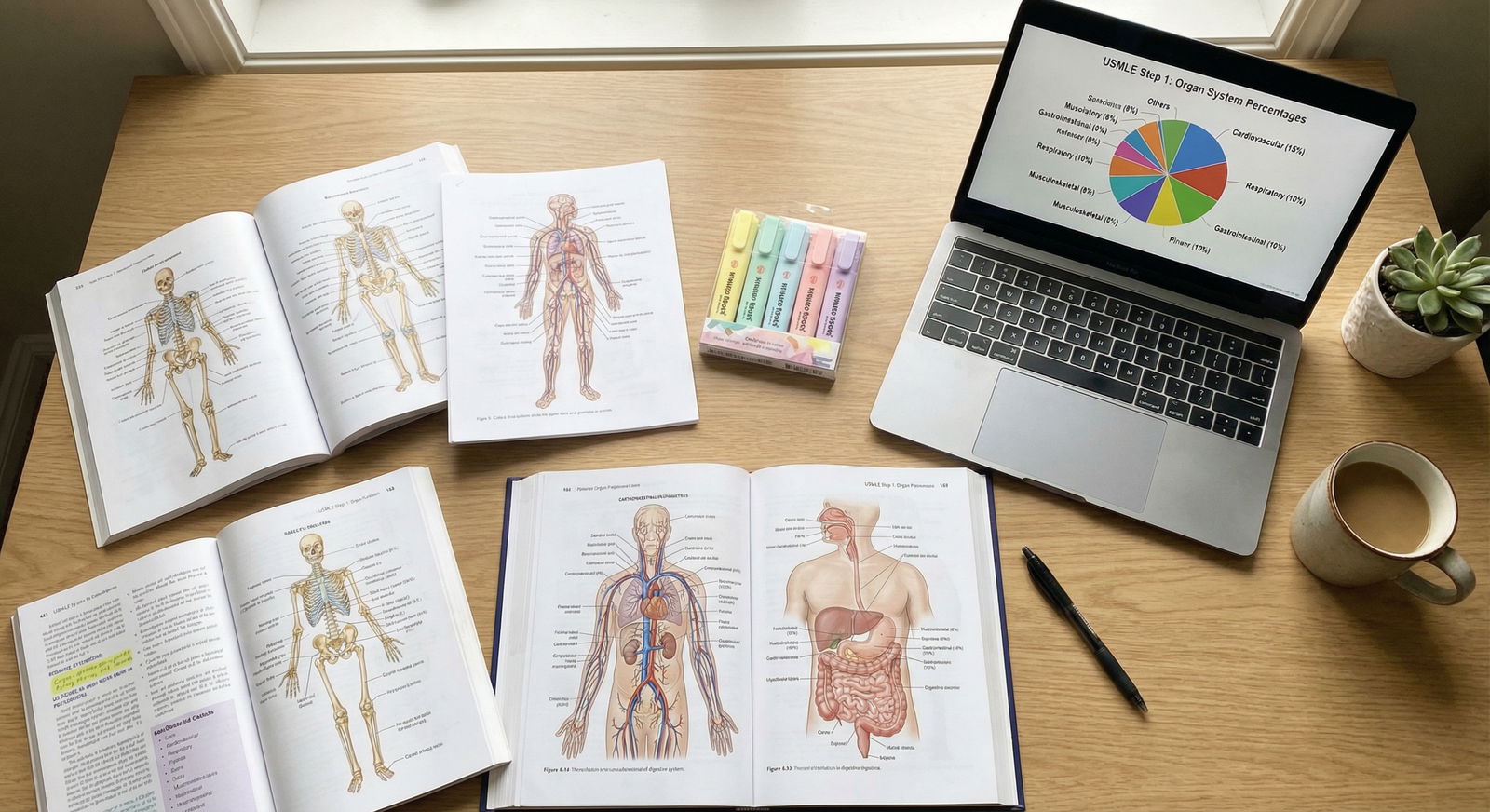
1. Organ System–Based Content
The majority of Step 1 questions are framed around organ systems, often in the context of realistic clinical vignettes.
Below are the major organ systems with approximate representation on the exam and examples of what you’ll need to master.
Cardiovascular System (≈7–11%)
Expect heavy integration of physiology, pathology, and pharmacology:
Key topics:
- Cardiac cycle, pressure-volume loops, and murmurs
- Ischemic heart disease, heart failure, cardiomyopathies, arrhythmias
- Hypertension and hyperlipidemia management
- Antiarrhythmics, antihypertensives, antiplatelet and anticoagulant drugs
Example Blueprint-aligned study strategy:
When reviewing heart failure, ensure you can:- Explain the underlying pathophysiology (e.g., decreased cardiac output)
- Interpret common hemodynamic graphs and physical findings
- Select appropriate first-line pharmacologic therapy in a given scenario
Respiratory System (≈6–10%)
Focus on mechanics, gas exchange, and common pulmonary disease:
Key topics:
- Lung volumes and capacities; ventilation-perfusion (V/Q) relationships
- Obstructive vs restrictive patterns, COPD, asthma, interstitial lung disease
- Pulmonary embolism, pulmonary hypertension
- Oxygen–hemoglobin dissociation curve and its shifts
Application:
Expect questions that require interpreting arterial blood gases, spirometry, or imaging to distinguish between respiratory pathologies.
Gastrointestinal System (≈8–12%)
A broad system with pathology and pharmacology heavily tested:
Key topics:
- Anatomy of the GI tract and associated organs (liver, gallbladder, pancreas)
- Peptic ulcer disease, IBD, malabsorption syndromes, hepatic failure, cirrhosis
- Biliary tract disease, pancreatitis
- Common GI drugs: PPIs, H2 blockers, laxatives, antiemetics
Practical tip:
Many GI questions integrate microbiology (e.g., H. pylori), pathology slides, and lab abnormalities (elevated LFTs, bilirubin patterns).
Renal and Urinary System (≈6–10%)
Highly conceptual and numerically heavy—requires systematic practice:
Key topics:
- Nephron physiology (glomerular filtration, tubular transport)
- Acid-base disorders and electrolyte imbalances
- Glomerular diseases (e.g., nephritic vs nephrotic syndromes)
- Acute and chronic kidney injury, renal pharmacology (diuretics)
Exam emphasis:
Be prepared to interpret lab values (Na+, K+, HCO₃⁻, pH, creatinine) and predict the effect of diuretics or disease on these values.
Endocrine System (≈6–10%)
Integration of physiology, signaling pathways, and feedback systems:
Key topics:
- Diabetes mellitus (types, complications, drugs), thyroid disorders
- Adrenal gland pathology (Cushing syndrome, Addison disease, hyperaldosteronism)
- Pituitary adenomas, hyperprolactinemia, hypopituitarism
- Hormone signaling mechanisms (G-protein coupled receptors, tyrosine kinase, etc.)
High-yield habit:
Create concise tables comparing endocrine disorders (hormone levels, symptoms, and lab patterns) and commit them to memory using active recall.
Nervous System and Special Senses (≈7–11%)
Dense but essential; often requires careful, layered review:
Key topics:
- Neuroanatomy (tracts, cranial nerves, brainstem lesions, spinal cord syndromes)
- Neuromuscular junction, demyelinating diseases
- Seizure disorders, stroke types, neurodegenerative diseases
- Neuropharmacology: antiepileptics, antipsychotics, antidepressants, anxiolytics
Blueprint reality:
Many questions are image-based (MRI, CT, histology) or rely on precise lesion localization using a described neurologic exam.
Musculoskeletal, Skin, and Connective Tissue (≈6–10%)
Involves anatomy plus autoimmunity, rheumatology, and dermatology:
- Key topics:
- Bone and joint anatomy; fractures and common orthopedic injuries
- Rheumatoid arthritis, osteoarthritis, spondyloarthropathies, gout, lupus
- Skin infections, inflammatory skin diseases, bullous disorders
- Pharmacology of NSAIDs, disease-modifying antirheumatic drugs (DMARDs)
Reproductive and Genitourinary Systems (≈6–10%)
A mix of anatomy, endocrinology, and pathology:
Key topics:
- Male and female reproductive anatomy and physiology
- Menstrual cycle endocrinology, pregnancy and fetal development
- Gynecologic and breast pathology, testicular and prostate diseases
- Contraception, fertility pharmacology, teratology concepts
Common testing style:
Clinical vignettes often integrate obstetric timelines, hormone levels, or pathology findings (e.g., ovarian masses with specific tumor markers).
2. Process and Discipline-Based Categories
Beyond organ systems, the Step 1 Blueprint defines cross-cutting disciplines and processes that appear throughout the exam.
Biostatistics, Epidemiology, and Population Health (≈2–6%)
These topics frequently appear and are often underemphasized by students:
Key content:
- Study designs (cohort, case-control, RCTs, cross-sectional)
- Measures of disease frequency and association (incidence, prevalence, relative risk, odds ratio)
- Sensitivity, specificity, predictive values, likelihood ratios
- Bias, confounding, p-values, confidence intervals
- Principles of screening tests and public health interventions
Practical exam tasks:
- Interpreting research abstracts and tables
- Calculating statistics from simple data sets
- Evaluating risk-benefit scenarios for screening and treatment
Behavioral Sciences and Mental Health (≈2–6%)
Focused on the biopsychosocial aspects of care:
Key content:
- Major psychiatric disorders and their treatments (depression, schizophrenia, anxiety disorders, substance use disorders)
- Developmental milestones and disorders
- Patient–physician communication and interview techniques
- Coping mechanisms, defense mechanisms, and stress responses
Test emphasis:
Many questions test professional behavior and communication more than DSM-level diagnostic nuance—“what should the physician say/do next?”
Medical Ethics, Professionalism, and Social Sciences
Though fewer in number, these questions are high-yield because they are often straightforward if you know the principles:
Core principles:
- Autonomy, beneficence, nonmaleficence, and justice
- Informed consent and decisional capacity
- Confidentiality and its exceptions
- End-of-life care, advanced directives, surrogate decision-making
- Cultural competency, health disparities, social determinants of health
Approach:
Familiarize yourself with the USMLE-style “best next step” in ethically challenging scenarios. Often the correct answer aligns with patient autonomy and safety while following legal and professional guidelines.
USMLE Step 1 Question Types and Exam Format
Content is only half the battle; you must also train for how knowledge is tested.
Exam Structure and Timing
- Total questions: Up to 280 multiple-choice questions
- Blocks: 7 blocks, up to 40 questions per block
- Total testing time: Up to 7 hours of test time, plus breaks
- Format: Computer-based, at a Prometric testing center
Time pressure is real, so practicing pacing is an essential part of Exam Preparation.
Common Question Formats
Single Best Answer MCQs
The cornerstone of Step 1:
- A clinical vignette or stem (often long and detailed)
- Followed by a question and 4–5 answer choices
- Only one best or most appropriate answer
Success tip:
Always identify:
- The question being asked (diagnosis? mechanism? next step?)
- The key discriminating details in the vignette
- Why each distractor is wrong—not just why the correct answer is right
Multi-Step Clinical Vignettes
Some questions require reasoning through multiple layers:
- Example: A patient presents with symptoms → you identify the disease → you then infer the genetic mutation → then select the lab value pattern that fits.
This is where integrating basic science with clinical reasoning (the heart of Medical Education) becomes critical.
Data Interpretation and Image-Based Questions
You may be asked to:
- Interpret EKGs, imaging (X-ray, CT, MRI), or pathology slides
- Read tables or graphs from a study
- Analyze lab profiles or flow cytometry outputs
These test whether you can apply foundational science knowledge in practical, real-world contexts.
High-Yield Study Resources and How to Use Them Strategically
Studying “hard” is not enough; you need to study strategically using resources aligned with the Step 1 Blueprint.
1. First Aid for the USMLE Step 1
- Role: A comprehensive, high-yield outline of Step 1 content
- Best use:
- Treat it as a roadmap and high-yield checklist
- Annotate it with explanations from UWorld and your lectures
- Review multiple times, especially in the final 4–6 weeks
2. UWorld Question Bank
- Role: The gold-standard Qbank for Step 1
- Best use:
- Aim to complete the entire bank (and review incorrects)
- Do questions in timed, random mode once you have some foundation
- After each block, carefully review explanations and link back to First Aid and Pathoma
- Track your performance by organ system and discipline to expose Blueprint weaknesses
3. Pathoma (or Equivalent Pathology Resource)
- Role: Clarifies core pathology concepts that underpin many Step 1 questions
- Best use:
- Watch videos during your first pass through systems
- Make summary notes or mind maps you can quickly revisit
- Use it to solidify understanding of disease mechanisms, not just memorize lists
4. Sketchy Medical (Microbiology, Pharmacology, Pathology)
- Role: Memory-enhancing visual mnemonics
- Best use:
- Use early in your study period to construct a robust, memorable foundation
- Reinforce regularly with Anki cards or spaced-repetition notes
- Particularly powerful for microbiology and pharmacology, where detail overload is common
5. Anki Flashcards and Spaced Repetition
- Role: Long-term retention via active recall
- Best use:
- Use evidence-based decks (e.g., well-regarded Step 1 decks) mapped to the Blueprint
- Do daily reviews; treat them like a non-negotiable “mental workout”
- Focus on understanding the card before trying to memorize the answer
6. Online Communities and Study Plans
- Role: Support, strategy sharing, and realistic expectations
- Platforms:
- Reddit (e.g., r/step1)
- Student Doctor Network
- School-specific groups and mentors
Use these to learn from others’ experiences, but avoid comparison traps. Adapt strategies to your own learning style and schedule.
Building an Effective Step 1 Study Timeline
Time management is a core skill in Medical Education. Your study plan should align with:
- Exam date
- Current knowledge level
- School curriculum
- Personal obligations and wellness needs
Below is a general framework you can adapt.
8–12 Months Before Exam: Foundation and Integration
Primary goals:
- Master core concepts as they are taught in your pre-clinical curriculum
- Start integrating high-yield Step 1 resources early
Action steps:
- For each organ system block in school, parallel it with:
- First Aid chapters
- Related Pathoma and Sketchy videos
- A small number of relevant UWorld questions
- Build your Anki habit from day one
- For each organ system block in school, parallel it with:
3–6 Months Before Exam: Transition to Dedicated Mode
Primary goals:
- Identify and remediate weak areas
- Increase question volume and test-like practice
Action steps:
- Begin or intensify full UWorld usage (40–80 questions/day, as feasible)
- Take baseline practice exams (NBME, UWorld self-assessments)
- Develop a weekly structure:
- Mornings: Qbank blocks + review
- Afternoons: Targeted review (pathology, biostatistics, systems you missed)
- Daily: Anki for active recall
1–2 Months Before Exam: Dedicated Intensive Preparation
Primary goals:
- Consolidate high-yield knowledge
- Practice under true exam conditions
- Fine-tune pacing and stamina
Action steps:
- Take 1 full-length practice exam every 1–2 weeks
- Carefully analyze incorrect and “guessed” questions
- Do mixed, timed UWorld blocks
- Prioritize Blueprint-heavy topics you are underperforming in (e.g., renal physiology, biostatistics)
Final 1–2 Weeks: Taper, Refine, and Protect Your Performance
Primary goals:
- Lighten cognitive load while focusing on high-yield review
- Optimize sleep, nutrition, and stress control
Action steps:
- Shorter review sessions focusing on:
- High-yield facts and charts (e.g., First Aid tables)
- Weak systems/processes flagged by your practice tests
- Practice a few timed blocks, but avoid late-night cramming
- Plan logistics for test day (transportation, food, timing of breaks)
- Shorter review sessions focusing on:
Remember: No amount of last-minute cramming can replace months of consistent, Blueprint-guided study. Your goal in the final week is to polish, not rebuild.

Taking Care of Yourself During Step 1 Preparation
High-level performance on Step 1 isn’t just about what you know—it’s also about how well you can access and apply that knowledge under stress.
Essential Wellness Strategies
Sleep:
Aim for 7–8 hours nightly. Poor sleep undermines memory consolidation and test performance.Physical activity:
Even 20–30 minutes of walking, stretching, or light exercise improves concentration and mood.Breaks and boundaries:
Use techniques like the Pomodoro method (e.g., 50 minutes work / 10 minutes break) to maintain focus and prevent burnout.Mental health support:
Reach out to peers, mentors, or counseling services if anxiety or stress becomes overwhelming. You are not alone in this process.Balanced expectations:
In the Pass/Fail era, your aim is mastery and readiness—not perfection. Focus on steady improvement and consistent effort.
FAQs About the USMLE Step 1 Blueprint and Preparation
1. What is the Step 1 Blueprint, and where can I find it?
The Step 1 Blueprint is the official content outline published by the USMLE program. It defines the knowledge areas, organ system distribution, and process skills that the exam covers. You can find the most recent version on the official USMLE or NBME website under the content outline or exam description section. Reviewing it at the start of your study period—and revisiting it periodically—helps keep your Exam Preparation tightly aligned with what will actually be tested.
2. How many questions are on the USMLE Step 1, and how is it structured?
USMLE Step 1 consists of up to 280 multiple-choice questions, divided into 7 blocks of up to 40 questions each. You are given up to 60 minutes per block and a full day of testing with scheduled breaks. All questions are single-best-answer MCQs, often presented as clinical vignettes that require you to integrate basic science with clinical reasoning.
3. Which study resources are most essential for Step 1 success?
While preferences vary, many students find the following core resources highly effective:
- First Aid for the USMLE Step 1 – high-yield content overview
- UWorld Question Bank – realistic questions and detailed explanations
- Pathoma (or similar) – strong foundation in pathology
- Sketchy Medical – visual mnemonics for microbiology and pharmacology
- Anki – spaced-repetition flashcards for long-term retention
The key is not just owning these resources, but using them consistently and mapping them to the Step 1 Blueprint.
4. How should I structure my Step 1 study schedule?
An effective schedule typically includes:
- Early integration of Step 1 materials with your pre-clinical courses
- Gradual increase in question-based learning 3–6 months before the exam
- A dedicated study period (4–8 weeks for many students) with:
- Daily mixed Qbank blocks
- Regular full-length practice tests
- Systematic review of weak areas identified by performance data
Your exact plan should reflect your baseline knowledge, school requirements, and personal circumstances. Adjust as needed based on practice test feedback.
5. How can I manage stress and maintain balance during Step 1 preparation?
- Set realistic daily and weekly goals rather than perfectionistic targets.
- Protect core habits: regular sleep, meals, and brief daily exercise.
- Schedule short, guilt-free breaks and one lighter “recovery” half-day per week.
- Connect with classmates or mentors for support and perspective.
- Consider mindfulness practices (e.g., brief guided meditations) to reduce anxiety and improve concentration.
Remember that sustainable, Blueprint-aligned preparation—combined with attention to your physical and mental well-being—is the most reliable path to passing Step 1 and stepping confidently into your clinical years.
By understanding and using the USMLE Step 1 Blueprint as your strategic guide, you transform Step 1 from an amorphous, anxiety-inducing hurdle into a defined, manageable challenge. With a clear grasp of content categories, question formats, and high-yield resources, you can approach your study period with clarity, purpose, and confidence—bringing you one step closer to your goal of becoming a physician.