Introduction: Why a Step 1 Study Group Can Transform Your Prep
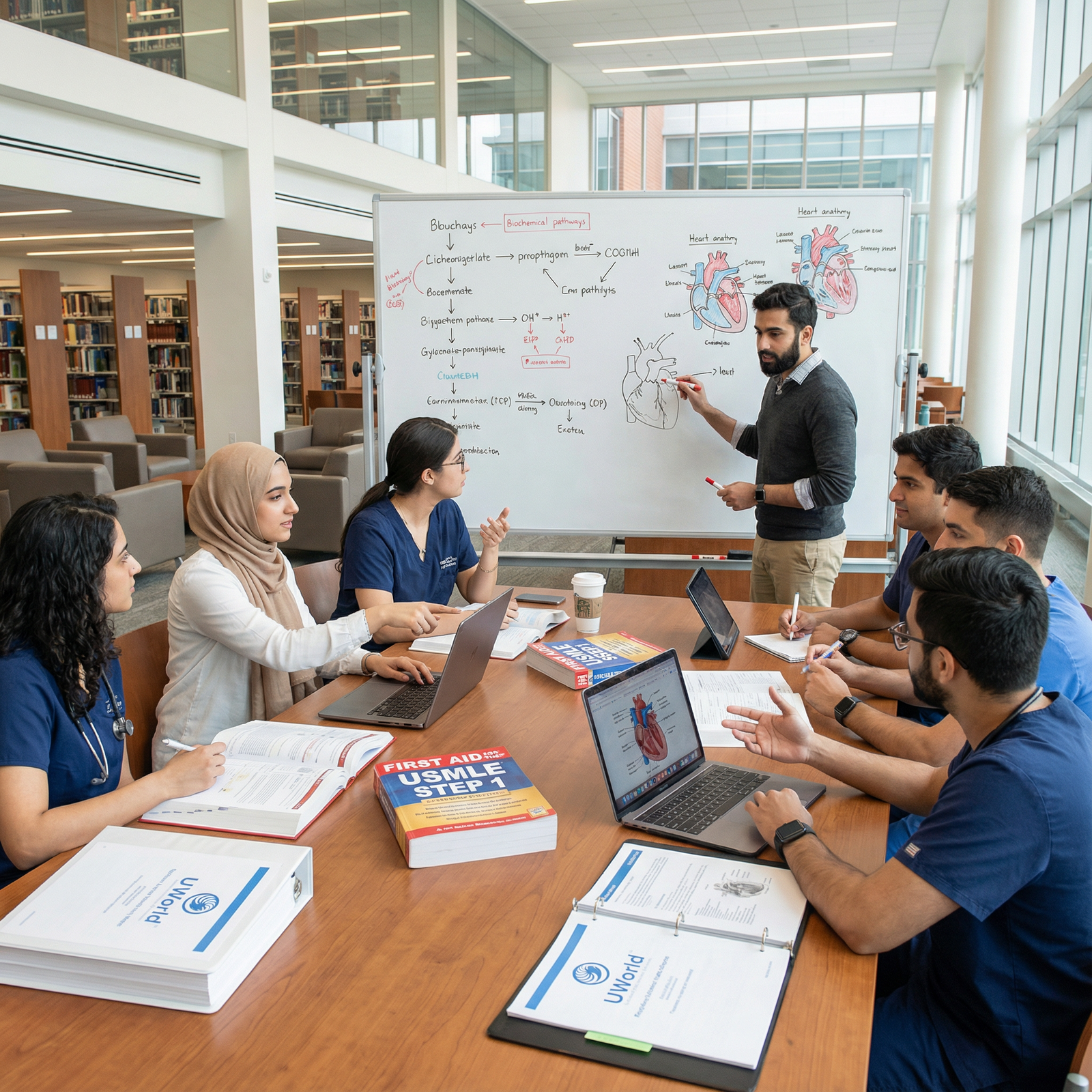
Preparing for the USMLE Step 1 is one of the most intense periods of medical school life. The volume of material, the pressure to perform, and the high stakes for future residency applications can make exam preparation feel isolating and overwhelming. While solo study is essential, a well-designed Step 1 study group can be a powerful complement to your individual work—if you build and run it intentionally.
An effective study group can:
- Deepen your understanding of high‑yield concepts
- Keep you accountable and on schedule
- Provide emotional support during a stressful time
- Expose you to new resources and problem‑solving approaches
This guide walks through how to design, launch, and sustain a USMLE Step 1 study group that genuinely helps you perform at your best. You’ll learn practical collaboration techniques, common pitfalls to avoid, and specific examples of how groups can structure their time and resources for maximum impact.
The Benefits of a USMLE Step 1 Study Group
Enhanced Learning Through Peer Teaching and Discussion
Study groups are not just about “studying together in the same room.” Done well, they fundamentally change how you learn.
Diverse perspectives and strengths
Every medical student brings a unique background and skill set:
- One member might be exceptional at visualizing anatomy or neuro pathways
- Another might have a strong foundation in biochemistry or immunology
- Someone else may have already completed most of UWorld and can share insights into common question patterns
This diversity allows your group to:
- Break down complex topics (e.g., renal physiology, biostatistics) from multiple angles
- Hear alternative explanations for the same concept until it finally “clicks”
- Compare different memorization techniques (mnemonics, diagrams, Anki, flowcharts)
Shared knowledge and curated resources
In medical school, information overload is real. In a Step 1 study group, members can:
- Share concise notes or summary sheets of high-yield topics
- Compare resource choices and help each other avoid unnecessary, low‑yield materials
- Build a shared question bank of tricky or frequently missed UWorld/NBME questions
- Create and share Anki decks or flashcard sets based on agreed‑upon resources
By pooling knowledge, you reduce redundancy and focus your limited time on the highest yield material.
Active engagement: learning by teaching
Teaching is one of the most powerful learning strategies. In a group setting, you can:
- Assign each member a topic (e.g., cardiac murmurs, glycolysis, vasculitides) to “teach back”
- Do rapid-fire concept checks where one person quizzes and others explain their reasoning
- Ask group members to explain why distractors are wrong in practice questions
Explaining mechanisms, pathways, and clinical reasoning out loud forces you to organize your thoughts and reveals gaps you may not notice when passively reading.
Accountability, Structure, and Motivation
Step 1 exam preparation is a marathon. A study group gives you an external structure to keep going.
Built‑in accountability
When you commit to meeting others at set times:
- You’re more likely to complete your daily or weekly study goals
- You’re less likely to procrastinate on difficult subjects
- You feel responsible to your peers, not just to yourself
Some groups set specific “pre-work” for each session (e.g., finish X pages of First Aid, Y UWorld questions, or Z Anki reviews) and check in on completion.
Emotional support and stress management
Medical school and USMLE Step 1 prep can be emotionally draining. A good group:
- Normalizes the stress and anxiety you’re feeling
- Provides a safe space to discuss test-related fears or burnout
- Celebrates small wins together—finishing a block of UWorld or completing a system
This sense of community can reduce feelings of isolation and help you sustain your effort over weeks and months.
Sharpened Clinical Reasoning and Problem-Solving
The USMLE Step 1 increasingly emphasizes application and integration, not just memorization.
Collaborative problem-solving
In group sessions, you can:
- Work through UWorld blocks or NBME-style questions together
- Discuss each question stem out loud, highlighting key clues and red flags
- Compare different reasoning paths to arrive at the correct answer
Hearing how others approach a clinical vignette can help you refine your own test-taking strategy and recognize cognitive traps.
Exam-style thinking
By regularly reviewing question explanations as a group, you learn to:
- Predict what the question is really asking before looking at the options
- Recognize patterns in how topics like pharmacology side effects or microbiology presentations show up on the exam
- Quickly rule out implausible answer choices
This collaborative analysis rehearses the mindset you’ll need on test day.
Step-by-Step Guide to Building a High-Impact Study Group
Step 1: Clarify Individual and Group Goals
Before you invite anyone, be clear on what you—and your prospective members—want from this study group.
Align expectations early
Consider asking each potential member:
- What is your goal for USMLE Step 1?
- Pass only vs. 240+ vs. highly competitive specialty target
- How far along are you in content review and question banks?
- How many hours per week can you realistically commit to group work?
Groups are most successful when members have broadly similar intensity, goals, and timelines. If one person is taking Step 1 in 3 weeks and another in 6 months, their needs will be very different.
Define the group’s purpose
Common group formats include:
Content-focused group
- Goal: Systematic review of high-yield topics (e.g., follow First Aid organ systems)
- Activities: Mini-lectures, whiteboard explanations, concept mapping
Question-focused group
- Goal: Improve test-taking skills and reasoning
- Activities: UWorld/NBME question discussion, timed blocks, error analysis
Hybrid group
- Goal: Combine structured content review with questions
- Activities: 50% topic review, 50% question breakdown
Clarifying your group’s main focus helps you design efficient sessions and choose the right members.
Set logistics up front
Agree on:
- Meeting frequency (e.g., 2–3 times per week vs. weekly)
- Session length (90–120 minutes often works better than marathon sessions)
- Modality: in-person, virtual, or hybrid (Zoom, Teams, etc.)
- Start and end date (e.g., from start of dedicated period to exam week)
Writing this down in a shared document (Google Doc/Notion) keeps expectations transparent.
Step 2: Choosing the Right Members for Your Study Group
Optimal group size
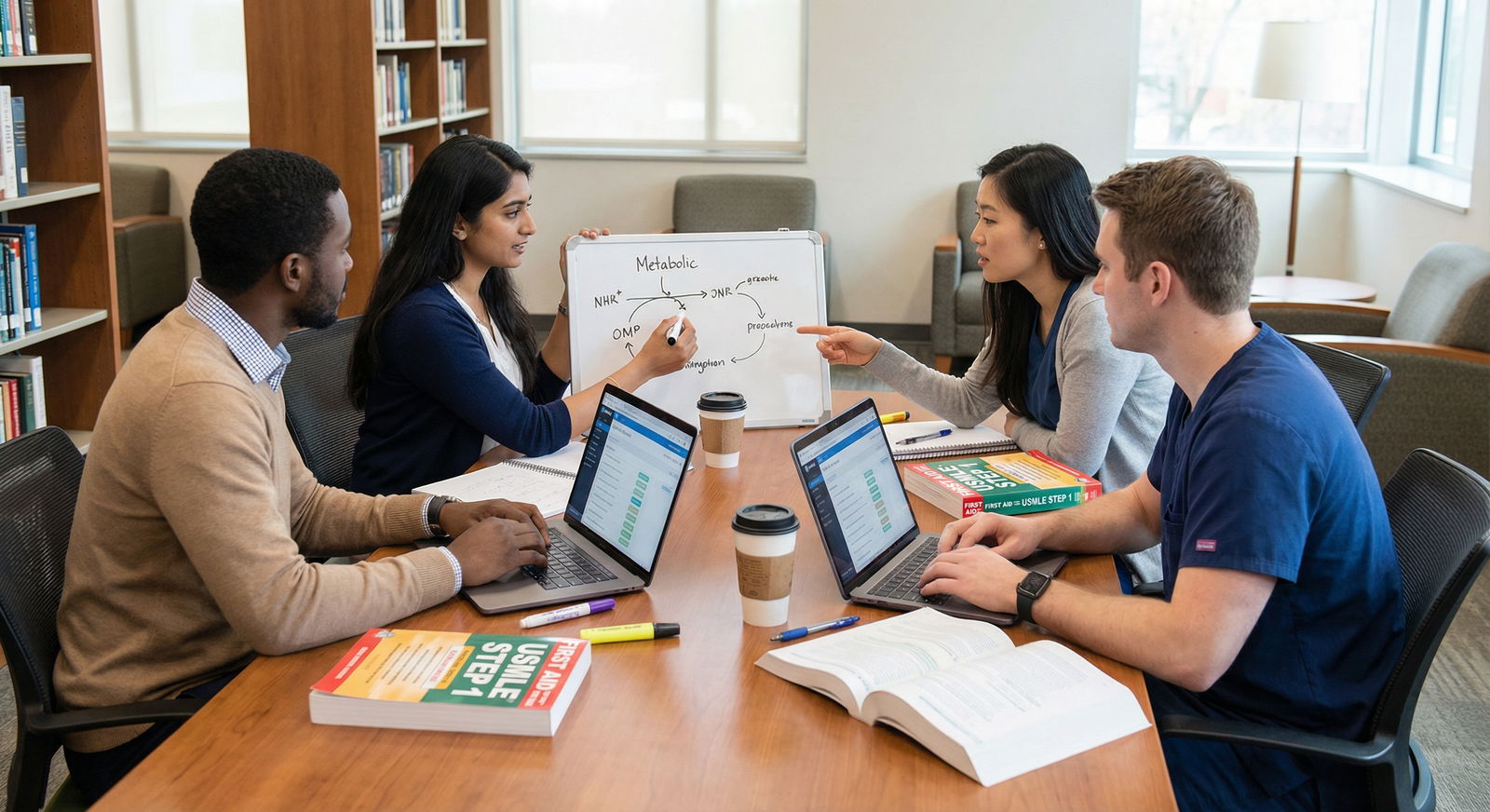
For most USMLE Step 1 study groups, 3–6 members is ideal:
- Small enough to allow everyone to speak and participate
- Large enough to include diverse strengths and perspectives
- Easier to schedule and manage than large, open groups
If your group grows beyond 6, consider splitting into two subgroups (e.g., different strengths, schedules, or goals).
Look for complementary strengths and compatible habits
Aim for:
- Content diversity: someone strong in path, someone in pharm, someone in physio, etc.
- Personality fit: respectful, punctual, willing to compromise
- Work-ethic alignment: similar dedication and seriousness about Step 1
Avoid:
- Members who consistently cancel or arrive unprepared
- People who dominate discussion and don’t let others speak
- Classmates who are constantly negative or dismissive of others’ approaches
You don’t have to be best friends with your group members, but you should trust them to be professional and reliable.
Where to find potential group members
- Your medical school class GroupMe/WhatsApp/Slack channels
- Formal Step 1 review courses or school-based review programs
- Peers you already know from anatomy lab, clinical skills groups, or previous study partnerships
When inviting people, be honest about your expectations and the time commitment.
Step 3: Establish Ground Rules and Structure from Day One
Clear ground rules prevent many common study group problems before they start.
Core rules to consider
Time respect
- Start and end on time—even if everyone isn’t there yet
- Limit side conversations and phone use during sessions
Preparation expectations
- Everyone completes assigned reading/questions before each meeting
- Members come with specific questions, missed UWorld items, or topics ready
Participation and communication
- One person talks at a time; no interrupting
- All members are encouraged to ask “basic” questions without fear of judgment
- Use group chats (e.g., WhatsApp) for quick updates, not long debates
Conflict resolution
- Address issues early and privately if possible
- Focus on behaviors (e.g., “You often arrive 20 minutes late”) not personalities
- If needed, re-evaluate group membership for persistent issues
Having these norms written and agreed upon (even informally) helps maintain a productive environment as stress levels rise closer to exam day.
Collaboration Techniques That Actually Work for Step 1
Structuring High-Yield Study Sessions
Unstructured “let’s just study together” meetings are rarely effective. Instead, use deliberate formats.
Example 90-minute hybrid session
0–10 minutes:
- Quick check-in (what each person worked on since last meeting)
- Review today’s goals (e.g., complete 10 cardiology questions + review heart failure pharm)
10–55 minutes (Content focus):
- 15 minutes: One member gives a 5-slide mini-teach on heart failure drugs
- 15 minutes: Group builds a whiteboard chart comparing drug classes, mechanisms, side effects
- 15 minutes: Rapid-fire recall—others explain indications/contraindications from the chart
55–85 minutes (Questions focus):
- Timed block of 8–10 cardiology UWorld questions individually
- Group reviews each question: identify key clues, discuss why each answer choice is right/wrong
85–90 minutes:
- Summary: 3–5 high-yield take-home points from the session
- Confirm next meeting’s topic and pre-work
Rotate roles to keep everyone engaged
- Session leader: Manages time, keeps group on track
- Content teacher: Prepares a short explanation of the core topic
- Question captain: Selects questions, leads discussion of rationale
- Scribe: Updates shared document with key points and missed concepts
Rotating these roles builds leadership skills and ensures everyone contributes.
High-Impact Learning Techniques for Study Groups
Active recall and spaced repetition
Use Anki or flashcards during group:
- One member reads a card; others answer aloud and explain
- Focus on cards that multiple members find challenging
At the end of each session, do a 5-minute “no-notes” recall:
- Each person shares 1–2 key concepts they learned or finally understood
Question-based learning
Dedicate entire sessions to question banks (UWorld, NBME practice tests, AMBOSS):
- Complete timed blocks individually before the meeting
- Use group time solely for reviewing rationales and identifying patterns
When reviewing questions, always ask:
- What was the key turning point in this stem?
- Why were the common wrong answers tempting but incorrect?
- How would the question change if one detail in the stem were different?
Visual and integrative tools
Build integrated mind maps for topics like:
- RAS system and related drugs
- Autoimmune diseases and associated antibodies
- Micro organisms and their toxins, virulence factors, and clinical presentations
Use the whiteboard or a shared digital whiteboard (e.g., Zoom, Miro) to:
- Draw pathways from memory, then fill in gaps together
- Sketch organ systems with related pharm, path, and physio linked together
Smart Use of Resources and Technology
Agree on core resources
To avoid confusion and redundancy, most groups do best when they align on:
Primary content source:
- First Aid for the USMLE Step 1, Pathoma, Boards & Beyond, Sketchy, etc.
Main question bank:
- UWorld is the standard; some supplement with AMBOSS or school-based banks
Shared tools:
- Google Drive/Docs for outlines and key summaries
- A shared Anki deck or tag system for high-yield topics
Agreeing on 1–2 primary resources per category keeps everyone on the same page and reduces the “resource FOMO” that often plagues exam prep.
Leveraging online platforms for remote or hybrid groups
- Video conferencing: Zoom, Microsoft Teams, Google Meet
- Shared note-taking: Google Docs, Notion, OneNote
- Communication: WhatsApp, GroupMe, Slack
- Digital whiteboards: Miro, Zoom whiteboard, Microsoft Whiteboard
Virtual groups can be just as effective as in-person ones when structured well.
Managing Common Study Group Challenges
Handling Conflicts, Imbalances, and Group Drift
Even strong groups face challenges—how you respond determines whether the group survives.
Common issues & practical fixes
Chronic lateness or lack of preparation
- Solution: Privately discuss impact (“We lose 15 minutes each time”) and reaffirm expectations. If it continues, consider asking if the group format still works for them.
Dominating personalities
- Solution: Use structured turn-taking (“Let’s go around and hear everyone’s thought process”) and assign the talkative member roles that require listening (e.g., scribe).
Topic drift and wasted time
- Solution: Create a written agenda before each meeting and designate a timekeeper who gently redirects when side conversations start.
Mismatched goals or timelines emerging over time
- Solution: Have a mid-course check-in. It’s okay if some members step back or if the group splits into smaller, more focused units.
Staying Motivated and On Track During Dedicated Prep
Motivation naturally fluctuates, especially during intensive dedicated study periods.
Track and celebrate progress
Maintain a shared tracker that includes:
- Systems/topics completed (e.g., “Completed cardio + renal path”)
- Question bank progress (e.g., “UWorld 45% complete, 65% correct”)
- Practice exam scores (NBMEs, UWSAs)
Celebrate key milestones:
- After finishing a full system or a major resource, do something simple together: group coffee, short walk, quick check-in about what’s going well.
Adapt as you approach exam day
Closer to the exam:
- Shift more time into timed question blocks and full-length practice exams
- Focus group meetings on:
- Reviewing missed questions and weak areas
- Rapid concept reviews rather than lengthy new content
Be willing to shorten or adjust meeting frequency during the final 1–2 weeks, when individualized strategy fine-tuning becomes critical.
Real-World Example: A Study Group That Worked
Case Study: Turning Mixed Strengths into Collective Success
A group of five second-year medical students decided to form a USMLE Step 1 study group three months before their dedicated period began. They agreed on these principles from the start:
- Weekly 2-hour meetings during the semester, transitioning to three times per week during dedicated
- Shared primary resources: First Aid, UWorld, Pathoma, and Sketchy
- Specific focus each meeting (e.g., “GI path and pharm”)
Each member brought a distinct strength:
- Alex: excellent in pathology and could simplify complex slides
- Riya: strong in pharmacology and loved creating comparison tables
- Jamal: great at breaking down UWorld questions and identifying patterns
- Maria: organized the group schedule and tracked progress
- Daniel: strong in biostatistics and behavioral sciences
They used a hybrid format:
- 45 minutes: content review through mini-lectures and whiteboard drawings
- 45 minutes: UWorld block discussion focused on rationale, not just answers
- 30 minutes: quick recap and planning for next session
They also used the Pomodoro technique for some sessions—25 minutes of intense focus followed by 5-minute breaks—to maintain concentration.
By exam time:
- Each member had completed UWorld once, with key marked questions reviewed in group
- They had collectively created a “group manual” of high-yield charts, diagrams, and common mistakes
- All five students passed Step 1 comfortably, and several exceeded their original score targets
Their success was less about innate ability and more about clear structure, mutual accountability, and consistent collaboration techniques.
FAQs about Building an Effective USMLE Step 1 Study Group
Q1: What is the ideal size for a Step 1 study group?
For most medical students, 3–6 members is ideal. This size balances diverse perspectives with the ability for everyone to participate. Groups larger than 6 often struggle with scheduling, side conversations, and unequal participation.
Q2: How often should a Step 1 study group meet, and for how long?
During pre-dedicated time, meeting 1–2 times per week for 90–120 minutes is usually sufficient. During dedicated Step 1 preparation, many groups increase to 2–4 meetings per week, still keeping sessions around 90–120 minutes to maintain focus. Longer sessions can work if they’re broken into structured blocks with short breaks.
Q3: What should we do if conflicts or mismatched expectations arise?
Address issues as early and specifically as possible. Use “I” statements (“I feel rushed when we start late”) and focus on behaviors rather than personal traits. If expectations no longer align—e.g., some members want daily meetings while others can only do weekly—it’s acceptable to restructure the group or split into two subgroups with clearer goals.
Q4: Which resources are best suited for study group use in Step 1 prep?
High-yield, group-friendly resources include:
- First Aid for the USMLE Step 1 (as a central framework)
- UWorld (for question-based learning and exam-style reasoning)
- Pathoma and Boards & Beyond (for conceptual explanations)
- Sketchy (especially for microbiology and pharmacology)
Groups work best when members agree on 1–2 primary resources for each category to avoid confusion and duplication.
Q5: How can we ensure that group study actually improves our scores and isn’t just social time?
Use clear structure and metrics:
- Start each session with specific goals (e.g., “Finish 10 endocrine questions and review adrenal pathology”)
- Track your individual and group progress—question bank completion, practice exam scores, and weak areas
- Periodically reassess whether the group is helping your performance. If your personal metrics stagnate or decline, adjust the format (more question-based, shorter meetings) or your level of participation.
A thoughtfully designed USMLE Step 1 study group can turn exam preparation from a solitary grind into a collaborative, efficient, and even rewarding process. By choosing the right members, setting clear goals, and using structured collaboration techniques, you can harness the power of peer learning to strengthen your knowledge, sharpen your reasoning, and approach exam day with greater confidence.