
Why Anki Is a Game-Changer for USMLE Step 1 Review
Preparing for the USMLE Step 1 is one of the most demanding phases of medical school. The volume of information, the pressure to perform, and the shift from classroom knowledge to exam-focused understanding can feel overwhelming. Many students quickly learn that passive studying (re-reading, highlighting, watching videos without active engagement) is not enough.
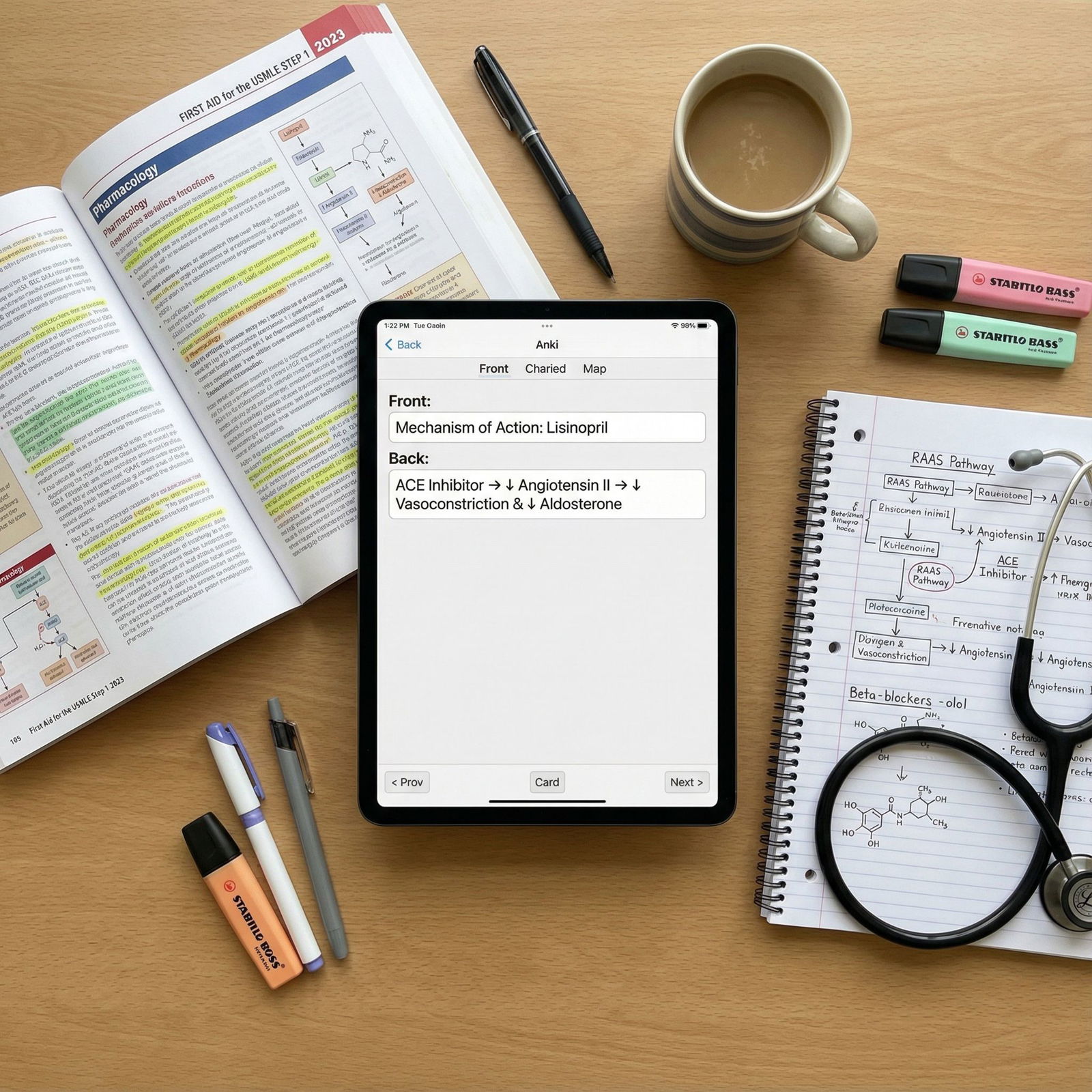
This is where Anki, a flashcard program built around Spaced Repetition, becomes a powerful ally. When used strategically, Anki can help you:
- Retain high-yield facts for the long term
- Systematically cover First Aid–level detail
- Integrate content from lectures, question banks, and review books
- Study efficiently even when your schedule is packed with rotations or classes
This guide will walk you through how to leverage Anki for an effective, efficient, and sustainable USMLE Step 1 review—from understanding how it works to building a daily routine you can maintain.
Understanding Spaced Repetition and Why It Matters for Step 1
Spaced Repetition isn’t just a buzzword; it’s one of the most evidence-based learning strategies available. Step 1 rewards long-term, integrated knowledge—not last-minute cramming. Spaced Repetition is designed exactly for that.
The Science Behind Spaced Repetition
Spaced Repetition is based on the “forgetting curve,” a concept from cognitive psychology showing how quickly we forget information if we don’t review it. Each time you successfully recall a piece of information just before you would have forgotten it, you strengthen that memory and can wait longer before reviewing it again.
In practical terms, this looks like:
Initial Learning
You learn “Imipenem is often co-administered with cilastatin to decrease inactivation in the renal tubules” during a lecture, from a video, or from First Aid.First Review (Short Interval)
Within hours or by the next day, a card appears in Anki:- Front: “Why is imipenem given with cilastatin?”
- Back: “Cilastatin inhibits renal dehydropeptidase I → decreases inactivation of imipenem in renal tubules.”
Subsequent Reviews (Longer Intervals)
Each time you correctly recall the answer, Anki increases the interval: 1 day → 3 days → 7 days → 15 days → months, etc. If you forget, the interval shortens again.
Why Spaced Repetition Is Perfect for USMLE Step 1
Step 1 requires you to know:
- Countless pharmacologic mechanisms
- Pathophysiologic pathways
- Biochemistry details
- Microbiology organisms and treatments
These are all fact-dense areas that are perfectly suited to flashcards and Spaced Repetition. Anki does the scheduling work for you, so you can focus on actually learning.
Well-designed Anki use turns your Step 1 preparation into a constant cycle of active recall, which has been repeatedly shown to outperform passive review methods.
Setting Up Anki for Effective USMLE Step 1 Review
1. Download, Sync, and Set Up the Basics
Start by downloading Anki from the official website: AnkiWeb. It’s available for Windows, macOS, Linux, and has companion apps for iOS and Android (mobile may be paid on iOS).
Key initial steps:
- Create an AnkiWeb account: This allows you to sync across laptop and phone so you can review anywhere (commute, gym, waiting rooms).
- Enable sync early: Turn on automatic syncing when closing/opening the app to avoid losing progress.
- Back up regularly: Anki automatically backs up, but occasionally export your decks as an extra safeguard.
2. Customize Anki with High-Yield Add-Ons
Anki’s core program is powerful, but add-ons can make it much more efficient for medical study. Popular add-ons for Step 1 preparation include:
Image Occlusion Enhanced
Ideal for:- Anatomy diagrams (labeling structures)
- Pathology images (identifying key features)
- Tables (masking specific rows or columns)
Hierarchical Tags or BetterTags
Helps you create structured tags like:Step1::Cardio::PharmorStep1::Micro::Bacteria::GramNegative
This allows target review by system, subject, or difficulty.Review Heatmap / Progress Trackers
Visualize your consistency and workload over weeks and months. This can be motivating and helps you predict heavy vs lighter review days.Advanced Review Bottom Bar / Custom Answer Buttons
Offers more information during review (e.g., card type, ease) and can make the interface more intuitive.
When installing add-ons:
- Only download from trusted sources (AnkiWeb)
- Avoid adding too many at once—start with 2–4 key ones and layer more as you get comfortable
- Always read the add-on description and comments for compatibility notes
3. Choosing Between Pre-Made Decks and Making Your Own
For Step 1, most students combine pre-made decks with personal cards.
Using Pre-Made Step 1 Decks
Widely used USMLE Step 1 Anki decks include:
AnKing (based on Zanki + others)
- Very comprehensive
- Tagged to resources (First Aid, Pathoma, Boards & Beyond, Sketchy, etc.)
- Highly organized with hierarchical tags
Original Zanki (and variants)
- Still widely used
- Strong system-based organization
- Good for integrated learning by subject/system
When using these decks:
- Do not blindly unsuspend every card at once.
Start with the systems or subjects you’re actively studying (e.g., Cardiovascular during your Cardio block). - Use tags to filter what you study.
For example, studyAnKing::Step1::Cardiowhile going through Cardio videos or lectures. - Treat pre-made decks as a spine, not a cage.
Add or edit cards so they reflect how you understand information.
Creating Your Own High-Yield Flashcards
Creating cards forces you to process and rephrase content—this alone improves retention. Good times to make your own cards:
- While doing UWorld or AMBOSS questions
- While reading First Aid, Pathoma, or Sketchy summaries
- During or immediately after lectures
When you miss a UWorld question on nephrotic vs nephritic syndrome, create:
- One card for the key distinguishing features
- One card for a representative clinical vignette
- One card for a high-yield associated disease (e.g., membranous nephropathy and solid tumors)
Over time, these personal cards often become your most valuable ones for Step 1.
How to Create High-Yield Anki Cards for Step 1
Not all flashcards are created equal. The design of your cards determines whether your deck is powerful or painful.
1. Follow the “One Fact, One Card” Rule
Avoid overloading cards with multiple facts. Instead:
Bad card:
Front: “Describe the features, diagnosis, and treatment of Graves disease.”
Back: 6–8 bullet points.Better approach: Break that into several cards:
- Front: “Autoantibody in Graves disease?”
Back: “TSH receptor–stimulating IgG (type II hypersensitivity).” - Front: “Classic signs of Graves disease?”
Back: “Hyperthyroidism + exophthalmos + pretibial myxedema.” - Front: “First-line treatment for Graves disease in pregnancy?”
Back: “PTU (first trimester), then methimazole.”
- Front: “Autoantibody in Graves disease?”
Short, focused cards are easier and faster to review and less mentally draining.
2. Use Clear Question-and-Answer Format
Good flashcards force active recall of a specific piece of information:
- “What is the most common cause of osteomyelitis in sickle cell patients?”
- “Which nerve is injured with a fracture of the surgical neck of the humerus?”
- “What is the mechanism of action of heparin?”
Avoid vague prompts like just “Heparin” or “Sickle cell + osteomyelitis”—you want a direct question.
3. Incorporate Clinical Vignettes Strategically
USMLE questions are vignette-based, not isolated fact recall. Use clinical contexts for:
- Classic disease presentations
- Pathophysiologic mechanisms
- Hospital-based management scenarios
Example:
- Front: “7-year-old boy with sickle cell disease has bone pain, fever, and elevated WBC. X-ray shows focal lucency in the femur. Most likely causative organism?”
- Back: “Salmonella (encapsulated, osteomyelitis in sickle cell).”
Balance is important: not every card should be a full vignette (they’re time-consuming to review), but vignettes are excellent for high-yield patterns.
4. Use Images and Image Occlusion for Visual Topics
Visual learning is crucial for:
- Anatomy
- Pathology slides
- Microbiology images
- Radiology findings
With Image Occlusion Enhanced, you can:
- Paste an image (e.g., brachial plexus diagram)
- Cover individual labels (nerves, roots, branches)
- Generate multiple cards from one image
This method is especially powerful for remembering complex visual relationships—such as nerve lesions, dermatome maps, or histologic hallmarks of disease.
5. Organize with Tags and Deck Structure
Structure helps you create focused review sessions:
- Use broad decks like:
Step 1 – SystemsStep 1 – FoundationsStep 1 – Question Bank Errors
- Use tags for granularity:
Cardio::Pharm::BetaBlockersPath::HemeOnc::LymphomaHighYield::MustKnow
Later, if you’re weak in Renal Physiology, you can quickly review all cards tagged Renal::Physiology, or revisit all QuestionBankErrors::Cardio.
Building a Sustainable Anki Routine for Step 1
Even the best deck is useless without consistency. The key to using Anki for Step 1 is building a daily routine that fits your schedule.
1. Prioritize Reviews Over New Cards
As your deck grows, your daily review load will become substantial. To avoid burnout:
- Always finish your due reviews before adding new cards for the day.
- Set a realistic daily new card limit (e.g., 30–60 new cards/day) and adjust based on your workload and energy.
If you’re overwhelmed:
- Decrease the number of new cards
- Temporarily suspend less important subdecks or tags
- Spread new content over more days
2. Time-Block Your Anki Sessions
Integrate Anki into your daily study schedule:
Morning (20–40 minutes):
- Clear as many due reviews as you can.
- This “resets” your cognitive baseline and frees mental bandwidth.
Midday (10–20 minutes):
- Quick review between lectures or after lunch.
Evening (20–40 minutes):
- Finish remaining reviews.
- Introduce new cards related to that day’s content.
This structure ensures you’re hitting Spaced Repetition windows throughout the day and not facing an enormous review pile late at night.
3. Integrate Anki with Lectures, Resources, and Qbanks
To maximize retention:
During Systems Blocks
- Watch lectures (e.g., Boards and Beyond, Sketchy) → then immediately review or unsuspend related Anki cards.
- Use tags corresponding to that system (e.g.,
Cardio::Path,Cardio::Pharm).
With First Aid and Pathoma
- As you go through a chapter, make or unsuspend cards that match the high-yield tables and figures.
- Add custom cards for points you personally find hard.
With Question Banks (UWorld, AMBOSS)
- Every time you miss or guess a question:
- Create at least 1–3 cards covering:
- The correct fact
- Why the distractors were wrong (especially if high yield)
- The pattern of the vignette (classic presentations)
- Create at least 1–3 cards covering:
- Every time you miss or guess a question:
These become your highest-yield decks because they are directly based on tested concepts.
4. Use Anki’s Statistics to Guide Your Study
Anki provides useful metrics:
- Card Performance: Which tags or decks have the highest lapse rates? These may be weak areas.
- Review Forecast: How many cards are due in the coming days? Plan heavy content weeks accordingly.
- Time per Card: If you’re spending too long on each card, you may need to simplify card structure.
Periodically review your stats (e.g., weekly) to decide:
- Which subjects need more non-Anki review (videos, reading)
- Whether you’re taking on too many new cards
- Whether certain decks should be suspended or postponed

Common Pitfalls When Using Anki for Step 1 (and How to Avoid Them)
1. Overloading Cards with Too Much Information
Problem: Long, paragraph-style cards are tiring, stressful, and ineffective.
Solution:
- Stick to one fact or concept per card.
- Break complex topics into multiple related cards.
- Use “cloze deletion” (fill-in-the-blank) for definitions and pathways if you prefer that style.
2. Inconsistent Use and Skipping Review Days
Problem: Missing several days leads to 1,000+ due cards and instant burnout.
Solution:
- Aim for short daily reviews rather than marathon catch-up sessions. Even 20–30 minutes on busy days is better than nothing.
- If you get behind:
- Temporarily reduce or stop new cards.
- Tackle old reviews in manageable chunks.
- Use the “reschedule” or “bury” features sparingly to avoid overwhelming yourself.
3. Avoiding Difficult Cards
Problem: Marking tough cards as “easy” or cheating by looking too quickly at the back.
Solution:
- Be honest with the difficulty rating.
- For repeatedly missed cards:
- Rewrite or simplify the card.
- Add a mnemonic, image, or association.
- Link it to a clinical scenario (from a question bank).
4. Relying Exclusively on Anki Without Conceptual Understanding
Problem: Memorizing disjointed facts without understanding underlying mechanisms.
Solution:
- Use Anki to reinforce, not replace, conceptual learning.
- Make sure each card connects back to:
- A video explanation
- A textbook paragraph
- A question stem or clinical context
If a card’s answer doesn’t make sense to you, that’s a sign you need to revisit the source material—not just keep flipping that card.
5. Not Customizing Pre-Made Decks
Problem: Pre-made decks can be too large, too detailed, or not aligned with how you think.
Solution:
- Edit card wording to match your own thought process.
- Suspend low-yield or redundant cards (especially if your review time is limited).
- Add extra hints or images to cards you struggle with.
Your Anki deck should evolve with you, not the other way around.
Putting It All Together: An Example Step 1 Anki Strategy
To illustrate how this works in practice, here’s an example approach used by many successful Step 1 test-takers:
Phase 1: Preclinical Years (Foundations)
- Use a pre-made deck (e.g., AnKing) aligned with your curriculum.
- Review Anki daily (20–60 minutes), primarily focused on your current block.
- Add cards from lectures and early Qbank questions.
Phase 2: Dedicated Step 1 Study (6–10 weeks)
- Maintain daily reviews (often 1–2 hours as your deck matures).
- Add or unsuspend cards directly tied to:
- UWorld questions
- First Aid pages you’re covering
- Pathoma / Boards and Beyond sections
- Focus heavily on “QuestionBankErrors” or similar tags.
Final Weeks Before Exam
- Gradually reduce new cards; emphasize consolidation.
- Use tags to focus on:
- Weak systems (e.g., Renal, Endocrine)
- Frequently missed topics (e.g., lysosomal storage diseases, immunology)
- Do mixed blocks of Qbank questions and review related Anki cards the same day.
This integrated approach uses Anki not as an isolated task, but as the central hub tying all your Step 1 resources together.
FAQ: Using Anki for USMLE Step 1 Preparation
1. How many Anki cards should I do per day for Step 1?
There’s no universal number, but a common range is:
- New cards: 20–60 per day
- Reviews: Varies with deck size; many students stabilize around 200–400/day in dedicated
The key is sustainability. If you consistently feel rushed, mentally exhausted, or unable to complete your reviews, lower your new card limit until your workload feels manageable.
2. Should I start making my own deck or use a pre-made Step 1 deck?
For most students, the most efficient approach is a hybrid:
- Use a trusted pre-made deck (e.g., AnKing) as your main foundation—this saves enormous time.
- Add personal cards from:
- Questions you miss
- Lectures unique to your school
- Concepts you find especially confusing
Personal cards are often your highest-yield cards because they target your specific weaknesses.
3. How do I use Anki alongside a question bank like UWorld?
A simple workflow:
- Do a block of 10–40 UWorld questions (timed or tutor mode).
- Carefully review each explanation.
- For every question you missed or guessed:
- Create 1–3 cards covering:
- The correct concept
- Why the wrong options are wrong (if high yield)
- Any associated classic vignette clues
- Create 1–3 cards covering:
- Tag these cards with something like
QuestionBankErrors::UWorld::Cardio.
Then, make these cards a priority in your daily reviews—these are directly tied to tested material.
4. Can Anki replace reading First Aid, Pathoma, or watching videos?
No. Anki is a reinforcement tool, not a primary teaching resource. You still need:
- Explanations and big-picture understanding from:
- Pathoma
- Boards and Beyond / Sketchy / other video series
- First Aid, textbooks, and class notes
- Practice questions to integrate and apply knowledge
Think of it this way:
- Videos and texts teach you concepts.
- Question banks teach you how concepts are tested.
- Anki makes sure you don’t forget what you’ve already learned.
5. What if I start Anki “late”—is it still worth it for Step 1?
Yes. Even if you start during dedicated or later in second year:
- Focus on high-yield, exam-relevant cards (e.g., pre-made Step 1 decks + UWorld-derived cards).
- Avoid trying to learn every obscure fact; prioritize what appears in question banks and core resources.
- Set realistic expectations for daily new cards so you don’t overwhelm yourself.
Even a few weeks of focused Anki with Spaced Repetition can significantly boost retention of the most frequently tested material.
By intentionally designing your cards, structuring your decks, and integrating Anki into a consistent study routine, you can turn a daunting amount of Step 1 content into manageable, daily steps. Used well, Anki doesn’t just help you pass an exam—it lays down durable knowledge that will serve you throughout clerkships, Step 2, and beyond.